Plato Comparisons
 Call Kai
 Learn
Learn Practice Test
 Spaced Repetition
 Match
Match Flashcards
 Knowt Play
1/30

There's no tags or description
Looks like no tags are added yet.
Name | Mastery | Learn | Test | Matching | Spaced | Call with Kai |
|---|
No analytics yet
Send a link to your students to track their progress
31 Terms
Plato and Sappho: Detailed Comparison
Sappho
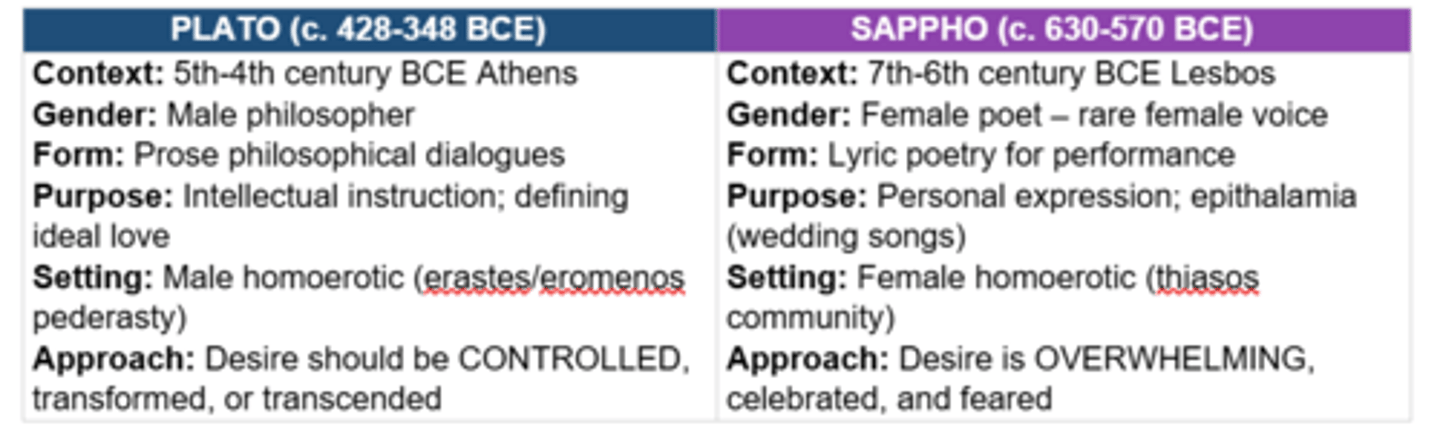
1.1 Contextual Overview
Key Distinctions
1.1 Contextual Overview
Understanding the fundamental differences between these two authors is essential for effective comparison. They represent radically different approaches to love and desire, shaped by their contexts, purposes, and philosophical frameworks.
KEY DISTINCTION FOR ESSAYS
Plato intends to DEFINE (through philosophy) – he develops an intellectual ideal. Sappho intends to DESCRIBE (through poetry) – she expresses lived emotional experience. This fundamental difference in purpose shapes everything they write about love.
Examiner Report 2023: 'The best responses often used the fact that Sappho and Plato were writing for different purposes to good effect, highlighting that Sappho's poetry is designed either as very personal or for public celebrations of love (epithalamia) whereas Plato was developing an intellectual ideal.'
Plato and Sappho: Detailed Comparison
Sappho
Physical Symptoms of Desire
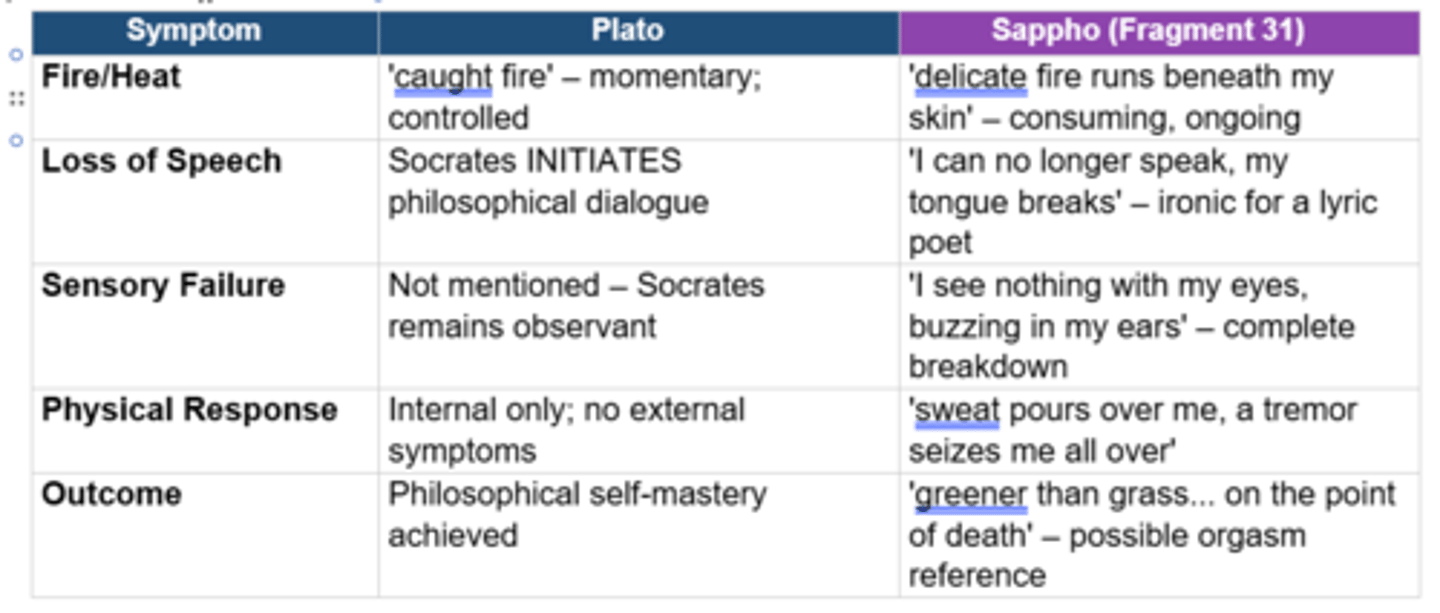
Both Plato and Sappho acknowledge that desire produces powerful physical effects, but their responses to these symptoms differ fundamentally.
PLATO: Charmides
'I caught fire and was no longer master of myself'
Context: Socrates describes his reaction upon seeing the beautiful youth Charmides. However, crucially, Socrates MASTERS his response through philosophy – he engages Charmides in dialogue about self-control (sophrosyne) rather than acting on desire.
SAPPHO: Fragment 31 ('He is as blessed as a god')
'A delicate fire runs beneath my skin... cold sweat... trembling... I am greener than grass, I seem near to dying.'
Context: A comprehensive catalogue of physical symptoms caused by seeing her beloved with another. The speaker is completely overwhelmed – there is no philosophical mastery, only total physical and emotional dissolution.
Plato and Sappho: Detailed Comparison
Sappho
Analysis pf Physical Symptoms
Plato and Sappho: Detailed Comparison
Sappho
Examiner Insight
Essay-Ready Point
EXAMINER INSIGHT: Fragment 31 Interpretation
Examiner Report 2023: 'The "delicate fire" metaphor was identified and discussed effectively, but interpretations of "greener than grass" to signify illness or jealousy rather than the ancient meaning of filled with desire, or a Homeric reference to fear, while very frequently used, were considered weaker. Better responses noted the strong sensory theme, particularly pointing out the irony in Sappho the lyric poet being struck dumb by the sight of her former lover, and understood the potential reference to orgasm in the poem.'
MISCONCEPTION TO AVOID: 'Some candidates thought the object of Sappho's affections in the poem was the male character rather than the female, which prevented them from accessing the highest marks on AO1.'
ESSAY-READY COMPARISON POINT
SIMILARITY: Both describe desire using fire imagery, acknowledging its powerful physical impact.
DIFFERENCE: Plato's Socrates masters his response through philosophy; Sappho's speaker is overwhelmed to near death. This reflects fundamentally different attitudes to rational control – for Plato, desire CAN and SHOULD be controlled by reason; for Sappho, desire is an irresistible force that overwhelms human rationality.
SCHOLARLY ANGLE: Anne Carson's concept of Sappho's 'bittersweet' (glukupikron) love emphasises how desire simultaneously attracts and destroys – a complexity absent from Plato's more optimistic view that philosophy can transcend desire's power.
Plato and Sappho: Detailed Comparison
Sappho
Emotional Intensity and Loss of Control
Mark Scheme Language
PLATO: Alcibiades' Speech (Symposium)
Alcibiades describes feeling 'enslaved' by Socrates – the only person who makes him feel 'shame'. He attempts seduction but is rejected.
Analysis: Alcibiades represents desire out of control. His 'overly emotional' speech (Examiner Report 2024) contrasts with the philosophical speeches that precede it. His failure to control desire leads to political and personal disaster – a warning about uncontrolled passion.
SAPPHO: Various Fragments
Fragment 130: Love as 'bittersweet' (glukupikron) and an 'impossible creature' (amachanon orpeton)
Fragment 96: 'the longing consumes her flighty soul'
Fragment 51: 'I do not know what I am going to do, I am in two minds'
Analysis: Sappho's 'desperate and jealous outpourings' (Examiner Report 2024) present emotional intensity as the natural, inevitable state of being in love. Unlike Alcibiades (who is criticised for emotional excess), Sappho presents such intensity without moral judgement.
MARK SCHEME LANGUAGE (2024)
'Symposium shows Alcibiades struggling to control his desire for Socrates and Pausanias dealing with jealousy over Agathon, so there is a clear emotional component to their relationships.'
'Many of the emotions Sappho raises in her poems to former lovers e.g. Anactoria are negative and associated with pain, longing and unrequited love.'
This parallel language from the Mark Scheme shows examiners expect comparison of emotional intensity between Alcibiades and Sappho.
Plato and Sappho: Detailed Comparison
Sappho
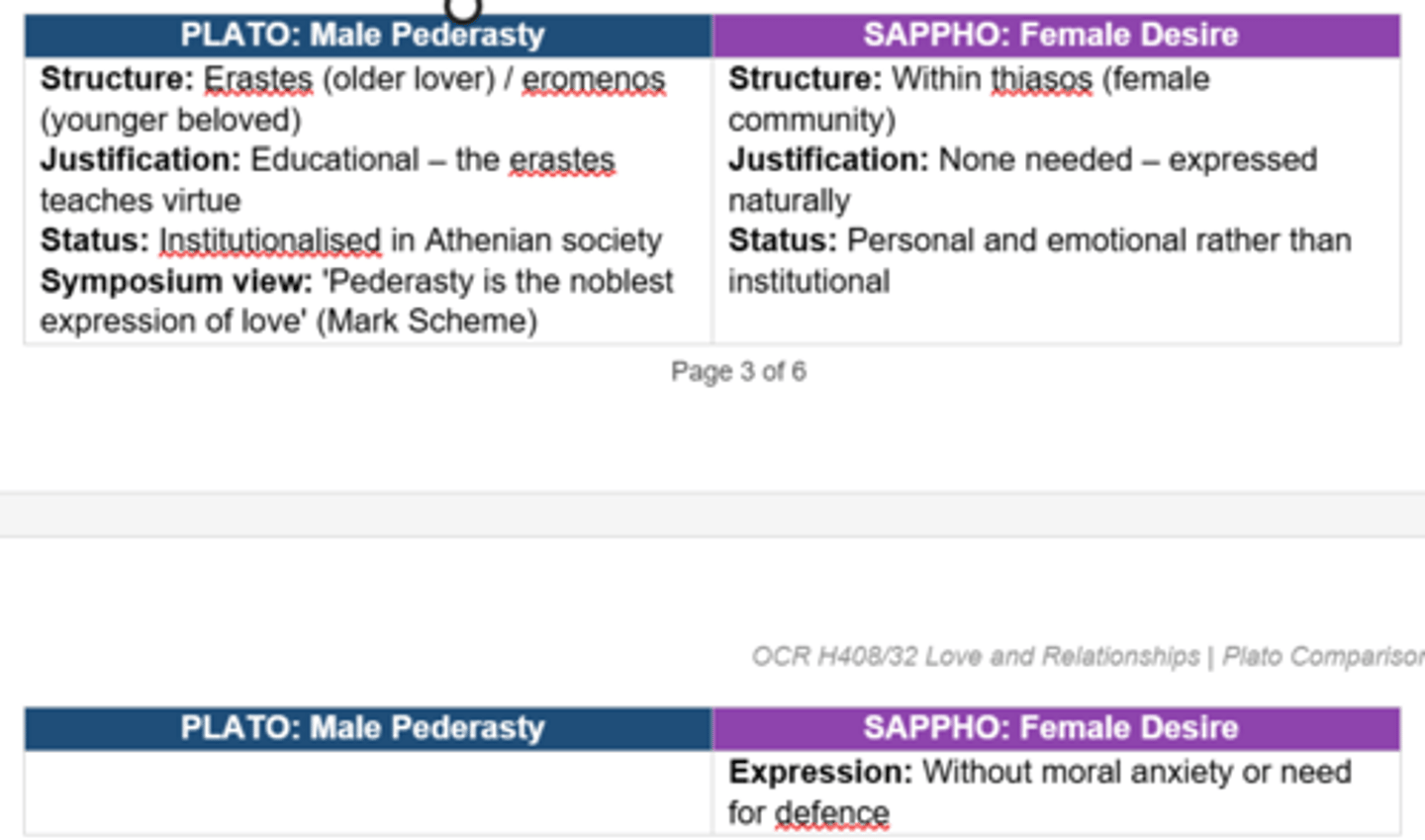
Homoerotic Desire: Contrasting Frameworks
Plato's Inconsistency Exam point
Both authors present same-sex desire as central to their work, but within fundamentally different social and moral frameworks.
PLATO'S INCONSISTENCY – KEY EXAM POINT
Symposium: Praises pederasty as 'the noblest expression of love' with 'an expected mental connection between partners'.
Laws: Condemns ALL same-sex relationships as 'against nature'.
Examiner Report 2023: 'Effective responses recognised that Plato suggests many conflicting and sometimes contradictory ways for men to handle feelings of desire, including encouraging pederastic relationships in the Symposium, but being vehemently opposed to homoerotic relationships of any kind in the Laws.'
CONTRAST: Sappho presents female homoerotic desire without ANY moral anxiety or condemnation. Her work has no equivalent to Plato's contradictory positions.
Plato and Seneca: Detailed Comparison
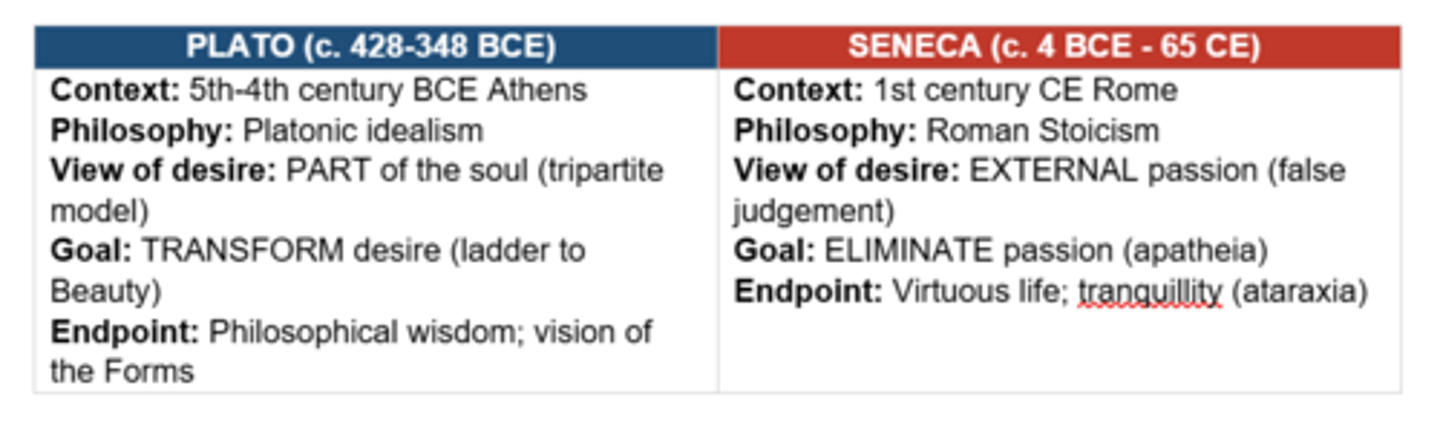
2.1 Contextual Overview
Plato and Seneca: Detailed Comparison
Psychology of Desire: Fundamentally Different Models
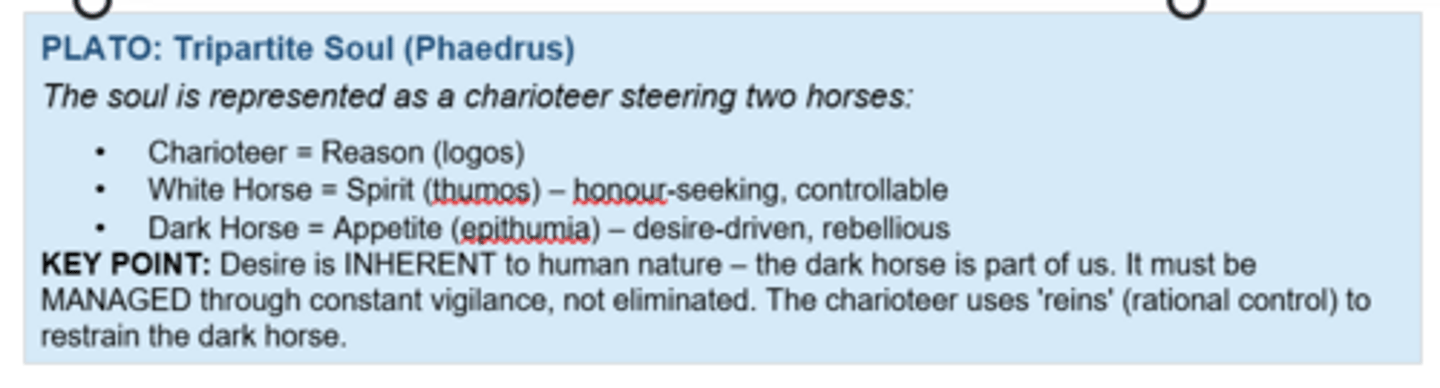
Plato
Plato and Seneca: Detailed Comparison
Psychology of Desire: Fundamentally Different Models
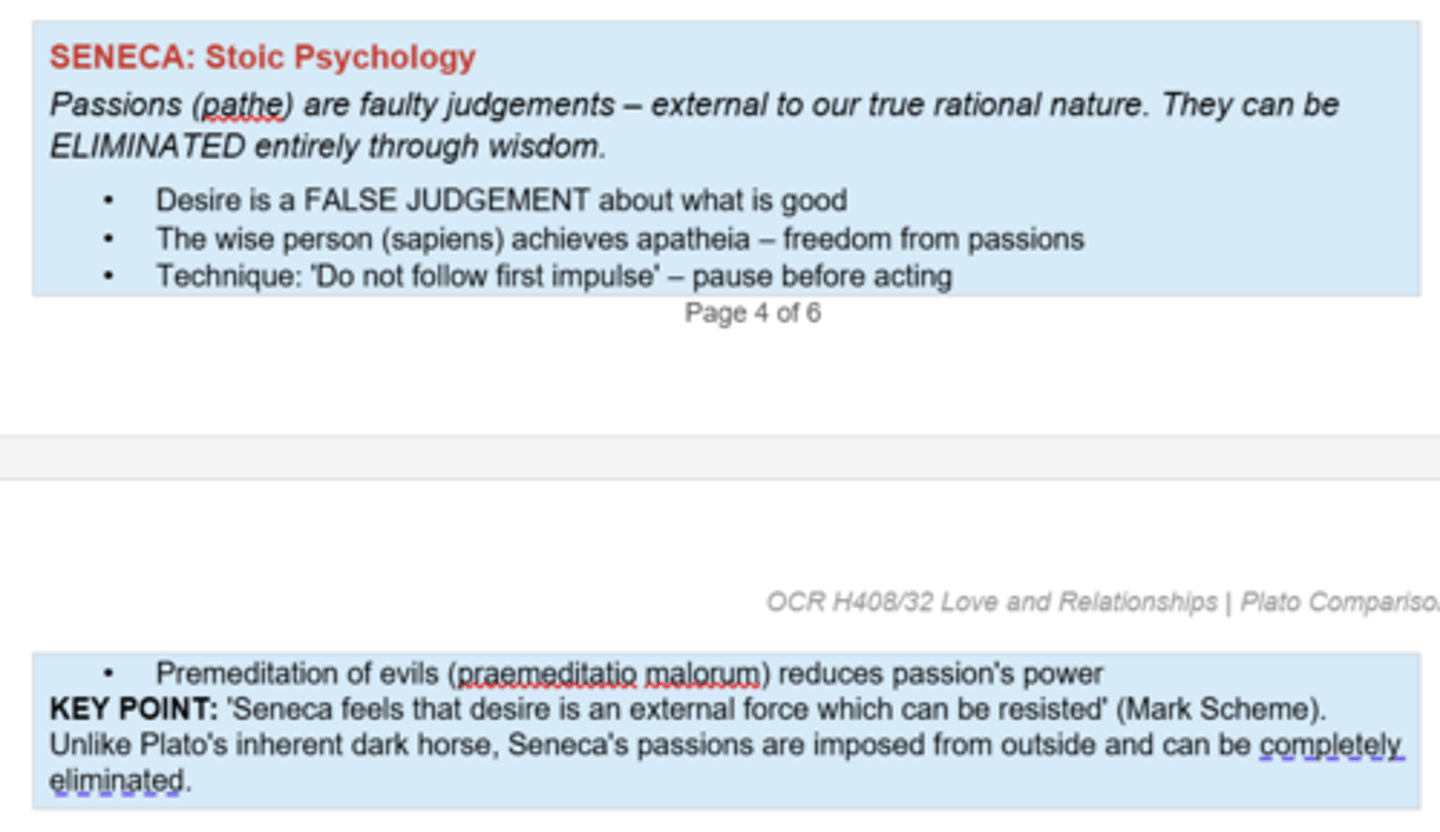
Seneca
Plato and Seneca: Detailed Comparison
Essay-Ready Comparison Point
ESSAY-READY COMPARISON POINT
KEY DIFFERENCE: For Plato, desire is an INHERENT part of human nature that must be MANAGED through constant rational control. For Seneca, desire is a FALSE JUDGEMENT that the wise can ELIMINATE entirely.
ANALOGY: Plato's charioteer MANAGES unruly horses that remain part of the team. Seneca's ideal would be to have NO unruly horses at all – the wise person travels without them.
EVALUATION: Plato's model is arguably more 'realistic' (Mark Scheme) – it acknowledges desire as permanently part of human nature. Seneca's ideal of apatheia may be more aspirational than achievable.
Plato and Seneca: Detailed Comparison
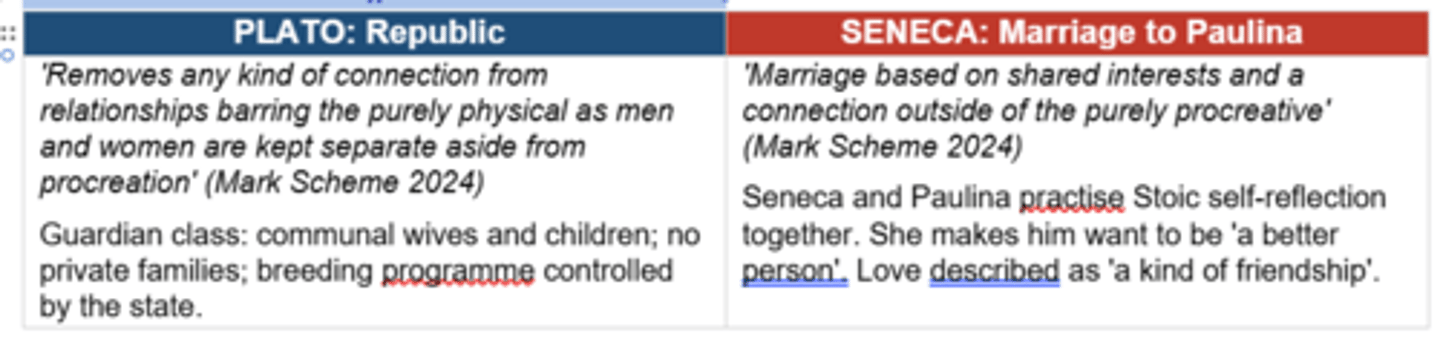
Marriage and Relationships
Plato and Seneca: Detailed Comparison
Inconsistency
PLATO'S INCONSISTENCY vs SENECA'S CONSISTENCY
PLATO: Republic strips relationships of emotional content; Symposium allows deep emotional connection between erastes/eromenos. This contradiction shows different works serving different purposes.
SENECA: More unified position – consistently values partnership based on friendship and shared virtue. However, examiners note potential 'hypocrisy' in Seneca: 'his modern take on successful love with his wife Paulina rooted in friendship and shared values may be considered at odds with the Stoic aim of apatheia' (Examiner Report 2024).
Plato and Seneca: Detailed Comparison
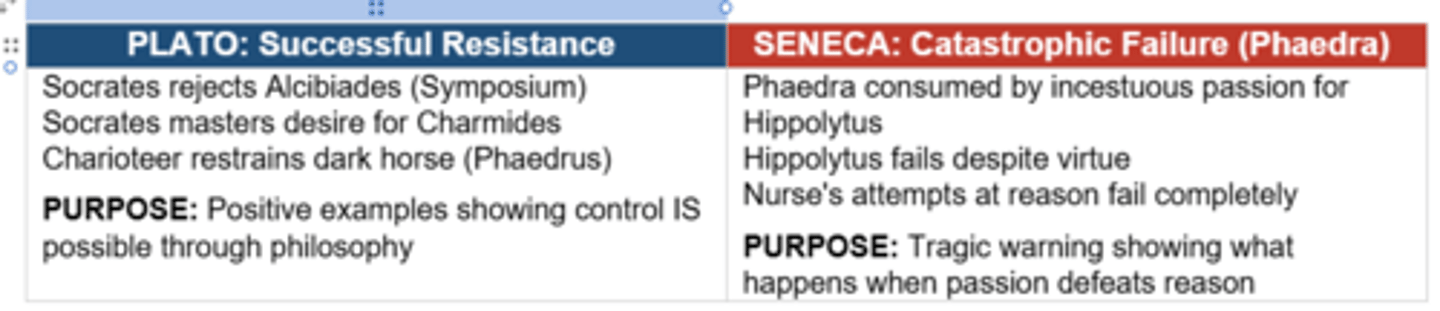
Examples of Resisting Desire: Success vs Failure
Plato and Seneca: Detailed Comparison
Examiner Insight
Using Phaedra Effectively
EXAMINER INSIGHT: Using Phaedra Effectively
Examiner Report 2024: 'The most successful responses used a wide range of examples... discussing desire as a vice and using Phaedra's excessive and incestuous desire for her stepson, Hippolytus, or referring to the stoic wise man's pursuit of apatheia exemplified by the Stilbo anecdote.'
WARNING: 'Less successful responses tended not to give examples from Seneca's works or rely heavily on a single text to provide all of their evidence.'
Plato and Seneca: Detailed Comparison
Essay-Ready Comparison Point
ESSAY-READY COMPARISON POINT
SIMILARITY: Both Plato and Seneca argue FOR rational control of desire – reason should govern passion.
DIFFERENCE IN METHOD: Plato shows SUCCESS stories (Socrates); Seneca shows FAILURE stories (Phaedra). Different pedagogical approaches to the same goal.
SCHOLARLY ANGLE: Martha Nussbaum's work on Stoic therapy of desire contrasts Greek and Roman approaches – Plato's transformation vs Seneca's extirpation of passion.
Plato and Ovid: Detailed Comparison
Contextual Overview
Examiner Insight
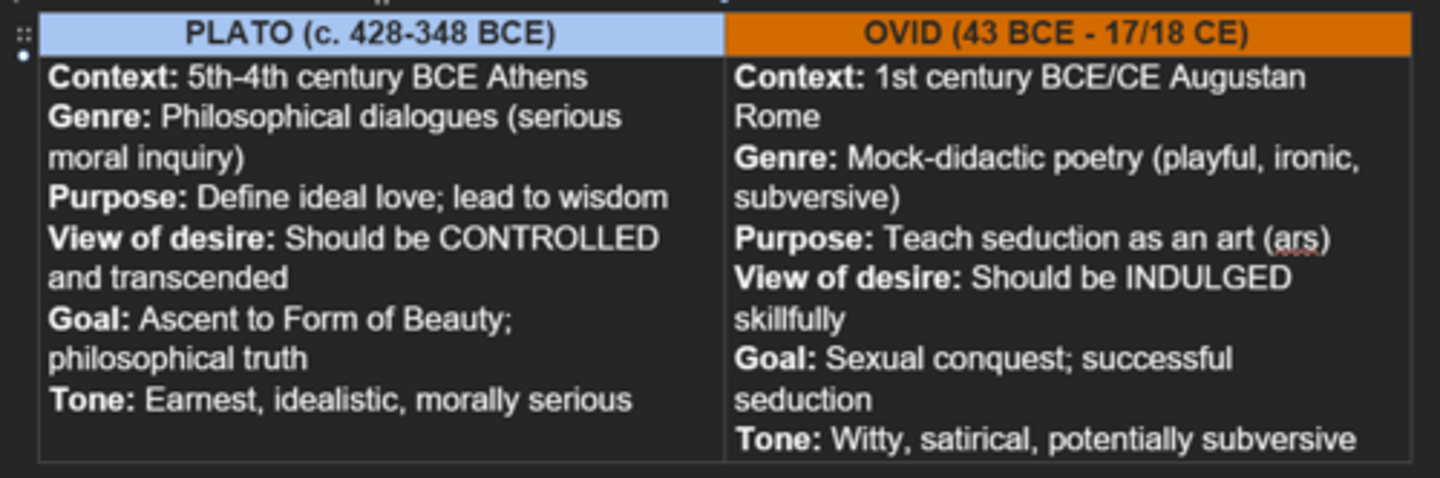
Plato and Ovid represent perhaps the most striking contrast in the specification – a philosopher seeking transcendence versus a poet celebrating earthly pleasures. Understanding this fundamental opposition is crucial for effective comparison.
EXAMINER INSIGHT: Understanding Ovid's Mock-Didactic Style
Examiner Report 2022: 'Less successful responses often did not discuss Ovid's advice as comic.'
Examiner Report 2024: 'The most successful 10-mark responses were characterised by a strong understanding of both the satire of this passage and the underlying seriousness of Ovid's message.'
KEY: Ovid's mock-didactic tone raises questions about how serious his advice is. Top responses recognise BOTH the humour AND the potential underlying warnings (e.g., about male predators, the dangers women face).
Plato and Ovid: Detailed Comparison
Physical Desire: Transcendence vs Indulgence
PLATO: Diotima's Ladder of Love (Symposium)
The true lover 'mounts continually upwards' from physical beauty:
1. Love of ONE beautiful body (physical attraction)
2. Love of ALL beautiful bodies (recognising shared beauty)
3. Love of beautiful souls (character over appearance)
4. Love of beautiful practices and laws (institutions)
5. Love of beautiful knowledge (intellectual beauty)
6. Vision of THE FORM OF BEAUTY ITSELF (transcendence)
KEY: Physical beauty is only the FIRST rung – a starting point to be transcended. The true philosopher leaves individual bodies behind in pursuit of absolute Beauty.
OVID: Ars Amatoria (The Art of Love)
'Only playful passions will be learnt from me: I'll teach girls the ways of being loved.' (III.27-28)
'inscribe on your trophies "Ovid was my master"' (III.812)
KEY: Physical conquest IS the goal, not a stepping stone. Ovid teaches techniques for attraction, seduction, and sexual success. Where Plato's lover ascends beyond bodies, Ovid's pursues them more skillfully.
Advice includes: make-up and hair, how to laugh attractively, what to wear, where to find lovers, sexual positions, how to feign pleasure.
Plato and Ovid: Detailed Comparison
Physical Desire: Transcendence vs Indulgence
Essay Comparison Point
ESSAY-READY COMPARISON POINT
FUNDAMENTAL OPPOSITION: Plato presents physical desire as a starting point to be transcended in the pursuit of philosophical wisdom. Ovid presents physical desire as an end in itself to be satisfied through skillful technique.
ALCIBIADES TEST: Where Socrates REJECTS Alcibiades' sexual advances (demonstrating philosophical self-mastery), Ovid would teach Alcibiades how to SUCCEED in his seduction.
SCHOLARLY ANGLE: Ovid may be seen to PARODY philosophical education. The structure of teacher-student mirrors Plato, but the content is inverted – seduction techniques replace virtue education.
Plato and Ovid: Detailed Comparison
Love as Education: Virtue vs Seduction
Mark Scheme Language
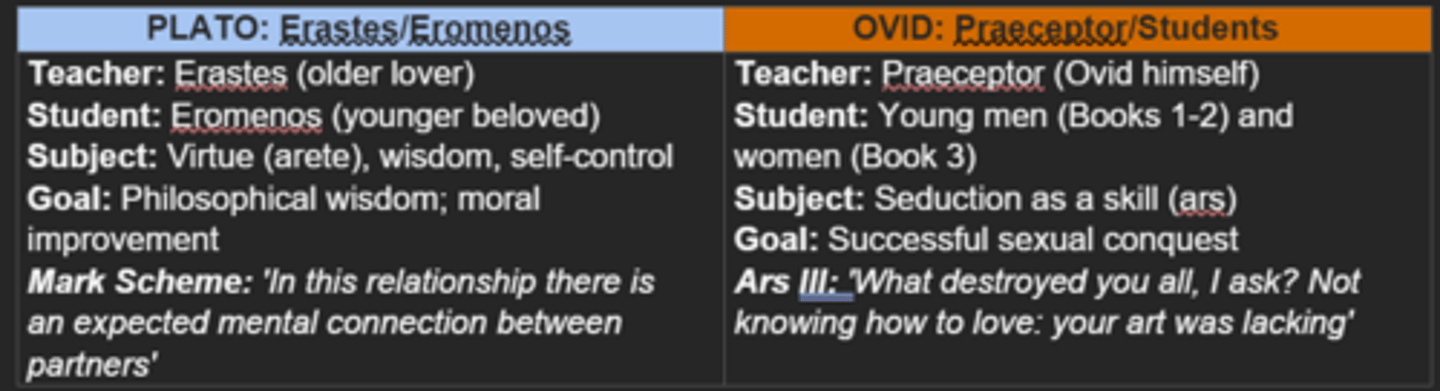
On Plato: 'Pausanias' defence of erastes/eromenos relationships in the Symposium' (Examiner Report 2023) – the educational justification for pederasty.
On Ovid: 'Ovid is mostly superficial' (Mark Scheme 2024); 'Ovid was a slightly less popular choice... as an author who did not present the same depth and complexity of emotion' (Examiner Report 2024). BUT note potential for deeper reading of underlying warnings.
Plato and Ovid: Detailed Comparison
Treatment of Women
Plato and Ovid: Detailed Comparison
Treatment of Women
Essay-Ready Comparison Point
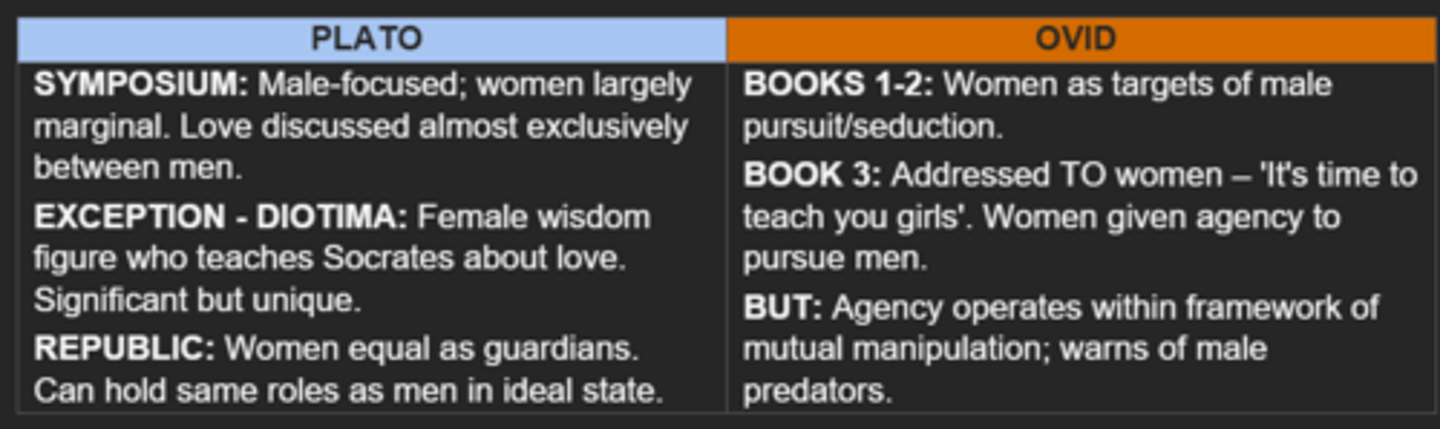
Both reflect gender hierarchies of their time, but in complex ways. Plato marginalises women in Symposium but gives them equality in Republic. Ovid appears to give women agency in Book 3, but within a framework of 'mutual manipulation' and 'warfare' between the sexes.
EXAMINER INSIGHT: 'More successful responses discussed the writers' perceptions of women, such as Seneca's stance that women are capable of virtue' (Examiner Report 2022). Consider how each author views female capacity for wisdom or agency.
Definitions of Love
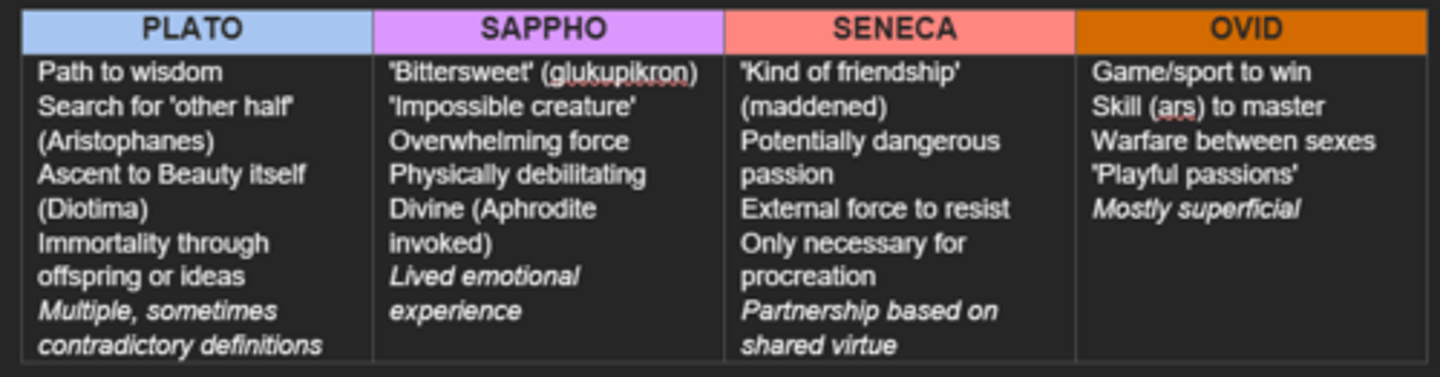
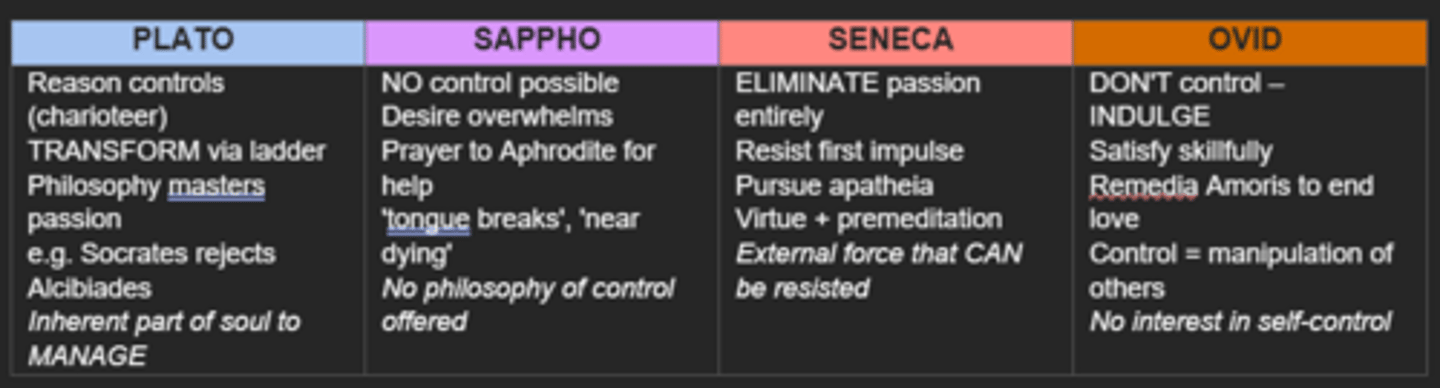
How to Control/Manage Desire
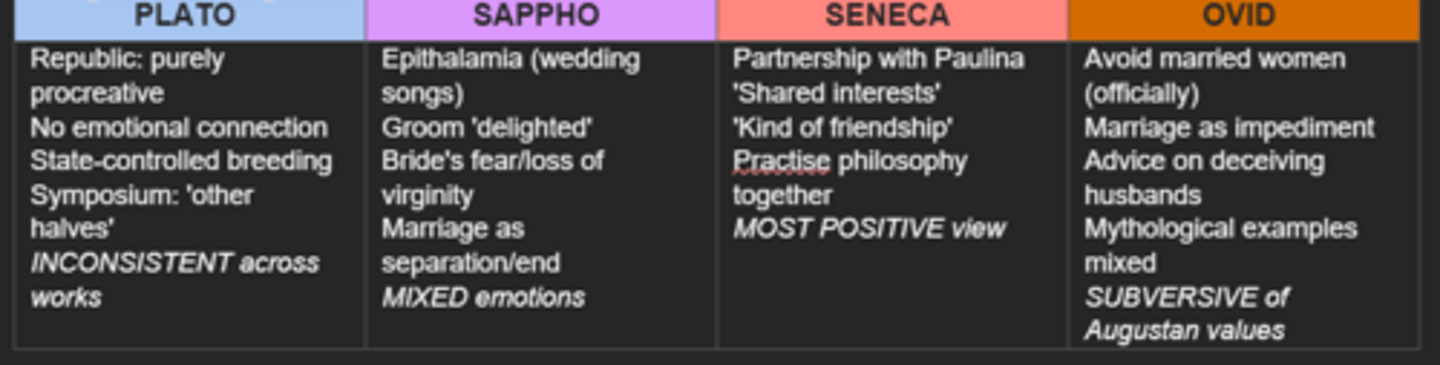
Marriage
Homoerotic Relationships

Ready-Made Essay Formulations
PLATO vs SAPPHO: Resistance to Desire
PLATO vs SAPPHO: Resistance to Desire
While Plato's Socrates successfully resists Alcibiades through rational self-control – demonstrating that philosophy can master desire – Sappho's poetry presents desire as an overwhelming force that is 'bittersweet' and physically debilitating: 'I am greener than grass, I seem near to dying' (Fragment 31). This reflects their fundamentally different purposes: Plato offers a philosophical ideal of rational control, while Sappho expresses the lived experience of desire without offering or seeking a method of mastery. For Plato, desire CAN and SHOULD be controlled; for Sappho, such control appears neither possible nor necessarily desirable.
Ready-Made Essay Formulations
PLATO vs SENECA: Psychology of Desire
PLATO vs SENECA: Psychology of Desire
Both Plato and Seneca advocate rational control of desire, but their psychological models differ fundamentally. For Plato, desire is an inherent part of human nature – the 'dark horse' in the Phaedrus charioteer analogy – that must be constantly managed by reason but can never be eliminated. For Seneca, passions are 'faulty judgements' external to our true rational nature that the wise can eliminate entirely, achieving apatheia. Plato's model is arguably more 'realistic' (as the Mark Scheme suggests) in acknowledging desire as permanently part of us; Seneca's ideal of complete freedom from passion may be more aspirational than achievable, a tension highlighted by examiner observations about his potential 'hypocrisy' in his own marriage.
Ready-Made Essay Formulations
PLATO vs OVID: Transcendence vs Indulgence
PLATO vs OVID: Transcendence vs Indulgence
Plato's Diotima teaches that physical desire should be transcended through the 'ladder of love', ascending from individual beautiful bodies to the Form of Beauty itself – physical attraction is merely the first rung, a starting point to be left behind. Ovid's Ars Amatoria inverts this completely: physical satisfaction IS the goal, not a stepping stone. Where Plato's true philosopher leaves bodies behind in pursuit of abstract wisdom, Ovid's praeceptor teaches students to pursue them more skillfully. This represents a fundamental philosophical opposition: Plato's idealism versus Ovid's materialism, transcendence versus indulgence, the serious versus the playful.
Ready-Made Essay Formulations
PLATO vs SAPPHO: Same-Sex Relationships
PLATO vs SAPPHO: Same-Sex Relationships
Plato's treatment of same-sex relationships is strikingly inconsistent: the Symposium praises pederasty as 'the noblest expression of love' with an educational justification, yet the Laws condemns all same-sex relations as 'against nature'. This contradiction likely reflects different works serving different purposes. Sappho, by contrast, presents female homoerotic desire within her thiasos community without any apparent moral anxiety or need for defence. Where Plato's treatment is institutionalised (erastes/eromenos) and ideologically fraught, Sappho's is personal, emotional, and assumed as natural.
Ready-Made Essay Formulations
PLATO vs SENECA: Marriage
PLATO vs SENECA: Marriage
The Republic strips relationships of emotional content – guardians are 'kept separate aside from procreation' (Mark Scheme) in a state-controlled breeding programme. This contrasts dramatically with Seneca's description of his marriage to Paulina as based on 'shared interests and a connection outside of the purely procreative' – a genuine partnership grounded in friendship and mutual pursuit of virtue. Of all four authors, Seneca offers the most positive representation of marriage, while Plato's Republic offers perhaps the most radically dehumanised.
The Republic strips relationships of emotional content – guardians are 'kept separate aside from procreation' (Mark Scheme) in a state-controlled breeding programme. This contrasts dramatically with Seneca's description of his marriage to Paulina as based on 'shared interests and a connection outside of the purely procreative' – a genuine partnership grounded in friendship and mutual pursuit of virtue. Of all four authors, Seneca offers the most positive representation of marriage, while Plato's Republic offers perhaps the most radically dehumanised.
Ready-Made Essay Formulations
PLATO vs OVID: Education
PLATO vs OVID: Education
Both Plato and Ovid use educational frameworks: Plato's erastes teaches virtue (arete) to the eromenos; Ovid's praeceptor teaches seduction to his students. But their goals are diametrically opposed – one leads upward to philosophical wisdom, the other to successful sexual conquest. Ovid may be seen to parody philosophical education: the structure of teacher-student mirrors Plato, but the content is inverted. Where Socrates teaches Alcibiades self-control (and ultimately rejects his advances), Ovid would teach Alcibiades how to succeed – 'what destroyed you all? Not knowing how to love: your art was lacking'.