Lecture 11 - Strength Training
 Call Kai
 Learn
Learn Practice Test
 Spaced Repetition
 Match
Match Flashcards
 Knowt Play
1/15

Earn XP
Description and Tags
Name | Mastery | Learn | Test | Matching | Spaced | Call with Kai | Chat |
|---|
No analytics yet
Send a link to your students to track their progress
16 Terms
Goals of strength training for sport performance
increase maximal strength
increase power = all athletes!!
increase muscular endurance
increase muscle size
prevent injury
What do powerlifters train for
strength
What do bodybuilders train for
size
What do olympic lifters train for
power
Power
Force x Velocity
When should rate of force development be focused on?
Activities in sports lasting less than 0.3 seconds
work on this by decreasing the explosive strength deficit
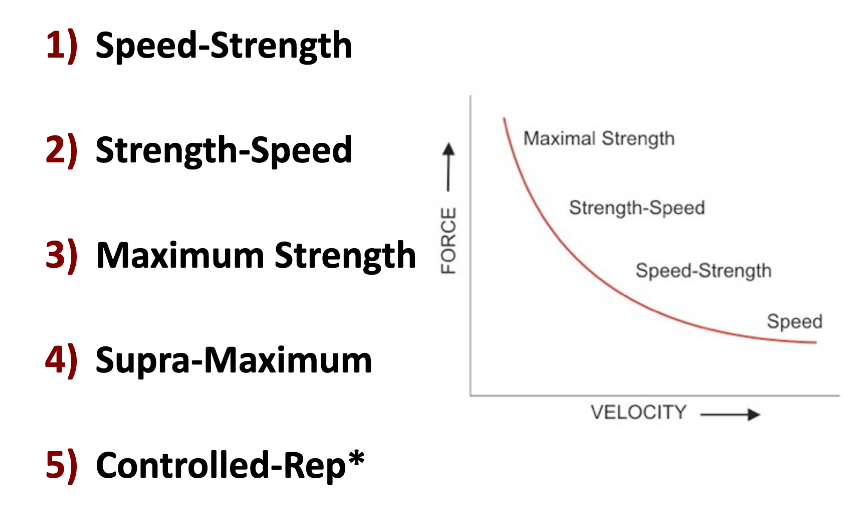
Strength Spectrum
supra-maximum goes off the curve at the top
hypertrophy training not on the curve (is underneath it)
Ballistic Speed-Strength Training
concentric
can be loaded or unloaded (ex: box jumps, squat jumps, med ball throws)
maximize acceleration and deceleration)
train to improve RFD
faster recruitment of high threshold motor units
greater recruitment of motor units and increased firing frequency
intra and intermuscular coordination
Plyometric Speed-Strength Training
running is categorized under this
eccentric and concentric components
involves short, rapid ground contact
can be loaded or unloaded
ex: jumps, hops, bounds, skips, hurdles
improves stretch-shortening cycle and RFD by:
enhancing muscle spindle reflex
inhibiting GTO reflex
improve storage and utilization of elastic strain energy —> increases muscle stiffness
Explosive Strength Training Strength-Speed Training
olympic lifts
heavy squat jumps, depth jumps
total body heavy throws
lifting exercises at 75-90% 1RM
low volume (ex: 3×3)
Improves RFD
increased neural drive: faster recruitment of high threshold motor units, greater recruitment of motor units, firing frequency, intra and intermuscular coordination
enhanced muscle force production
increased muscle and tendon stiffness
Heavy Lifting Absolute Strength Training
multi-joint movements (squat, bench deadlift)
functional core training
85-100% of 1RM (don’t do for isolation)
controlled eccentrics
warm up to high % as needed
Improves maximum strength by:
induce optimal changes to muscle morphology and neural capacity of filaments per myofibril, myofibrils per muscle fiber, and intra and intermuscular coordination
difficult to do year long because of amount of recovery needed and fatigue affects sport performance —> why programs utilize it in the off-season
Supra Maximal Training
Extreme Neural Loading
heavy eccentric training (100-140% of 1RM)
heavy holds (110-130% of 1RM)
partial reps (1/4 squats)
cheating past sticking points using momentum (used to improve a lift not overall sport performance)
gains are lift focused
Improves central nervous system
because loads are so heavy —> faster recruitment of high motor units and max motor unit recruitment
performing eccentrics in prepatory phase can reduce RFD
***very easy to over train and hard on joints
Controlled Rep (Classic Hypertrophy)
65-85% of 1RM
slower but more reps so more time under tension
improves tendon stiffness
majority of adaptations formed are in the muscle itself, not the central nervous system
Increases muscle size:
helps strengthen weakness, balances each side, can target specific needs
Teaching Squat Form
Feet: flat, facing forward, shoulder width, COG
through center
Knees: straight
Hips: posterior tilt
Back: straight, tight, chest full of air, shoulders retracted
Arms: elbows bent, “bending” bar over back
Hands: outside shoulder width
Head: neutral
bar can be positioned low on back or high on back (low bar/high bar)
Teaching Bench Form
Set-up
Feet: pulled back, under knees, COG on balls of feet
Hips: butt on bench
Back: shoulders retracted, scapula tucked, chest full of air
Arms: straight, locked, wide enough for 90° bend
Hands: tight grip, thumbs around bar
Head: neutral
Teaching Deadlift Form
Set-up
Feet: flat, facing forward, shoulder width, COG over center
Back: straight, tight, flat, shoulders retracted and depressed
Arms: straight, locked, tight
Hands: tight grip, just outside of knees
Head: neutral