Blood Bank Solo 2 Supplemental Information
 Call Kai
 Learn
Learn Practice Test
 Spaced Repetition
 Match
Match Flashcards
 Knowt Play
1/29

Earn XP
Description and Tags
Name | Mastery | Learn | Test | Matching | Spaced | Call with Kai | Chat |
|---|
No analytics yet
Send a link to your students to track their progress
30 Terms
Anti-A | Anti-B | A1 Cells | B Cells |
|---|---|---|---|
4+ | 0 | 0 | 0 |
Likely: Group A with a missing anti-B
Alternate: Group AB with a missing B antigen
Anti-A | Anti-B | A1 Cells | B Cells |
|---|---|---|---|
1+ | 4+ | 4+ | 0 |
Likely: Group B with an extra reaction with anti-A
Anti-A | Anti-B | A1 Cells | B Cells |
|---|---|---|---|
1+ | 4+ | 2+ | 0 |
Likely: Group B with an extra reaction with anti-A
Alternate: Group AB with a weakly reactive A antigen and an extra reaction with A cells
Anti-A | Anti-B | A1 Cells | B Cells |
|---|---|---|---|
0 | 4+ | 4+ | 2+ |
Likely: Group B with an extra reaction with B cells
Anti-A | Anti-B | A1 Cells | B Cells |
|---|---|---|---|
0 | 0 | 0 | 4+ |
Likely: Group A with missing A antigen reaction
Alternate: group O with missing anti-A reaction
Anti-A | Anti-B | A1 Cells | B Cells |
|---|---|---|---|
0 | 0 | 0 | 0 |
Likely: Group O with missing antibody reactions
Alternate: Group AB with missing antigen reactions
Anti-A | Anti-B | A1 Cells | B Cells |
|---|---|---|---|
4+ | 0 | 1+ | 4+ |
Likely: Group A with extra reaction with A cells
Anti-A | Anti-B | A1 Cells | B Cells |
|---|---|---|---|
4+ | 4+ | 2+ | 2+ |
Likely: group AB with extra reactions with A and B cells
Anti-A | Anti-B | A1 Cells | B Cells |
|---|---|---|---|
2+ | 2+ | 4+ | 4+ |
Likely: Group O with extra reactions with anti-A and anti-B
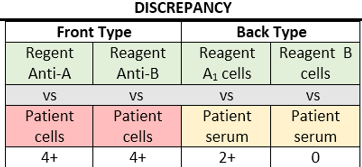
Interpretation: Front type says the patient is AB
Interpretation: Back type says the patient is B
Explanation: 22% of group A patients are actually members of the subgroup A2. These individuals may produce anti-A1
Here, a type A2B individual is producing anti-A1
Conclusion: Patient is type A2B
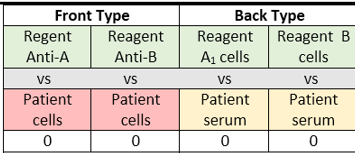
Interpretation: Front type says the patient is O
Interpretation: Back type says the patient is AB
Explanation: Some people are simply unable to produce enough antibodies. These include the immunocompromised, the elderly and newborns.
Here a type O individual is unable to produce enough (anti-A1; anti-B) antibodies to react with the reagent red cells on the back type
Conclusion: Patient is type O and immunocompromised
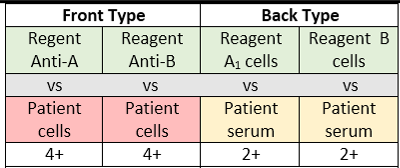
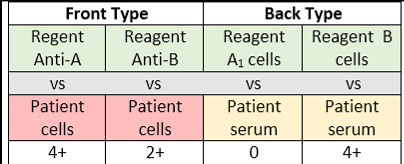
Interpretation: Front type says the patient is AB
Interpretation: Front type says the patient is O
Explanation: Notice that the back type reaction is very weak. This may be a discrepancy due to cold agglutinins
Here it appears that a type AB individual’s serum is somehow reacting weakly with the reagent A and B cells. Such a weak reacting discrepancy may be due to cold agglutinins. Warming an aliquot of the patient serum and repeating the back type may eliminate such a discrepancy
Conclusion: Patient is type AB with cold agglutinins
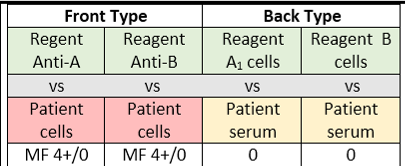
Interpretation: Front type says the patient is either AB or O or both
Interpretation: Back type says the patient is AB
Note: Patient received 10 units of type O RBCs
Explanation: The mixed field reaction suggests the presence of two different populations of cells: AB and O
This discrepancy is not so rare. Since type O is a universal donor with respect to RBC’s, patients often receive type O RBCs - especially during serious traumas when several units of RBCs need to be given out without testing
Conclusion: Patient is type AB and received several type O RBC units which are showing up on the front type
Interpretation: Front type says the patient is AB
Interpretation: Back type says the patient is A
Note: Patient has a current GI disease
Explanation: Notice that the anti-B reagent reacts weakly with the patient cells in the front type. This may be an acquired B
Whenever you see “GI” involvement and a weak B, think acquired B. Essentially, gram negative bacteria (eg. E. coli) deacetylate the terminal N-acetyl D-galactosamine of the A antigen into D-galactosamine (which resembles D-galactose of the B antigen). For a limited time until the GI problem is resolved the patient will type as AB
Conclusion: Patient is type A. Due to a GI disease, the patient demonstrates an acquired B
Anti-A | Anti-B | A1 cells | B cells | O cells | Auto control* |
0 | 0 | 0 | 0 | 0 | 0 |
Possible Cause: Group O newborn or elderly patient; patient may have hypogammaglobulinemia or agammaglobulinemia, or may be taking immunosuppressive drugs
Resolution Steps: Check age and diagnosis of patient and immunoglobulin levels if possible; incubate at RT for 30 min or at 4 degrees Celsius for 15 min; include group O and autologous cells at 4 degrees Celsius
Anti-A | Anti-B | A1 cells | B cells | O cells | Auto control* |
4+ | 0 | 1+ | 4+ | 0 | 0 |
Possible Cause: Subgroup of A; probably A2 with anti-A1
Resolution Steps: React patient cells with anti-A1 lectin; test serum against additional A1, A2, and O cells
Anti-A | Anti-B | A1 cells | B cells | O cells | Auto control* |
4+ | 4+ | 2+ | 2+ | 2+ | 2+ |
Possible Cause:
1) Rouleaux (multiple myeloma patient, any patient with reversed albumin-to-globulin ratio or patients given plasma expanders)
2) Cold autoantibody (probable group AB with auto anti-I)
3) Cold autoantibody with underlying cold or RT reacting alloantibody (probably group AB with an anti-I and a high-frequency cold antibody (ex. anti-P1, anti-M, anti-Le^b)
Resolution Steps:
1) Wash RBCs, use saline dilution or saline replacement technique
2) Perform cold panel and autoabsorb or rabbit erythrocyte stroma (REST) absorb or reverse type at 37 degrees Celsius
3) Perform col panel autoabsorb or REST, and run panel on absorbed serum; select reverse cells lacking antigen for identified alloantibody; repeat reverse group on absorbed serum to determine true ABO group or at 37 degrees Celsius
Anti-A | Anti-B | A1 cells | B cells | O cells | Auto control* |
4+ | 4+ | 1+ | 0 | 0 | 0 |
Possible Cause: Subgroup of AB; probable A2B with anti-A1
Resolution Steps: Use anti-A1 lectin; test serum against additional A1, A2, and O cells
Anti-A | Anti-B | A1 cells | B cells | O cells | Auto control* |
4+ | 0 | 0 | 4+ | 3+ | 0 |
Possible Cause: A1 with potent anti-H
Resolution Steps: Confirm A1 group with anti-A1 lectin; test additional A2, O, and A1 cells and an O(h) if available
Anti-A | Anti-B | A1 cells | B cells | O cells | Auto control* |
0 | 0 | 4+ | 4+ | 4+ | 0 |
Possible Cause: O(h) Bombay
Resolution Steps: Test with anti-H lectin; test O(h) cells if available; send to reference lab for confirmation
Anti-A | Anti-B | A1 cells | B cells | O cells | Auto control* |
0 | 0 | 2+ | 4+ | 0 | 0 |
Possible Cause: Subgroup of A; probably A(x) with anti-A1
Resolution Steps: Perform saliva studies or absorption/elution
Anti-A | Anti-B | A1 cells | B cells | O cells | Auto control* |
4+ | 2+ | 0 | 4+ | 0 | 0 |
Possible Cause: Group A with an acquired B antigen
Resolution Steps: Check history of patient for lower gastrointestinal problem or septicemia; acidify with anti-B typing reagent to pH 6.0 by adding 1 or 2 drops of 1N HCl to 1 mL of anti-B antisera, and measure with a pH meter (this acidified anti-B antisera would agglutinate only true B antigens not acquired B antigens); test serum against autologous cells
Anti-A | Anti-B | A1 cells | B cells | O cells | Auto control* |
4+ | 4+ | 2+ | 0 | 2+ | 0 |
Possible Cause: Group AB with alloantibody
Resolution Steps: Perform antibody screen and panel; Identify room temperature antibody; repeat serum type with antigen-negative reagent cells or perform serum type at 37 degrees Celsius
Anti-A | Anti-B | A1 cells | B cells | O cells | Auto control* |
0 | 4+ | 4+ | 1+ | 1+ | 1+ |
Possible Cause: Group B with cold autoantibody
Resolution Steps: Enzyme-treat RBCs and perform autoabsorption at 4 degrees Celsius or perform pre-warmed testing
Missing or weak reaction in the forward group
Possible Causes:
Missing or weak reaction in the reverse group
Possible Causes:
Unexpected positive reaction in the forward group
Possible Causes:
Unexpected positive reaction in the reverse group
Possible Causes:
Mixed field agglutination in the forward group
Possible Causes:
Different current ABO group from historic ABO group
Possible Causes: