rate if reaction unfinished
 Call Kai
 Learn
Learn Practice Test
 Spaced Repetition
 Match
Match Flashcards
 Knowt Play
1/29

There's no tags or description
Looks like no tags are added yet.
Name | Mastery | Learn | Test | Matching | Spaced | Call with Kai | Chat |
|---|
No analytics yet
Send a link to your students to track their progress
30 Terms
What must happen for a reaction to occur?
Particles must collide
What is rate of reaction?
The change of concentration/amount of a reactant or product per unit time
What is the formula for rate of a reaction?
Amount of a reactant used/product made all over time
What is collision theory?
For a reaction to occur, the particles must collide in the right direction
They must also have a minimum amount of kinetic energy
What is activation energy?
The minimum amount of energy required for a reaction to occur
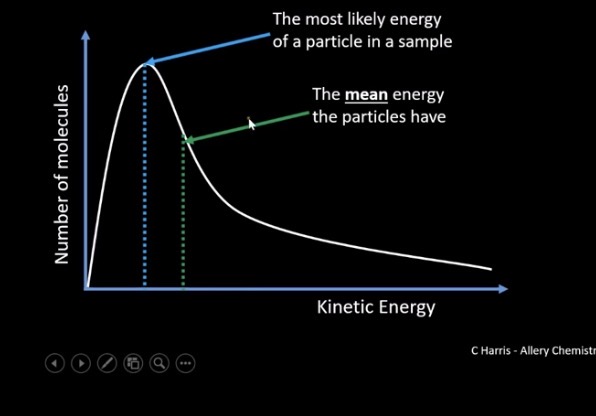
What does maxwell boltzmann distrubution show?
Shows the energy in gas particles
How to find the total number of particles in a boltzmann distrubution curve?
Area under curve
What does the peak represent in a maxwell boltzmann distribution curve?
The most likely energy of a particle in a sample
What does the middle of the downward slope of the maxwell-boltzmann distrubution curve represent?
The mean energy the particles have
What does just before the end of the boltzmann curve represent?
Activation energy
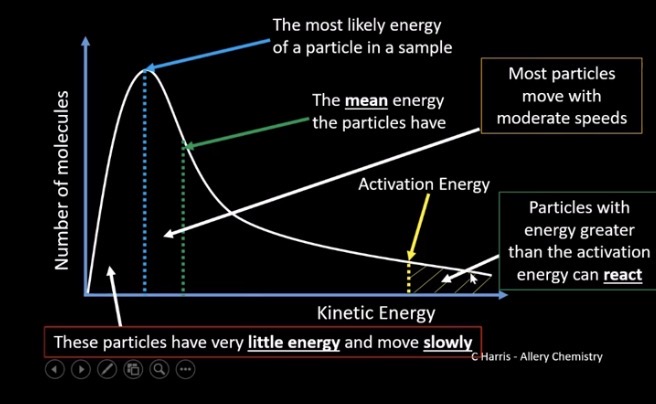
What does the area after the activation energy represent in a boltzmann curve?
Particles here have energy greater than the activation energy and can react
How does temperature affect rate of reaction?
Increase in temp = increase in kinetic energy
Particles move faster so higher frequency of collisions
A lager proportion of the molecules will have energy greater than the activation energy
More successful collisions per second so rate of reaction increases
How does concentration affect rate of reaction?
Increase in conc = more particles in a given volume
Increases particle density, particles collide more frequently
More successful collisions per second so rate increases
How does pressure affect rate of reaction?
Increase in pressure = decreases the volume occupied by the gas
Gas particles are closer together so increases the number of particles per unit volume = higher frequency of collisions between particles.
More successful collisions per second, rate of reaction increases
How does increase in temperature change the boltzmann curve?
Curve shifts to the right
Peak is lower- bc energy is distrubution is greater among the particles
Total area under curve is SAME (bc same no.molecues)
But area under the curve beyond the activation energy iNCREASES (Bc more particles have energy greater than the activation energy)
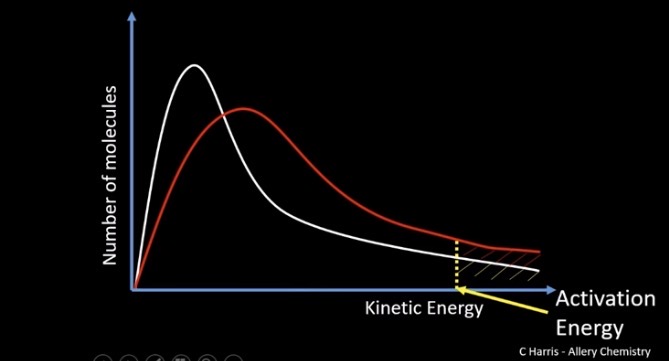
How does a decrease in temperature change change the botzmann distrubution curve?
Curve shifts left
Peak is higher
Area under curve is the SAME
Area under curve beyond activation energy DECREASES. (Bc most of the particles dont have enough energy to react)
What is a catalyst?
A substance that increass the rate of a reaction by providing an alternative pathway that has lower activation energy without getting used up itself
The catalyst is chemicallly unchanged at the end of the reaction
What are catalysts used for?
To speed up a reaction- provides an alternative pathway
To make product faster and can be used to lower the temp required for a reaction (saves time + money)
Lowering temp =less co2 produced
What are the environmental benefits of using catalysts?
Lower temperatures and pressures are required.
This reduces energy and CO2 produced
Less waste is produced as catalysts allow scientists to use reaction with better atom economies
What is a heterogenous catalyst?
A catalyst that is in a different state to the reactants
What will increasing the surface area of the heterogenous catalyst do?
Increase rate of reaction bc more particles can react with the catalyst at the same time
What is a homogenous catalyst?
A catalyst that is in the same state as the reactants
What is an example of a homogenous catalyst?
Sulphuric acid to make an ester
what are catalytic converters and what are they made of?
Are in cars to reduce levels of pollution.
Made from a rhodium, platinum and palladium alloy
What does a catalyst do to the botzmann distrubution curve?
The catalyst lowers the activation energy so more particles now have enough energy to react
The line that means activation energy shifts further left
How can rate be measured in experiments with disappearing cross experiment? +drawbacks
place a cross on paper and time how long it takes for cross to disappear (/precipitate to form)
Subjective - use same observer to reduce errors
How can rate be measured in experiments with amount of mass lost? +safety
For reactions that produce a gas - place reaction on balance and measure the mass loss as gas is lost
Use fume cupboard if gas is harmful/toxic
How can rate be measured in experiments with volume of gas produced?
If a gas is produced, measure the amount of gas produced using a gas syringe - measure this over a set amount of time
What does the gradient represent on a rate of reaction graph?
Rate of reaction