BSC 300: Ch. 1-3
 Call Kai
 Learn
Learn Practice Test
 Spaced Repetition
 Match
Match Flashcards
 Knowt Play
1/85

Earn XP
Description and Tags
Key terms from chapter 1-3
Name | Mastery | Learn | Test | Matching | Spaced | Call with Kai | Chat |
|---|
No analytics yet
Send a link to your students to track their progress
86 Terms
What are the 4 main types of biological noncovalent interactions?
Ionic (electrostatic interactions)
Hydrogen bonds (nonbonding electron hydrogen attraction)
Van der Waals (transiet dipole interactions)
Hydrophobic effect interactions (reduces contact with water)
T/F: it takes the same amount of energy to break a bond as what is released when the bond is formed
T
Are polar molecules hydrophillic or hydrophobic?
Hydrophillic
Are nonpolar molecutes hydrophillic or hydrophobic?
Hydrophobic
What is electronegativity?
The ability of an atom to attract electrons towards itself forming a polar covalent bond
What are functional groups?
Groups of atoms giving organic molecules different characteristics and properties
Noncovalent bonds are responsible for the _____ interaction between cellular macromolecules
Transient
Within noncovalent bonds, the multipoint contacts additive provides what 3 specificity in molecular interactions?
Selectivity in biological associations
Conformation of macromolecules
Formation of complexes between macromolecules
Within noncovalent bonds, the multipoint contacts additive produces _____ structures
Stable
Ionic bonds are attractions between charges atoms and are _____ in the presence of water, and may be _____ within large biological molecules
Weakened, significant
Hydrogen bonds occur when _____ bound hydrogen has a partial positive charge and attracts electrons of a second atom
Covalently
Hydrogen bonds determine the structure and properties of _____
Water
Hydrophobic attractions between nonpolar molecules are due to transient dipole formation. What type of noncovalent bonding is this an example of?
Van der Waals interactions
_____ interactions occur when nonpolar molecules associate and minimize their exposure to polar molecules
Hydrophobic
Proteins are polymers of _____ and form a diverse group of macromolecules
Amino acids
Nucleic adics are polymers of _____ that store and transmit genetic information
Nucleotides
_____ include simple sugars and sugar polymers
Carbohydrates
Lipids are a diverse group of _____ molecules
Nonpolar
_____ are made of glycerol linked by 3 ester bonds the 3 _____
Fats, fatty acids
What reaction resuls from the polymerization of 2 monomers by forming a covalent bond?
Dehydration (condensation)

_____ reactions are responsible for the breakdown or cleavage of a covalent bond by incorperating water
Hydrolysis

Amino acids only differ in their _____
Side chains (R group)
Key Term: Amino acids are linked together by _____ bonds into a _____ chain
Peptide, polypeptide
R groups may be what 3 things?
Polar charged
Polar uncharged
Nonpolar
Polar charged amino acids contain R groups that act as stronger organic _____ or _____
Acids, bases
Polar uncharged amino acids are _____ acidic or basic and are _____ charged at pH 7
Weakly, not
Amino acids with nonpolar R groups are _____
Hydrophobic
Amino acids with nonpolar R groups generally lack _____ & _____
O, N
Amino acids with nonpolar R groups _____ interact with water or form electrostatic bonds
Cannot
What are the 3 unique amino acids?
Glycine
Proline
Cysteine
What makes the amino acid glycine unique?
W
What makes the amino acid proline unique?
What makes the amino acid cysteine unique?
Name the purines (2 ring structure) in DNA and RNA
Adenine and guanine
Name the pyrimidines (single ring structure) in DNA and RNA
Cytosine and thymine in DNA
Cytosine and uracil in RNA
Nucleosides consist of
Nucleostides consist of
What is the difference between nucleosides and nucleotides?
In the classic double-stranded DNA complex A is linked to T by _____ hydrogen bonds
2
In the classic double-stranded DNA complex G is linked to C by _____ hydrogen bonds
3
Of the 2, is AT-rich or GC-rich DNA more stable?
GC-rich is more stable due to the 3 hydrogen bonds
What is the general chemical formula of a charbohydrate?
(CH2O)n
_____ serve as energy storage molecules or stuctural molecules
Carbohydrates
Glycosidic bonds are —___—___—___— links between sugars
— C — O — C —
In carbohydrates _____ are used as a source of readily available energy
Disaccharides
In carbohydrates _____ are found bound to a cells surface proteins and lipids and may be used for cell recognition
Oligosaccharides
What are the 3 major types of lipids we will be focusing on?
Fatty acids
Saturated (lack C=C double bonds)
Unsaturated (have 1 or more C=C double bonds that give the chain kinks)
Sterols (4 ring structure)
Phospholipids (amphipathic)
Keq = Product / Reactant
when…
Forward and reverse rates are equal
Cell linked reactions are at a _____ not equilibrium
Steady state
Dissociation constant (Kd) is a measure of…
Noncovalent interactions
Cytoplasm has a pH of…
7.2 - 7.4
Lysosome has a pH of…
4.5
At equilibrium, what is the equation for molar concentrations (M)?
k1[A][B] = k2[C][D]
When Keq = 1, the reaction is at…
Equilibrium
If cells biochemical reactions are at equilibrium what happens?
Cell death
T/F: Macromolecules can have distinct binding sites for multiple ligands
T
Large macromolecules can have multiple distinct independent or interdependent binding cites
Changes in pH affect the _____ state and _____ of proteins
Ion, function
Kinetic energy: Thermal
The flow of energy from a region of higher temperature to lower temperature
T/F: Thermal energy is a major player in cellular activity
F
Kinetic energy: Radiant
Kinetic energy of photons, or waves of light
ex. Photosynthesis
Kinetic energy: Mechanical
Major form of kinetic energy in biology
ex. Reorganization of the cytoskeleton
Kinetic energy: Electric
Energy of moving electrons or charged particles
ex. Transport of charged ions across the cell membrane; electrically active neurons
Potential energy: Chemical
Potential energy: Concentration gradients
Potential energy: Electric
Transduction
The conversion of energy from one form to another
What is the first law of thermodynamics?
The law of conservation of energy
What is the second law of thermodynamics?
Events in the universe tend to proceed from a state of higher energy to a state of lower energy towards equilibrium
What is entropy?
A measure of randomness or disorder
The second law of thermodynamics is only absolute in a _____ (no external energy)
Closed system
The first and second laws of thermodynamics can be expressed mathmatically as…
ΔH = ΔG + TΔS
If ΔG = 0 the reaction is…
At equilibrium
If ΔG < 0 the reaction is _____ and enegetically favorable
Exergonic
If ΔG > 0 the reacion is _____ and energentically unfavorable
Endergonic
What equation do we use to tell if a reaction will be spontaneous?
ΔG = ΔH - TΔS
If ΔG is negative, the reaction will be energetically _____
Favorable
If ΔG is positive, the reaction will be energetically _____
Unfavorable
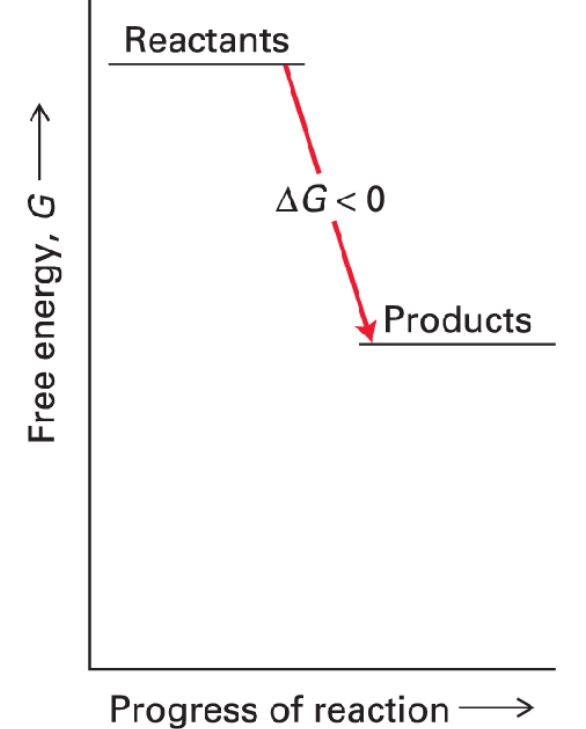
Is this an exergonic or endergonic reaction?
Exergonic

Is this an exergonic or endergonic reaction?
Endergonic
Reactions with K’eq > 1 have _____ ΔG and are _____ reaction favorable
Negative, forward
Reactions with K’eq < 1 have _____ ΔG and are _____ reaction favorable
Positive, reverse
Reactions with K’eq = 1 have _____ ΔG and are _____ reaction favorable
0, equally (equilibrium)
Catalysis does NOT influence the _____ of a reaction
Thermodynamics
Key Concept: Cellular reactions with +ΔG occur because of what 3 things?
The ratio of reactants to products is kept low enough to drive the forward reaction
Input of energy; coupled reactions
The use of activated carrier molecules
In coupled reactions, the product of the 1st reaction becomes…
The reactant or substrate for a 2nd reaction