Assessment of renal function
 Call Kai
 Learn
Learn Practice Test
 Spaced Repetition
 Match
Match Flashcards
 Knowt Play
1/82

There's no tags or description
Looks like no tags are added yet.
Name | Mastery | Learn | Test | Matching | Spaced | Call with Kai | Chat |
|---|
No analytics yet
Send a link to your students to track their progress
83 Terms
what to categories of substances can we measure to assess the kidneys?
clearance of waste from plasma
preservation of plasma resources
what products of clearance of waste from plasma can we measure
amount of plasma being produced
waste products being cleared
what 3 categories of substances can we measure for kidney function of preservation of plasma resources?
water
protein
minerals
what waste products can we measure for kidney function in the blood? (6)
urea
creatinine
phosphorus
SDMA
potassium
FGF-23
what is GFR
glomerular filtration rate is the volume of fluid filtered from glomerular capillaries into bowmans capsule per unit time
what is GFR related to?
function of whole kidneys
How does renal damage affect GFR
renal damage → nephron loss → GFR falls
why do we measure renal clearance and not GFR
more feasible
what do we require a substance to be in order to measure it for renal clearance?
filtered
not reabsorbed
not secreted
how do we calculate renal clearance
urine conc of substance x urine volume per unit time / plasma conc of substance
what are the units of GFR
volume per time (per kg BW)
why is urea not reliable to measure for renal clearance?
produced in liver by NH3 but is reabsorbed in the kidney - also highyl influenced by external factors e.g. diet
why do we want to use other markers in concurrence with creatinine?
creatinine only lowers in the case of very severe renal disease therefore whilst it’s a good marker it’s not a good for detecting early signs of disease
state 3 causes of why urea levels may change besides due to disease
distal nephron resorption of urea for medullary conc grad
post-prandial increase after protein meal
GI bleeding causes it to increase
why is urea less reliable marker in horses and ruminants?
microbial NH3 production
what is an:
ammoniotelic
ureotelic
uricotelic species?
excretes ammonium
excretes urea
excretes uric acid

what does this graph tell us?
urea and creatinine concentrations only increase above the normal threshold when there’s significant nephron damage - around 70-75%
how does excretion of phosphate change with GFR change?
phosphate excretion reduces with GFR reduction
if phosphate isn’t excreted in the kidney due to reduced GFR where does it build up?
in the blood
are high levels of phosphate in the blood lead ot a good prognosis?
no
how can we restrict phosphate with kidney disease?
restrict intake - renal food
phosphate binders
what is an issue iwth renal food, especially for outdoor cats?
they don’t enjoy it - sometimes it’s better to ensure the animal is eating rather than be super picky on what they eat and make owners feel bad
why may plasma potassium change with renal disease?
failure to excrete → due to acute renal failure and blockage/bladder rupture
what does SDMA stand for?
symmetric dimethylarginine
is SDMA better than creatinine?
not hugely, both only show up when the kidney has severe nephron loss
should we just take a measure of creatinine on its own and use this to determine the health of the kidneys?
no, we should use other parameters in onjunction e.g. SDMA
what is FGF-23 used to detect?
CKD-MBD (chronic kidney disease -metabolic bone disease) in early stages
why do we use FGF-23 over phosphorus?
it increases before phosphorus levels increase
what does a USG of 1.010 compared to 1.020 tell us about osmolality of plasma?
urine with 1.020 has a plasma of twice the solute concentration than the urine of 1.010
if we have a very concentrated sample with a USG off the scale, how do we determine the USG?
Dilute the urine sample e.g. 50:50, calculate USG and then multiply the USG (after the decimal point) - and that gives you the original
USG of diluted sample is 1.040
double this = 1.080
what are typical USG values for:
dogs
cats
horses
cattle
1.015 - 1.045
1.035 - 1.065
1.020 - 1.050
1.025 - 1.045
why may the USG of a healthy animal fall out of the given ‘reference intervals’
depends on the animals’ water intake vs water loss
what may give us a false impression of osmolality in the urine?
presence of non-typical solutes will change the SG
what assumption does USG rely on
only things in urine are what’s supposed to be in healthy urine
why is isosthenuric urine a concern (in context of other things
it means the kidneys aren’t secreting or reabsorbing in the renal tubule
what do we need to look at in addition to USG to determine if there’s a concentrating problem?
hyddration status
azotaemia
in an animal with healthy renal function, what is azotaemia an indication of?
poor renal perfusion
in animals with typical renal perfusion, what is azotaemia an indicator of?
insufficient nephrons
if there’s insufficient nephrons to filter the blood, what type of azotaemia will this cause?
renal
if there’s insufficient renal blood supply - not enough to be filtered what type of azotaemia will this cause?
pre-renal
what does it mean if an animal is dehydrated/azotaemic and the USG is;
1.008-1.012
<1.008
>1.025
no active change - renal failure
can dilute, kidneys aren’t failing but may be ADH issue
is appropriately concentrating - azotaemia is pre-renal
Why is hyposthenuria an ADH problem and not a renal failure problem?
In the loop of Henle the tubular filtrate has water pumped out down the descending limb and salts pumped out in the ascending limb
at the DCt therefore the tubular fluid is very dilute
int he collecting duct and DCT ADH should be acting to alter the dilution of the urine based on the body’s needs
if ADH isn’t working/not being produced then the urine won’t be concentrated, staying dilute
what does isosthenuria mean
same strength urine - osmolarity equivalent to plasma osmolarity
what does hyposthenuric mean?
lower strength urine - urine osmolarity less than isosthenuric
what does eusthenuria mean?
expected strength urine - given normal renal function and hydration status
what is hypersthenuria?
high strength urine - highly concentrated urine
in a dehydrated animal where the kidneys are tryingt o preserve water, what should the USG be around?
>1.030 (depends on species)
ina dehydrated animal where the kidneys are unable to preserve water, what does this mean that’s been lost and what do we expect the USG to be?
nephron loss
<1.030
for an azotaemic, pre-renal animal, what do we expect the urine concentration to be?
>1.030 - concentrated - due to low GFR and low blood volume
for a renal azotaemic animal what do we expect the USG to be?
<1.030 (but >1.007) or
1.008-1.012
for a hyposthenuric animal, when we restrict water/water intake is normalised what do we expect if:
hyposthenuric due to more water than required to offset losses
compromised ADH production or action
concentrated urine >1.030
<1.030
what should we measure to assess proteinuria?
urine protein: creatinine = UPC
why do we measure urine protein: creatinine to determine if there’s proteinuria?
it assumes constant creatinine clearance
cause of pre-renal proteinuria?
overload like glucosuria
cause of renal (glomerular) proteinuria
damaged glomeruli
cause of renal (tubular) proteinuria?
unable to resorb normal amounts of filtered protein
cause of post renal proteinuria?
urinary tract inflammation
what does the presence of casts indicate?
tubule disease/damage
what are 4 types of casts
hyaline
cellular
granular - fine/coarse
waxy
what are hyaline casts
mucoprotein
what are cellular casts
rbc
wbc
epithelial cells
are granular casts
degenerate cellular casts - imply longer stasis
what are waxy casts, what do they imply?
end-product of degeneration
implies long period of stasis
what is renal clearance?
indication of kidney’s ability to remove compounds
what are 3 things renal clearance depend on?-
GFR
tubular reabsorption
tubular secretion
experimentally how could we measure GFR by clearance?
timed urine collections and blood samples
inulin and exogenous creatinine infusion
clearance from plasma e.g. radioisotopes
what can we measure clinically to determine GFR by clearance?
timed urine collections and blood samples for endogenous creatinine
plasma clearance - iohexol, exogenous creatinine
scintigraphy
what do we need to measure creatinine clearance, is this feasible?
accurate urine collection over time
not practical clinically
why is blood creatinine not 100% reliable?
there’s tubular secretion some Gi clearance at high concentrations too
how do we calculate creatinine clearance?
urine creatinine x urine volume / serum creatinine x time x bodyweight
State how much of the following are absorbed into the PCT:
sodium and water
organic solutes
potassium
urea
phosphate
2/3
100%
65%
50%
80%
what does a <1 fractional clearance indicate?
net conservation(resorption) of the electrolyte
what does a fractional clearance >1 indicate?
electrolyte is lost and not resorbed indicating tubular disease
what is the electrolyte fractional clearance compared to?
creatinine
why may metabolic acidosis arise with renal disease?
limitation on NH4+ production and excretion
initial compensatory increase in remaining nephrons
compensation fails at 10-20% normal GFR
serum HCO3- decreases
loss of buffer means pH change (small initially)
until anions accumulate → larger pH gap
why may we see non-regenerative anaemia with kidney disease?
reduced EPO from damaged kidneys
when we have clinical pathology of the kidneys, state 4 clinical changes we may see/measure
non-regenerative anaemia
increased plasma ‘‘waste’’
urine USG
urinalysis - pathology evidence and proteinuria
when we see the following, what does it tell us about nephron loss:
isosthenuria
azotaemia
hyperphosphataemia
hyperkalaemia
67% loss
75% loss
85% loss
95% loss
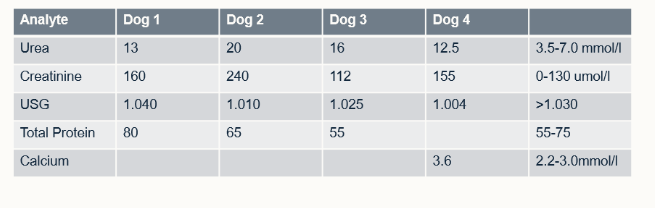
Is dog 1, pre-renal, post-renal or renal?
urea and creatinine are high = azotaemia
USG is high - but above 1.025 therefore not renal damage
total protein is high → could be dehydrated
therefore likely pre-renal and dehydration

For dog 2, are they pre-renal, renal or post-renal?
high urea and creatinine high = azotaemic
isosthenuric = indication of kidney damage
protein is in range
therefore likely renal
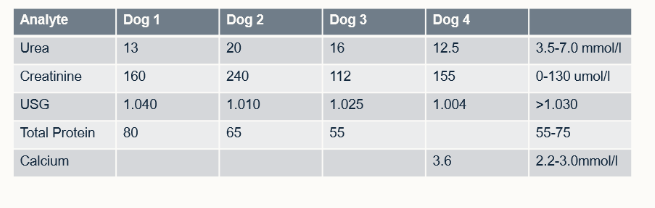
for dog 3, is it pre-renal, renal or post renal?
urea is high but creatinine in range
USG 1.025
protein in range
Two options: wait and re-test to see if anything has changed or recognise that urea can be impacted by gastric disease therefore investigate there
So likely pre-renal

For dog 4 is it pre-renal, renal or post-renal?
urea is high and creatinine = azotaemic
isosthenuric
high calcium levels
calcium blocks ADH action therefore likely secondary diabetes insipidus - need to work out underlying primary disease