Special Senses: Anatomy and Physiology of Vision, Hearing, Smell, Taste, and Equilibrium
 Call Kai
 Learn
Learn Practice Test
 Spaced Repetition
 Match
Match Flashcards
 Knowt Play
1/34

There's no tags or description
Looks like no tags are added yet.
Name | Mastery | Learn | Test | Matching | Spaced | Call with Kai | Chat |
|---|
No analytics yet
Send a link to your students to track their progress
35 Terms
What are the five special senses?
smell, taste, sight, hearing, touch
What is a receptor?
A structure specialized to detect a stimulus.
Name the four classes of receptors by modality.
Thermoreceptors, photoreceptors, chemoreceptors, nociceptors, and mechanoreceptors.
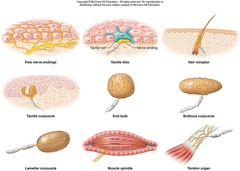
What are exteroceptors?
Receptors that detect stimuli from outside the body, such as light or chemicals.
What are interoceptors?
Receptors that detect stimuli from within the body, such as those from the stomach and intestines.
What are proprioceptors?
Receptors that provide information about the position of the body, located in muscles, tendons, and joints.
What do tactile Meissner's corpuscles sense?
Light touch and texture perception, located in hairless areas of the skin.
What is gustation?
The sense of taste, which involves taste buds located primarily on the tongue.
What are the types of taste receptors?
Taste buds are classified into filiform, foliate, fungiform, and vallate.
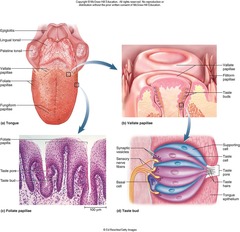
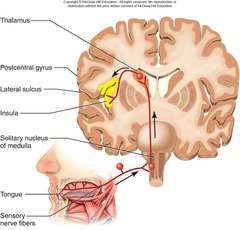
Which cranial nerves are involved in taste?
Facial (CN VII), Glossopharyngeal (CN IX), and Vagus (CN X).
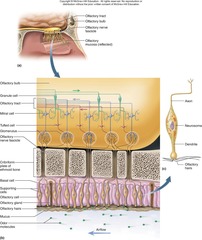
What is olfaction?
The sense of smell, involving olfactory cells located in the olfactory mucosa.
What is the function of the auricle (pinna)?
To direct sound into the auditory canal.
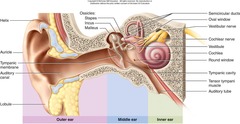
What is the tympanic membrane?
Also known as the eardrum, it vibrates in response to sound.
What is the role of the auditory (eustachian) tube?
To equalize pressure on either side of the tympanic membrane.
What is the function of the olfactory neurons?
To detect odor molecules through olfactory hairs.
What are the two senses housed in the ear?
Hearing and equilibrium (balance).
What are the three auditory ossicles?
Malleus, incus, and stapes.
What structure is located at the entrance to the cochlea?
The oval window.
What are the two types of fluids found in the inner ear?
Endolymph (in the membranous labyrinth) and perilymph (between the membranous labyrinth and bone).
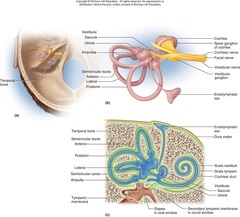
What is the role of the cochlear duct?
It is the organ of hearing.
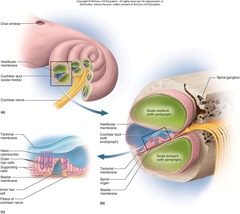
What is the function of the hair cells in the cochlea?
They convert sound vibrations into electrical signals.
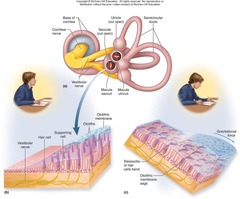
What structures comprise the vestibular apparatus?
Three semicircular canals.
What is the primary function of the eye's accessory structures?
To protect and assist the eye in vision.
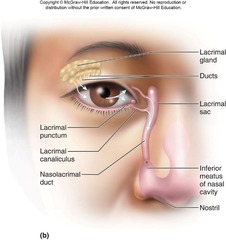
What is the role of the lacrimal apparatus?
It produces and drains lacrimal fluid (tears).
What is conjunctivitis?
Inflammation of the conjunctiva, often referred to as pinkeye.
What are the extrinsic eye muscles responsible for?
Controlling the movement of the eyeball.
What are the three layers of the eyeball?
Fibrous tunic, vascular tunic (uvea), and inner neural layer (retina).
What is the function of the retina?
To convert light energy into action potentials.
What are rods and cones?
Photoreceptor cells in the retina; rods are for night vision, and cones are for color vision.
What is the significance of the optic chiasm?
It is where half of the optic nerve fibers cross to the opposite side of the brain.
What is the function of the aqueous humor?
To maintain intraocular pressure and provide nutrients to the eye.
What is the role of the ciliary body?
It controls the shape of the lens for focusing.
What is the macula lutea?
The area of the retina responsible for detailed vision.
What is the fovea centralis?
The part of the retina with the highest concentration of cones, providing the sharpest vision.
What is the function of the vitreous humor?
To fill the vitreous chamber and maintain the shape of the eye.