cell cycle
 Call Kai
 Learn
Learn Practice Test
 Spaced Repetition
 Match
Match Flashcards
 Knowt Play
1/18

There's no tags or description
Looks like no tags are added yet.
Name | Mastery | Learn | Test | Matching | Spaced | Call with Kai | Chat |
|---|
No analytics yet
Send a link to your students to track their progress
19 Terms
Interphase
Interval between 2 successive M phase
Preparatory phase
Resting phase
95 % cell cycle
G1
Pre S post M
Cell metabolically active no replication
RNA and protein synthesis
Dna 2c
S phase
Post g1 pre g2
Dna replication [4c 2n=46]
Centriole duplication
Histone synthesis
G2
Post S and Pre M
Tubulin and cyclin protein synthesis
G0
Cell no devide inactive
Exit or suspended form of cell cycle
Heart cell , nerve cell permanent cell
Non histone in all phases

Early prophase
Late prophase
End of prophase
Initiation of condensation of chromosome
Detangles
Duplicated centrosome move to opp. Pole
%%%%%%%%%%
Chromosome have 2 sister chromatid
NM start disappearing
MT radiate frok centrosome forking aster
Aster 2 spindle = mitotic apparatus
Animal amphastral
Plant anastral mitosis
₹₹₹₹₹₹₹₹₹$₹₹₹₹₹¥
No GB , ER nucleolus NM disintegrated

Metaphase
Complete disintegration of NM and condensation kf chromosome
Chromosome lie at equator metaphasic plate
Spindle attached
Best stage for morpho
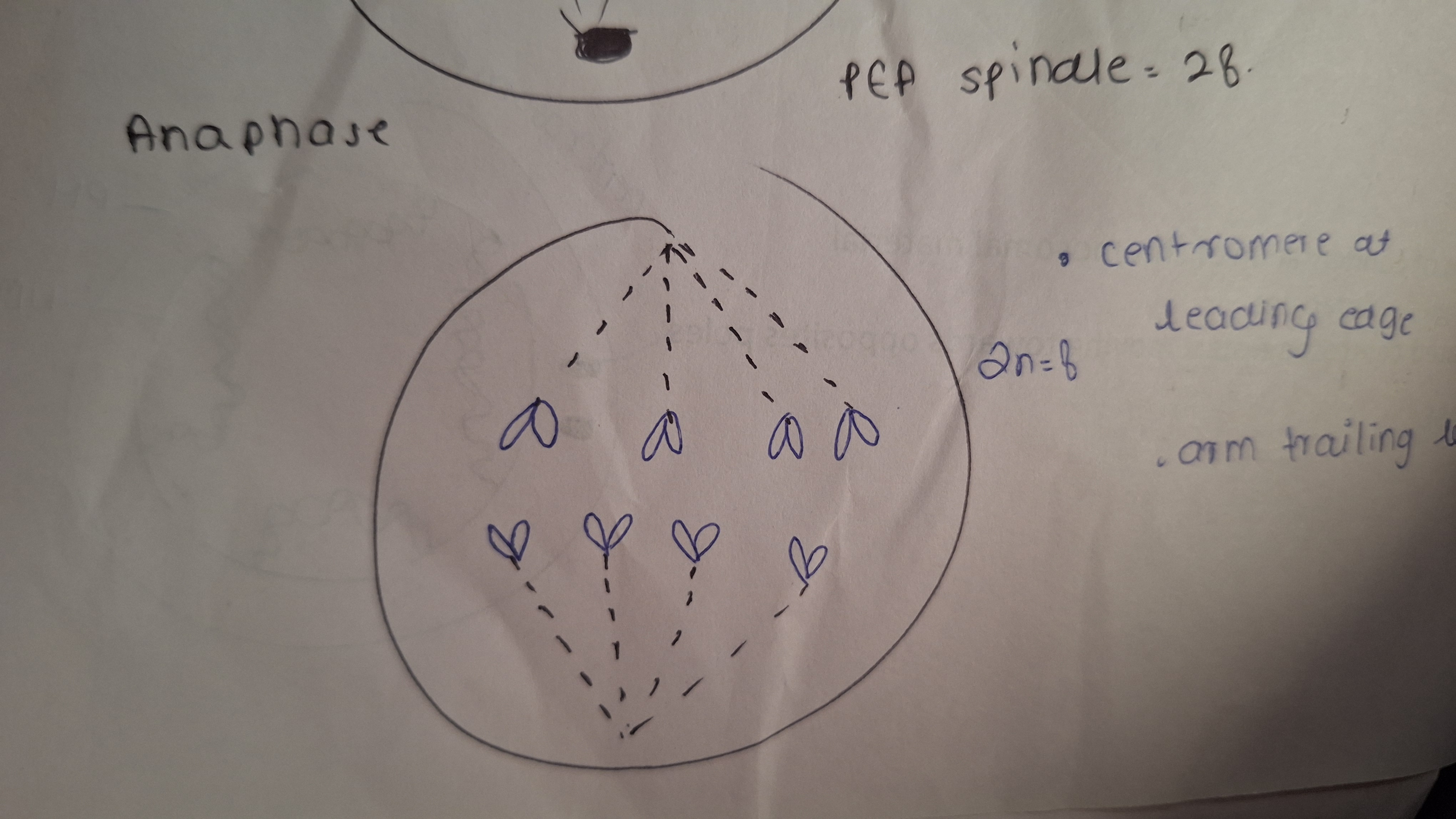
Anaphase
Contraction of spindle
Spilttion of centromere
Sister chromatid separate
Move to opp pole
No of chromosome double 4n=8
Cytokinesis
Plant cell - cell plate
Deposition of GB vesicles taht release Calicut and pectin forming
Middle lamella ams desolation of this seamless result in 2 daughter cell
And failure of cytokinesis after karyo leads to syncytium
Animal cell furrow
Contracting ring formed at edges [ centripetal]
That invagination the cell leading to cenge to form 2 new cell
It differ in noth cause of presence kf inextensible cell wall in plants
![<p>Plant cell - cell plate </p><p class="has-focus">Deposition of GB vesicles taht release Calicut and pectin forming </p><p class="has-focus">Middle lamella ams desolation of this seamless result in 2 daughter cell </p><p class="has-focus">And failure of cytokinesis after karyo leads to syncytium </p><p class="has-focus">Animal cell furrow </p><p class="has-focus">Contracting ring formed at edges [ centripetal] </p><p class="has-focus">That invagination the cell leading to cenge to form 2 new cell </p><p class="has-focus">It differ in noth cause of presence kf inextensible cell wall in plants </p>](https://assets.knowt.com/user-attachments/e30894cd-4e9b-45d4-89ab-2ff4e0ba7c60.jpg)
Significance of mitosis
Mitosis result in 2n daughter cells
Growth of multicellular
Restore nucleo-cytolasmiv ratio
Cell repair like blood cells gut cells
And in apical and lateral cambium
Meiosis 1
Prophase 1
Leototene
Chromosome compaction continues through out
Visible under light microscope
Zygote
Pairing between maternal and paternal chromosome to form synapsis and this synapsed chromosome arw called bivalent teratd = 2 homologous crhomsoem 4 chromatid
Pachytene
Longer then beofre
Characterised by formation of recombination nodule in sister chromatid of homologous chromosomes
Each bivalent consist of 4 chromatid
At end of pachytene CO is complete but homologous chromosomes still attached At site
Diplotene
At start = dissolution of synaptonemal complex
Separation of chomo but still attached at CO site resulting x shape structure called chiasmata
In oocyte diplotene kast for years
Diakinesis
Last stage
Termination of chiasmata
Spindle fire occur
Chromo fully condensed
NM disappeared
Metaphase 1
Recombined bivalent arrange at equator
2 metaohaseic plate
1 spindle attach to one chromo ans 2 ro bivalent

Anaphase 1
Shortening of spindle
Separation of homo chromo
But no spiltting of centromere
Disjunction of chormo
Constitution of gamete decided

Telophase 1
The nuclear membrane reappear
In many cases the chromosome do undergo some dispersion they do not reach extremely extended state of interphase nucleus
Inter kinesis ir intrameiotic is short lives amd no replication


Meiosis 2 same as mitosis