4 - Locomotion and Movement
 Call Kai
 Learn
Learn Practice Test
 Spaced Repetition
 Match
Match Flashcards
 Knowt Play
1/9

There's no tags or description
Looks like no tags are added yet.
Name | Mastery | Learn | Test | Matching | Spaced | Call with Kai | Chat |
|---|
No analytics yet
Send a link to your students to track their progress
10 Terms
What is a moment (torque) and how is it calculated
A moment is a rotational force around a joint
M=F*r
M = moment (Nm)
F = force (in Newtons)
r = moment arm (the perpendicular distance from the axis of rotation to the line of action of the force) (In metres)
What is a motor unit (again)
A motor unit consists of one motor neuron, its motor axon and all muscle fibres it innervates
What is motor control and what are the multiple brain regions
Motor control is voluntary movement that begins through activity in multiple brain regions
PRIMARY MOTOR COTREX : initiates/executes movements
initiation/execution of motor plans by developing a program of commands for lower motor neurons
~60% of upper motor neurons originate here
PREMOTOR CORTICES : plans/selects complex movements
Planning complex movements
Selecting movements
Postural preparation
Processing visual information
SUPPLEMENTARY MOTOR AREA : plants movement sequences
helps plan sequence of muscle contractions
Plans extent of contractions required for movement
POST PARIETAL CORTEX : sensory/body-environment map
uses sensory information to create a conscious map of the body and its relationship with its surroundings
What are the three main descending motor pathways
CORTICOSPINAL PATHWAY : motor cortex → spinal chord
mainly controls - voluntary movement of trunk and limbs
CORTICOBULBAR PATHWAY : motor cortex → brainstem
Controls - voluntary movement of face and head
EXTRAPYRAMIDAL PATHWAYS : brainstem → spinal chord
Important for - posture, balance, muscle tone
What are the steps to a corticospinal pathway?
Command begins at primary motor cortex
Signal travels to upper motor neurons through brainstem
Most fibres cross over at the pyramids
Fibres continue in the lateral or anterior corticospinal tracts
Upper motor neurons synapse with lower motor neurons
Lower motor neurons directly activate skeletal muscles
What are the lateral and anterior tract of the corticospinal tracts
LATERAL TRACT (90% of CORTICOSPINAL tract)
innervates the limbs
ANTERIOR TRACT (10% of the CORTIOSPINAL tract)
innervates axial muscles (neck, thoracic and abdominal)

Describe the different stages of the gait cycle
GAIT CYCLE
measured from initial contact → next initial contact
Foot contact or heel strike
TOE OFF : foot leaves the ground
STANCE PHASE : the limb of interest is on the ground
SWING PHASE : the limb of interest is off the ground
DOUBLE SUPPORT : both feet on the ground
SINGLE SUPPORT : one foot on the ground
What are central pattern generators
A central pattern generator is a neural circuit within the spinal chord
Generates rhythmic motor patters without requiring continuous cortical input
What is the difference between Cortical control and central pattern generators
COTRICAL CONTROL
generates voluntary movement
Requires conscious intention
Cortex = Driver
CENTRAL PATTERN GENERATORS
generates rhythmic locomotion
Can operate largely automatically
CPG = engine
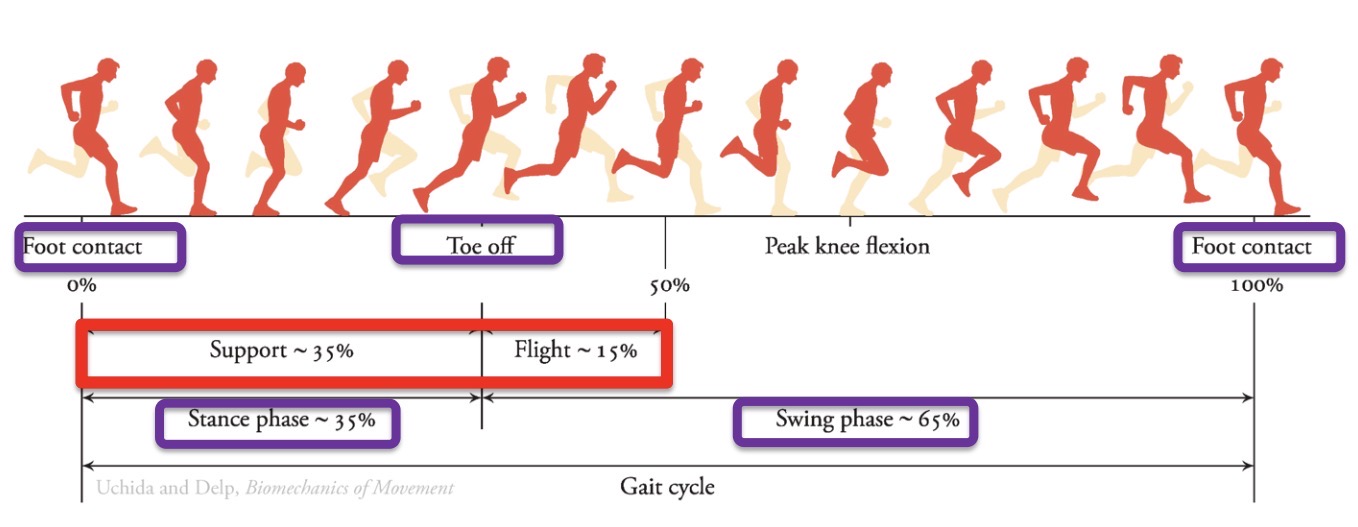
What are the main differences between walking and running gait cycle
In running, we do not benefit from the exchange of forward kinetic energy and gravitational potential energy, but instead store and release elastic potential energy in our muscles and tendons as they stretch and recoil
Running has support phase + flight phase (no double support)