Critical Thinking Ch 1D: Analyzing Arguments - Inductive and Deductive
 Call Kai
 Learn
Learn Practice Test
 Spaced Repetition
 Match
Match Flashcards
 Knowt Play
1/11

There's no tags or description
Looks like no tags are added yet.
Name | Mastery | Learn | Test | Matching | Spaced | Call with Kai | Chat |
|---|
No analytics yet
Send a link to your students to track their progress
12 Terms
Inductive Argument
An inductive argument assumes that what has been true for some/most will be
true for all.
• It makes a case for a general conclusion from more specific premises.
Inductive Argument Examples
Ex 1: Most earthquakes I have felt have occurred at night. The next earthquake to hit LA will
be at night.
Ex 2: Martha is a grandmother, so Martha is old.
Ex 3: I won the last five times I gambled. Thus, I have luck on my side and will continue to win!
Evaluating an Inductive Argument
The argument is strong if it makes a compelling case for its conclusion. (Built on
much valid evidence.)
The argument is weak if its conclusion is not well supported by its premises. (Built
on little or faulty evidence.)
An inductive argument cannot prove its conclusion true. The argument can only be evaluated in terms of its strength.
Deductive Argument
A deductive argument assumes that what is true for all members of the set
must be true for each member if the set.
A deductive argument makes a case for a specific conclusion from more general
premises.
Deductive Argument Examples
Ex 1: Premise: An island is surrounded by water.
Premise: Hawaii is an island.
Conclusion: Hawaii is surrounded by water
Ex 2: An island is surrounded by water. Santa Clarita is not surrounded by water and is thus not an island. (Valid)
Ex 3: An island is surrounded by water. Antarctica is surrounded by water and is thus an island. (Invalid)
An argument is VALID
If the conclusion follows necessarily from its premises regardless of the truth of the premises or conclusion.
If the conclusion does not follow necessarily from the premises, then the argument is
invalid
If the argument is valid, then it is impossible for the premises to be true and the conclusion to
be false
An argument is SOUND
If it is a valid argument and its premises are all true

Deductive Examples
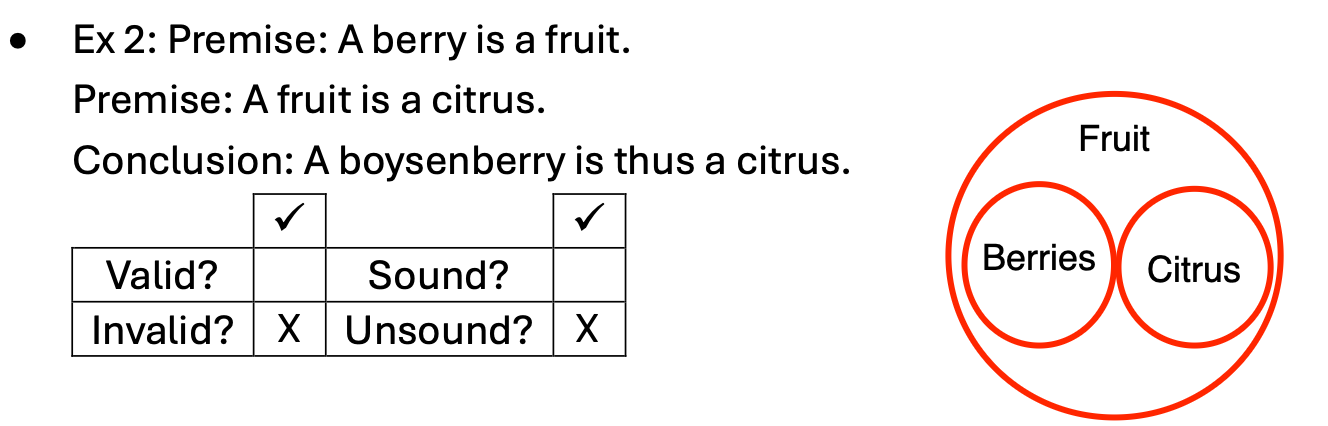
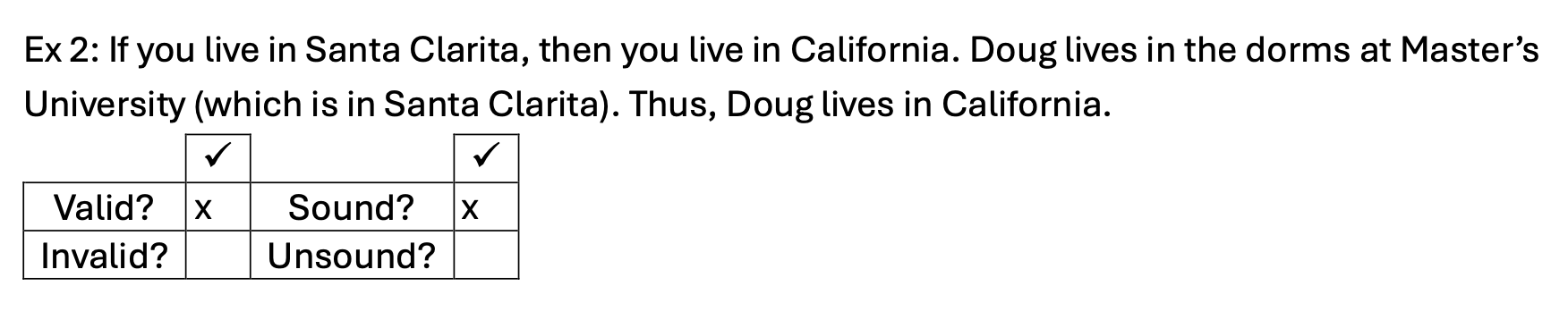
Conditional Deductive Arguments

Affirming the Conclusion Examples (Consequent)
q is true, thus p is true → invalid
The truth of the conclusion doesn’t prove the truth of the hypothesis.
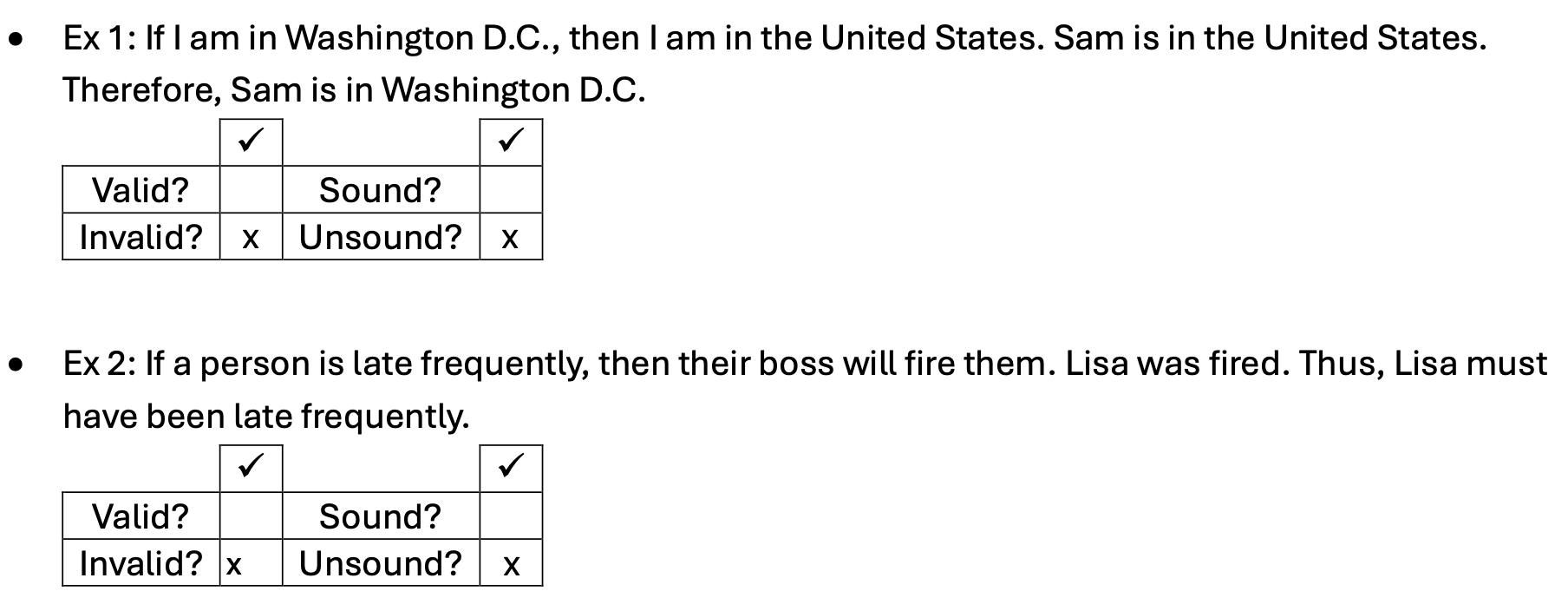
Denying the Hypothesis Examples (Antecedent)
• p is not true, thus q is not true → invalid
• If the premise is not true, it doesn’t prove the conclusion also not true.

Denying the Conclusion Examples (Consequent)
• q is not true, thus p is not true → valid
• If the conclusion is not true, it proves the premise is not true.
