Lecture 12: Global Change Ecology
 Studied by 0 people
 Call Kai
 Learn
Learn Practice Test
 Spaced Repetition
 Match
Match Flashcards
 Knowt Play
1/54

There's no tags or description
Looks like no tags are added yet.
Name | Mastery | Learn | Test | Matching | Spaced |
|---|
No study sessions yet.
55 Terms
The Great acceleration
Humans have only been around for a relatively short period of time.
Yet, we have affected ecosystems across the globe, sometimes irreversibly altering the ecological course of this planet
The Anthropocene
Humans have left permanent records in the sediment that will be detected 2 million yrs in the future.
Crawford Lake in Ontario was chosen as the "key site that shows we're in a new climate epoch“ due to its clear sediment records demonstrating human activity, such as plutonium from nuclear testing
Examples of Ecological Impacts: The Sixth Mass Extinction
Humans have accelerated species extinction rates by orders of magnitude.
For example, during 1900-2014, ~20 times more vertebrate species went extinct than would be expected with natural extinction rates. Without human disturbance, it would have taken ~900-11,000 years on average for the same number of species to go extinct
Examples of Ecological Impacts: Insect Declines and Extinctions
33% of documented insect species are declining globally.
Biomass declines of close to 80% have been documented in some places.
The windshield phenomenon
refers to the observation that fewer insects accumulate on cars’ windshields while driving compared to a few decades ago, vividly illustrating global insect declines.
Anthropogenic Threats to the Environment
Ecologists are facing numerous new challenges in the Anthropocene, including understanding the impacts of, and devising mitigation strategies for:
Climate Change
Land Use Change
Overexploitation Invasive Species &
Ecosystem Homogenization
Pollution
Primary threats to the environment and biodiversity include
habitat loss, overexploitation, invasive species, pollution, and climate change.
The importance of these threats varies globally and by species.
Overexploitation definition and examples
Unsustainable exploitation can lead to abundance declines or extinctions of the resource species.
Ex passenger pigeons
Exploitation (~harvesting):
the destructive use of animals, plants, and their products for various consumptive (e.g., food, medicine) and non consumptive (e.g. trophy hunting) purposes.
Exploitation < growth rate
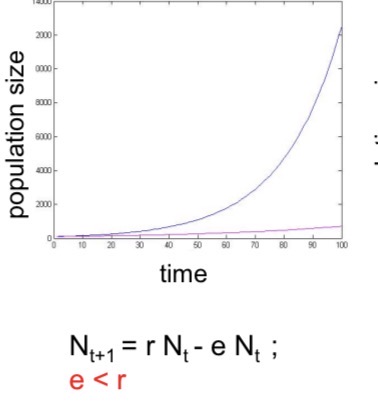
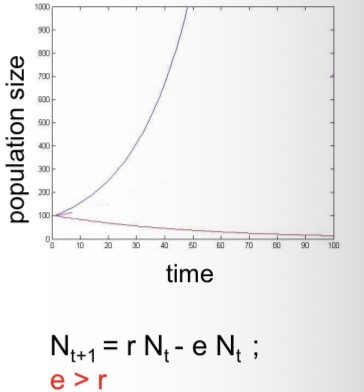
Overexploitation (~overharvesting):
harvesting wild organisms at rates that are faster than the rates at which they can recover.
Exploitation > growth rate
Example: The Empty Oceans
Overfishing has led to depleted fish stocks worldwide
Example: The collapse of the cod fishery
Example: Sustainability of global fish stocks
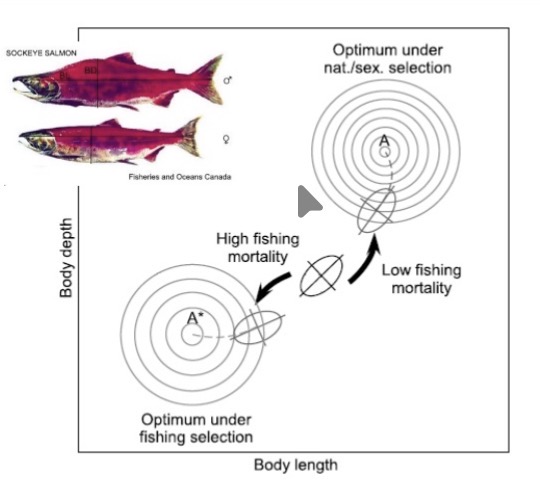
Fishers prefer the big fishes → it is better for the fish to be smaller because then fishers won’t care about them
Because hunting imposes an artificial selection pressure to be “less attractive to hunters”, overfishing has also led to declines in the average body masses of many commercial fish species
Conservation efforts are complicated by shifting baselines
shifting baselines
a phenomenon where a new generation’s lack of direct experience with what past environmental conditions were like leads to the acceptance of the current conditions as the new normal, and thus, a progressive deterioration of the environment
Ex. Fishers a long time ago came back from fishing saying “i caught a fish l l this big”
Then 20 yrs later his nephew comes back from fishing saying “i caught a fish l l this big”
The uncle and nephew have different baselines, and the nephew doesn’t realize there has been a change of fish size because he wasn’t fishing 20 yrs ago
Ex. Prof remembers windshield being full of insects, but I don’t have that experience with that, I only know a world with fewer insects
Overfishing can have complicated knock-on effects that may further threaten ecosystems.
Example: Trophic cascade due to sea otter loss
Example: Trophic cascade due to shark removal
Example: Release of jellyfish from predators and competitors
Growth of jelly fish in ocean because they’ve lost their top predators and also because they lots competitors (other fish)
Depleted fish stocks and knock-on effect can lead to concerns for human well-being.
Example: Overfishing, human population growth and food security
Overexploitation Example: Terrestrial Systems
Example: Wolf removal and reintroduction, leading to trophic cascades in Yellowstone N.P.
Example: Declines in elephant tusk size and bighorn sheep horns due to hunting pressure → elephant with large tusk is more likely to be hunted (“decline of the fittest”)
Land Use Change: Habitat Degradation, Habitat Fragmentation, Habitat Loss
Humans rely on healthy ecosystems, yet threaten them.
To date, we have modified ~60% of Earth’s land surface and impacted all marine ecosystems.
Habitat degradation, habitat fragmentation, and habitat loss are by far the biggest threats to biodiversity.
Habitat degradation:
Changes that reduce the quality of a habitat
Example:
Eutrophication
Erosion
Pollution
Habitat loss occurs when
a natural habitat becomes incapable of supporting its native species.
Example: Loss of old growth forests to build cities, roads and agriculture
Example: River dams fragmenting aquatic populations → dams destroy habitat completely, river not making it to ocean because of our dams
Habitat fragmentation occurs when
continuous habitat is broken up into smaller pieces.
Aside from leading to smaller habitats, habitat fragmentation tends to increase the number of contact edges between habitat and non-habitat, leading to an increased vulnerability to edge effects (changes that occur/begin at the boundary of two habitats, such as road mortalities, disease spillovers, etc).
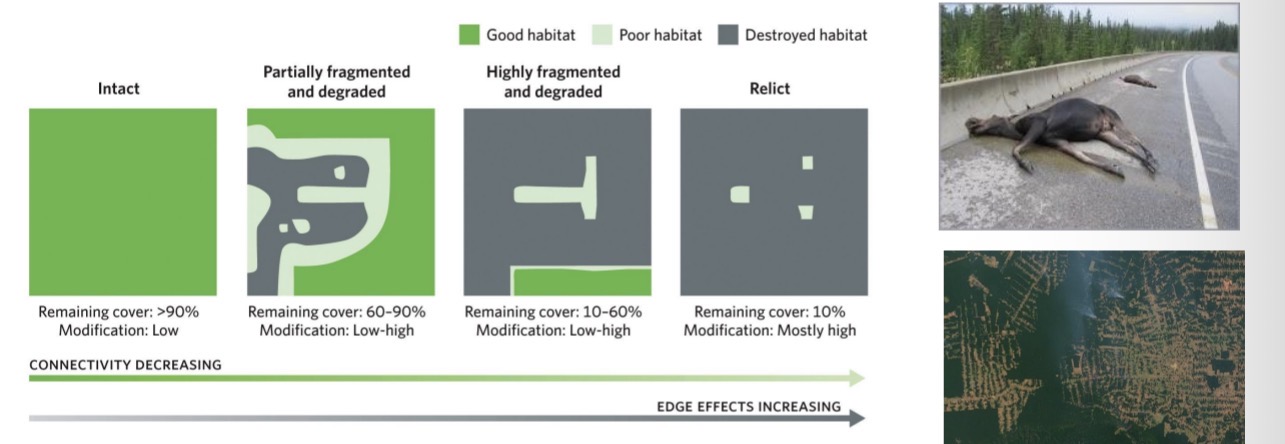
Habitat fragmentation can
lead to increased contact between humans and wildlife (an edge effect), increasing the chances of zoonotic disease spillovers.
Example: Ebola, Lyme disease
facilitate the invasion and establishment of non-native species
Cut down trees that are transported, are not just wood, but still have insects living in them. These get carried over to other areas → potential to be invasive
Dispersal
is the movement of an individual to a new location.
It occurs in all species and is a fundamentally natural process.
Human accelerated dispersal
Increasing human population size, mobility, and transportation of goods has led to a corresponding rate of increase in the introduction of new species to new locations
Example: Introductions of non-native species in Europe
A non-native species is a species that is
(1) present in a location where it did not evolve, and (2) was moved there via human action.
Many cause little to no harm (e.g., because they fail to establish large populations) and many have been beneficial to human societies.
Example: The economic value of introduced food crops (wheat, corn, rice, etc.) and livestock (cattle, poultry, etc.) was ~$800 billion / year in the U.S. in 1998
An invasive species is a species that is
(1) present in a location where it did not evolve, (2) was moved there via human action, and (3) has spread in its new location, producing negative impacts on the environment, human health, or economic systems.
Some invasives can cause tremendous harm to ecosystems and human societies, either directly or indirectly.
Ex. smallpox brought to North America by Europeans. Smallpox is not native to North America, and indigenous people were impacted because they did not have an immunity against it
Invasive Species Example: Cane Toads in Australia
Cane toads were introduced to Australia in 1935 in an attempt to control cane beetles.
The initial population of about 100 animals grew to now >200 million toads.
Invasive Species Examples: Zebra Mussels & Garlic Mustard in Ontario
Zebra mussels were introduced into the Great Lakes around 1989 via the ballast water of ships.
The strong competitive ability of zebra mussels has led to steep declines in native freshwater mussels (60%-90%) & billions of dollars of harm for industry and taxpayers.
Garlic mustard was introduced from Europe around 1860 as a culinary herb.
Garlic mustard is an ecosystem engineer – it is highly competitive and creates an environment (by allelochemicals) that is beneficial for itself but not for many other species. This leads to reduced biodiversity and the homogenization of ecosystems
Homogenization of Ecosystems and Ecosystem Productivity
Some invasive species can become highly dominant (e.g., due to a lack of natural predators or strong competitors), which can reduce species diversity and lead to the homogenization of ecosystems.
Reduced species diversity, in turn, tends to impact community function, for example, through reduced drought resistance, plant productivity, soil fertility, water quality, and other factors
All attributes tend to be better when there is more diverse species there
Invasive Species Control
Managers try to control invasive species by chemical (pesticides), biological (release diseases to kill unwanted species), and physical means (physically remove species).
A combination of approaches often works best, but eradication is frequently impossible. Once invasive species are established, the goal is usually mitigation
Population dynamics principles suggest that controlling an invasive species early
maximizes the chances of success and minimizes the costs: due to low initial densities and localized populations, Allee effects, demographic stochasticity, environmental stochasticity, and other mechanisms, increase the chances of eradication (cf. Lecture 5).
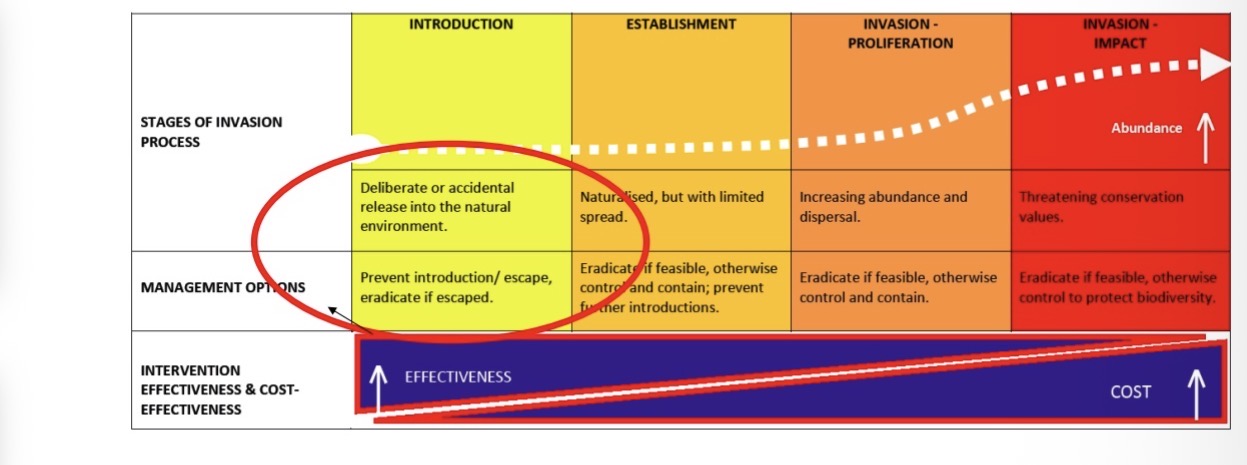
Even better than “catching them early” is
a precautionary approach that tries to prevent invasions altogether
Example: Ecology and Economics of Pandemic Prevention
Dobson et al. (2021) estimated that the costs of mounting and maintaining a pandemic prevention plan for 10 years would only be about 2% of the costs of the COVID-19 pandemic
Pandemic prevention can be like don’t bring wildlife to the edges back into human societies, early testing etc
Humans don’t react to problems until they blow out of proportion
But problems are much simpler when its small
Pollution Examples
Eutrophication
Road salts affecting the water regulation and, thus, the survival of amphibians (wood frog bloated from road salts because they’ve absorbed them)
Microplastics
The Great Pacific Garbage Patch → twice the size of Texas, just garbage in the ocean
Persistent Toxins
Example: DDT → used in the war to kill mosquitos to prevent soldiers from getting sick. DDT ends up in the food chain, doesn’t break down, DDT accumulates in the top predators as it goes up the trophic levels
Birds would lay eggs that would implode when touched
In many places DDT is banned
Why do cloudy winter days/nights feel warmer than clear ones?
Clear skies: Little water vapour → heat escapes easily → colder winter nights.
Cloudy skies: Clouds act like a blanket → trap heat → warmer winter nights.
Greenhouse gases + clouds make a bigger difference in winter because there’s less incoming sunlight, so trapped heat is more noticeable.
Only models with human activity taken into account
Can explain climate change
Ways that Climate Change is Altering the Planet Example
Melting glaciers
Melting sea ice
Melting permafrost
Rising sea levels
Increasing forest fires
Rising sea levels
Tipping Points
Everything seems fine until the point where it is not
when an ecosystem or climate system seems stable until a critical threshold is reached, and then it changes suddenly and dramatically.
Ex. If we loose ice sheets in the arctic, that would be a tipping point because we can’t just rebuild them very quickly, that water is in the ocean
climate change projections
Matters are going to get worse, but the extent depends on the decisions that we are making now.
Average global surface temperatures have already increased by ~1.1-1.5°C above pre-industrial times, and are expected to continue increasing by an additional 1.0-3.7°C until the end of the century compared to the 1986-2005 averages.
Given current emissions, we will have used up the maximum carbon budget that is permissible if we want to limit warming to no more than 1.5°C above pre-industrial times by ~2030.
The Paris Climate Agreement specifies a goal of no more than a 2°C (and preferably no more than 1.5°C) increase compared to pre-industrial times.
Climate change Ecological Impacts, Summary
Temperature, precipitation, and other abiotic variables are key drivers of many ecological processes.
Their changing affects natural systems from the organismal to the ecosystems level.
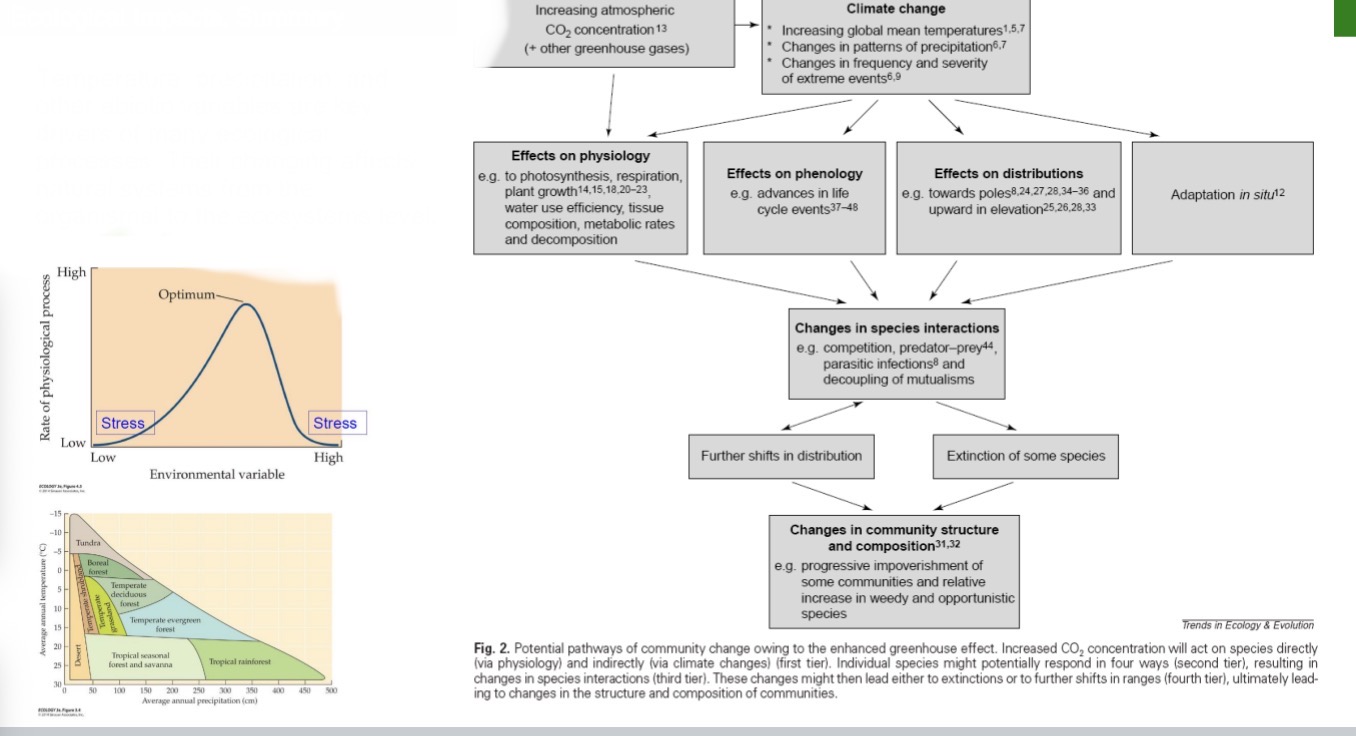
Adaptation & Evolution
Species with short generation times (like a mosquito) may be able to adapt to a changing climate, but for species with long generation times (like polar bears), environmental changes often outpace their ability to adapt.
New “hybridization zones” may also arise due to the altered ranges of species, leading potentially to the rise of new species.
Example:
Impacts of climate change on polar bear population dynamics
Hybridization between polar bears and grizzly bears
Physiological Impacts
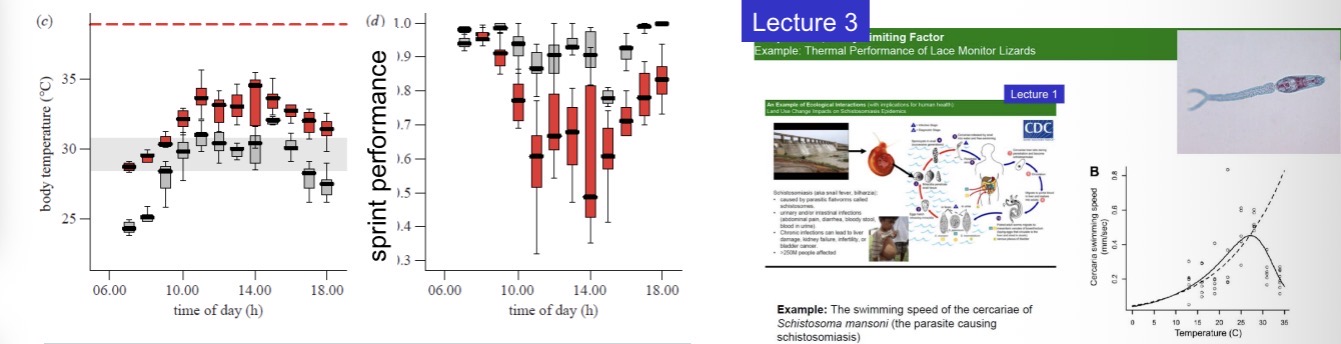
Ectotherm physiology and performance are directly impacted by temperature.
Example: Lizard body temperatures and sprint velocities under normal temperatures (grey) and in a warmer climate (red). The shaded area corresponds to optimal temperatures, the red line to lethal temperatures.
Example: Swimming velocity of the cercariae of Schistosoma mansoni
Temperature effects on endotherms are usually
indirect (e.g., through changes in resource supply), but some direct effects are possible: e.g., heat stress can reduce the reproduction, survival, and immune response to diseases in muskoxen.
Phenological Changes
Climate change is shifting seasonal patterns around the globe, driving changes in phenology (the timing of periodic biological phenomena that are correlated with cyclic or seasonal events).
Ex when do birds start to sing → they sing because they want to snow → when is mating season
If March temperatures now occur in February, then the biological activity that used to happen in March should now appear in February.
Climate change is shifting seasonal patterns around the globe, driving changes in
phenology
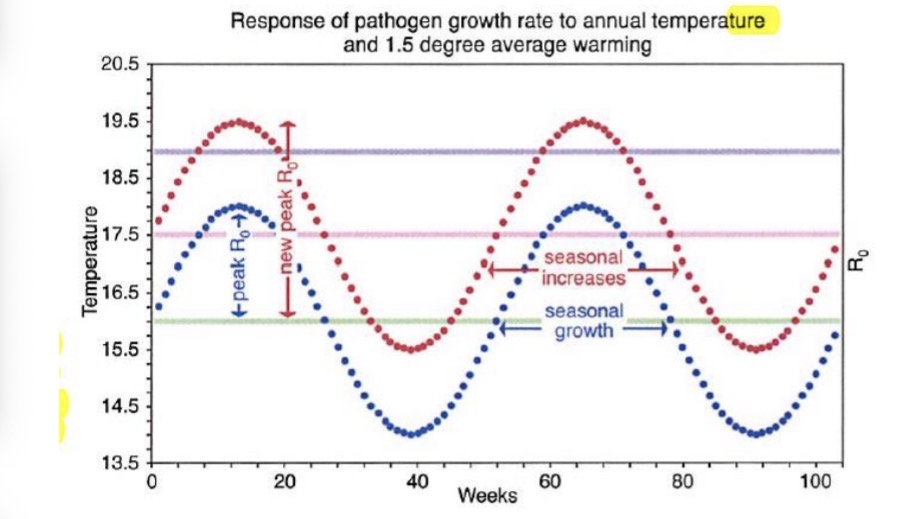
Example: It has been hypothesized that earlier springs and later falls may allow for a prolonged infection season, and that, combined with faster larval growth rates under warmer temperatures, this may lead to an increased number of parasite generations, and thus, increased population growth, in a season.
warming makes parasite development speed up
Metabolic processes are faster, the parasite grows up faster, and now it only takes a week for a generation instead of 2 weeks
Even if summer is the same length, higher temperatures can increase the number of generations produced within that period.
Earlier spring, later falls, longer transmission season
If the timing of events shifts in different manners for interacting species, phenological mismatches may occur.
Example: phenological mismatch between a predator (great tit) & its prey (caterpillar)
Caterpillar hatches earlier in spring. So when the birds are ready to lay their eggs, the caterpillars have already become butterfly’s, so there is no food for the younglings
Example: phenological mismatch between a herbivore (caribou) & its resource (plant growing season)
Caribou’s go to northern feeding grounds because there are lots of flowers they can eat. Now that the flower is growing earlier, caribou arrives, no flowers for them to eat
Climate change is affecting feeding conditions for many species. Altered resource dynamics lead to altered population dynamics.
Example: Collapses in the population cycles of lemmings due to diminished snow cover in the Arctic
Melting snow cover: so lemmings can’t hide from predators anymore and the plants are affected
Lemmings stoped cycling
Geographic Range Shifts
A species’ distribution is constrained by the species’ tolerances to various environmental variables.
Shifting climates can, thus, lead to local population declines & extinctions, as well as the colonization and establishment in new areas.
As a result, range shifts, range contractions, and range expansions may occur, depending on the species’ niche flexibility and dispersal ability.
(A) a simplified temperature gradient from the Arctic (cold) to the equator (warm);
(B) a hypothetical species’ corresponding (temperature-dependent) R0. The species can establish in regions where R0≥1.
Following climate warming (dashed lines), the species will go extinct (R0<1) in some tropical regions, and may expand its range into Arctic areas where R0 is now larger than 1.
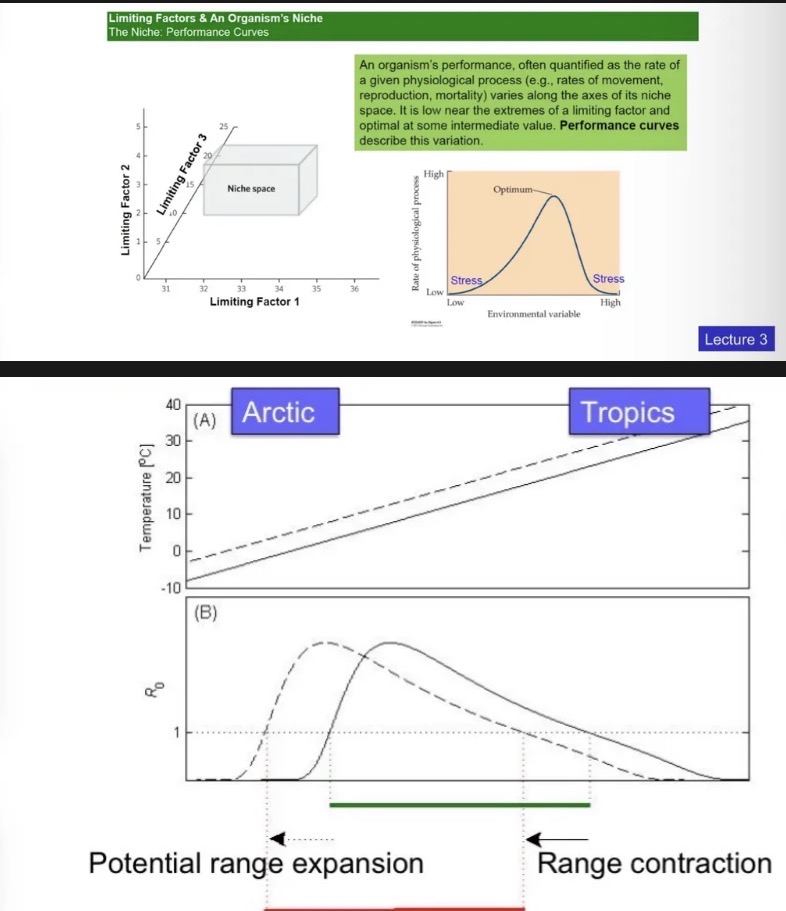
When viewed across large geographic scales, many species have shifted their ranges
polewards in latitude and/or upwards in elevation in response to warming, as expected .
New Species Interactions
Range changes lead to new species interactions, possibly to the detriment of one species
Example: Range- expanding red foxes outcompeting arctic foxes
Red foxes are increasing, arctic foxes are decreasing. Red foxes are going north and out competing the artic foxes. Arctic foxes get displaced and red foxes persist
Example: Winter ticks have now established in the Yukon and Northwest Territories. Winter ticks are known to grow rapidly when environmental conditions suit them, leading to epizootic outbreaks with up to 50,000 ticks per moose. There are concerns that moose could facilitate tick dispersal further northwards, bringing them into contact with barrenground caribou.
Changing Communities
Multiple changes in multiple species add up to community changes – some of which are predictable, while others lead to never-before-seen community compositions.
Example: Changing tundra plant communities → As the tundra warms, cold-adapted plants are outcompeted by shrubs and other species that can now survive in the warmer conditions.
The dilution effect
suggests that higher biodiversity leads to reduced disease.
This effect may have large consequences for human health if tropical, mosquito-borne diseases were to establish in temperate regions.
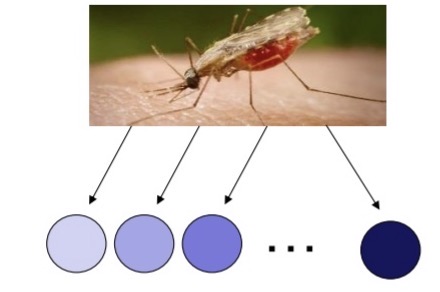
Dilution effect In a species-rich community (e.g., the tropics),
a vector has many different host species to feed on.
Some of these will be suitable hosts for the parasites that it is transmitting, while others won’t be.
As such, there will be many “wasted bites” (from the parasite’s perspective), where the parasite ends up in a non-suitable host and cannot complete its life cycle.
This, in turn, might reduce population growth rates.
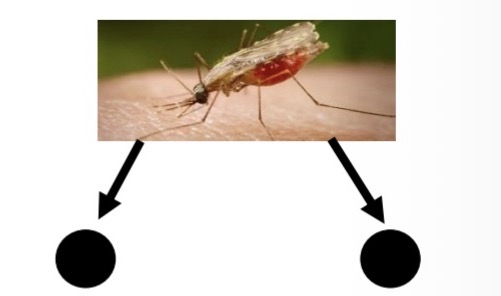
In a less species-rich community, the dilution effect becomes
weaker as bites will concentrate on fewer species.
For example, it has been hypothesized that mosquito bites might be more concentrated on humans and livestock in temperate regions (e.g., Europe, North America) than in tropical ones, which, in turn, might lead to higher infection rates with tropical diseases, such as malaria & dengue fever, once they establish in these regions.
Ecosystem Changes Examples
Desertification
Degrading estuaries due to pollution and sea level rise
Coral bleaching due to warming oceans and ocean acidification