GEN 4200 DNA Structure, Replication, and Recombination Learning Objectives
 Call Kai
 Learn
Learn Practice Test
 Spaced Repetition
 Match
Match Flashcards
 Knowt Play
1/8

There's no tags or description
Looks like no tags are added yet.
Name | Mastery | Learn | Test | Matching | Spaced | Call with Kai | Chat |
|---|
No analytics yet
Send a link to your students to track their progress
9 Terms
Explain the four characteristics required of genetic material
Replication: Accurate copies must be made to ensure stability of cell populations and to pass to next generation
Storage of Information: Information is stored in the form of a macromolecule. Information is contained within every cell
Encoding of phenotype and a method of transmitting of this information to produce the phenotype
Show variation through the process of mutation
Review key experimental results that supported DNA, rather than proteins as the genetic material (Griffith, Avery, MacLeod, McCarty, Hershey and Chase)
Frederick Griffith (1928): Principle of transformation. Virulent bacteria that are heat-treated can pass virulence to harmless bacteria
Avery, Macleod, and McCarty (1944): DNA is the agent of transformation. Selected elimination of macromolecules results in transformation only when DNA is present
Hershey and Chase (1952): DNA is transferred to cells. Proteins and DNA of bacteriophages were labeled with radioactivity. DNA contains instructions for viral replication
Describe the overall structure of the DNA molecule (Double helix, antiparallel, complementary base pairing, nucleotides, etc)
Nucleotides are the building blocks (subunits) of DNA:
Deoxyribose sugar, phosphate, and a nitrogenous base
Types of nitrogenous bases: purines (feature a double-ring structure consisting of a six-membered ring fused to a five-membered ring. Adenine (A) and Guanine (G) in both DNA and RNA) and pyrimidines (Feature a single, smaller six-membered ring structure. Cytosine (C) in both DNA and RNA but Thymine (T) in DNA and Uracil (U) in RNA)
Nucleotides are linked through the phosphodiester bond
Because of the linkage and the linear nature of DNA, polarity is automatically established
One end will have a free phosphate on the 5’ carbon, and the other a free OH on the 3’ carbon meaning the free phosphate group on the 5’ end isn’t binding to anything
Two DNA strands (polymers) are joined together to create the functional molecule of heredity
Double helix with strands arranged in an antiparallel manner
Complementary base pairing is key to holding two strands together
3 hydrogen bonds between cytosine and guanine (pyrimidine with purine)
2 hydrogen bonds between thymine and adenine (pyrimidine with purine)
The DNA double helix model:
Two strands are held together through the hydrogen bonds between complementary base pairs
The two strands are in an antiparallel orientation
The sugar-phosphate backbone is on the outside with base pairs in the middle
Two grooves are present: the major groove and the minor groove (these grooves are important for gene expression)
Nitrogenous bases are inside and hydrophobic
Describe Semiconservative Replication and its requirements (not part of the learning objectives)
Because of complementary base pairing, one strand of DNA automatically has the information to build a new strand
Original (parent) strand is called the template strand (already contains information)
Used to create new daughter strands
Semiconservative-template strand becomes part of new DNA molecule
A single double helix becomes two new daughter helices
Mechanism established via Meselson and Stahl experiment (1958)
Successful replication requires the following:
A DNA template strand (must be single strand for replication)
Pool of free nucleotide triphosphates (must be accessible and balanced ex: dATP, dGTP, dCTP, dTTP)
Enzymes and other proteins (DNA polymerase, primase, single-strand binding proteins, DNA helicase, DNA topoisomerases, ori proteins)
A primer with a free 3’ OH
DNA replication occurs during the S phase of the eukaryotic cell cycle
Multiple signaling inputs and regulatory steps dictate the progression of the cell through the stages of the cell cycle
Replication must be complete and accurate before the division phase of the cycle
Explain DNA polymerase and how it works (not part of the learning objectives)
DNA Polymerase catalyzes the formation of new phosphodiester bonds
Joins two nucleotides together in the same strand
Uses energy from high energy phosphate bonds contained in the free nucleotide triphosphates
DNA polymerase can only make a new phosphodiester bond when the free 3’ OH is available
DNA strands can ONLY be created in the 5’-3’ direction
Describe the key steps in the semiconservative replication of DNA (Review results of Meselson-Stahl experiment)
Initiation - DNA helix is opened to create two template strands
Designated sequences within the DNA serve as initiation site
Called origins of replication, eukaryotes have multiple origins per chromosome
Creates a replication bubble in the DNA
DNA helicase unwinds helix
Initiator proteins recognize origin sequence
Primase synthesizes RNA primer
Elongation - Synthesis of a new DNA strand
DNA polymerase reads the nitrogenous bases on the template strand and adds complementary nucleotides
New DNA strands are build in the 5’-3’ direction ONLY
The parent double helix has two strands oriented in opposite directions

Explain the occurrence of the leading and lagging strands in DNA replication
The direction of replication is bidirectional along both template strands
Because template strands are antiparallel, new DNA cannot be synthesized continuously in both directions
New daughter strands will be antiparallel to template
Leading strand: New DNA molecule is synthesized continuously
Lagging strand: New DNA molecule is synthesized discontinuously
Each fragment is called an Okazaki fragment
Okazaki fragments are joined together via the enzyme DNA ligase
Define homologous recombination and explain the mechanism (Explain why crossing over may or may not occur)
DNA replication during meiosis provides the opportunity to create new combinations of alleles
Alleles-different versions of the genes
New allele combinations are created through independent assortment or recombination (homologous recombination, HR)
HR is how new allele combinations are made for genes located on the same chromosome
During meiosis, homologous chromosomes have been replicated
Each chromosome has two sister chromatids
The pairs of chromosomes are aligned during prophase, allowing non-sister chromatids to exchange genetic information
Crossover chromosomes are also called recombinant chromosomes or recombinants
HR requires a physical break in the DNA strands
Double strand break is made by specific proteins
Exonuclease will degrade 5’ ends of the break to leave 3’ ss trails
To repair the break, HR relies on the availability complementary sequence from the opposite homologous chromosome
HR proteins will force the double helix of the opposite homolog to open at regions of complementarity
Heteroduplex forms when DNA from one homolog is paired to the other
D loop forms due to strand displacement
The single strand of the D loop pairs with opposite free 3’ tail
DNA synthesis replaces the DNA that was degraded to create the 3’ tails
Backbones sealed by DNA ligase
Cleaving of the heteroduplexes will result in either a crossover or non-crossover chromosome
Cleavage occurs at structures called the Holliday junctions
Only cells undergoing meiosis exhibit homologous recombination
DS breaks initiated by the Spo11 protein
Mitotic cells do have replicated DNA, so does recombination occur?
Yes, called mitotic recombination
DS breaks are typically initiated by environmental agents that damage DNA (X-rays, chemicals)
Can be useful in laboratory settings to create new mutations
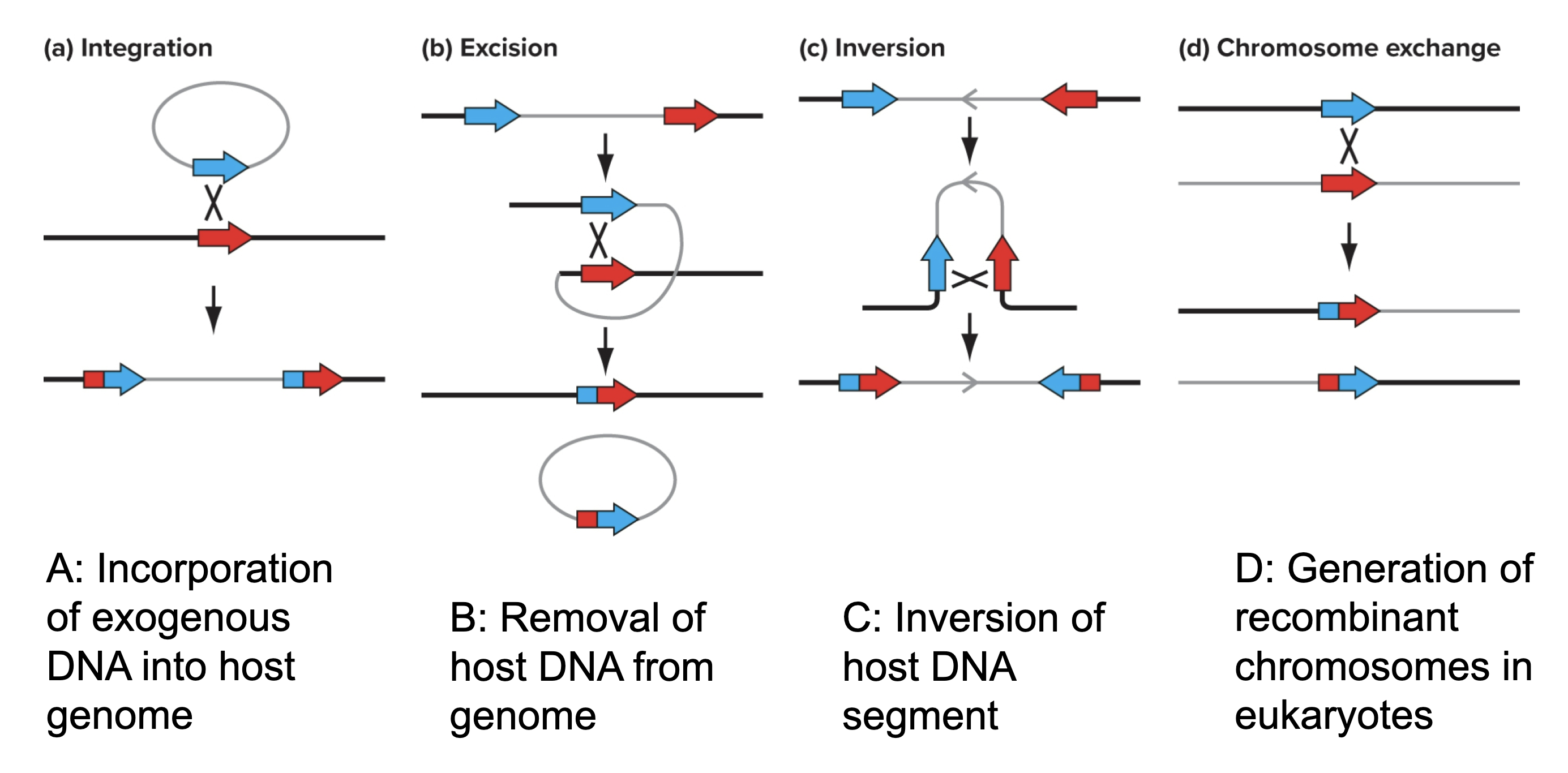
Define site-specific recombination and explain the possible genetic outcomes of this process
Site-specific recombination is the basis of site-specific gene editing
The breakage and rejoining of DNA molecules occurs only at particular DNA sequences
Target sites are usually less than 200 base pairs long
Typically requires only a recombinase protein rather than a suite of many proteins
Limited to certain organisms, which includes bacteriophages
Allows insertion of viral genome into the host genome
Other outcomes are possible