Movement Analysis Wk 1: Introduction to Occupation-Based Anatomy
 Call Kai
 Learn
Learn Practice Test
 Spaced Repetition
 Match
Match Flashcards
 Knowt Play
1/90

There's no tags or description
Looks like no tags are added yet.
Name | Mastery | Learn | Test | Matching | Spaced | Call with Kai | Chat |
|---|
No analytics yet
Send a link to your students to track their progress
91 Terms
The study of human movement, focusing on the active and passive structures involved
Kinesiology
Focuses on the forces (internal + external) that affect movement
The study of mechanical laws + their application to the human body (ex. lever arms)
Can be static or dynamic
Biomechanics
The focus is on ROM, strength, and endurance
Allows us to analyze movement in activity
DOES NOT address a holistic approach
Biomechanical Frame of Reference
Everyday activities that people do to bring meaning and purpose to life
Ex. ADLs, IADLS, rest and sleep, education, work, play, leisure, health management, and social participation
Occupations
Completing these meaningful activities by a person, group, or population
Occupational performance
Goal-directed actions that contribute to occupational performance
Ex. Motor, process, and social interaction
Performance skills
Reaching, stabilizing, manipulating, and walking
Physical contribution to occupation
Motor skills
Cognitive, emotional, and psychosocial function essential
Navigating and organizing
Process skills
Underlying body structures that contribute to movements involved in daily function
Relates to motor performance skills
Functional anatomy
Moving from one position or place to another
Examples:
Changing positions in bed
Transferring
Walking
Functional mobility
Emphasizes the meaning behind the motion, recognizing movement as an outflow of individual volition, or will
Purposeful movement
Habits
Routines
Roles
Rituals
Performance patterns
Identifies performance skills and patterns that facilitate or inhibit occupational performance
Activity analysis
Term for back or dorsal
Posterior
Term for front, volar, or ventral
Anterior
Term for direction of the skull
Cranial
Term for beneath or toward the tail
Caudal
Attachment that moves the least (stable)
Usually proximal
Origin
More movable attachment
Usually distal
Insertion
Use of physical touch to identify structures
Usually done in muscle belly (between origin + insertion)
Looking for muscle contraction
Palpation
Features that are palpable or visible on the surface of the skin
Surface anatomy
Component of bone that protrudes beneath skin
Bony landmark
Divides body into right and left sides
Flexion and extension movements
Sagittal plane
Coronal plane
Divides body into anterior and posterior portions
Abduction and adduction movements
Frontal plane
Divides body into inferior and superior portions
Rotatory (rotary) movements
Transverse plane
Joints rotate around what?
Axes of motion
What is the joint’s center of rotation?
Axis
When referring to axes of motion
Medial to lateral
Frontal axis
When referring to axes of motion
Anterior to posterior
Sagittal axis
When referring to axes of motion
Inferior to superior
Vertical axis
Cooperative, interdependent movement of segments and joints of the body
Kinetic chains
Functional movement
Proximal joints moving in relation to fixed/distal segment
Promote stabilization
Examples:
Pushing a grocery cart
Squatting to pick up a box
Closed-chain
Free movement of distal segment in space
Allows joints to move together OR independently of others
Promotes mobility
Example: conducting an orchestra
Open-chain
Any push or pull of matter
Ex. gravity
Force
Pulling force
Tensile force
Pushing force
Compressive force
The lever arm is known as what?
Distance from a joint to the muscle
Moment arm
These are pulley systems, provide mechanical advantage, and generate functional motion
Levers
Exerted force and resistive force on opposite sides of axis
Axis in the middle
Examples: seesaw, human neck
First-class lever
Resistive force closer to axis than exerted force and on same side
*Greatest mechanical advantage
Examples: using a wheelbarrow, the ankle
Second-class lever
Most common in human body
Allows for higher-velocity movements
Third-class lever
*MC: The effort is between the axis and resistance, what lever is this?
Third-class
Force generated within the joint in response to external forces acting upon it
Joint reaction force
Amount of applied force per area
Example: pounds per square inch
Stress
Amount of material displacement (tissue) under specific amount of stress
Strain
The ability to stretch and return to original shape (what the normal body does)
Elasticity
Made of collagen + calcium
Bone
Greater mineral content than collagen
Shaft of long bones
Rigid support
Cortical bone
Higher collagen content
Found in marrow cavity and at end of long bones (ex. ball + socket joint)
Cancellous (spongy) bone
Covers ends of long bones
Dense connective tissue to absorb force between bones
Multiple layers
Articular (hyaline) cartilage
Degeneration of cartilage within a joint
Osteoarthritis
Connect bone to bone
Joint stability (ex. posture, support)
Ligaments
Connect muscle to bone
Transfer force
Tendons
Dense fibrous sleeve around synovial joint
Passive stability
Contains synovial fluid
Joint capsule
Fibrous insertion that connects adjacent muscles
Example: Abdominal muscles that forms rectus sheath
Aponeurosis
Moves bones of skeleton
Supplies force for purposeful movement
Striated and alternating bands of fibers
Skeletal muscle
Contraction of this flexes the elbow
Biceps Brachii
Acts in multiple directions
Elevates the scapula
Flexes the cervical spine laterally
Upper trapezius
Microscopic study of body tissue
Skeletal Muscle Histology
What are the three layers of skeletal muscle histology (inner to outer)?
Endomysium
Perimysium
Epimysium
Contractile units of a muscle
Sarcomeres
*MC: What activates a muscle contraction?
Sarcomeres
A muscle is the strongest in what position?
Midrange
Area of a cross-section of muscle at its widest point
The wider the muscle is, the stronger
Physiological cross-sectional area (PCSA)
Fibers oriented obliquely (slanted)
Multipennate, bipennate, and unipennate
Pennate muscles
Type 1 fibers
Low force over a long period of time (endurance, stamina, strength)
More resistant to fatigue
Ex. Distance runner
Slow-twitch fibers
Type II Fibers
Powerful contractions (not so good for endurance)
Ex. Sprinter
Fast-twitch fibers
Learned patterns of motion
Motor memory
This is the prime mover (ex. biceps for elbow flexion)
Agonist muscle
This is the contrasting muscle to a prime mover (ex. triceps, lengthens + works against you)
Antagonist muscle
Muscles that assist prime mover (working together)
Ex. 3 main muscles for elbow flexion: biceps brachii, brachialis, brachioradialis (last 2 are an example)
Synergists
Muscles that work together
Act in different directions to produce same motion or stabilize a joint
Force couple
Some muscles cross 1 joint
Ex?
Brachialis
Some muscles cross multiple joints - crosses wrist + metacarpals for flexion
Ex?
FDP
Contraction with NO change in length
Ex. Holding a 10lb weight
Isometric contraction
Contraction with change in muscle length + joint motion
Isotonic contraction
Lengthening (isotonic contraction)
Ex, Loering mug back to table
Eccentric
Shortening (isotonic contraction)
Ex. Bringing mug to mouth
Concentric
Mobile joints
Allow purposeful movement
Synovial joints
Sutures of skull
Little/no mobility
Stability
Fibrous joints
Pubic symphysis
Little/no mobility
Stability
Cartilaginous joints
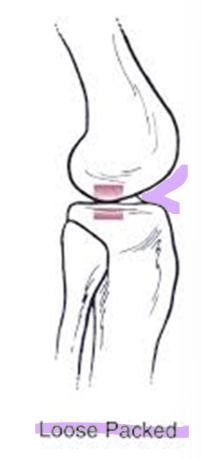
Maximal contact between articular surfaces
Maximal tension on surrounding ligaments
Example: knee in full extension
Close-pack position

Least surface contact
Laxity of surrounding ligaments
Increased mobility of joint
Example: knee in slight (25 deg) flexion
Open-pack position
Spherical surface fits into concave depression
Most mobile
Rotates around three axes
Example: glenohumeral joint (shoulder)
Ball-and-socket joint
Oval-shaped convex end articulates with elliptical concave basin of another
Motion around two axes
Example: radiocarpal joint
Ellipsoid joint
Motion around single axis
Only flexion and extension
Collateral ligaments limiting medial and lateral movement
Example: humeroulnar (elbow) joint
Hinge joint
Modified ellipsoid joint
Convex and concave articulating surfaces
Motion around two axes
Example: carpometacarpal (CMC) joint of thumb
Saddle joint
Two flat surfaces of adjacent bones
Least movement
Translation (gliding) movements between surfaces
Example: carpal bones of the wrist
Gliding joint
Motion around one axis
Bones rotating around another
Example: atlantoaxial joint
Pivot joint
Gross movement of bones in relation to one another
Osteokinematics
Distal bone glides in opposite direction of rotational movement
Ex. Wrist
Convex-Concave Rule