Cell Structure and Function Cells and Organelles
 Call Kai
 Learn
Learn Practice Test
 Spaced Repetition
 Match
Match Flashcards
 Knowt Play
1/135

There's no tags or description
Looks like no tags are added yet.
Name | Mastery | Learn | Test | Matching | Spaced | Call with Kai | Chat |
|---|
No analytics yet
Send a link to your students to track their progress
136 Terms
Schwann
scientist who first postulated cell theory, stating that all organisms consist of one or more cells and the cell is the basic unit of structure.
Virchow
scientist who added the third tenet to cell theory, stating that all cells arise only from preexisting cells.
Abiotic synthesis
first phase of cell appearance involving the nonliving creation of simple organic compounds.
Abiotic polymerization
second phase of cell appearance involving the assembly of simple organic compounds into macromolecules.
Stanley Miller Experiment
A famous biochemical setup demonstrating the abiotic synthesis of organic molecules from a simulated primitive atmosphere.
Simulated atmosphere gases
specific mixture of gases used in the Miller experiment, containing CH4, NH3, H2, and H2O
Ribozymes
RNA molecules capable of performing enzymatic reactions, such as forming peptide bonds during translation.
RNA world
hypothesized early period in evolutionary history where RNA existed as the primary informational molecule before the appearance of DNA and proteins.
Protocells
Primitive cell-like structures formed when primordial lipids came together to trap RNA molecules.
Liposome
A hollow structure formed by a lipid bilayer that can encapsulate genetic material to create a primitive cell.
In 1839, Schwann postulated the foundational aspects of cell theory. Which of the following statements matches one of his original two tenets?
The cell is the basic unit of structure for all organisms.
what biochemical fact supports the idea that RNA preceded DNA in evolutionary history?
Deoxyribonucleic acids (DNA components) are derived enzymatically from corresponding ribonucleotides (RNA components).
What specialized role do ribozymes perform during modern translation that highlights their ancestral capability to drive an "RNA world"?
They catalyze the formation of peptide bonds during translation
The four-phase model for the appearance of cells states that the encapsulation of the first living molecule must occur within a simple ____________.
membrane
Primordial lipids came together in the early earth environment to enclose and trap strands of ____________, ultimately creating the first primitive cells.
RNA
Three Domains of Life
Bacteria, Archaea, Eukarya
Evolutionary Divergence
biological fact that bacteria and archaea are as divergent from one another as humans and bacteria are.
Bacterial and Archaeal Size
1-5 micrometers
Eukaryotic Size
10-100 micrometers
Eukaryotic Chromosomal DNA
Linear DNA molecules structurally associated with true histone proteins.
Archaeal Chromosomal DNA
Typically circular DNA molecules structurally associated with histone-like proteins.
which of the three domains of life contain a true nucleus and membrane-bound organelles?
Eukaryotes only
How do the structural components of microtubules and microfilaments differ between prokaryotes (Bacteria and Archaea) and Eukaryotes?
Bacteria and Archaea contain actin-like and tubulin-like proteins, whereas Eukaryotes contain true actin and tubulin proteins.
Which domain(s) are capable of performing bulk vesicular transport via exocytosis and endocytosis according to the comparison data?
Eukaryotes only
Which of the following correctly details the shape of chromosomal DNA and its associated organizing proteins across the domains?
Eukaryotes have linear DNA with histone proteins, while Archaea have circular DNA with histone-like proteins.
Unlike eukaryotes which contain true actin and tubulin proteins, Bacteria build their microfilaments and microtubules using actin-like and ____________ proteins.
tubulin-like
While bacterial chromosomal DNA is typically circular with few associated proteins, eukaryotic chromosomal DNA is linear and bound tightly to true ____________ proteins.
histone
According to the chromosomal DNA property data, Archaea possess a typically circular chromosome that uniquely complexes with ____________ proteins.
histone-like
Surface area to volume ratio
A critical ratio that severely drops as a cell's individual side length increases
which cellular processes and structures are strictly restricted to Eukaryotes, while being completely absent in both Bacteria and Archaea?
A true nucleus, membrane-bound organelles, and exocytosis/endocytosis
what are the direct internal physical consequences when a cell's size increases too much without internal compartmentalization?
Molecular concentration falls and chemical reaction rates slow down.
Unlike eukaryotes, both bacteria and archaea contain microtubules and microfilaments composed of ____________ proteins rather than true actin and tubulin.
actin-like and tubulin-like
Cells that are specialized for nutrient absorption adapt their shapes using microvilli to maximize their total structural ____________.
surface area
Cytoplasmic streaming
An active eukaryotic transport strategy (called cyclosis in plants) used to actively move cytoplasmic contents throughout large cells
Cyclosis
Movement of cytoplasm around the cell for plants
Vesicles
Membrane-bound transport packages used by eukaryotic cells to move molecules along protein fibers.
Internal organelles
Specialized cellular compartments that allow localized concentration of molecules for a particular cellular function.
Eukaryotic structural complexity
typical animal and plant cells, which are larger and more compartmentalized than prokaryotes.
Core eukaryotic components
plasma membrane, a nucleus, membrane-bounded organelles, and a cytosol interlaced by a cytoskeleton.
Plant and fungal cell boundary
rigid cell wall structure that is surrounded by an extracellular matrix.
Microtubule
A type of protein fiber shown in the transport diagram along which cellular vesicles are physically carried.
Eukaryotic cells are too large to rely purely on passive diffusion. Which of the following active strategies do plant cells specifically use to mechanically mix and distribute their cytoplasmic contents?
Cytoplasmic streaming (cyclosis)
When a cell grows in size, its average internal molecular concentration falls and reaction rates slow down. How do eukaryotic internal organelles structurally solve this specific problem?
They allow localized concentration of specific molecules needed for a particular function.
While both animal and plant cells possess a plasma membrane and a cytoskeleton, what unique boundary structures are found specifically in plant and fungal cells?
A rigid cell wall surrounded by an extracellular matrix
Eukaryotic cells move specific molecules actively through their cytoplasm packed inside membrane-bound ____________ that travel along specialized protein fibers.
vesicles
In a typical eukaryotic cell, the liquid portion of the cytoplasm known as the cytosol is extensively interlaced by a structural network called the ____________.
cytoskeleton
As cell size increases, the rate of unassisted chemical reactions inside the cell will naturally ____________ unless active transport mechanics are used
slow down
Glycoprotein
A membrane protein containing short carbohydrate side chains attached to it on the external side of the membrane.
Membrane protein domains
Functional segments of a membrane protein, where most have at least one hydrophobic membrane-spanning domain.
Nuclear envelope
double-membrane structure that surrounds the nucleus and contains regular openings called nuclear pores.
Chromatin
The complex of DNA and organizing proteins found dispersed within the nucleoplasm of the nucleus.
Nucleolus
The prominent, dense structure located inside the nucleus responsible for ribosome synthesis.
how much volume can a central vacuole occupy, and what physical phenomenon does it create?
It occupies about 90% of cell size to store nutrients, waste, and water, generating turgor pressure against the cell wall.
The plasma membrane consists of a phospholipid bilayer with embedded proteins. What is true regarding membrane protein symmetry?
Membrane proteins are not symmetrical because modification happens only at a specific part of the protein
what specific components are manufactured inside the dense sub-compartment known as the nucleolus?
Ribosome proteins and transcription cues
According to the evolutionary pathway diagrams and handwritten annotations detailing the Endosymbiont Theory, what are the distinct ancestral lineages for animal cells versus plant cells?
Ancient aerobic purple bacteria evolved into animal mitochondria; ancient photosynthetic cyanobacteria evolved into plant chloroplasts.
The endomembrane system utilizes small, membrane-bound transport vesicles to move materials between compartments. Are these transport vesicles classified as independent organelles?
No, they are not considered organelles; their role is strictly membrane packing to facilitate transport between parts of the system.
While the outer boundary of a plant cell is a rigid cell wall, the vital structure that establishes cell boundaries and houses asymmetrical proteins is the ____________ bilayer.
phospholipid
The nuclear envelope is a double-membrane structure where specialized openings called ____________ allow nucleotides to enter the nucleus and tRNAs to exit.
nuclear pores
Mitochondria
An organelle found in large numbers in most cells, in which the biochemical processes of respiration and energy production (ATP) occur.
Inside a plant chloroplast, individual thylakoid discs organize into tight horizontal stacks called a ____________, which serves as the location for photosynthesis.
granum
The specialized network of interconnected structures (Endomembrane system) includes the Endoplasmic Reticulum, the Lysosomes, and the ____________.
Golgi Apparatus
Endosymbiotic similarities
Mitochondria, chloroplasts, and bacteria all contain circular DNA without histones, allowing them to make their own RNA and proteins.
Prokaryotic ancestral clues
Mitochondria and chloroplasts share similar rRNA sequences, ribosome sizes, and translation inhibitor sensitivities with bacteria, showing they likely share a common ancestor.
Organelle double membranes
Structures where the inner membrane features bacterial-like lipids and the outer membrane features eukaryotic lipids.
Endomembrane System
synthesizes and packages proteins destined for various organelles, cellular membranes, or secretion.
vesicles
Small membrane-bound transport units that function strictly in membrane packing to act as vehicles between parts of the system
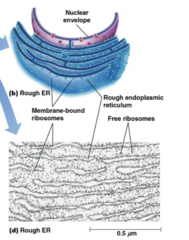
Endoplasmic Reticulum
An extensively folded organelle that sits close to the nucleus and is directly connected to the outer nuclear envelope membrane to enlarge its surface area.
Smooth ER functions
lipid synthesis and chemical detoxification
Rough ER functions
Protein synthesis via associated ribosomes, along with protein modification.
Ancient aerobic purple bacterium
specific ancestral prokaryote engulfed by a protoeukaryotic cell that evolved to propagate independently as a mitochondrion.
Ancient photosynthetic cyanobacterium
specific ancestral prokaryote engulfed by a eukaryotic descendant that evolved to propagate independently as a chloroplast.
what unique asymmetry characterizes the lipid layers of both mitochondria and chloroplasts?
The inner membrane features bacterial-like lipids, while the outer membrane contains eukaryotic lipids.
The endomembrane system utilizes small, membrane-bound vesicles to direct proteins around the cell. According to the handwritten annotations, what is the exact classification of these vesicles?
They are not considered independent organelles; they function strictly as vehicles for membrane packing between different system parts.
how is the Endoplasmic Reticulum physically organized within the cytoplasm?
located close to the nucleus, directly connected to the outer nuclear envelope membrane, and folded to enlarge its surface area.
An investigator isolates two distinct fractions of the endoplasmic reticulum. Fraction 1 is covered in ribosomes and active in protein modification. Fraction 2 lacks ribosomes and performs detoxification. How are these fractions classified?
Fraction 1 is Rough ER; Fraction 2 is Smooth ER.
The interconnected organelles that cooperate within the endomembrane system are the Endoplasmic Reticulum, the Lysosomes, and the ____________.
Golgi Apparatus
According to the Endosymbiont Theory diagram, the early ancestral cell that first engulfed an oxygen-utilizing bacterium is called a ____________.
protoeukaryote (or protoeukaryotic cell)
The detailed structural diagram of the Rough ER highlights that it contains both membrane-bound ribosomes and ____________ ribosomes.
free
the Endoplasmic Reticulum plays an important role in protein ____________.
sorting
Golgi Apparatus functions
Processing and packaging secretory proteins (such as glycosylation), along with the synthesis of complex polysaccharides.
Golgi stack composition
A series of individual, disconnected compartments typically consisting of 3-8 sacks.
Golgi polarity
A structural feature defined by having 2 sides, starting at the incoming cis side.
Lysosomes
Single-membrane enclosed compartments that serve as the specialized garbage disposal of the cell.
Lysosomal function
Storing acid hydrolases to digest different macromolecules, breaking them down into monomers to be recycled for making new macromolecules.
Transition vesicle
Vesicles that transport materials from the Rough endoplasmic reticulum to the Golgi
Secretory vesicle
A membrane package that buds off the Golgi apparatus and travels to the plasma membrane for exocytosis.
how do materials physically travel through the Golgi apparatus?
They move from one individual sack to another packed inside transport vesicles.
The slide poses the question: "Why won't lysosome enzymes digest the lysosome itself or the cell?" Based on the biochemistry of these enzymes, what mechanism protects the cell from self-digestion?
The enzymes are acid hydrolases that require a low pH to function; if they leak into the neutral cytosol, they become inactive.
what is the correct chronological sequence of structures a protein encounters when destined for secretion out of the cell?
Rough ER → Transition vesicle → Golgi apparatus → Secretory vesicle → Plasma membrane
Hand-annotated notes emphasize that the Golgi apparatus acts fundamentally as a cellular ____________ center for further chemical modification.
sorting
While mitochondria possess a double-membrane structure, lysosomes are bounded by a ____________ membrane.
single
According to the text labels on the lysosome slides, lysosomes contain specialized digestive enzymes generically classified as ____________.
hydrolases
The process depicted at the very end of the secretory pathway, where a secretory vesicle fuses with the plasma membrane to release its contents outside the cell, is called ____________.
exocytosis
Peroxisome classification
An organelle that resembles lysosomes in size and appearance but is explicitly not part of the endomembrane system.
Where are peroxisomes especially prominent in animals?
Organelles that are especially prominent in the liver and kidney cells of animals.
Catalase
The specific peroxisomal enzyme that safely converts highly toxic hydrogen peroxide (H2O2) into water and oxygen
Peroxisomal oxidation
A process that digests long-chain fatty acids by breaking them into smaller pieces and aids in detoxification by breaking down aromatic molecules.
Cis vs trans golgi
-Cis faces towards ER and is convex. Proteins enter from the cis face.
-Trans faces towards Plasma membrane and is concave. Proteins exit from trans face.
Animal and yeast vacuoles
Temporary storage units containing molecules like amino acids and sugar, or transport structures formed via phagocytosis.