Micro chp4
 Call Kai
 Learn
Learn Practice Test
 Spaced Repetition
 Match
Match Flashcards
 Knowt Play
1/22

There's no tags or description
Looks like no tags are added yet.
Name | Mastery | Learn | Test | Matching | Spaced | Call with Kai | Chat |
|---|
No analytics yet
Send a link to your students to track their progress
23 Terms
Generalized anatomy of ALL bacterial cells?
Every bacterial cell has 4 basics:
A cell membrane
DNA (chromosome/nucleoid),
Ribosomes
Cytoplasm.
Everything else (flagella, capsule, endospores) is optional, not universal.
Types of external cell appendages?
Three types stick out from the cell:
flagella (for swimming)
pili (for DNA transfer)
fimbriae (for sticking to surfaces).

Structure & attachment of flagella/axial filaments?
A flagellum has 3 parts
filament (the whip, made of flagellin),
hook (connector),
basal body (motor anchored in the wall). Spirochetes instead have axial filaments tucked INSIDE the cell (between wall and outer sheath) that make the cell twist/flex.
How do flagella cause motility/behavior?
The flagellum spins like a propeller. Spinning counterclockwise = smooth "run" forward.
Spinning clockwise = "tumble" (random direction change). Bacteria use this to steer toward food or away from danger.
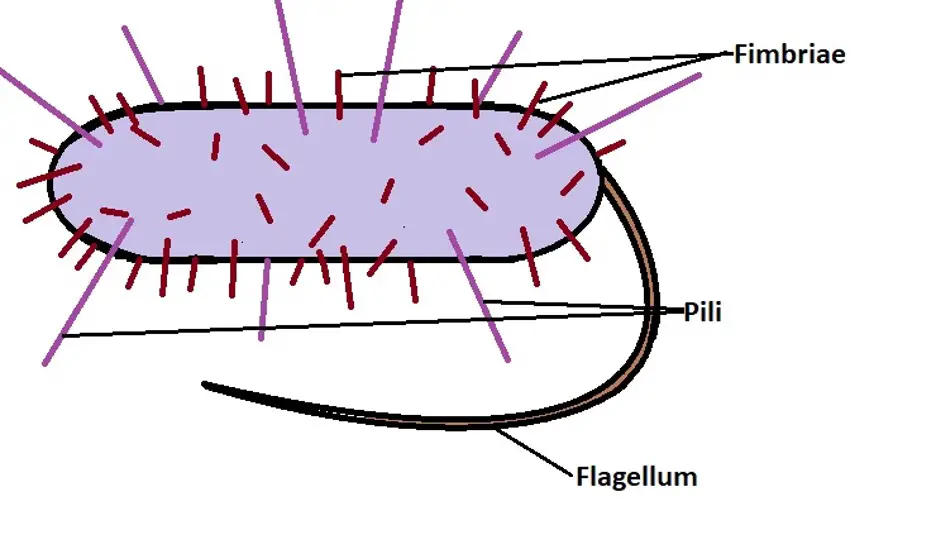
Structure & function of pili and fimbriae?
Fimbriae = short, sticky hairs — help bacteria cling to surfaces/each other (forms biofilms).
Pili = longer tubes — their main job is conjugation (passing DNA to another cell); only gram-negative bacteria have them.

Glycocalyx definition, forms & functions?
The glycocalyx is a sugary/protein coat outside the cell wall — its job is sticking to surfaces.
Comes in 2 versions: slime layer (loose, protects from drying out) or capsule (thick and tough — helps pathogens hide from immune cells).
What is the cell envelope?
"Cell envelope" just means cell wall + cell membrane together. It gives the cell its shape and keeps it from bursting (lysis).
Cell wall structure & role of peptidoglycan?
Peptidoglycan (PG) is the main building material of the cell wall — think of it as a mesh: sugar chains linked together by short protein bridges. Antibiotics like penicillin work by breaking those bridges, causing the cell to burst.

Gram-positive vs gram-negative cell walls?
Gram+ = one thick layer of peptidoglycan, no outer membrane (simpler, 2-layer envelope).
Gram- = thin peptidoglycan sandwiched between two membranes (3-layer envelope), and that extra outer membrane has LPS (toxic if released) — which is also why gram-negative infections are harder to treat.
Other/atypical cell walls & cells without walls?
Mycobacterium/Nocardia have a normal gram+ wall PLUS a waxy coat (mycolic acid) — makes them tough to kill/stain.
Mycoplasma skip the cell wall entirely — they use cholesterol in their membrane for strength instead, so their shape is irregular.
Cell membrane structure & major roles?
It's a "fluid mosaic" — a flexible double layer of fat (phospholipids) with proteins floating in it.
Jobs: acts as a barrier, controls what gets in/out (transport), and hosts metabolic reactions.
Bacterial chromosome & plasmids?
Chromosome = one big circular DNA loop with everything the cell NEEDS to survive.
Plasmids = small extra circular DNA loops, optional, often carrying "bonus" genes like antibiotic resistance — these are what scientists borrow for genetic engineering.
Bacterial ribosomes & cytoskeleton?
Ribosomes = protein-making machines, found in every single cell (2 pieces: big + small subunit). Cytoskeleton = an internal scaffolding some bacteria have that holds their shape and helps during division — not universal.
Inclusion bodies & granules — importance?
Both are storage pockets inside the cell.
Inclusions store nutrients (like carbon) for later use.
Granules store inorganic material — a cool example is magnetosomes (iron crystals) that work like a tiny internal compass.
Life cycle of endospore-forming bacteria?
Normal cell (vegetative) → harsh conditions hit → cell forms a tough, dormant endospore (sporulation) → conditions improve → spore "wakes up" back into a normal cell (germination).
Important: this is survival, NOT reproduction — one cell in, one cell out.
Resistance & significance of endospores?
Endospores are nearly indestructible — they shrug off heat, drying, radiation, and most chemicals (even boiling water). Only certain gram+ bacteria make them (Clostridium, Bacillus).
This is why medical/surgical equipment needs full sterilization, not just cleaning.

Shapes of bacteria & variants?
5 main shapes to know —
coccus (round)
bacillus (rod)
vibrio (curved comma)
spirillum (rigid spiral)
spirochete (flexible corkscrew)
Some bacteria don't stick to one shape at all (pleomorphic).
Arrangements of bacteria & how formed?
Depends on how cells split.
Cocci: split one way = pairs/chains, two ways = 4-packs or cubes, many ways = messy clusters (staph).
Bacilli only split one direction, so they just form pairs or chains.
Characteristics used to classify bacteria?
5 tools scientists use together:
shape (microscope)
colony look (macroscopic)
biochemistry (physiology)
immune markers (serology)
DNA sequencing (genetics — usually 16S rRNA).
Species & subspecies levels for bacteria?
Bacterial "species" = grouped by shared traits, not by mating (they don't reproduce sexually).
A "strain" is a specific lineage from one parent cell.
A "type" is even more specific — labeled by things like which antibodies react to it (serotype) or how dangerous it is (pathotype).

Basic characteristics of Archaea?
Archaea look like bacteria (no nucleus) but are chemically different — their membrane lipids and cell walls are built differently (no peptidoglycan).
Most live in extreme places and are very hard to grow in a lab, so scientists mostly study their DNA instead.
Compare Archaea vs Bacteria vs Eukarya?
Bacteria & Archaea: no nucleus, single cell, split in two to reproduce.
Eukarya: has a nucleus + other internal compartments, can be multicellular, usually reproduces sexually.
Archaea and Bacteria look similar but their cell chemistry (lipids, walls) is actually quite different.
Archaeal adaptations as extremophiles?
Archaea often thrive where nothing else can — super salty water (halophiles), boiling-hot vents (hyperthermophiles, up to 120°C), or freezing cold (psychrophiles).
Scientists think they resemble the earliest life on Earth, since early Earth was also harsh and low-oxygen.