How do we study this - Chapter 7
 Call Kai
 Learn
Learn Practice Test
 Spaced Repetition
 Match
Match Flashcards
 Knowt Play
1/34

There's no tags or description
Looks like no tags are added yet.
Name | Mastery | Learn | Test | Matching | Spaced | Call with Kai | Chat |
|---|
No analytics yet
Send a link to your students to track their progress
35 Terms
DNA
The molecule that carries hereditary information, written in a chemical alphabet
Gene
A stretch of DNA that codes for something - usually a protein. Think of it as one instruction in a very long instruction manual.
Allele
One of the possible variants of a gene. You inherit one allele from each parent. Where people differ genetically, they differ in alleles.
Genotype
A person's full hereditary information - the complete set of alleles you were dealt at conception.
Phenotype
A person's actual observed properties: body, development, behaviour. What we can measure. Genotype plus environment plus development.
Behavioural genetics
The empirical science of how genes and environments combine to generate behaviour.
Quantitative genetics
Analysing similarity among people according to how biologically related they are. Twin and adoption studies are two members of this family.
Adoption study
Comparing adopted children to both their adoptive parents and their biological parents.
Twin study
Comparing how similar identical (MZ) pairs are with how similar fraternal (DZ) pairs are.
Heritability coefficient
A statistic from 0 to 1 that purports to measure the role of genetics in explaining differences among individuals. Easy to compute, easy to misread.
Gene-environment interaction (GxE)
When a genetic difference affects behaviour under some environmental conditions but not others.
Eugenics
WHO, Darwin’s cousin, coined the term in 1883, from Greek roots meaning “WHAT.”
Eugenics
FRANCIS GALTON, Darwin’s cousin, coined the term in 1883, from Greek roots meaning “WELL BORN.”
Eugenics
His argument: talent and character run in WHAT; therefore they are WHAT; therefore a society could improve itself by encouraging the “fit” to WHAT and preventing the “unfit” from doing so
Encouraged institutionalization, marriage restriction, forced sterilization
Eugenics
His argument: talent and character run in FAMILIES; therefore they are INHERITED; therefore a society could improve itself by encouraging the “fit” to REPRODUCE and preventing the “unfit” from doing so
Encouraged institutionalization, marriage restriction, forced sterilization
Eugenics
Alberta's Sexual Sterilization Act (1928) created a four-member Eugenics Board with the power to authorise WHAT of people held in provincial institutions. Emily Murphy, of the Famous Five, was among its advocates
Eugenics
Alberta's Sexual Sterilization Act (1928) created a four-member Eugenics Board with the power to authorise STERILIZATION of people held in provincial institutions. Emily Murphy, of the Famous Five, was among its advocates
Eugenics
Those sterilized were disproportionately women (about WHAT%), young (about WHAT% under 20), poor, and Indigenous - Métis and First Nations people were roughly WHAT% of cases while being about 3% of Alberta's population
Eugenics
Those sterilized were disproportionately women (about 65%), young (about 70% under 20), poor, and Indigenous - Métis and First Nations people were roughly 25% of cases while being about 3% of Alberta's population
Eugenics
WHO was admitted to the Provincial Training School at age 10, assessed briefly by the Board, and sterilized in 1959 during what she was told was an appendectomy. She learned the truth as an adult, when she and her husband could not conceive, and was wrongfully sterilized as she scored normal in the IQ range
Eugenics
LEILANI MUIR was admitted to the Provincial Training School at age 10, assessed briefly by the Board, and sterilized in 1959 during what she was told was an appendectomy. She learned the truth as an adult, when she and her husband could not conceive, and was wrongfully sterilized as she scored normal in the IQ range
What eugenics got wrong
WHAT
WHAT
WHAT
WHAT
What eugenics got wrong
Familial ≠ inherited
One gene, one trait
Heritable means fixed
The measure was prejudice
What eugenics got wrong
Familial ≠ inherited
Traits cluster in families for many reasons: shared WHAT, but also shared WHAT, shared WHAT, shared diet, shared neighbourhood, shared trauma. Eugenicists read family resemblance as proof of WHAT.
What eugenics got wrong
Familial ≠ inherited
Traits cluster in families for many reasons: shared GENES, but also shared POVERTY, shared SCHOOLING, shared diet, shared neighbourhood, shared trauma. Eugenicists read family resemblance as proof of HEREDITY.
What eugenics got wrong
One gene, one trait
Complex human traits were modelled as simple characters - “feeblemindedness” as a single recessive. We now know behavioural traits are WHAT: thousands of WHAT & WHAT, each with a small effect. There was never just one undesirable gene.
What eugenics got wrong
One gene, one trait
Complex human traits were modelled as simple characters - “feeblemindedness” as a single recessive. We now know behavioural traits are POLYGENIC: thousands of GENES & VARIANTS, each with a small effect. There was never just one undesirable gene.
What eugenics got wrong
Heritable means fixed
Even a strongly heritable trait can respond completely to the WHAT. PKU is caused by a single gene and is managed by diet. Heritability tells you nothing about whether a trait can be WHAT.
What eugenics got wrong
Heritable means fixed
Even a strongly heritable trait can respond completely to the ENVIRONMENT. PKU is caused by a single gene and is managed by diet. Heritability tells you nothing about whether a trait can be CHANGED.
What eugenics got wrong
The measure was prejudiced
The traits being assessed - “moral defect,” “feeblemindedness” - were WHAT judgments dressed as diagnoses. Early IQ tests administered in English to recent immigrants produced exactly the results the testers expected.
What eugenics got wrong
The measure was prejudiced
The traits being assessed - “moral defect,” “feeblemindedness” - were SOCIAL judgments dressed as diagnoses. Early IQ tests administered in English to recent immigrants produced exactly the results the testers expected.
Adoption study
Adoptions naturally separated the parents who WHAT from the parents who WHAT - not WHAT assignment but informative
Adoption study
Adoptions naturally separated the parents who GAVE BIRTH from the parents who RAISE - not RANDOM assignment but informative
Adoption study
Biological parents - gave the child WHAT only = WHAT pathway
Adoptive parents - gave the child its WHAT only = WHAT pathway
Adoption study
Biological parents - gave the child GENE only = GENETIC pathway
Adoptive parents - gave the child its HOME only = ENVIRONMENTAL pathway
Adoption study
If the child resembles the biological parents, the WHAT pathway is carrying the WHAT.
Adoption study
If the child resembles the biological parents, the GENETIC pathway is carrying the TRAIT.
Example:
height
adult body build
Adoption study
If the child resembles the adoptive parents, the WHAT pathway is carrying the WHAT.
Adoption study
If the child resembles the adoptive parents, the ENVIRONMENTAL pathway is carrying the TRAIT.
Example:
IQ differences?
Adoption studies limitations
WHAT placement. Agencies do not assign children at WHAT. If they tend to place the children of educated birth parents with educated adoptive parents, the two pathways get glued back together
Adoption studies limitations
SELECTIVE placement. Agencies do not assign children at RANDOM. If they tend to place the children of educated birth parents with educated adoptive parents, the two pathways get glued back together
Adoption studies limitations
WHAT range of homes. Adoptive families are WHAT. They are, on average, more WHAT and better WHAT than families in general - so the study samples only a narrow slice of possible WHAT and will understate how much environments can matter
Adoption studies limitations
RESTRICTED range of homes. Adoptive families are SCREENED. They are, on average, more STABLE and better RESOURCED than families in general - so the study samples only a narrow slice of possible ENVIRONMENTS and will understate how much environments can matter
Adoption studies limitations
WHAT prenatal environment. An adopted child WHAT nine months of WHAT with the birth mother: nutrition, stress hormones, alcohol, tobacco. That is an environmental effect that looks exactly like a WHAT one in this design
Adoption studies limitations
SHARED prenatal environment. An adopted child SHARED nine months of BIOLOGY with the birth mother: nutrition, stress hormones, alcohol, tobacco. That is an environmental effect that looks exactly like a GENETIC one in this design
Adoption studies limitations
WHAT at placement. A child adopted at four is not a child adopted at four days. Early WHAT travels with the child
Adoption studies limitations
AGE at placement. A child adopted at four is not a child adopted at four days. Early ADVERSITY travels with the child
Twin studies
Twin studies don't measure WHAT directly. They use WHAT in similarity between MZ and DZ twins to estimate how much genetic differences contribute to WHAT in a trait.
Twin studies
Twin studies don't measure GENES directly. They use DIFFERENCES in similarity between MZ and DZ twins to estimate how much genetic differences contribute to VARIATION in a trait.
Twin studies
Two kinds of twins:
WHAT
WHAT
Twin studies
Two kinds of twins:
Monozygotic (MZ, “identical”)
Dizygotic (DZ, “fraternal”)
Twin studies
Two kinds of twins:
Monozygotic (MZ, “identical”): WHAT
Dizygotic (DZ, “fraternal”): WHAT
Twin studies
Two kinds of twins:
Monozygotic (MZ, “identical”): one zygote, the same DNA - essentially clones
Dizygotic (DZ, “fraternal”): two zygotes, ~50% shared DNA - ordinary siblings born at the same time
Twin studies
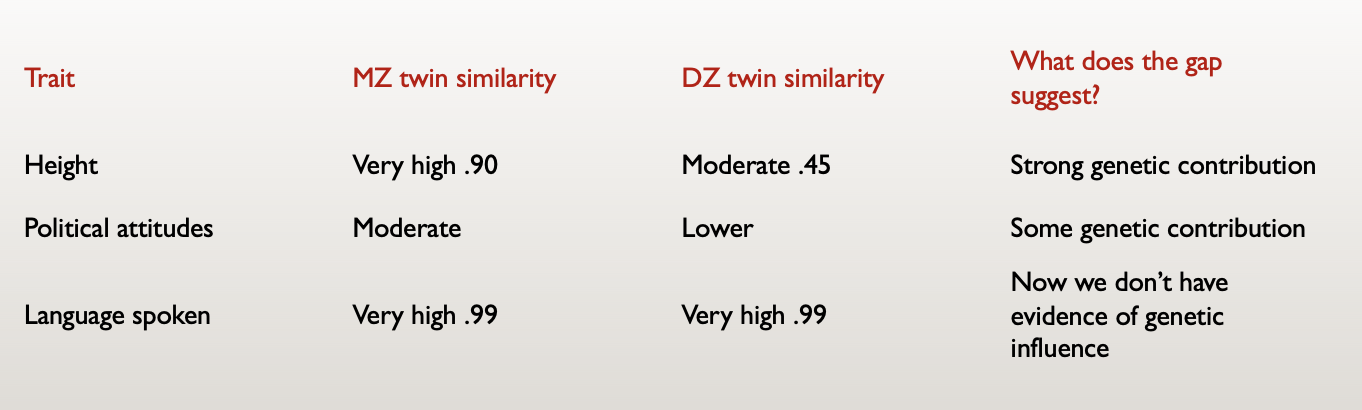
The logic: We are not interested in how similar identical twins are by themselves. We are interested in how much WHAT similar they are than fraternal twins
Twin studies
The logic: We are not interested in how similar identical twins are by themselves. We are interested in how much MORE similar they are than fraternal twins
If genes matter, identical (MZ) twins should be more WHAT than fraternal (DZ) twins. The bigger the WHAT in similarity, the WHAT the evidence that genetic differences contribute to variation in the trait.
If genes matter, identical (MZ) twins should be more SIMILAR than fraternal (DZ) twins. The bigger the DIFFERENCE in similarity, the STRONGER the evidence that genetic differences contribute to variation in the trait.
Twins reared apart
It showed that MZ twins raised apart are still substantially correlated on WHAT and WHAT
They were still very WHAT = similarity cannot be explained by WHAT together
Twins reared apart
It showed that MZ twins raised apart are still substantially correlated on IQ and PERSONALITY
They were still very SIMILAR = similarity cannot be explained by GROWING UP together