Bloodstream Infection and Infective Endocarditis
 Call Kai
 Learn
Learn Practice Test
 Spaced Repetition
 Match
Match Flashcards
 Knowt Play
1/39

There's no tags or description
Looks like no tags are added yet.
Name | Mastery | Learn | Test | Matching | Spaced | Call with Kai | Chat |
|---|
No analytics yet
Send a link to your students to track their progress
40 Terms
Bloodstream infection types/common organisms involved
Bacterial → Bacteremia
Staphylococci
Streptococci
Enterococci
Gram-negative bacilli: E. coli, Klebsiella spp.
Pseudomonas
Most likely organism(s) causing BSI can often be deduced based on patient’s risk factors, community-vs healthcare- acquired, site of primary infection
Fungal → Fungemia
Candidemia if Candida spp. involved
Viral → Viremia
BSI = Bloodstream infections
BSI typically involves only one organism
CRBSI or CLABSI = Catheter-related or Central line-associated BSI
BSI RIsk Factors
Sources of BSI
Primary sites of infection examples:
Pneumonia, SSTI, Intra-abdominal infections, UTI
Poor oral hygiene - transiently introduces bacteria to blood thru brushing of gums
IV drug use
IV catheters
Other risk factors include:
Immunocompromised, diabetes, indwelling prosthesis, recent surgery
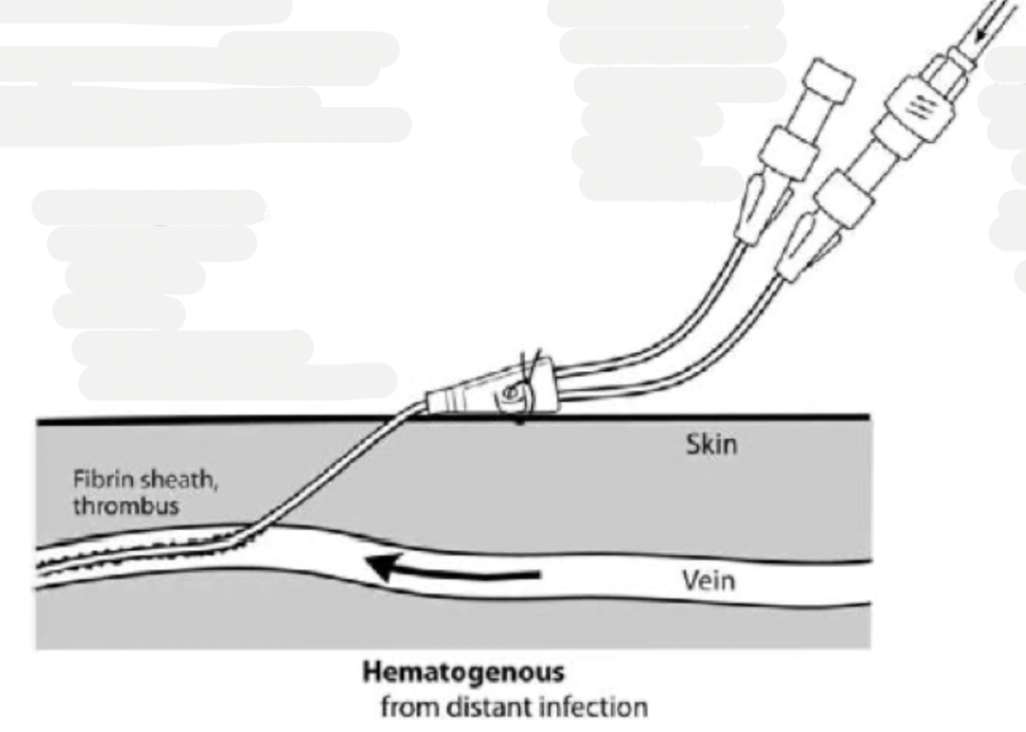
How the pathogen gains entry into bloodstream
Insertion site
Primary source for BSO with short-term catheters
Skin organisms - endogenous (skin flora) extrinsic (HCW hands, contaminated disinfectant)
Catheter hub/lumen:
Primary source for BSI with long-term
Contaminated catheter hub - catheters endogenous and extrinsic
Infusate/IV fluid:
Rare cause of BSI
Contaminated infusate - extrinsic (fluid, medication) Intrinsic (manufacturer)
Proper strategy for obtaining blood cultures for diagnosis of BSI
Draw 2 sets blood cultures BEFORE antibiotics started
1 set = 1 pair → 2 bottle
2 sets = 2 pairs → 4 bottles
Each “set” = 1 aerobic bottle + 1 anaerobic bottle
There should be 2 aerobic bottles and 2 anaerobic bottles
Each “set” should be drawn from difference sites
Central line + percutaneous/peripheral site
Identification methods
Gram stain
Culture
Rapid diagnostic tests
PCR
What should be done in order to minimize the likelihood of getting false-positive cultures that represent contamination rather than true BSI?
If a blood culture is positive, it is NOT always a real infection - sometimes it is just contamination
How do we tell?
How many bottles are positive?
1 out of 4 bottles are positive → likely contamination
Multiple bottle or sets positive → likely true infection
The more bottles that grow the same organism, the more believable it is
Which sets are positive?
If bacteria show up in different sets from different sites → real infection more likely
If only one set is positive → suspicious for contamination
Organisms
Staphylococcus epidermidis is often considered contamination especially if only 1 bottle
Staphylococcus aureus, or other microbes other than S. epidermis, almost always treated as a real infection, even if only one bottle is positive
Clinical setting: Patient s/sx, risk factors for BSI is also considered to determine if real infection:
Fever, low BP, signs of infection, risk factors (IV lines, immunosuppression)
Exam Question: Given a scenario, is this likely a contaminant or infection, and would you treat it with antibiotics?
Be sure to take a look at the number of bottles that are positive and the type of organism
S. epidermis that is 1 out 4 bottle positive = contaminant, do not treat
Everything else = infection, treat
Understand the purpose for using antibiotic lock therapy for catheter-related/central line associated bloodstream infection (CRBSI/CLABSI)
For patients where catheter salvage (keeping the line) is attempted, consider antibiotic lock therapy
Primarily for patients with long-term caths, dialysis caths
Must use in conjunction with systemic IV antibiotics
Refers to filling a catheter with a high-concentration antibiotic solution and letting it “lock”/soak inside the line to kill bacteria
A small amount of antibiotic solutions is injected into the catheter lumen, the solutions stays inside the catheter for several hours
This targets bacteria living in biofilms inside the line
CLABSI/CRBSI Management
Aside from initiating antimicrobial therapy, removal of IV catheter may be needed
Removal recommended if:
Short term cath with
G– bacilli, S. aureus, Enterococci, Fungi, Myobacteria
Long term cath with:
Severe sepsis
Endocarditis
Thrombophlebitis
Blood culture still + despite > 72 hours appropriate antimicrobial
S. aureus, Fungi, or Mycobacteria
Short term catheters
defined as < 10 days
Complicated infection
Remove catheter and treat with systemic antibiotic for 4-6 weeks; 6-8 weeks for osteomyelitis in adults
Uncomplicated infections
Coagulase-negative staphylococcus
If the organism is a coagulase negative staphylococcus
Remove catheter and treat with systemic antibiotic for 5-7 days
If catheter is retained, treat with systemic antibiotic + antibiotic lock therapy for 10-14 days
For all other organisms: S. aureus, Enterococcus, Gram-negative bacilli, Candida
Remove catheter and treat with systemic antibiotic (antifungal for candida spp.) for 7-14 days (treat for 14 days after the first negative blood culture for candida spp.; ≥ 14 days for S. aureus)
Long term catheters
defined as ≥ 10 days
Complicated infections
Remove CVC/P and treat with antibiotics for 7-10 days
Remove CVC/P and treat with antibiotics for 4-6 weeks; 6-8 weeks for osteomyelitis in adults
Uncomplicated infections
…
Tunneled hemodialysis catheters
Empiric antibiotics + antibiotic lock
MSSA Empiric/Definitive therapy options
No renal dysfunction adult dosing
Nafacillin 2 g IV q4h
Cefazolin 2 g IV q8h
MRSA Empiric/Definitive therapy options
No renal dysfunction adult dosing
Vancomycin
target trough 15-20 mg/L or AUC/MIC 400-600 mg*hr/L
Daptomycin 6 mg/kg IV q24h (some use 8-10 mg/kg per dose)
Enterococcus faecalis Empiric/Definitive therapy options
No renal dysfunction adult dosing
Vancomycin
Target trough 15-20 mg/L
Ampicillin 2 g IV q4h (preferred b/c very narrow)
E. coli, Klebsiella spp. Empiric/Definitive therapy options
No renal dysfunction adult dosing
Ceftriaxone 2 g IV q24h
If EBSL: Ertapenem 1 g IV q24h (critically ill: Meropenem 1 g q8h)
Ciprofloxacin 400 mg IV q12h or 500 mg PO q12h
Levofloxacin 500 mg PO/IV q24h
Definitive only and clinically stable: TMP/SXM PO 5 mg/kg/dose q8-12h
Pseudomonas Empiric/Definitive therapy options
No renal dysfunction adult dosing
Cefepime 2 g IV q8h
Ceftazidine 2 g IV q8h
Piperacillin/tazobactam
Ciprofloxacin 400 mg IV q8h or 750 mg PO q12h
Meropenem 1 g IV q8h
Intermittent infusion (30 mins): 4.5 g IV q6h
Extended infusion (4 h): 3.375 g - 4.5 g IV q8h
Empiric Therapy
If organism is unknown (or if organism known but no susceptibility available), determine the most appropriate EMPIRIC therapy based on suspected organism(s) in BSI
This is the best educated guess before culture results
Example:
If worried about MRSA → Start Vancomycin
If believed infection is from urine, educated guess is likely E. coli → start Ceftriaxone
Definitive therapy
If organism is known (with susceptibilities), determine the most appropriate DEFINITIVE therapy for this BSI
Once lab identifies organisms + susceptibilities, switch to definitive therapy
Example:
If the culture confirms MRSA → continue vancomycin
If you started ceftriaxone for E. coli BUT culture shows Pseudomonas aeruginosa, ceftriaxone does not cover this → must switch antibiotics to Cefepime, Zosyn, or Meropenem
Treatment approach to BSI
Initiate empiric antimicrobial ASAP
Make sure spectrum covers suspected organisms
Narrow therapy as needed once ID and susceptibility available → switch to definitive therapy
Dose at higher end of dose range - be aggressive
IV route and “cidal” (bacteriacidal) drugs preferred
Once patient stable, potentially consider switch to PO therapy of equivalent spectrum antimicrobial with high bioavailability
Ex: For gram negative bacteremia, can potentially change from IV ceftriaxone to PO Ciprofloxacin
Final treatment Duration:
7 to 14 days typically
HOWEVER, final duration depends on organism(s), other concurrent infections, infectious source(s), and complications
Determine an appropriate start date for the course of therapy

Day 1 of therapy refers to the first day the patient receives an antibiotic that actually works against the identified bacteria
b/c E. coli is already susceptible to the antibiotic (Zosyn) started initially, the appropriate start date was 02/28
Remember E. coli is a G – bacteria, so its duration of therapy should be 7 days

b/c pseudomonas is resistant to the initial therapy (Zosyn), which was started on 02/28, then the earlier date does NOT count as day 1
Day 1 is 03/03 when Cefepime was started b/c it covers Pseudomonas and its not resistant to the drug

For S. aureus, treatment duration starts AFTER blood cultures become negative b/c you must confirm the bloodstream infection is cleared
Day 1 therapy was 03/06 b/c the cultures came back clear/negative from S. aureus
Must continue therapy for total duration even after culture comes back negative
For the antimicrobial therapies recommended, list the side effects and monitoring parameters appropriate for each therapy
Monitor for resolution of symptoms (fever, WBC), effectiveness of antimicrobial therapy
Follow up on culture and micro susceptibilities
Screen for drug interaction and monitor for drug toxicities
Adjust antimicrobial doses PRN
Optimize pharmacodynamics (consider drug PK as well as organisms and MIC)
Monitor renal function; Keep in mind of need renal dosing adjustments, including those on dialysis
Ensure appropriate treatment duration
Distinguish between uncomplicated versus complicated Staphylococcus aureus bacteremia (i.e. what factors should be evaluated?)
o Given a patient case, determine the most appropriate duration of therapy for Staphylococcus aureus bacteremia
▪ Duration for uncomplicated Staphylococcus aureus bacteremia, and how to determine an appropriate start date for the course of therapy
▪ Generally recommended duration of antibiotic therapy for complicated Staphylococcus aureus bacteremia
S. aureus Bacteremia
Duration of therapy dependent on uncomplicated vs. complicated bacteremia
Uncomplicated if meets all of the following:
NO endocarditis
NO implanted prostheses
NO evidence of metastatic sites of infection
Follow-up blood cultures 2 - 4 days after initial positive cultures are negative
Afebrile within 72 hours of starting effective treatment
Treatment duration
Uncomplicated: 14 days
Complicated: 4 to 6 weeks, depending on extent of infection and complication(s) (source control)
Exam question:
Given a scenario, do you think this is a complicated or uncomplicated infection and what would be the duration of therapy?
Infective Endocarditis (IE) - What is it/Pathophysiology
Inflammation of endocardium
Most commonly involves the heart valve
But can involve ventricular septal defect, damaged endocardium, or intracardiac devices
Pathophysiology
Bacteria enters bloodstream and finds “refuge” and attaches to damaged areas of cardiac tissue or foreign material in heart
Fibrin and platelet recruitment → clot formation, growth → bacterial growth → more fibrin/platelet recruitment → etc
Complications
Valvular abscess
Valve prolapse, aortic insufficiency → HF
Septic emboli → stroke, PE
IE Risk Factors
Prior IE
Prosthetic heart valve
Congenital heart disease
Rheumatic heart disease
IV drug use
Presence of intravascular device
Others
> 60 y/o
Male
Poor dentition/dental infection
Uncontrolled DM
Recognize signs/symptoms of IE, including major/minor Modified Duke’s Criteria
Definite IE
Pathological
Culture positive, evidence embolized vegetation or intra-cardiac abscess
Clinical
Two major criteria
1 major criteria + 3 minor criteria
5 minor criteria
Possible IE
1 major criteria + 1 minor criteria or 3 minor criteria
Rejected/Rule-out
Does not meet above criteria and alternative diagnosis found
Major
Blood culture positive for typical organisms consistent with IE on 2 separate blood cultures
Single positive blood culture for Coxiella burnetii
Evidence endocardial involvement, + ECHO results
Minor
Predisposition, predisposing heart condition, IVDU
Fever (temp > 38*C or 100.4*F)
Vascular phenomena: arterial emboli, pulmonary infarcts, myotic aneurysm, intracranial hemorrhage, conjunctival hemorrhage, Janeway lesions
Immunologic phenomena:Osler nodes
Micro evidence: positive blood cultures for organism not typically associated with IE
Describe the advantages and disadvantages between transthoracic and transesophageal echocardiograms (TTE vs TEE)
Used for IE diagnosis (echocardiogram) - helps visualize heart
Transthoracic (TTE)
Echo over the thorax
Transesophageal (TEE)
this is more invasive, probes down the esophagus
But helps visualize heart better (preferred)
Need to put patient to sleep
Identify the most common bacterial (gram-positive organisms) causes of IE
Bacterial
Staphylococci (G+)
Streptococci (G+)
Enterococci (G+)
G– bacilli
HACEK - will not be on exam
Streptococcal Endocarditis Native Valve (NVE) Regimen
Note: PCN MIC is 0.12 mcg/mL or less
Pen G 2 to 3 mil units IV q4h x4w
OR
Ceftriaxone 2 g IV q24h x4w
“easier” to administer
This is a 4 week regimen, not two, because dealing with heart infection
Streptococcal Endocarditis Native Valve (NVE) Regimen
Note: PCN MIC is 0.12 mcg/mL or less
Pen G 2 to 3 mil units IV q4h x2w
OR
Ceftriaxone 2 g IV q24h x2w
PLUS
Gentamicin 3 mg/kg per 24 h IV or IM in 1 dose
This is a 2 week regimen (decrease from 4 weeks) because of the addition og gentamicin
Gentamicin Synergy
3 mg/kg q24h: ONLY target trough <1mg/L
1mg/kg q8h: target peak 3-5 mg/L, target trough <1mg/L
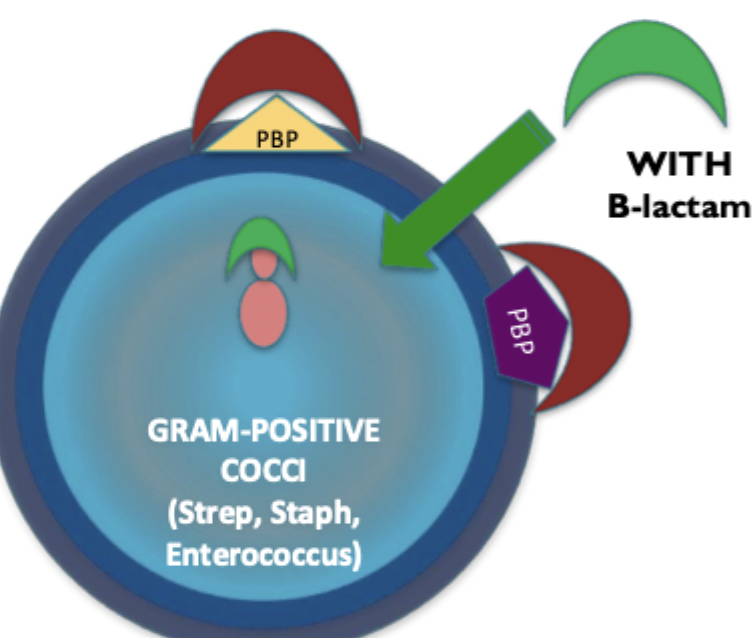
Synergy: Beta-lactam + Gentamicin
Without beta-lactam
gentamicin has trouble getting inside the bacteria
especially true for gram-positive cocci (thick cell wall)
so its effect is limited
With the beta-lactam
Beta-lactam damages the bacterial cell wall by binding to penicillin binding proteins, prevents peptidoglycan cross linkage
this creates holes/weak spots
Now gentamicin can enter the bacteria more easily, reach its target (30S ribosome), and shut down protein production
results in much stronger bacterial killing especially for endocarditis infections and gram-positive organisms
The downside
gentamicin is toxic:
Nephrotoxicity
Ototoxicity
So reserved for serious infection only
Easy analogy
Beta-lactam = breaks the wall
Gentamicin = goes inside and shuts down the factory
Streptococcal Endocarditis Native Valve (NVE) Regimen
Vancomycin 15 mg/kg IV q12h
In practice, usually 15-20 mg/L or AUC/MIC 400-600 mg*hr/L - for exam, will be tested on in practice/clinical parameters
Streptococcal Endocarditis Native Valve (NVE) Regimen
Note: PCN MIC > 12 mcg/mL to < 0.5 mch/mL
Pen G 4 mil units IV q4h x4w
PLUS
Gentamicin 3 mg/kg per 24 IV or IM in 1 dose x2w
Ceftriatone reasonable alternative for VGS isolates S to Cef
2g IV q24h
OR
Vancomycin 30 mg/kg per 24 h IV in 2 equally divided doses
Vanco is allergy to beta-lactam
target AUC 400-600
target trough 15-20
Streptococcal Endocarditis Prosthetic Valve Regimen
Pen G 4 mil units IV q4h x6w
OR
Ceftriaxone 2 g IV q24h x6w
With or Without
Gentamicin 30 mg/kg per 24 h IV or IM in one dose x2w
Streptococcal Endocarditis Prosthetic Valve Regimen
Pen G 4 mil units IV q4h x6w
OR
Ceftriaxone 2 g IV q24h x6w
PLUS
Gentamicin 3 mg/kg per 24 h IV or IM in one dose x6w
Staphylococcal Endocarditis Native Valve Regimen
MSSA
Nafcillin or Oxacillin 2 g IV q4h x6w
Cefazolin 2g IV q8h x6w
more commonly used
Staphylococcal Endocarditis Native Valve Regimen
MRSA
Vancomycin 15 mg/kf IV q12h x6w
In practice, this regimen is used: 15-20 mg/L or AUC/MIC 400-600 mg*hr/L
Daptomycin 8-10 mg/kg IV q24h x6w
use total BW
Staphylococcal Endocarditis Prosthetic Valve Regimen
MSSA
Nafcillin or Oxacillin 2 g IV q4h ≥6w
Cefazolin 2 g IV q8h alternative in pts w non-immediate-type hypersensitivity reactions to penicillins
PLUS
Rifampin 300 mg PO q8h ≥6w
PLUS
Gentamicin 1 mg/kg IV q8h x2w
use IBW
If we're doing divided doses, usually we're doing 1mg per kilogram every 8 hours, using ideal body weight, and so you need the peak and trough.
Gentamicin synergy:
target peak 3-5 mg/L
target trough <1 mg/L
Staphylococcal Endocarditis Prosthetic Valve Regimen
MRSA
Vancomycin 15 mg/kg IV q12h ≥6w
PLUS
Rifampin 300 mg PO q8h ≥6w
PLUS
Gentamicin 1 mg/kg IV q8h x2w - use IBW
Recall Vancomycin target trough or AUC/MIC and Gentamicin Synergy target peak and trough
Enterococcal Endocarditis - If susceptible to penicillin/ampicillin + gentamicin NVE or Prosthetic Valve
Recommended for patients with a CrCl > 50 mL/min
Ampicillin 2 g IV q4h x4-6w
OR
Pen G x4-6w
PLUS
Gentamicin 1 mg/kg IV q8h x4-6w - use IBW
Enterococcal Endocarditis - If susceptible to penicillin/ampicillin + gentamicin - NVE AND Prosthetic Valve
CrCl > 50 mL/min
Double beta-lactam ampicillin 2 g IV q4h x6w
PLUS
Ceftriaxone 2 g IV q12h x6w