Concept 8.1: An organism’s metabolism transforms matter and energy
 Call Kai
 Learn
Learn Practice Test
 Spaced Repetition
 Match
Match Flashcards
 Knowt Play
1/16

Name | Mastery | Learn | Test | Matching | Spaced | Call with Kai | Chat |
|---|
No analytics yet
Send a link to your students to track their progress
17 Terms
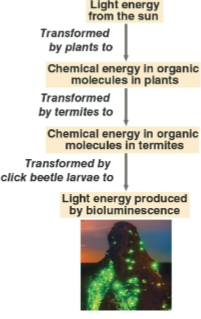
First Law of Thermodynamics
Law that states that energy can be transferred or transformed, but not created or destroyed
Demonstrated through energy use by living things
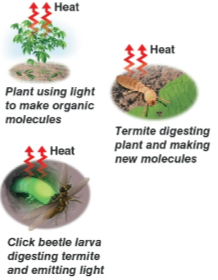
Second Law of Thermodynamics
Law that states that energy transfer or transformation increases universal entropy
Demonstrated through the conversion of energy to heat by living things through inefficienies in conversion
Metabolism
The totality of an organism’s chemical reactions
Arises from orderly interactions between molecules
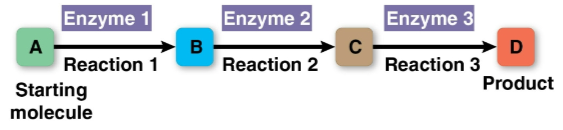
Metabolic pathway
Pathway where a specific molecule is altered in a series of steps to produce a product, catalyzed by enzymes
Enzyme
A macromolecule that speeds up a specific reaction
Catabolic pathway
Metabolic pathway that releases energy by breaking down complex molecules into simpler compounds
Seen through cellular respiration breaking down glucose with O2
Allows for energy use by anabolic pathways
Described as “downhill”
Anabolic pathway
Metabolic pathway that consumes energy by building up complex molecules from simpler ones
Seen through the synthesis of protein from amino acids
Uses energy from catabolic pathways
Described as “uphill”
Energy
The capacity to cause change or do work, existing in various forms
Living cells must transform energy from one form to another to do the work of life
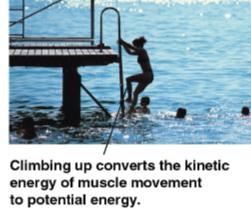
Kinetic energy
Energy associated with motion
Moving objects impart motion to other matter
Thermal energy
The kinetic energy associated with random movement of atoms or molecules
One object to another is called heat
Light is another type, done through photosynthesis
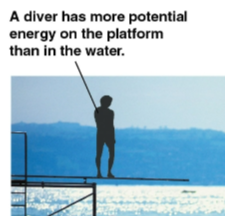
Potential energy
Energy that matter possesses because of its location or structure
Possessed due to the arrangement of electrons in bonds between atoms
Chemical energy
Potential energy available for releaes in a chemical reaction
Glucose has more of this as it is released during catabolism
Thermodynamics
The study of energy transformations in a collection of matter
Isolated system
A system that is unable to exchange energy or matter with its surroundings, as in a vacuum-sealed drink bottle
Open system
A system that is able to transfer energy and matter between the system and its surroundings, as in organisms that absorb energy and release heat and waste
Spontaneous processes
Processes that increase the entropy of the universe without energy input, happening at varying rates
Balances out anabolic reactions that build up molecules through the breakdown of molecules in catabolic reactions for heat and small molecules
Nonspontaneous processes
Processes that decrease entropy and require an input of energy
Seen through anabolic reactions amongst amino acids to proteins
Balanced by the catabolic breakdown of organized form of matter