hass econ
 Call Kai
 Learn
Learn Practice Test
 Spaced Repetition
 Match
Match Flashcards
 Knowt Play
1/28

Earn XP
Description and Tags
Name | Mastery | Learn | Test | Matching | Spaced | Call with Kai | Chat |
|---|
No analytics yet
Send a link to your students to track their progress
29 Terms
explain who adam smith is and his influence on economic thinking
Adam Smith was a 18th century Scottish philosopher and economist who had important ideas about economics and created a book called "The Wealth of Nations". His influence on economics was done through his ideas of free market, production methods, division of labour, and the GDP (gross domestic product)
difference between a free market and protected market
A free market is where buyers and sellers trade freely without much government control. A protected market is where the government adds rules or barriers to help local businesses and limit outside competition. The key difference is free markets have little government intervention, while protected markets have many restrictions and guidelines
Describe the key idea from Wealth of Nations
Division of labour - the idea that splitting up work into specialised tasks increases productivity as workers become skilled in specific roles rather than doing everything themselves
Specialisation - focusing on one task or product to gain expertise on that specific subject.
define economics
economics is the study of how to use limited resources efficiently and wisely in ways that make individuals and society better off materially so that living standards increase.
Define the basic economic problem
we have unlimited needs and wants but limited resources to satisfy those needs and wants
relative scarcity
The concept of relative scarcity is based on the relationship between wants and resources. Human wants are unlimited and cannot be fully satisfied because the resources are limited, so resources are scarce relative to the demand for goods and services.
choice
the decision of choosing between alternatives as resources are scarce and all wants cannot be satisfied
opportunity cost
Opportunity cost is defined as the next best alternative foregone, and represents the true economic cost of a choice
4 factors of production with examples
Land/Natural - refers to the land. everything is grown on it, underneath it, etc., and it includes natural resources. I.e. gold, coal, oil, and cultivated products such as rice and wheat
Labour - The effort and skills of people who work to produce goods and services – the human factor, and includes physical and mental labour. i.e. engineers, construction workers, etc.
capital - capital goods or man-made resources used in the production of a good or service and includes human and physical capital. Essentially what makes labour more productive. i.e. machinery in a factory, trucks, tools used by a carpenter, etc.
enterprise - when entrepreneurs organise of all factors of production to produce a good or a service. They take the risk and the profit. i.e. a restaurant owner, Jeff Bezos, Elon musk, any entrepreneur.
4 basic economic questions
What to produce?
How to produce it?
How much to produce?
For whom to produce it?
2-sector circular flow of income model
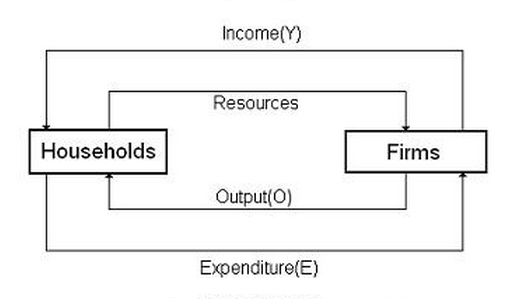
what are the 2 flows? describe them
real flow which is the flow of goods and services (resources and output), and money flow which is the flow of income and expenses/expenditure
5 sector model
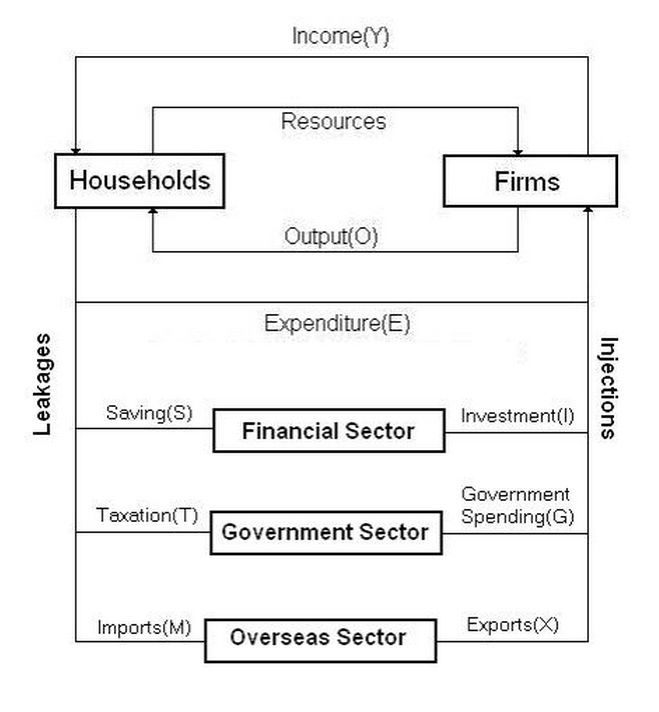
equilibrium
Equilibrium in the circular flow of income is when the income received by households from firms is the same as the expenditure from households to firms, and that is equal to the output from firms to households.
In the 2 sector model it is Y=O=3
In the 5 sector model it is S+T+N=I+G+X
Give real-life examples of participation in the circular flow of income
A guy works at Subway:
He gives Subway human labour - resources
In turn, subway makes food for households
Subway pays him (his salary) for working - income
Households pay subway for their food - expenditure
He saves money in his bank (saving), and the bank then invests that money into firms (investment)
He has to pay taxes (t) to the government who spend the money on social security and welfare (g)
He buys a lamp from America (M) and the country then exports beef to America (X)
explain the law of demand
As the price of product falls, the quantity demanded of the product will usually increase, ceteris paribus.
explain the law of supply
As the price of a product falls, the quantity supplied of the product will usually decrease, ceteris paribus.
the difference between the effect of income on normal goods and inferior goods
Normal goods - as income rises, the demand will also rise. i.e. as income rises, someone may prefer getting good quality takeout noodles rather than instant noodles, increasing demand for the takeout
inferior goods - as income rises, the demand will fall as consumers will start to purchase higher priced, higher quality good (normal goods), in its place
describe how the change in price of substitutes and complements affects the price of a good or service
Substitute goods
Products that can replace each other in consumption because they satisfy similar needs or wants (i.e. beef and chicken, Pepsi and coke)
When the price of a substitute rises, the original good becomes relatively cheaper so consumers switch and purchase the original good
Demand for original good also increases as people want to avoid the higher cost of the substitute
Complement goods
Complementary goods are goods that are used together because the consumption of one enhances the use or value of the other (i.e. cars and petrol, printers and ink, etc.)
When the price of a complementary good rises, the cost of consuming both goods together becomes more expensive
Therefore the demand for the related good decreases as the cost is higher for one good, reducing the consumed quantity for both and vice versa.
non price factors that effect demand
Change in price/demand of related Goods
Change in price/demand of substitutes, complements
Change in consumers’ money Income
Normal and inferior goods - demand for the inferior good goes down as people now have the money/resources to buy higher quality goods
Change in tastes and preferences
Consumer tastes can change and are influenced by marketing campaigns (i.e. fidget spinners in 2017), trends, cultural shifts
Change in seasonal factors
Demand changes during different seasons due to the circumstances
i.e. demand for winter coats go up in winter and demand for swimsuits go up in summer
Change in demographics (size and/or composition of population)
Increase in population increases the demand for most goods
Change in composition (age distribution) shifts demands for specific goods (i.e. an aging population could increase the demand for healthcare and retirement services)
Change in income distribution
Change in how income is spread across the population
If the income distribution becomes more unequal (small percentage of the population earning a much larger share of the wealth), there would be a rise in demand for luxury goods for the wealthy class
If the income distribution becomes more equal (growing middle class), there would be a stronger demand in normal goods like homes, cars, and consumer electronics
Change in government policy
Can influence consumer demand in 3 main ways:
Taxes - an increase in taxes on a specific good makes it more expensive for consumers to buy, which can decrease demand
Subsidies - A subsidy makes a good cheaper to produce, which can lower its market price and increase demand
Regulations: New regulations or laws can also affect demand. For instance, a government-mandated safety feature for cars might increase their price and decrease demand
Change in expectations of future price changes
If consumers expect the price of a good to increase in the near future, they'll likely increase their current demand to buy it before the price goes up
Conversely, if they expect the price to decrease, the current demand would decrease as the consumers are waiting for the price to drop
non-price factors that affect supply
Change in price of factor inputs (factors of production)
If the cost of labour increases, the supply decreases as there is a higher production cost and vice versa
Change in price of related goods
i.e. If the price in cotton rises, farmers might grow more of cotton rather than a cheaper crop
Change in state of technology
Advancements in technology can cause the product to be more efficient and cheaper overall to supply, which would increase the supply
Change in weather conditions
This factor is especially relevant to agriculture. Favourable weather conditions, such as sufficient rainfall and sunlight, can lead to a better harvest and increase the supply of crops. In turn, bad weather like droughts, floods, or extreme cold can damage crops and decrease supply.
Change in government policy
Regulations: a change in regulation can either increase or decrease the supply depending on the regulation
Subsidy - lowers production cost and increases supply
Taxes - an increase in taxes increases production cost and therefore decreases supply
Trade restrictions - trade restrictions such as tariffs and quotas can decrease supply
Change in expectations of producers (expected future prices)
If producers expect the price of their good to increase, they might hold back and sell it at a later time, decreasing the current supply
If they expect prices to fall, they might try and sell their goods now which would increase current supply.
define a market and its key participants
A market is any place or system where buyers and sellers interact to exchange goods, services, or resources. It doesn't have to be a physical location; it can be a digital marketplace online or even just a network of people.
The two key participants are:
Buyers: the individuals, households, or firms that want to acquire goods or services. Their role is to create demand.
Sellers: the firms or individuals that offer goods or services for sale. Their role is to create supply.
outline the different types of markets
retail - The market where businesses sell goods or services directly to individual customers for their personal use, rather than for resale or business purposes.
clothing - Also known as the apparel market, or fashion industry, where they produce and sell clothing
food/hospitality - The food industry encompasses all businesses producing, processing, packaging, distributing and serving food and drinks, e.g. restaurants, bars, cafes, catering services.
online - An electronic marketplace where multiple sellers offer their products or services to a wide range of buyers. It is the online equivalent of a physical marketplace, but with a wider reach - it includes overseas customers
tourism - Tourism market encompasses the collective buying and selling of tourism related products and services. It includes all businesses and individuals in serving tourists
characteristics and examples for the retail market
characteristics:
The goods or services offered by the retailer are exchanged
key actors are retailers, suppliers, customers
Demand can come from consumer needs, preferences, and purchasing power, influenced by factors like population growth, income levels, and overall economic conditions
Supply comes from manufacturers who produce goods and then distribute them through various channels
There can be a combination between physical and non-physical (online) retail markets
examples:
amazon
target
kmart
myer
alibaba
characteristics and examples for the clothing market
characteristics:
Production and value chain of clothing and garments, embellishment using embroidery are exchanged
Key actors include major brands, retailers (shops), manufactures and consumers
The demand comes from consumer preferences, fashion trends, social media influence and economic conditions
The supply of clothing comes from the manufacturing process - sourcing materials, production and distribution
both physical and online
examples:
nike
adidas
shein
valleygirl
uniqlo
characteristics and examples for the food/hospitality market
characteristics:
The food market exchanges food and beverages in exchange for money.
Key actors in the market are farmers, waiters, chefs, consumers.
The 4 main factors that change global demand for food are population, macroeconomics, prices and "soft drivers".
Food supply is diverse in the locations that food is sourced (global, national, regional and local sources), in the way crops are grown, the enterprises we source food from (community, social, commercial), and the scale of enterprises we source food from (small, medium and large scale).
The food market can exist as both physical and non-physical
examples:
Nestle
Coca-Cola
Domino's
Woolworths
Subway
characteristics and examples for the online market
characteristics:
In online markets, both tangible goods (electronics, clothing, and books) and intangible resources (services, information, experiences) are exchanged.
Key actors include consumers, sellers/merchants, and the platforms(websites/apps/marketplaces)
The demand comes from the customers, and can be influenced by social media, price, availability, shipping (distance)
The supply comes from manufacturers, wholesalers, drop-shippers, and various companies
non - physical — exists on the web
examples:
amazon
ebay
etsy
temu
characteristics and examples for the tourism market
characteristics:
In the tourism market, experiences and services(accommodations, transportation, activities, and other travel-related goods and services are mainly exchanged for money
key actors in the tourism market include consumers, tourism businesses, government agencies, local communities, and educational institutions
Demand comes from a variety of factors including the income and spending habits of potential tourists, their motivations for travel, the prices of destinations and related products, and the economic condition
supply comes from the various businesses and resources that cater to the tourists
The tourism market exists physically, but can also exist digitally through websites
examples:
Virgin Australia
Airbnb
Tripadvisor
Viator
Expedia
describe the role of markets in allocating scarce resources
Markets allocate resources efficiently through prices that signal scarcity and value.
Higher prices ration goods to those willing to pay, preventing waste
Producers increase supply when the price rises and decrease supply when the price falls
Competition drives markets to produce better and cheaper products
Markets quickly adjust to changes without central control, as the collective decision of buyers and sellers guide resources to their most valued use