Prokaryotic and Eukaryotic Cell Structures and Functions
 Call Kai
 Learn
Learn Practice Test
 Spaced Repetition
 Match
Match Flashcards
 Knowt Play
1/29

There's no tags or description
Looks like no tags are added yet.
Name | Mastery | Learn | Test | Matching | Spaced | Call with Kai | Chat |
|---|
No analytics yet
Send a link to your students to track their progress
30 Terms
Prokaryote
Cell that does not have a nucleus or membrane-bound organelles. DNA is located in the nucleoid.

Nucleoid
Region in a prokaryotic cell where the DNA is located; it is not surrounded by a membrane.

Eukaryote
Cell that has a nucleus and membrane-bound organelles. Plants, animals, fungi, and protists are eukaryotes.

Cell membrane
Selectively permeable phospholipid bilayer that controls what enters and leaves the cell and helps with cell communication.

Mitochondria
Site of cellular respiration; produces most of the cell's ATP from energy stored in organic molecules.

Chloroplast
Organelle in plants and algae that performs photosynthesis, converting light energy into chemical energy stored in sugars.

Lysosomes
Membrane-bound organelles containing digestive enzymes that break down macromolecules, damaged cell parts, and waste.

Peroxisomes
Organelles containing enzymes that break down fatty acids and detoxify harmful substances, including hydrogen peroxide.

Cytosol
Fluid portion inside the cell where organelles are suspended and many metabolic reactions occur.
Flagellum
Long, whip-like structure that helps a cell move.

Centrosome
Region that organizes microtubules and helps form the spindle during cell division in animal cells.

Cytoskeleton
Network of protein fibers that provides shape, support, movement, and intracellular transport.

Microfilaments
Thin cytoskeleton fibers made mainly of actin; involved in cell shape, movement, and muscle contraction.

Microtubules
Hollow cytoskeleton fibers made of tubulin; maintain cell shape, move organelles, form spindle fibers, and help form cilia and flagella.

Microvilli
Small folds/projections of the cell membrane that increase surface area for absorption.

Nucleus
Membrane-bound organelle containing the cell's DNA; controls gene expression and many cell activities.

Nuclear envelope
Double membrane surrounding the nucleus; contains pores that regulate movement between the nucleus and cytoplasm.

Nucleolus
Region inside the nucleus where rRNA is produced and ribosomal subunits are assembled.

Chromatin
DNA associated with proteins; packages and organizes the cell's genetic information.

Endoplasmic Reticulum (ER)
Membrane network involved in the production and transport of proteins and lipids.

Rough ER
ER covered with ribosomes; synthesizes and modifies proteins that will be secreted, placed in membranes, or sent to organelles.

Smooth ER
ER without ribosomes; involved in lipid synthesis, detoxification, and calcium storage.

Ribosomes
Structures made of rRNA and proteins that carry out protein synthesis (translation).

Cell wall
Rigid outer layer that provides support, protection, and shape. Plant cell walls are primarily made of cellulose.

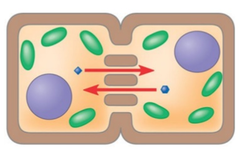
Plasmodesmata
Channels connecting neighboring plant cells, allowing substances and signals to pass directly between them.
Central vacuole
Large organelle in plant cells that stores water and other substances and maintains turgor pressure for structural support.

Golgi apparatus
Modifies, sorts, and packages proteins and lipids into vesicles for transport.

Vesicles
Small membrane-bound sacs used to transport or store substances within or outside the cell.

Glycoproteins
Proteins with attached carbohydrate groups that help with cell recognition, communication, and adhesion.
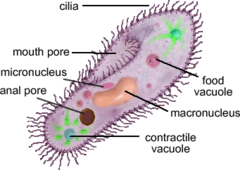
Food vacuoles
Membrane-bound sacs that contain food particles and help with intracellular digestion.