(Not Finished) TUT3 R11 Doing the Work
 Call Kai
 Learn
Learn Practice Test
 Spaced Repetition
 Match
Match Flashcards
 Knowt Play
1/24

Earn XP
Description and Tags
Zachary, L. J. (2009). Chapter 5: Doing the work. The mentee’s guide: Making mentoring work for you (pg. 79-97). San Francisco, CA: Jossey-Bass.
Name | Mastery | Learn | Test | Matching | Spaced | Call with Kai |
|---|
No analytics yet
Send a link to your students to track their progress
25 Terms
Enabling
Early mentoring involves uncertainty about compatibility, expectations, and whether both mentor and mentee can meet each other’s needs.
This phase is where the relationship is tested and shaped through action, not just intention.
Balancing Relationship and Learning
Effective mentoring requires balancing interpersonal connection (between the mentor and mentee) with purposeful learning and goal achievement.
Without focus on concrete developmental goals and effective use of time, mentoring risks becoming purely social and ineffective.
Time
Lack of time is one of the most common reasons mentoring relationships fail.
Competing work, personal, and life demands make it difficult to schedule and protect mentoring time.
Perceived vs Actual Lack of Time
Mentoring problems are often blamed on time scarcity, but the issue may be poor time use rather than a true lack of time.
Rescheduling and unfocused meetings reduce the quality of mentoring more than limited availability itself.
Shared Responsibility for Time Management
Both mentor and mentee must commit to honoring mentoring time, using it intentionally, and monitoring how effectively it is used.
Successful mentoring requires discipline, not just good intentions.
Importance of Early Agreements
Time expectations should be discussed before the mentoring relationship begins, including how often meetings will occur and how time will be spent.
These agreements help prevent time-related breakdowns later.
Mentoring While Busy
Once the relationship is underway, mentoring can lose priority amid daily pressures.
Mentees must actively manage and protect mentoring time to ensure the relationship remains productive.
Dealing with Time Concerns
To deal with time challenges, mentees must actively monitor and manage how mentoring time is used
Mentoring Time Pie
A tool to help mentees visualize how they spend their time
Draw a circle
Divide the slices based on how that time is actually spent
Shadowing
Reflecting on practice
Day-to-day problem solving
Receiving or giving feedback
Catching up / social conversation
Mentoring Time Pie Purpose
Helps you visualize where mentoring time goes
Encourages self-awareness and accountability
Makes time use concrete rather than vague
Mentoring Time Pie Sharing
Mentee shares the time pie with the mentor.
The mentor gives feedback on whether the breakdown matches their perception.
This opens up honest discussion and alignment.
Mentoring Time Pie
After sharing, mentor and mentee discuss:
“What do we need to do more of?”
(e.g., feedback, goal-focused work, skill development)
“What do we need to do less of?”
(e.g., unfocused socializing, repetitive problem-solving)
Other Strategies for Spending Mentoring Time Well
Make mentoring “prime time”
Come prepared
Stop when time is being wasted
Make mentoring prime time
Give mentoring your full attention
Be fully present and respectful of your mentor’s time
Eliminate distractions (phone, email, multitasking)
Treat mentoring time as high-value, focused work
Come prepared
Preparation helps you use less time more effectively
Have a clear purpose or agenda for each meeting
Track learning through notes or a journal
Follow through on agreed-upon actions
Preparation allows mentoring to stay goal-oriented rather than casual
Stop when time is being wasted
Recognize when mentoring is becoming unproductive
Call a time-out if:
Life or work demands temporarily overwhelm you
Meetings lack focus
You need time to reflect and process learning
Pausing intentionally is better than continuing inefficiently
Monitoring Mentor Meetings
Helps ensure that mentoring time
Is used effectively
Stays aligned with agreed-upon goals
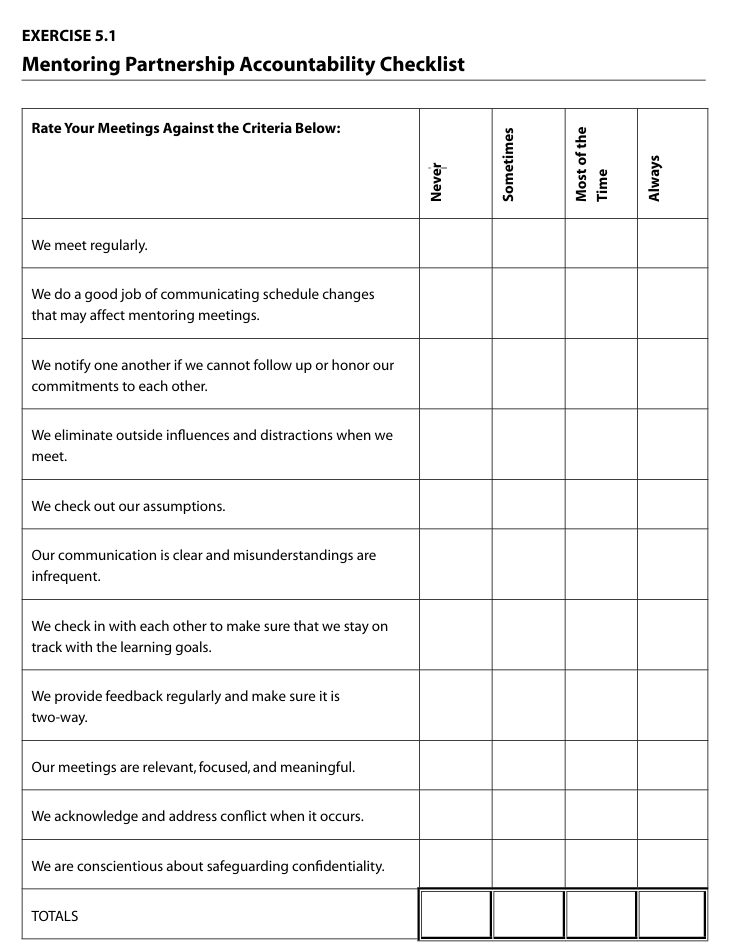
Mentoring Partnership Accountability Checklist
The accountability tool provides a neutral and structured way to raise concerns about time use
Supports open communication, keeps the relationship on track, and helps both partners reflect on and improve how mentoring time is spent
Keeping the Focus on Learning
Search for learning opportunities
Journaling
Learning as the core focus
Learning is the central purpose of the mentoring relationship, and it must remain the top priority.
While mentors provide guidance, the mentee is responsible for keeping learning goals front and center.
Searching for Learning Opportunities
The mentee must actively seek learning opportunities, help the mentor provide the right balance of challenge and support, and track progress toward SMART goals in collaboration with the mentor.
Learning Styles as a Starting Point
Understanding one’s learning style (diverging, assimilating, converging, accommodating) is helpful, but relying on it too much can limit growth.
Mentoring should be used to move beyond habitual ways of learning.
Avoiding Learning Stagnation
Repeating the same learning approaches can lead to boredom and limited development.
Mentoring offers a chance to try new methods and prevent the “same old same old” learning pattern.
Expanding Learning Opportunities
Tools like structured exercises can help identify new learning opportunities as the mentor–mentee relationship deepens.
Creativity and openness become easier as mutual understanding grows.
Cascade Approach
Brainstorming freely and using imaginative prompts helps expand learning possibilities.
This approach encourages thinking outside the box and broadening learning horizons.