Rad 130 - structure of matter Part 1
 Call Kai
 Learn
Learn Practice Test
 Spaced Repetition
 Match
Match Flashcards
 Knowt Play
1/56

There's no tags or description
Looks like no tags are added yet.
Name | Mastery | Learn | Test | Matching | Spaced | Call with Kai | Chat |
|---|
No analytics yet
Send a link to your students to track their progress
57 Terms
indivisible (a = without, tom= to cut)
Atom means:
The smallest components of matter.
Smallest particle that has all the properties of an element.
Describe an atom:
protons, neutrons, and electrons.
Atoms are made of:
a material that consists of a single type of atom, that have the same number of protons and same chemical properties
What is an element?
118
How many elements are there?
the number of protons
What determines the type of element and atom forms?
the greeks
Who was the first to start having awareness about atoms?
Earth, Air, Water, Fire
Cold, Hot, Dry, Wet
The greek atom was defined as which 4 substances and which 4 properties?
He classified elements by atomic mass
He identified some atoms react chemically the same
He hypothesized the hook and eye format
John Dalton, an English teacher, in 1808, made what contributions to the research of atoms?
created the 1st periodic table
showed atoms can be arranged in order with increasing atomic mass
sorted elements in to 8 groups with similar properties
What contributions did Mendeleev make to the research of atoms?
alkali metals (except hydrogen)
Group 1 =
soft metals
highly reactive
combine easily with O2 and H2O
Describe the alkali metals:
halogens
Group VII (7) =
gasses
combine easily with anything
Describe the halogens
Noble Gases
Group VIII (8) =
inert/highly resistant (don't combine easily)
Describe the noble gases:
Thomson in late 1890's
Who discovered that electons were part of the atom?
plum pudding model
Thomson's atomic model was called:
Rutherford - 1911
Who introduced the nuclear model of the atom?
small dense positive center (nucleus), surrounded by negative cloud of electrons
Describe Rutherford's nuclear model:
Neil Bohr - 1913
Who discovered the "miniature solar system" atom?
miniature solar system
electrons revolve around the nucleus in predetermined energy levels
Describe the Bohr Atom
small dense positive nucleus
negative charged electron cloud revolving around the nucleus in fixed orbits
Describe the atom as we know it today:
p+ and e- are equal
What is a neutral atom?
Electron, neutron, proton
What are the 3 fundamental particles of the atom?
a particle in the nucleus, protons and neutrons
What is a nucleon?
electron = -
neutron = 0
proton = +
What is each particle's charge?
over 100
How many subatomic particles have been discovered?
how an atom will react
Electrons arranged around a nucleus determine what?
3 miles
If a nucleus was the size of a baseball, electrons would be how far away?
empty space
Most of an atom is:
alphabetic abbreviation for an element
What is a chemical symbol?
# and arrangement of electrons
Chemical properties of an atom are determined by
the number of protons, determines the element
The atomic number indicates what?
the number of nucleons (protons and neutrons)
The atomic mass indicates what?
atomic mass (number of nucleons)
The A# is:
atomic number (number of protons)
the Z# is
the atomic number
Z#
number of protons
What is this?
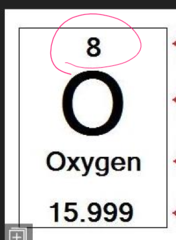
chemical symbol
What is this?
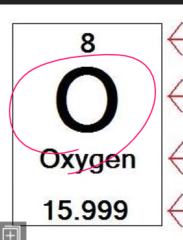
element name
What is this?

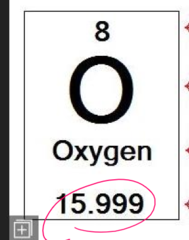
atomic mass
A#
number of nucleons
What is this?
A# - Z# = neutrons
How can you determine the number of neutrons?
A# - atomic mass - nucleons
Which number is superscript of chemical symbol?
Z# - atomic number - protons
What number is subscript of chemical symbol?
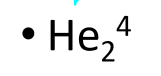
2 protons
4 nucleons
How many protons and nucleons does this element have?
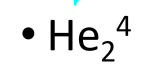
A= 4
Z= 2
identify the A# and Z#
nucleus
Where are protons located?
- +1 charge
- located in nucleus
- different number in each element
- determines the element
- determines atomic number (Z#)
What are the properties of a proton?
- no charge
- located in the nucleus
- determines atomic mass together with protons (A#)
What are the properties of a neutron?
- -1 charge
- located surrounding nucleus, in orbital shells
- not included in atomic mass (A#) or atomic number (Z#)
-can be easily ionized because they are much smaller than protons
What are the properties of an electon?
more energy and the nucleus (+ charge) has less influence on them.
finish this sentence:
Electrons further from the nucleus possess_____
K, L, M, N... etc
Electron shells are called ___
K
Which electron shell is closes to the nucleus?
quarks
Nucleons are composed of ____
gluons
Quarks are held together by
it becomes a different element
If the atomic number is changed, how does that affect the element?
yes
If the atomic number changes, does the atomic mass number change?