Intermolecular forces, Intermolecular Forces
 Call Kai
 Learn
Learn Practice Test
 Spaced Repetition
 Match
Match Flashcards
 Knowt Play
1/30

There's no tags or description
Looks like no tags are added yet.
Name | Mastery | Learn | Test | Matching | Spaced | Call with Kai | Chat |
|---|
No analytics yet
Send a link to your students to track their progress
31 Terms
polar molecule
molecule that has an overall dipole moment
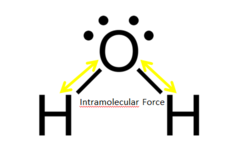
Intramolecular forces
forces that hold the atoms together in a molecule
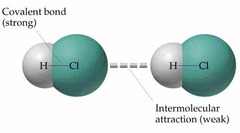
Intermolecular forces
interactions between molecules (much weaker)
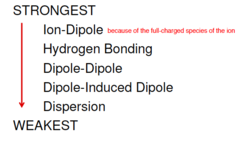
intermolecular force strength
measures by: boiling and melting point- the higher, the stronger the forces
Types of Van der Waals forces:
Dipole-dipole
Ion-dipole
Dipole-induced Dipole
Dispersion
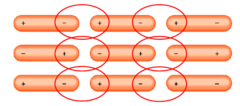
Dipole-dipole forces
forces between polar molecules (partially charged)- opposite poles match up by electrostatic attraction
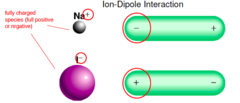
Ion-dipole forces
forces between a fully charged species (ion) and a dipole by electrostatic attraction.
Increase in strength with increase in charge or decrease in size of ion
(how ions are dissolved in water- attract to the H2O and pulled away by electrostatic charge)
Dipole-induced-dipole forces
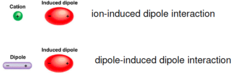
forces arising from temporary dipoles induced in atoms by ions with a permanent dipole (either ion or dipole).
Temporary dipoles created when non-polar molecule interacts with polar- temporarily shifts the electrostatic charge to attract the polar molecule, then returns when removed
Dispersion forces
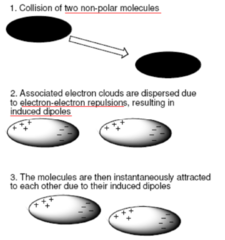
Weak force- Occurs between all non-polar molecules due to their electron density.
- Collision of 2 non-polar molecules causes their electrostatic regions to shift temporarily (creating induced dipoles) and the molecules are instantaneously attracted
- Increase with molar mass
Polarizability
Ease with which the electron distribution in a molecule can be distorted
Increases with:
- greater number of electrons
- more diffuse electron cloud
Hydrogen bonds
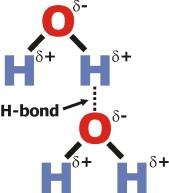
A special dipole-dipole interaction between a Hydrogen atom and either N, O, or F atom (smallest and most electronegative on PT)
- the lone pair on either N, O, F (in a molecule) is what causes the bond- strongest interaction with H
- reason why solid form of water floats on liquid form- H bonds- once frozen becomes less dense than liquid
surface tension
Surface tension is the amount of energy required to stretch the surface area of a liquid by unit area
- strong intermolecular force = strong surface tension
viscosity
Measure of fluids resistance to flow
- strong intermolecular force = high viscosity

solubility
- Polar compounds dissolve other polar compounds
- Non-polar compounds dissolve non-polar
- Polar compounds insoluble in non-polar
Intermolecular Force
Force between molecules
Intramolecular Force
Force within a molecule
Covalent Bond
Force of attraction within a molecule created by the sharing of electrons
Ionic Bond
Force of attraction created by the transfer of electrons between atoms
Polar Molecule
Molecule in which the covalent bonds are asymmetrically arranged
Nonpolar Molecule
Molecule in which the covalent bonds are symmetrically arranged
London Dispersion Force
Intermolecular force between nonpolar molecules
Dipole-Dipole Force
Intermolecular force between polar molecules
Hydrogen Bond
Intermolecular force between molecules containing hydrogen bonded to N, O, or F
Surface Tension
The force exerted along the surface of a fluid that causes it to "bead up" and form into drops
Vapor Pressure
Pressure exerted on the surface of a liquid by the vapor
Direct relationship
Relationship between strength of intermolecular force and boiling point
Inverse relationship
Relationship between the strength of the intermolecular force and the vapor pressure
Boiling point
Temperature at which the vapor pressure is equal to the atmospheric pressure

Water
Substance exhibiting hydrogen bonding
hydrocarbons
Substance exhibiting London dispersion forces
Carbon monoxide
Substance exhibiting dipole-dipole forces