Set Texts (jus need to add spec)
 Call Kai
 Learn
Learn Practice Test
 Spaced Repetition
 Match
Match Flashcards
 Knowt Play
1/48

There's no tags or description
Looks like no tags are added yet.
Name | Mastery | Learn | Test | Matching | Spaced | Call with Kai |
|---|
No analytics yet
Send a link to your students to track their progress
49 Terms
What two newspapers are the set texts?
The Mirror (‘ZERO SHAME’)
The Times (‘release of gray report’)
What topic do both newspapers focus on?
Partygate - when the gray report revealed that the Conservative Party had been having secret parties during lockdown despite telling the country not to do so.
The key individual criticised was Boris Johnson.
Both articles came out on the same day - Feb 1 2022
What should you talk about in the exam regarding these articles?
Representation.
And how this links to their political stance.
THE MIRROR: what are the features of the mirror newspaper?
Tabloid
Labour (left-wing)
Aimed towards the working-class, less educated audience
Softer news
Lots of images
Costs 90p.
SET TEXT: Picture of Mirror article front cover
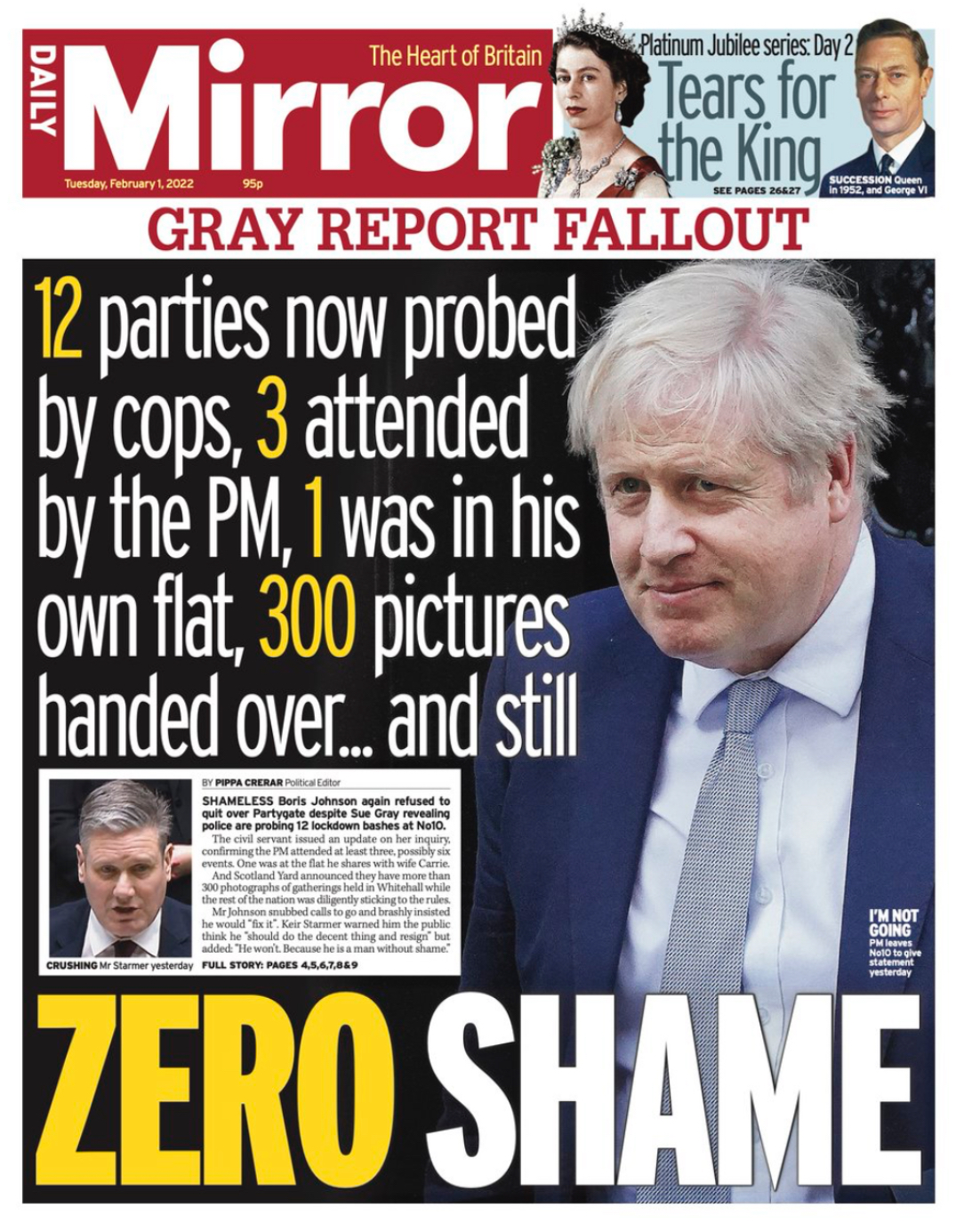
How does the masthead appeal to an audience?
Signature red top logo - iconography.
This clearly signifies to the reader that they’re reading the mirror, aswell as the colour red representing their left-wing political stance.
David Hesmondhagh ‘minimum risk, maximum profit’ fits well here.
What does the strapline show?
“The heart of Britain” - makes it feel like the newspaper is central to our lives and important to the country.
What’s the only use of serif font on the cover?
In the subheading ‘GRAY REPORT FALLOUT’.
The serif font signifies the most serious detail of the newspaper.
What is the significance of the colour, tone and typography in the headline?
Colour - yellow is used to highlight significant number details that portray Johnson negatively
Tone - very critical of boris, emotive and angry tone
Typography - ‘ZERO SHAME’ is all in capitals to show anger.
What does the elipses in the headline show?
That there has still been no apology - emphasises the mirror’s outrage at Boris.
What is the effect of the ‘I’M NOT GOING’ caption?
This quote from Boris shows that he isn’t going to resign - he isn’t taking responsibility for his actions.
This represents him as childish.
What type of language do they use to describe Boris?
Biased language - they call Boris “shameless”.
This creates a negative representation.
How does the mirror try to turn the public against Boris?
Creates a binary opposition between him and the public -
“while the rest of the nation was diligently sticking to the rules” he was out parting
Is the cover conventional for a tabloid?
Yes - large images, small amounts of copy, sans serif font
How are Johnson and Starmer represented in the images?
Binary opposites (Levi-Strauss).
Boris - smug facial expression, worried stare, messy hair (childish)
Starmer - active and thoughtful leader, neat hair (mature), upright posture, looks to be speaking confidently
What does the plug - ‘Tears for the King’, and images of the Queen and her father - represent?
It represents a sense of patriotism.
This is because the mirror is aimed at a broad audience - most English people loved the Queen.
But this goes against the views of the Labour Party - who have a disliking to the royal family.
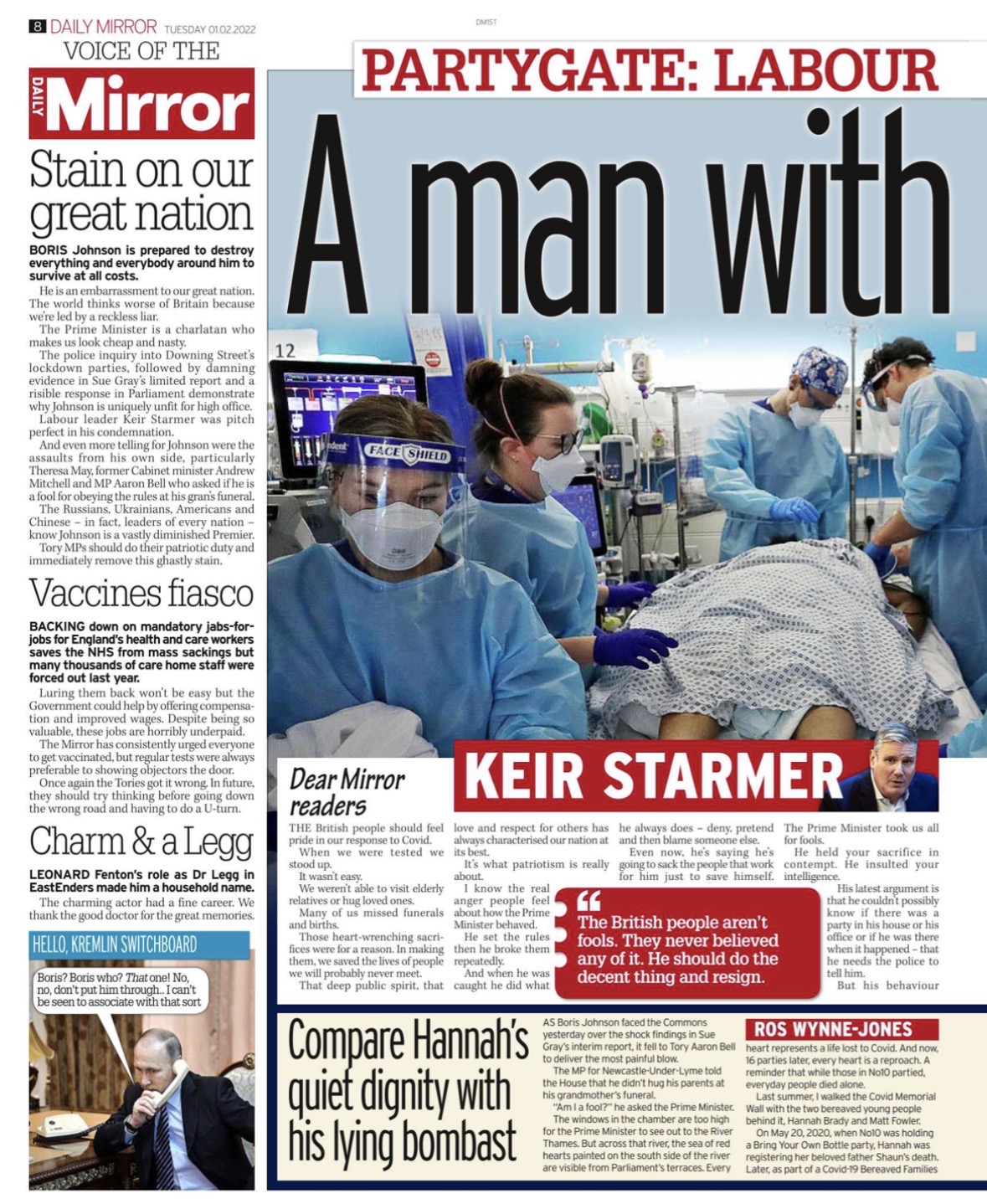
Double page spread of the article (first half)
Second half of double page spread
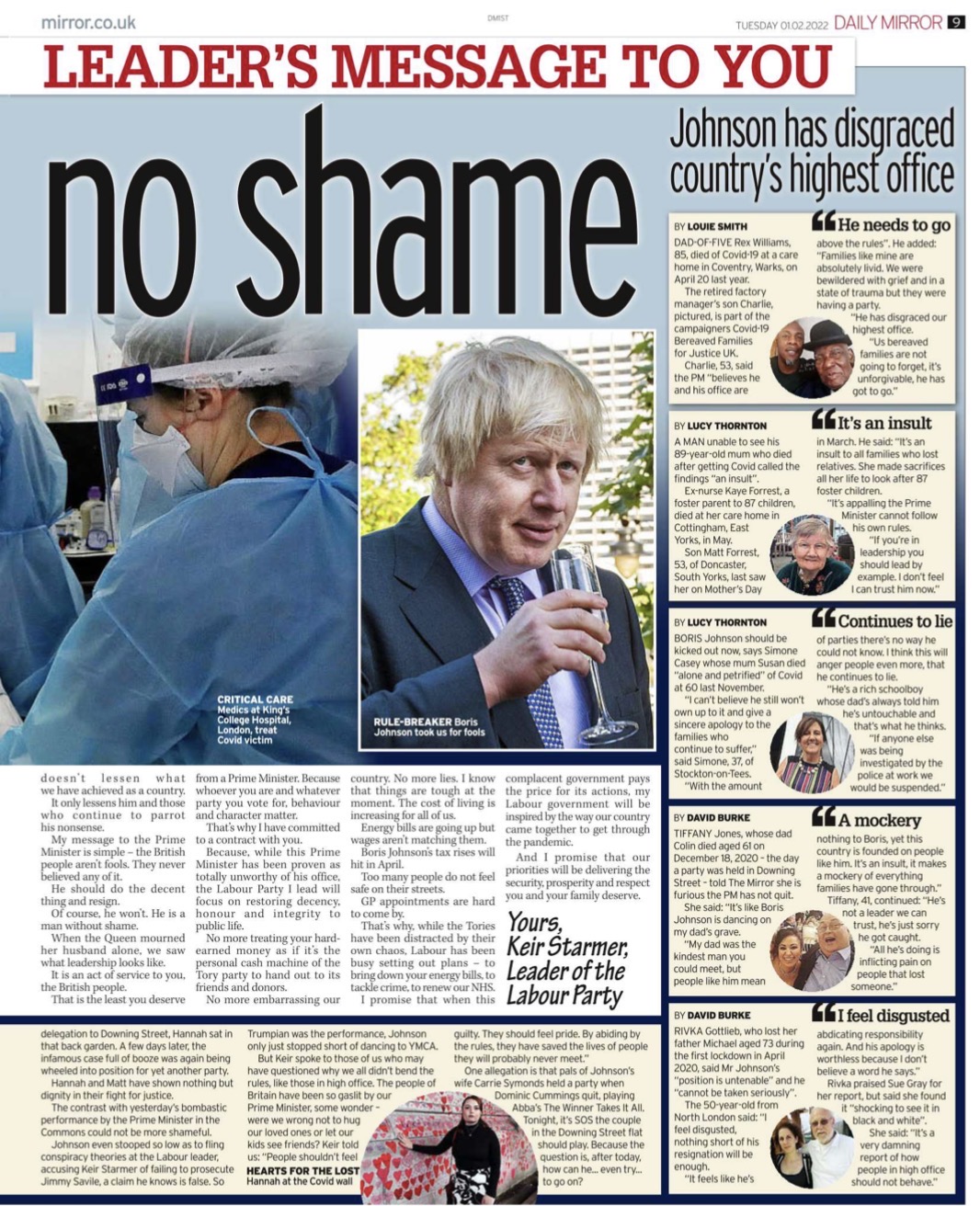
What features are included on the double page spread?
Lots of different features:
Editorial
Letter
Direct quotations
Cartoon
Large images
Central story
How is The Mirror’s branding reinforced on this spread? What theory does this link to?
The inclusion of the masthead again.
The red text and boxes - same colour of red as the masthead.
This links to Gerbner’s cultivation theory - this repetition of The Mirror’s branding will cultivate an audience to side with them.
What does the repetition of the word ‘shame’ show?
Emphasises that Boris has done something negative.
How do the two images contrast eachother (binary opposition)?
One image shows Boris happily drinking champagne.
The main image is of NHS workers working very hard to save lives, caption says “critical care”
This contrast shows Boris as not being hardworking and just being lazy.
Who wrote this article? What does this explain?
Keir Starmer - leader of the Labour Party at the time
This explains why the article is so against Boris and the Conservatives.
What sort of language does Starmer use in the article?
Inclusive language - makes the readers feel like he’s on their side, shows Starmer is a man of the people
“Dear mirror readers”
“We weren’t able to visit elderly relatives”
“Many of us missed funerals”
What’s a technique Starmer uses to try and gain support from readers?
Flattering them - “The British people aren’t fools”
Explain the affect of the “Compare Hannah’s quiet dignity with his lying bombast” story
Hannah (member of the public) is represented as heroic - quietly overcoming struggles in covid.
Boris is shown as a villain who partied and drank while she struggled.
Intertextual reference - it says the conservatives played ABBA song “The winner takes it all” at a party. This is a metaphor for the Conservative Party - they’re cocky, they ‘take all’ from the public.
What’s featured on the right hand side of the spread?
A series of small extracts where ordinary people have given their opinions about party gate.
The people are working-class - relatable to audience of the mirror
What do these extracts connote?
That the public is against Boris.
These sources are trustworthy as they’re from the public.
What’s the “vaccines fiasco” article about?”
How care workers have struggled.
The article represents the NHS as victims - they’re struggling, they should be supported.
What does the article on the top left say?
“Stain on our great nation” - makes Boris seem dirty, he’s ruined the country.
Explain image of putin in bottom left
It’s a political meme.
Putin says on the phone that even he can’t be associated with Boris.
Putin is known to be a very negative person.
This satire links Boris to ideas of tyranny.
Apply Hall’s representation theory to The Mirror article?
Stereotypical representation of the prime minister - based off of a few negative traits.
Apply Gerbner’s cultivation theory to the newspaper.
Repeated negative representations of Boris and the Conservative Party will cultivate the audience to dislike them.
Apply Hall’s reception theory to the newspaper.
Preferred reading - left-wing, working-class audience will agree with the negative representations of the Conservative Party
Oppositional reading - right-wing, upper-class audience will disagree with these negative representations as they support Boris and the Conservative Party.
THE TIMES: what are the features of the times newspaper?
Broadsheet
Lots of writing, less images
Leans right (but Murdoch says it’s balanced)
Aimed at intellectual, older audience
Sophisticated
Costs £2.20
SET TEXT: picture of The times article front cover
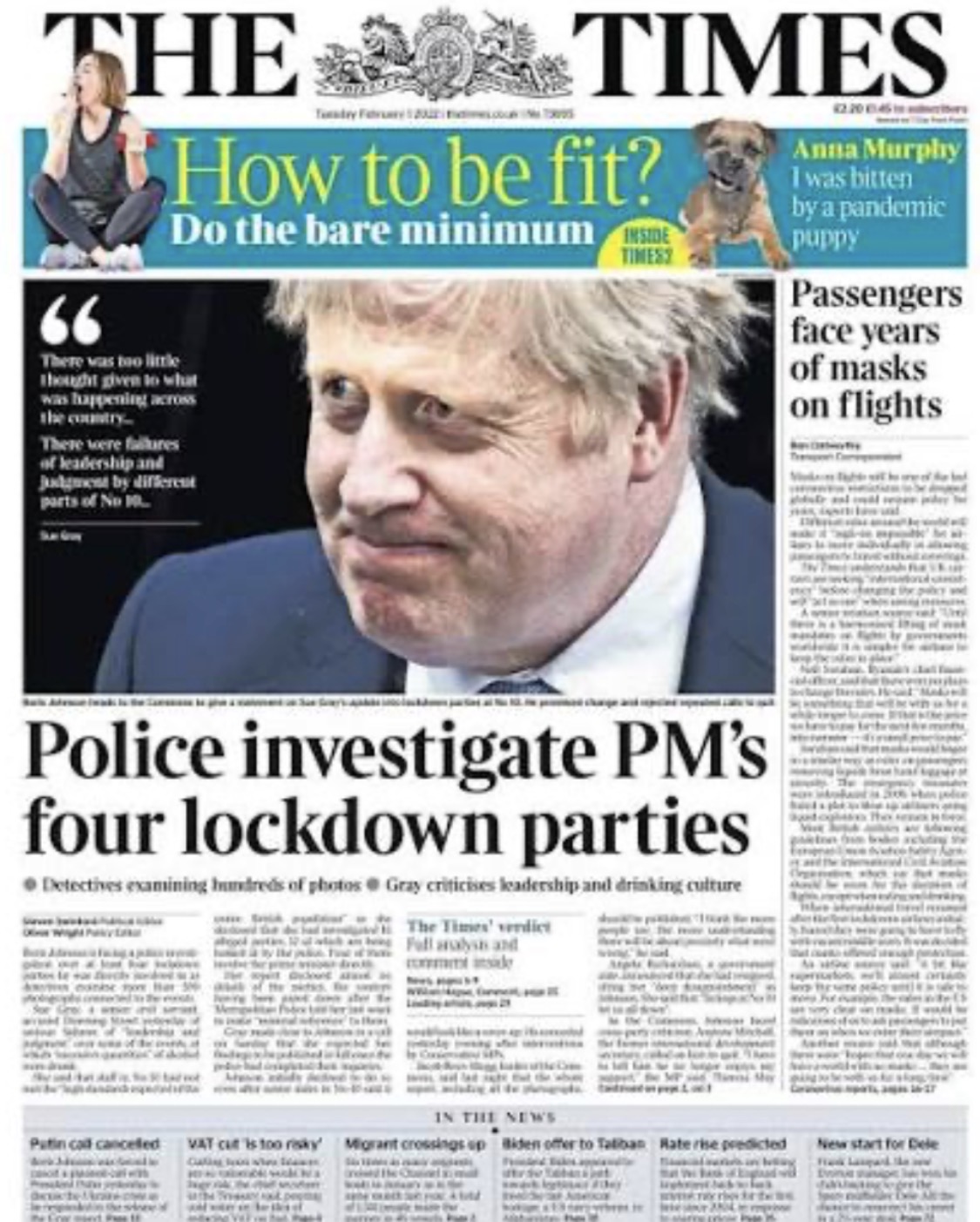
How does the masthead appeal to an audience?
The serif font and coat of arms logo connote sophistication and high-class.
The bold font connotes importance
What does The Times’ logo signify?
That the paper has traditional values.
Also connotes royalty and being British.
What’s the tone of the article?
More matter of fact, less critical of the Conservative Party.
This is because the newspaper leans right.
What is the main (and only) picture on the front cover?
A close up of Johnson’s face - he appears sheepish
Picture analysis
Boris’ facial expression lacks confidence - he seems ashamed of himself.
Although he is wearing a suit - power and wealthy.
How is the meaning of the image anchored?
Through pull quotes - “too little thought”, “failures of leadership”.
Elipses suggest that there is more to come - eg more evidence
Suggests that Boris has failed.
Why is this representation unusual?
The Times leans right - support the Conservative Party.
This shows that so many people of the public were outraged that they had to side with them and represent Boris negatively in order to appeal to more readers.
What’s the significance of the ‘How to be Fit’ plug?
This is a sky box.
The yellow font is used to draw attention.
It shows that it offers information outside of politics - appeals to a wider audience
Also represents people as being lazy and wanting quick fixes - “do the bare minimum”
How is relatability shown on the front cover?
“Pandemic puppy” - relates to context of covid. Lots of people bought pets during covid to combat loneliness.
Also targets a younger audience.
What does the large amount of small copy signify?
That the paper is a broadsheet - aimed at older, highly educated people.
What’s the effect of the use of facts and statistics on the front cover?
They emphasise how much evidence there is against Boris.
“Four lockdown parties” “detectives examining hundreds of photos”
Who condemns Johnson in quotes on the newspaper? Why is this significant?
Both Labour and Conservative Party members - shows he’s lost support from everyone.
What other kinds of stories are featured on the front cover - ‘In The News’ section?
Factual and objective ones - just stick to the main facts.
These are jumplines - hooks readers in to reading other pages of the newspaper
Eg migrants crossing the channel

