IPFC 1 - Pregnancy Supplementation
 Call Kai
 Learn
Learn Practice Test
 Spaced Repetition
 Match
Match Flashcards
 Knowt Play
1/26

There's no tags or description
Looks like no tags are added yet.
Name | Mastery | Learn | Test | Matching | Spaced | Call with Kai | Chat |
|---|
No analytics yet
Send a link to your students to track their progress
27 Terms
When is the embryo/fetus is most susceptible to damage (i.e. drugs, illnesses)?
as the major organs/systems form during the first trimester
Neural Tube Development
- first 3-4 weeks, specific cells in the embryo. curl up and edges fuse together to form foundation of spinal cord and brain
- neural tube fusing process (21-28 days) is usually complete by 28 days after contraception
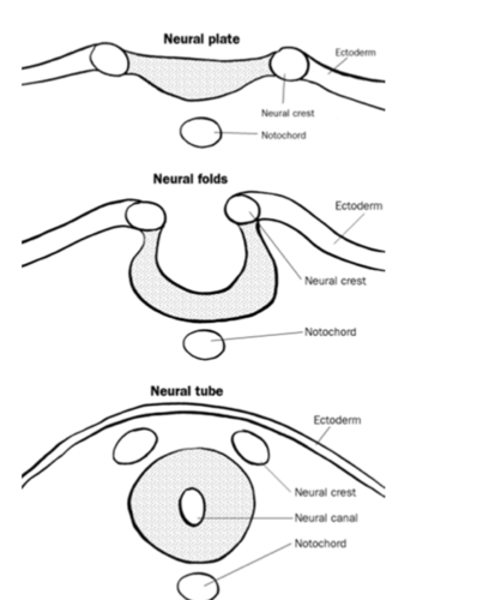
Neural Tube Defects (NTD)
• Group of disorders that can cause life-long complications of varying severity or fatality.
• If the tube does not close properly along its entire length, then a NTD will form at the open location.
• Affect the brain’s development and can leave the spinal cord vulnerable to damage.
• One of the most common congenital abnormalities.
Spina Bifida
• a cleft, or split like opening, in the back part of the spinal vertebrae
• meningocele or meningomyelocele is the most severe form ; occurs when an opening in the spine allows the spinal cord to be exposed.
• more severe cases involves the spinal cord causing neurological damage
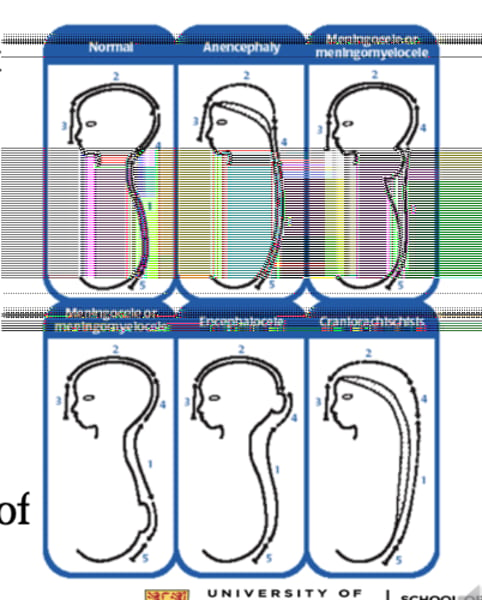
Anencephaly
• cephalic end of the neural tube fails to close resulting in the absence of a major portion of the brain, skull, and scalp.
_____% babies are born with congenital abnormalities due to folate deficiencies
4-5%
Folic acid associated with preventing:
neural tube defects (NTD), heart defects, urinary tract anomalies, oral facial clefts, limb defects
Folate vs Folic Acid
• Oral intake of folic acid is primary source for the embryo or fetus via transplacental transfer
• Folic acid is more stable and most often used in vitamin supplement (B9) and food fortification
– 100% bioavailable
• Folates found naturally occurring in foods and in the body in many forms.
– 50% bioavailable
T/F Based on mandated levels of folic acid fortification, women are likely achieve their requirements through diet alone.
False
T/F "Organic foods" do not require the same mandatory fortification by Health Canada
true
Risk Factors for NTDs
1) genetics
2) environmental
Genetic NTD risk factors
• Family history ( father, mother, previous fetus, sibling, or 2nd/3rd degree relative)
• Gene polymorphisms that effect folate metabolism
• Gene mutations
• Chromosomal anomalies
• Affects related to DNA methylation
Environmental NTD risk factors
• Dietary folate intake
• GI absorption issues (i.e. Crohn’s disease, gastric bypass surgery)
• Kidney dialysis
• Diabetes (type I or II)
Drug that reduce Folic Acid Levels
• Anti-epileptics: phenytoin, phenobarbital, carbamazepine, valproate
• Acid Reducers: Antacids, H2 blockers (cimetidine), proton pump inhibitors
• Bile acid sequestrants
• NSAIDs (not routine use/very large therapeutic doses)
• Sulfasalazine
• Triamterene
• Methotrexate
• Tetracycline
Target population folic acid supplementation:
Women aged 12-45 years who could become pregnant
• Health care providers should advise benefits of taking an oral daily multivitamin containing folic acid to optimize serum and red blood cell folate levels
Folic acid should be taken in what form?
a daily oral multivitamin that includes a 2.6-mg dose of vitamin B12
• If individual has pre-conception obesity (BMI >30.0 kg/m2) they may require a more personal and focused assessment
Low NTD risk criteria and recommendation
- No family history of NTD (female & male)
- 0.4mg qd in a multivitamin + folate rich food for 3 months before conception & 4-6 wks post- partum (PP) or until breastfeeding stops
Moderate NTD risk criteria and recommendation
- Family history, co-morbidities (GI/diabetes), drug interactions
- 1mg qd + folate rich food 3 months before conception & first trimester then decrease to 0.4mg (in a multivitamin tablet) till PP or breastfeeding stops
High NTD risk criteria and recommendation
- Female or male with a personal hx (previous pregnancy or 1st degree
relative)
- Hx medical or surgical conditions, including obesity that may affect folate levels
1) daily supplementation with 4-5 mg of folic acid then decrease to 0.4mg (in a multivitamin tablet) at 12 weeks till PP or breastfeeding stops
2) personalized option using a pre-conception assessment of maternal serum folic acid to determine the appropriate dose
Folic Acid Forms Available in Canada
• 0.4mg tablets, 1mg tablets (OTC) and 5mg tablets (Rx)
• 0.4mg–1mg in OTC women’s multivitamin or pre-natal vitamin
• High-dose = 1 multivitamin (1mg) + 3 x 1mg tablets
• Rx: 5mg tablets or Pregvit (1.1mg) or Pregvit Folic 5 (5mg)
Risk of taking more than one multivitamin / day
too much vitamin A which can have teratogenic effects
When is High-Dose Folic Acid Supplementation dangerous?
• Obesity and Diabetes
• May correlate with neurocognitive development: Autism
Which other supplements ARE recommended during pregnancy
Iron (to prevent IDA)
Vitamin D (600IU daily minimum found in prenatal vitamins)
Maybe calcium (1000mg/day from food)
Vitamin D prenatally
Having sufficient serum Vitamin D pre-
conception can increase likelihood of getting pregnant and having
live birth; increased levels preconception (but not in early
pregnancy) are associated with reduced pregnancy loss
Which other supplements ARE NOT recommended during pregnancy
Vitamin C - no evidence
Vitamin - no evidence
Omega 3 - no evidence
What to avoid prenatally
- high doses of Vitamin A due to teratogenic effects
- high doses of caffeine (>300mg/day) due to risk of miscarriage
- herbal/natural products due to lack of information & GMP
- recreational drugs including cannabis products
Multiple Micronutrient (MMN) Supplementation in Pregnancy
Micronutrient = multivitamins and minerals
pregnant women who received MMN supplementation had fewer low birthweight babies and small-for-gestational-age babies