Chapter 2: Atomic Structure, Molecular Glues, and Molecules of Life
0.0(0)
Studied by 1 person View linked note
 Call Kai
 Learn
Learn Practice Test
 Spaced Repetition
 Match
Match Flashcards
 Knowt Play
Card Sorting
1/54

Last updated 8:25 PM on 10/4/22
Name | Mastery | Learn | Test | Matching | Spaced | Call with Kai | Chat |
|---|
No analytics yet
Send a link to your students to track their progress
55 Terms
1
New cards
Neutrons
no charge, # = protons.
2
New cards
Denaturation
loss of structure→ loss of function.
3
New cards
Protons
positive charge, atomic # = ID of element.
4
New cards
Peptide bond
covalent bond links amino acids.
5
New cards
matter
material that takes up space
6
New cards
atoms
building blocks of matter
7
New cards
electrons
negative charge
- used in atomic bonding
- usually # = protons
- used in atomic bonding
- usually # = protons
8
New cards
ions
e =/ p
9
New cards
carbohydrates
carbon, hydrogen, oxygen
10
New cards
monosaccharides
simple sugar with 1 sugar
ex: glucose
ex: glucose
11
New cards
disaccharides
simple sugar with 2 sugars
ex: sucrose=fructose + glucose
ex: sucrose=fructose + glucose
12
New cards
organic molecules=
carbon + hydrogen
13
New cards
oligosaccharides
simple sugar with 3-100 monomers that attach to proteins, create blood types and identify cells
14
New cards
polysaccharides
= complex carb
E storage structure made of joined monosaccharides
E storage structure made of joined monosaccharides
15
New cards
glycogen
type of polysaccharide that has long-term energy storage
- made of glucose
- ex: liver + skeletal muscle
- made of glucose
- ex: liver + skeletal muscle
16
New cards
4
____ major macromolecules of life
17
New cards
lipid groups
triglycerides, sterols, waxes, phospholipids
18
New cards
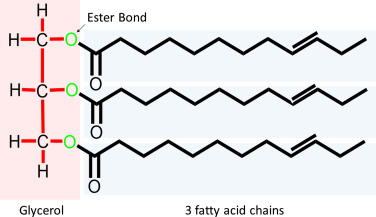
triglycerides
lipid of 3 fatty acids bonded to glycerol
- sterols and waxes
- long-term storage of energy
- sterols and waxes
- long-term storage of energy
19
New cards
sterols
triglyceride with 4 rings
- ex: cholesterol (cell membrane), steroid hormones (testosterone, estrogen)
- ex: cholesterol (cell membrane), steroid hormones (testosterone, estrogen)
20
New cards
peptide bond
covalent bond links amino acids
21
New cards
protein folding
unique 3D structure
22
New cards
denaturation
loss of protein structure→ loss of function
- ex: fever
- ex: fever
23
New cards
nucleic acids
DNA + RNA
24
New cards
nucleotide monomers
5 carbon sugar + phosphate group + nitrogenous base
25
New cards
phosphate groups
cytosine, thymine, adenine, uracil
26
New cards
DNA
deoxyribonucleic acid
double helix
- found in nucleus as chromosomes with genes on them
- original instructions for protein
double helix
- found in nucleus as chromosomes with genes on them
- original instructions for protein
27
New cards
RNA
ribonucleic acid
single helix
enables protein synthesis
ex: mRNA, rRNA, tRNA, siRNA, snRNA
single helix
enables protein synthesis
ex: mRNA, rRNA, tRNA, siRNA, snRNA
28
New cards
waxes
triglyceride made of a fatty acid and alcohol with a water repellant covering
29
New cards
lipids
hydrophobic, accumulate in adispose (fat tissue), form hormones, cell membranes
30
New cards
ATP
adenosine triphosphate
ENERGY
nucleotide
"A" in DNA and RNA
ENERGY
nucleotide
"A" in DNA and RNA
31
New cards
electrically neutral atoms
e=p
32
New cards
isotopes
p=p n=/p
- radioactive
- radioactive
33
New cards
cations
positively charged ions
34
New cards
anions
negatively charged ions
35
New cards
elements
pure substances (1 type of atom)
36
New cards
25
____ elements essential to life
37
New cards
bulk elements
majority of composition of living things
38
New cards
Carbon, hydrogen, oxygen, phosphorus, iodine, nitrogen, magnesium, gallium, NaCl, potassium, calcium, iron
CHOPIN's MiGhty Salty K Cafe (bulk elements)
39
New cards
trace elements
required in small amounts
40
New cards
molecule
2+ bonded atoms with outermost electrons
creates energy
creates energy
41
New cards
ionic bonds
electrical attraction
electrons transferred
- weak under dry conditions
electrons transferred
- weak under dry conditions
42
New cards
covalent bonds
sharing electrons
nonpolar vs polar
nonpolar vs polar
43
New cards
nonpolar
equal sharing of electrons in a covalent bond
44
New cards
polar
unequal sharing of electrons in a covalent bond
45
New cards
water
polar covalent bond
- H bonds weak but strong together
essential to life
life solvent
temp regulation (high heat capacity)
- H bonds weak but strong together
essential to life
life solvent
temp regulation (high heat capacity)
46
New cards
water is essential to life
ability to dissolve in water helps classify chemicals
47
New cards
hydrophilic
water-loving
polar
dissolves easily
travels in blood
cant cross cell membranes
polar
dissolves easily
travels in blood
cant cross cell membranes
48
New cards
hydrophobic
water fearing
nonpolar
doesn't dissolve well
doesn't travel in blood well
can cross cell membranes
nonpolar
doesn't dissolve well
doesn't travel in blood well
can cross cell membranes
49
New cards
cohesive
water molecules stick together
50
New cards
adhesive
water molecules stick to other things (meniscus)
51
New cards
hydrolysis
water breaks down macromolecules
52
New cards
native
properly folded protein structure
53
New cards
fibrous proteins
fibers, make structure of cells, insoluble
54
New cards
globular proteins
soluble, transport, round shaped
55
New cards
simple sugars
source of quick energy
- 3 types
- 3 types