PT7525 - Understanding Vestibular Anatomy and Physiology: Key Terms and Definitions
 Call Kai
 Learn
Learn Practice Test
 Spaced Repetition
 Match
Match Flashcards
 Knowt Play
1/125

There's no tags or description
Looks like no tags are added yet.
Name | Mastery | Learn | Test | Matching | Spaced | Call with Kai | Chat |
|---|
No analytics yet
Send a link to your students to track their progress
126 Terms
1. Stabilization of images on retina during head movement.
2. Maintain postural stability.
3. Spatial orientation.
What are three functions of vestibular system?
VOR; equal and opposite
Stabilization of images on retina during head movement is function of ________________________ → Eyes move _________________________ to head.
Stabilize vision; cervicogenic headache
Someone /c dysfunctional VOR will lock out neck and head (i.e., tighten suboccipital muscles) to _________________________. Associated /c ________________________.
Lateral vestibulospinal tract
Stabilizes trunk.
Medial vestibulospinal tract
Stabilizes head and neck.
Gravity-sensing; semicircular organs; otoliths
Vestibular system achieves spatial orientation via __________________________ organs that determine which direction is up: 3 ___________________________ and 2 __________________________ bilaterally.
Front; back
Cochlea sits in __________________________, while vestibular system sits in _______________________.
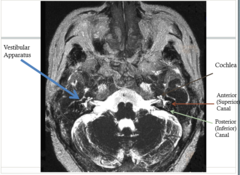
Petrous part of temporal bone; trauma
_____________________________ is very hard to protect vestibular system! → Can crack /c _________________________, associated /c labyrinthine concussion.
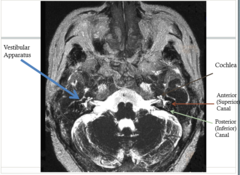
Labyrinthine concussion
Concussion that harms vestibular system (causes dizziness).
Outer ear
External auditory meatus (ear canal).

Middle ear
Ear drum, stapes, incus, malleus.
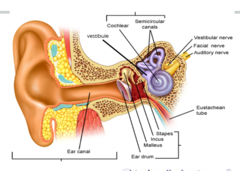
Tympanic membrane
Ear drum; border of inner + outer ear.

Inner ear
Cochlea, vestibule, semicircular canals.
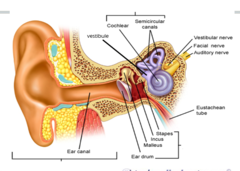
Cochlea
Hearing system.

Vestibule
Holds saccule and utricle.
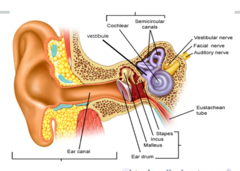
Eustachian tube (auditory tube)
Connects middle ear to respiratory + GI tracts → Infections can spread here.

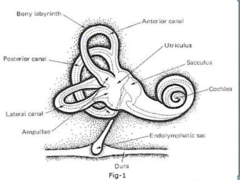
Bony labyrinth
Contains perilymph (blue in image).
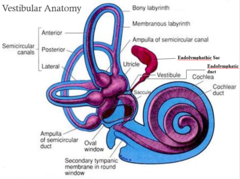
Membranous labyrinth
Contains endolymph (purple in image).
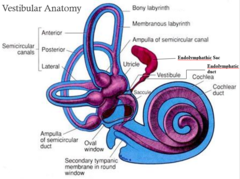
Endolymph
Honey consistency, otoliths take time to move through canals in BPPV.
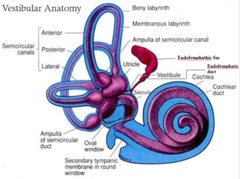
Endolymphatic hydrop
Swelling of system d/t excessive endolymph production (i.e., Meniere's disease).

Endolymphatic sac
Immune function, produces endolymph (might resorb it also).

Ampulla
Widened portion of semicircular canals that contains hair cells.

Otoconia
Small rocks of limestone (CaCO3) that are only supposed to live in utricle + saccule, it ends up in semicircular canals and causes BPPV.
Accept and dissipate
Oval and Round Windows:
Have a soft tissue-film over them and are compliant so can ____________________________ sound energy.
Across ossicles → Hit footplate of stapes (oval window) → Cochlea → Round window → Middle ear
What is pathway of sound?
Barotrauma
Damage to windows (rupture) that will cause hearing loss.
Tear; third window
Ask about hearing loss because of these windows → Could have _________________________ or ________________________ (new hole).
≠
Trauma probably also hurt vestibular system because window damage ____________________ LOB.
Oval window
Transmits sound energy to inner ear. → Sound energy that gets into cochlea is from vibrations of oval window from ossicles. Energy then leaves cochlea after the sound is dissipated.
Round window
Dissipates sound energy from middle ear after travels around cochlea.
Closed; popping ears; drain
Eustachian Tube (Auditory Tube):
- __________________________ in resting state.
- Can be opened by ________________________.
- If chronic infections, cannot ______________________!

Bony labyrinth, membranous labyrinth
What structures compose peripheral vestibular system?
Bony labyrinth
- All structures in inner ear.
- Filled /c perilymph (similar to CSF and ECF).
- Contains semicircular canals (SCC), cochlea, and vestibule.
Membranous labyrinth
- Suspended within bony labyrinth.
- Filled /c endolymph (similar to ICF) → Very viscous, honey consistency.
- Contains 5 sensory organs (proprioceptors of ear).
Ampulla
Membranous labyrinth contains portions of SCC - widened at each end to form __________________________ (3).
Crista, cupula
What structures are contained within ampulla?
Crista
Ridge of neuroendothelial cells = contains hair cells that project upwards; barbell/saddle shaped.
Cupula
Gelatinous matrix that arises from crista, capable of bending in either direction.
Otolith
Composed of utricle and saccule.
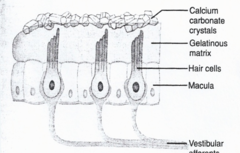
Macula
Contains hair cells.
Otolithic membrane
Analogous to cupula of otolith but has otoconia on top.
Rush of endolymph; cupula; hair cells; electrical energy; spatial orientation
__________________________ in opposite direction of head turn → Mechanical deflection of _________________________ → Bending of __________________________ → Mechanical energy converted to __________________________ for brain to process → ________________________
Angular
Semicircular canals are responsible for processing ___________________________ movement.

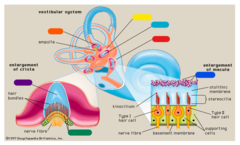
Crista
Contains hair cells (orange in image).
Cupula
Physical block, debris cannot cross since goes to roof of ampulla (purple in image).

Hair cells
Come out of crista ampullaris and project into cupula (green in image).

Linear/translatory movement
Otoliths are responsible for detecting _________________________.

Utricle
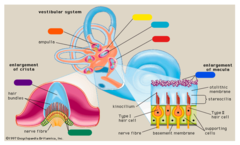
Detects forward-backward/horizontal movement (yellow in image).
Saccule
Detects elevator/vertical movement (red in image).

Macula
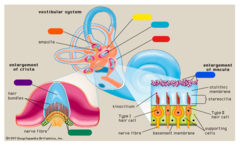
Contains otoconia, otolithic membrane, stereocilia, and kinocilium (teal in image).

Otoconia; gravity-dependent
Weight of ________________________ (blue in image) on top of otolithic membrane is only thing that makes utricle + saccule ___________________________.
Acceleration; constant velocity
Otoliths sense __________________________ because hair cells deflect, but as you maintain __________________________, hair cells return to resting position and you adapt to the velocity so you don't perceive movement.
Ex: Take-off/landing vs. cruising at 300 mph in plane

Gravity; hair cells; linear acceleration
Otolithic Organs:
- Assist /c maintaining balance in relation to __________________________.
- Contain _______________________ that project into matrix that support otoconia.
- Detect linea movement and ______________________.
Linea acceleration; static tilt
Otolithic organs (utricle and saccule) detect ___________________________ and __________________________.
Saccule
- Vertical (elevator)/"pitch"
- Sensitive to up/down movements
- Macula: Contains hair cells attached to vestibular afferents, oriented vertically
Utricle
- Horizontal (car)/ "roll"
- Sensitive to anterior/posterior movements
- Macula: Contains hair cells attached to vestibular afferents, oriented horizontally
Opposite
Hair cells delect in direction ______________________ of macula.
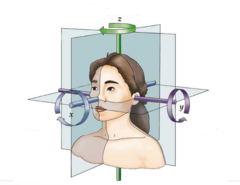
Yaw
Rotation around z axis (i.e., no).

Pitch
Rotation around y axis (i.e., yes).

Roll
Rotation around x axis (i.e., side-bending).
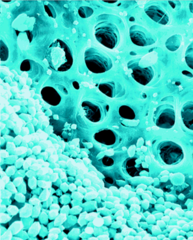
Otoconia
Calcium carbonate crystals.
Denser
Otoconia are _______________________ than cupula - respond to effects of gravity better.
Cilia
Hairlike projections that extend from hair cell.

Fractured; trapped
Aging and Otoconia:
Otoconia become ________________________ over time /c age. → This is how you end up /c otoconia ________________________ in places they shouldn't be (i.e., BPPV).

Semicircular canals
Detect angular acceleration.
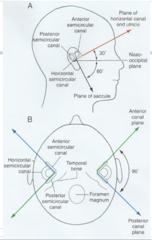
Anterior (superior), posterior (inferior), horizontal (lateral)
What are three types of semi-circular canals?
90°
Anterior (superior) and posterior (inferior) SCC are oriented ________________________ to each other.
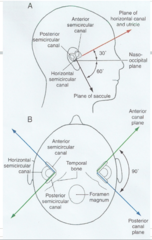
30° upward
Horizontal (lateral) SCC is inclined _______________________ so pitching head at 30° downward puts it parallel to ground.
Opposite
Endolymph moves __________________________ of head turn.
Cupula; hair cells
Flow of endolymph deflects _________________________, triggering __________________________ to increase or decrease firing rate.
R posterior SCC; L posterior SCC; inhibited; into; away
Coplanar Pairs of SCC:
- L anterior SCC is same plane as ________________________ (LARP).
- R anterior SCC is same plane as ________________________ (RALP).
When one is excited, the other is _________________________ when we move in that plane of motion. → One bends ________________________ kinocilium and one bends ________________________.
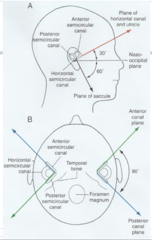
90°; its own plane; coplanar contralateral pairs; head; input
Semicircular Canals:
- ________________________ to each other
- Responds to motion best within ________________________
- _________________________: Horizontal - Horizontal, R Anterior - L Posterior, L Anterior - R Posterior
- Direction of _______________________ movement is determined by comparing incoming _________________________ from coplanar pairs of SCCs

100 pps; decreases; direction
"Push-Pull" Output Relationship:
- Each side has a baseline firing rate of ~__________________________
- Neural firing rate increase in one canal and _______________________ in coplanar pair in response ton endolymph flow
- Determines ________________________ of movement
- Allows for sensory redundancy, elimination of "common-mode noise", compensation for sensory overload
Sensory redundance
One side blocked, CNS still receives input from the other.
Elimination of "common-mode noise"
Brain ignores simultaneous changes on both sides = temperature/chemistry.
- Ex: 100 pps on R horizontal + 100 pps on L horizontal
Compensation for sensory overload
Can continue to receive input from excitatory side when speeds exceed 180 degrees/second (inhibitory side is driven to 0 pps).
- Side you turn to = excitatory
- Side you turn away from = inhibitory
Always movement (vertigo)
Infection causes dysfunction which makes it seem like there is _________________________!
Mirror; excitatory; inhibitory
- _________________________ images of each other
- Small towards tall cilia = ____________________________
- Small away from tall cilia = ____________________________

Ewald's 2nd law
States that the responses to rotations that excite a canal are greater than the responses that inhibit a canal.
Side of lesion; intact L side
Ewalds 2nd Law:
- Rationale for UVH avoid head movement toward ____________________________.
- Ex: Right UVH
- Decreased firing from R (already less than 100 pps) intact L side
- Turn to R would inhibit the ______________________ = no accurate information from either side of vestibular system
R; L; L beating nystagmus; nothing; worse
Ewalds 2nd Law:
- If turn head to L, eyes drag to ____________________ and snap back to _______________________. → ___________________________ /c R UVH. Eyes drag to side of problem!
- If turn head to R, vestibular input has been dropped to ________________________! → L side (good side) is inhibited so patients feel ____________________ turning toward side of lesion.
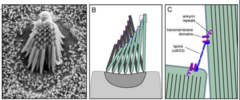
Stereocilia
Connected by tip-links, so when one moves all are stimulated.
Depolarization (excitation)
Stereocilia deflect towards kinocilium = __________________________.
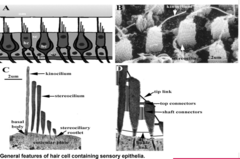
Hyperpolarization (inhibition)
Stereocilia deflect away from kinocilium (a.k.a. kinocilium deflects towards stereocilia) = _________________________.

Ascending
Hair cells are arranged in order of _______________________ height.

Displacement
Hair cells convert ________________________ into neural firing.
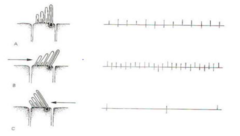
100 spikes/sec
Resting firing rate of nerve cells in each labyrinth is ________________________.
Inhibition
Shifts hard to L
Kinocilium → stereocilia
________________________
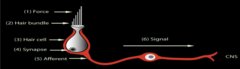
Tip links
Connect stereocilia and kinocilium.
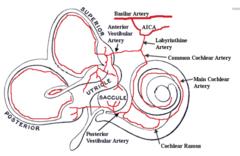
AICA; hearing and balance loss
Very little collateral blood supply so _________________________ stroke takes out entire vestibular system → __________________________
Labryinthine artery
- Branch of AICA
- No collateral blood supply = susceptible to ischemia
- Branches into A.V.A. and P.V.A.
(purple in image)
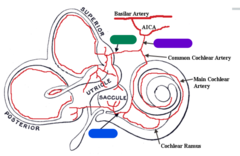
Anterior vestibular artery
- Most susceptible to infarct
- Vestibular nerve
- Utricle
- HC
- AC
(green in image)
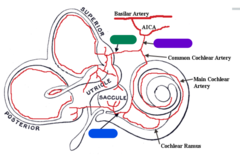
Posterior vestibular artery
- PC
- Saccule
(blue in image)
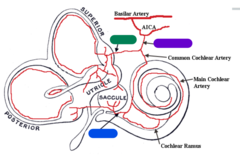
Superior vestibular nerve
Anterior/superior and horizontal SCC, utricle.
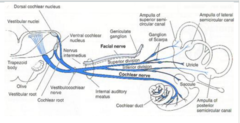
Inferior vestibular nerve
Posterior/inferior SCC, saccule.

Superior vestibular nerve; lateral beating nystagmus
Neuritis/neuronitis typically affects _________________________ d/t smaller orifice pass through → _________________________ d/t compression of horizontal SCC.
Vestibular afferents
Neural activity transmitted from hair cells through _______________________ to vestibular nerve.
Superior vestibular nucleus
Relay for VOR.
Medial vestibular nucleus
Relay for VOR, VSR.
Lateral vestibular nucleus
Primarily responsible for VSR.