BIOL 371 Vascular Seedless/Seed Plants
 Call Kai
 Learn
Learn Practice Test
 Spaced Repetition
 Match
Match Flashcards
 Knowt Play
1/73

There's no tags or description
Looks like no tags are added yet.
Name | Mastery | Learn | Test | Matching | Spaced | Call with Kai | Chat |
|---|
No analytics yet
Send a link to your students to track their progress
74 Terms
What phase is dominant in the vascular seedless plants?
sporophytic phase
What two additional adaptations did vascular seedless plants add?
supportive vascular tissue
conducting cells for transport of water and structural support
root system
absorption of water and minerals
How did vascular tissue develop?
evolved in a series of gradual steps with progressively more lignin deposition, increasing level of structural support and efficient water transfer
simple water conducting cells → first vascular tissue → tracheids → vessels
Where does the main support for upward growth and improved water conductance come from?
lignification of secondary cell walls (xylem and sclerenchyma)
Difference between tracheids and vessels
tracheids
closely packed elongated cells
thickened secondary cell walls with lignin deposits (gaps called pits)
better structural support
vessels
shorter and wider
both walls have gaps
more efficient water transfer through pits (faster)
Are tracheids or vessels weaker?
vessels
Is more biomass found above or below ground level in vascular plants?
>50% of overall biomass is below ground level in vascular plants
What is the purpose of roots in vascular plants?
can act as nutrient reserves and as backup plant stock
Are vascular plants drought tolerators or avoiders?
drought avoiders - they hold onto moisture
How is water pulled from the root to the leaves?
stomata openings and transpiration create a negative pressure to draw up water from the root to stem tissue
What happens as plants transpire?
about 90% of water absorbed by the root is lost through transpiration but this allows for sufficient water to be translocated throughout the plant and intake of necessary soil nutrients
How did microphylls develop?
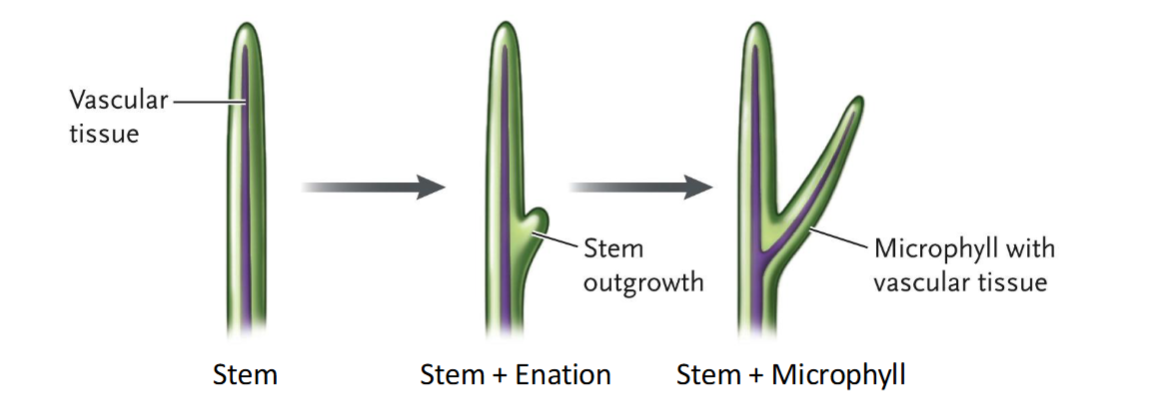
What is vasculature largely composed of?
xylem, phloem, sclerenchyma and parenchyma in one bundle
Why did stems begin modifying?
to increase photosynthetic surface area, allowing them to catch more light
What are microphylls?
narrow leaves with on strand vasculature (vein)
Lycophytes charcteristics
highly diverse
small growing on forest floors in moist conditions
some are poikilohydric
all have microphylls
What happened to lycophytes after the carboniferous period?
during the carboniferous period lycophytes increased, even making tree sized ones, after this period they decreased with the tree sized ones disappearing while small ones remained
When did microphylls and megaphylls evolve?
during the carboniferous period
What were the dominant animals during the carboniferous period?
arthropods, increased oxygen allowed for massive ones
What began emerging during the carboniferous period?
reptiles
seed plants
What is the main event of the carboniferous period?
oxygen levels were raised to about 30%
What are megaphylls?
broader leaf with multiple veins within a web of photosynthetic tissue
What advantage do megaphylls have over microphylls?
greater photosynthetic area with efficient nutrient transfer capabilities
Which plants have megaphylls?
all pteridophytes (true ferns) and seed plants
What are the most abundant group of seedless vascular plants?
ferns (pterophyta)
Is the green plant the sporophyte or gametophyte in ferns?
sporophyte (2n) stage
What is the key difference between dominance mosses and ferns?
mosses have a gametophyte dominant stage which is shown by the leafy part while in ferns that is their sporophyte stage
What are fronds?
finely divided leaves in ferns
What are sori?
clusters of sporangia grouped together on the underside or margins of fern fronds
What are characteristics of true ferns?
well developed vasculature (true xylem tracheids) and root systems
drought avoiders: can survive without continuous moisture
What are indusia?
protective covering sori while developing acting as shields
Fern life cycle
Sporophyte → sori/sporangia → meiosis → spores → gametophyte → sperm + egg → fertilization → new sporophyte.
Mature fern (sporophyte, 2n) develops sori on the underside of its fronds.
Sori contain sporangia, where meiosis produces haploid spores (n).
The spores are released and dispersed by wind.
If a spore lands in a suitable environment, it germinates into a tiny gametophyte (prothallus).
The gametophyte produces flagellated sperm (in antheridia) and eggs (in archegonia).
Water allows the antheridium bursts allowing sperm to swim to the egg in a mature archegonium, and fertilization occurs.
The zygote (2n) grows into a young sporophyte attached to the gametophyte.
The young sporophyte becomes an independent mature fern, which forms new fronds with sori, and the cycle repeats.
Do fern gametophytes have male and female
they are hermaphroditic meaning they contain both archegonia and antheridia
Where does the sporophyte grow in ferns?
sporophyte retained on the gametophyte but quickly outgrows it
Where are archegonia and antheridia found on the fern gametophyte?
antheridia are near the bottom near the rhizoids and the archegonia are at the top near the notch (eggs at top sperm on bottom)
How does cross fertilization happen in ferns?
antheridiogen prevents archegonia from forming on neighboring gametophytes, making only antheridia which produce sperm that must fertilize eggs on nearby gametophytes instead of self fertilizing
What part of the fern is photosythetic?
both the sporophyte and the gametophyte
Which gametangia are formed first?
archegonia which then dictate neighboring gametophyte development by encouraging antheridia formation
How do sporophytes in ferns continue in their cycle?
they live a long time and produce new fronds which will continue producing new sporangia
Why did the diploid sporophyte become dominant in ferns?
Because two gene copies (sister chromatids) can mask harmful mutations and support more complex structures by leaving room to accumulate mutations
What benefit does the haploid stage provide to the alternation of generations cycle?
exposes harmful mutations to natural selection allowing them to be selected against keeping generations healthy over time
it purges deleterious mutations as the haploid have no chance of complementing them while it allows favorable mutations to be passed on by being inherited by next generation
Which land plants are most dominant?
Vascular seed plants
What are the vascular seed plants separated into?
gymnosperms and angiosperms
What is the dominant stage in vascular seed plants?
sporophyte stage - the gametophyte stage is EXTREMELY reduced
What is pollen
the male gametophytic tissue
What is the main difference between spores in non-vascular/seedless vascular plants and vascular seed plants?
in non vascular/seedless vascular plants spores are released to create gametophytes and they are identical in shape/size while in vascular seed plants spores are not released to create gametophytes and spores are not identical in shape/size they are different from males and females
What is the difference between fertilization in non-vascular/seedless vascular plants and vascular seed plants?
external water is required for fertilization as flagellated sperm swims to fertilize egg in non-vascular/seedless vascular plants while external water is not required for fertilization in vascular seed plants as unflaggelated sperm is carried through pollen tubes to fertilize the egg
Difference between embryo protection in non-vascular/seedless vascular plants vs vascular seed plants
embryos are not protected in non-vascular/seedless vascular plants while embryos are protected using seeds in vascular seed plants
Key differences between non-vascular/seedless vascular plants and vascular seed plants
greater protection of the embryo (further protection of gametophyte) and less water needed
What are gymnosperms?
a group of seed-producing plants that bear "naked seeds," meaning their seeds are completely exposed on the surface of scales or leaves rather than being enclosed within a protective ovary or fruit
What are microspores?
tiny, haploid plant spores that develop into male gametophytes (pollen), which in turn produce sperm for fertilization
What are megaspores?
the megaspore develops into the female gametophyte, which in turn produces the egg cells for fertilization
What is pollen?
male gametophyte developed from the microspore on the sporophyte prior to dispersal
What is the ovule?
Sporophyte structure that houses and protects the megaspore that gives rise to the female gametophyte
What becomes the seed?
the fertilized ovule
Why do seeds desiccate (dry out) before dispersal?
To enter dormancy, allowing them to survive dispersal and unfavorable conditions until they can germinate.
What are the reproductive structures that contain haploid spores in conifers called?
cones
What is released in conifer male gametophytes?
pollen, the male gametophyte
Conifer life cycle
Sporophyte (mature pine tree, 2n) → male and female cones → meiosis → microspores + megaspores (n) → male gametophyte (pollen) + female gametophyte (inside ovule) → pollination → pollen tube forms → sperm + egg → fertilization → zygote (2n) → seed → seedling → new sporophyte (mature pine tree).
Mature pine tree (sporophyte, 2n) produces male (pollen) cones and female (ovulate) cones.
In the cones, meiosis produces microspores (n) in the microsporangia and megaspores (n) in the megasporangia.
Microspores develop into pollen grains (male gametophytes), while the surviving megaspore develops into the female gametophyte inside the ovule.
Wind carries the pollen to a female cone (pollination).
The pollen grain germinates and grows a pollen tube toward the egg, while producing sperm cells.
One sperm fertilizes the egg, forming a zygote (2n).
The zygote develops into an embryo inside a seed.
The seed is dispersed and germinates into a seedling.
The seedling grows into a mature pine tree (sporophyte, 2n), and the cycle repeats.
Are archegonia and antheridia present in gymnosperms?
only one of them is present in gymnosperms.
Archegonia ✅ Present
Found within the female gametophyte inside the ovule.
They contain the egg cells.
Antheridia ❌ Absent
Gymnosperms (like pine trees) do not produce antheridia.
Instead, the male gametophyte is the pollen grain, which produces sperm cells through its generative cell.
How is the megaspore formed inside the ovule?
megaspore divides by meiosis creating 4 megaspores, but only one survives
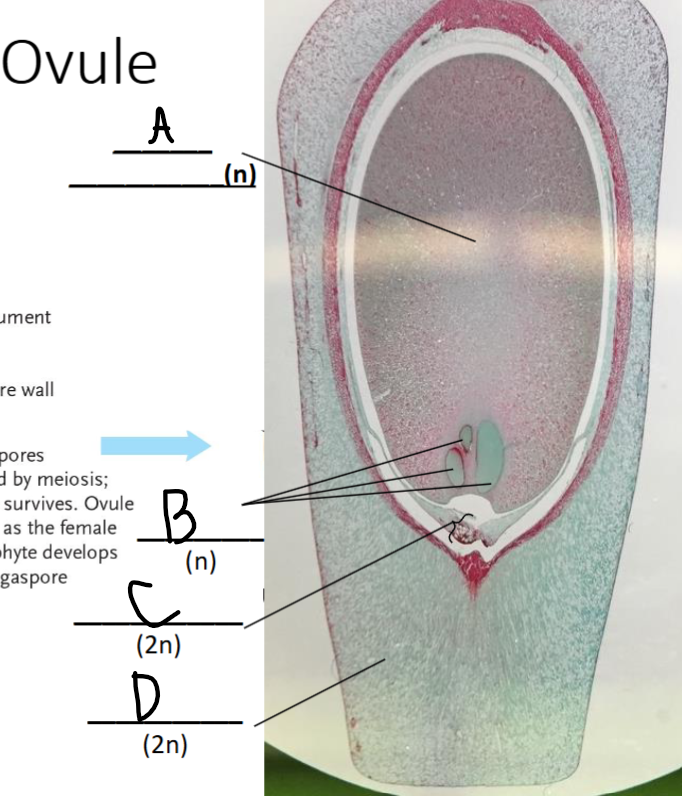
A - female gametophyte
B - Archegonia
C - Megasporangium
D - Integument
What is the integument?
The integument is the protective outer layer that surrounds the ovule in seed plants (gymnosperms and angiosperms).
What state is matured pollen in?
inactive, dry state allowing for dispersal by wind in order to carry to female cones
What is a pollination drop?
A pollination drop is a sticky, sugary liquid secreted by the ovules of gymnosperms (like conifers, cycads, and ginkgo) to capture airborne or insect-transported pollen.
What happens once pollen is hydrated by the pollination drop?
it produces the pollen tube which grows for several months
How is pollen guided to the archegonium?
archegonium releases pollen attractant chemicals to guide pollen tube growth towards the egg cell
What happens when the pollen tube reaches the archegonium?
Pollen tube ruptures when it has reached the archegonium to release: 1 Tube nucleus, 2 Sperm Cells, and a Sterile Cell
How many sperm are released and fertilize in gymnosperms?
only 1 sperm cell will fuse with the egg in each archegonium out of the 2 that are released
How long does it take for a gymnosperm seed to be created? Why?
2 years - due to dry conditions
Describe what happens in a single scale of a female cone?
female cone has many scales, two ovules per scale, four megaspores per ovule, one megaspore survives. One megaspore develops into female gametophyte. Two to four archegonia per gametophyte. Four embryos per archegonium. Less than 16 embryos compete, mature seed with one embryo
What components make up a mature gymnosperm seed?
Egg cell + Sperm cell → Zygote → 1 dominant embryo (2n)
• Female Gametophyte tissue → nutritive tissues (n)
• Integument → Protective seed coat (2n)
What main adaptations do seeds allow for?
• Long distance transport – Reduces parent- offspring competition, promotes outcrossing,
and expansion of territory
• Dormancy – Embryo protected until the right conditions are perceived
• Protection from predation