Bio1020 Unit 3: Genetics
 Call Kai
 Learn
Learn Practice Test
 Spaced Repetition
 Match
Match Flashcards
 Knowt Play
1/135

Earn XP
Description and Tags
Chromosomal basis of inheritance, molecular basis of inheritance, mutation, complexity + biotechnology.
Name | Mastery | Learn | Test | Matching | Spaced | Call with Kai | Chat |
|---|
No analytics yet
Send a link to your students to track their progress
136 Terms
Chromosome
Condensed form of proteins and nucleic acids, carrying gneetic information, visible only during cell division
Chromatin
Relaxed + spread out mass of nucleic acids and proteins when cell is not dividing.
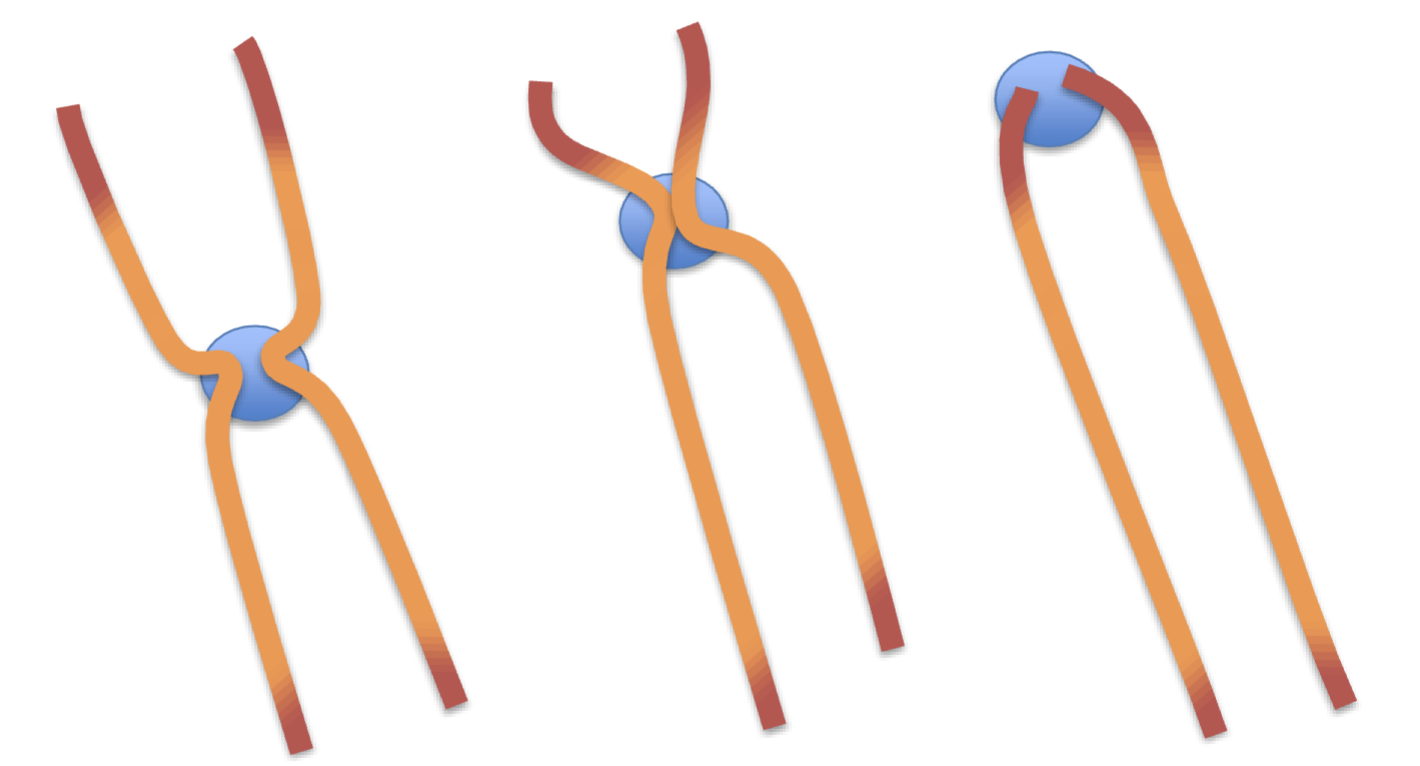
Characterise each chromosome by shape.
Metacentric, acrocentric, telocentric
Haploid
Organisms that have one set of chromosomes of which each is unique
Diploid
Organisms that have two sets of chromosomes of similar shapes
Euploidy
The right number of chromosomes for an organism
Aneuploidy
An incorrect chromosome number
Which organisms use XY sex determination system?
Plants, vertebrates, insects
Which is male and female in the XY sex determination system?
XY is male, XX is female
Homomorphic chromosomes
Chromosome pairs that are similar in shape, size and gene content
Heteromorphic chromosomes
Chromosome pairs that differ in shape size and gene content
Pseudoautosomal Regions (PARs)
Homologous sequences of nucleotides found at the tips of sex chromosomes
PARs in humans
PAR1, PAR2
Function of SRY and Eif2s3y genes
Determining male phenotype, morphological development + guiding gametes
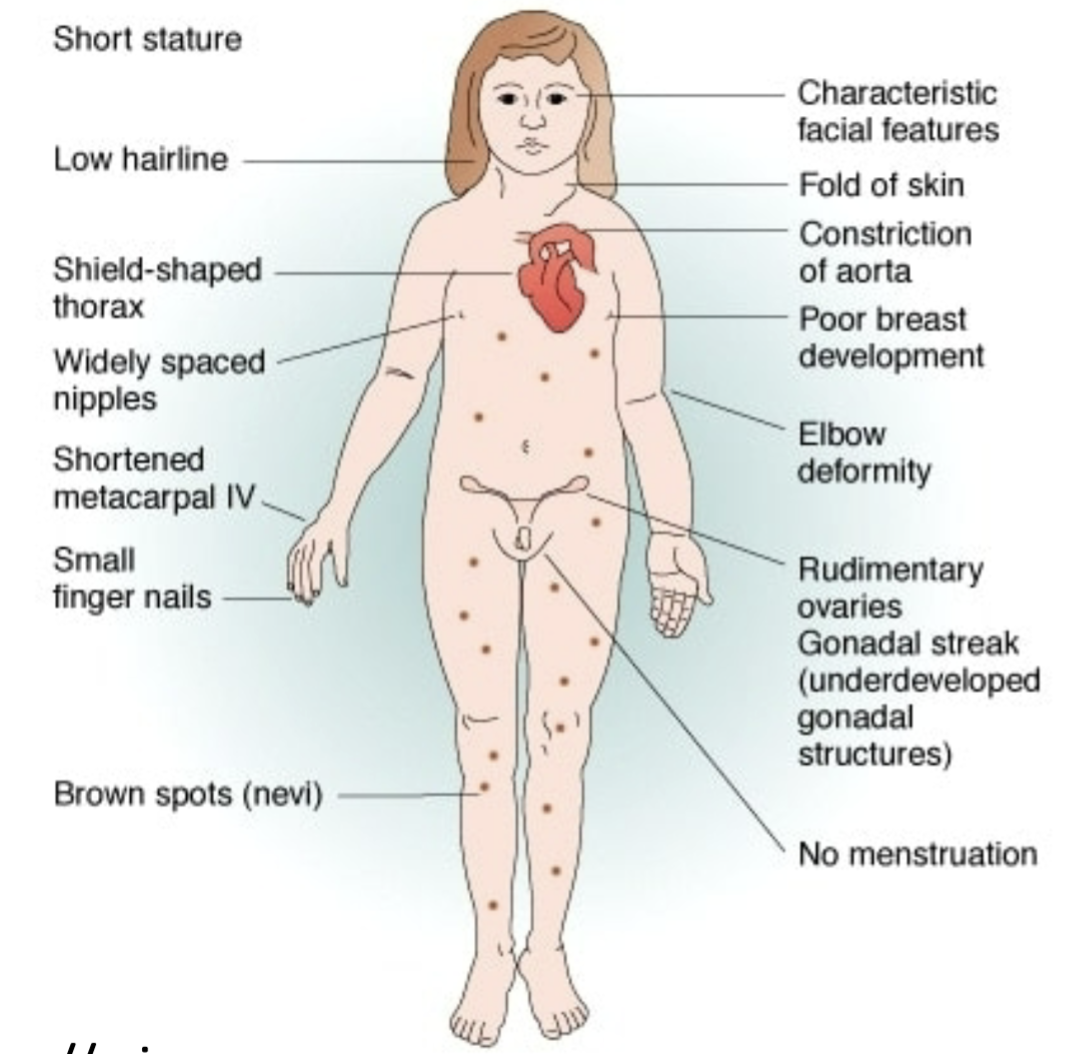
Turner syndrome cause
X
Turner syndrome symptoms
Female phenotype
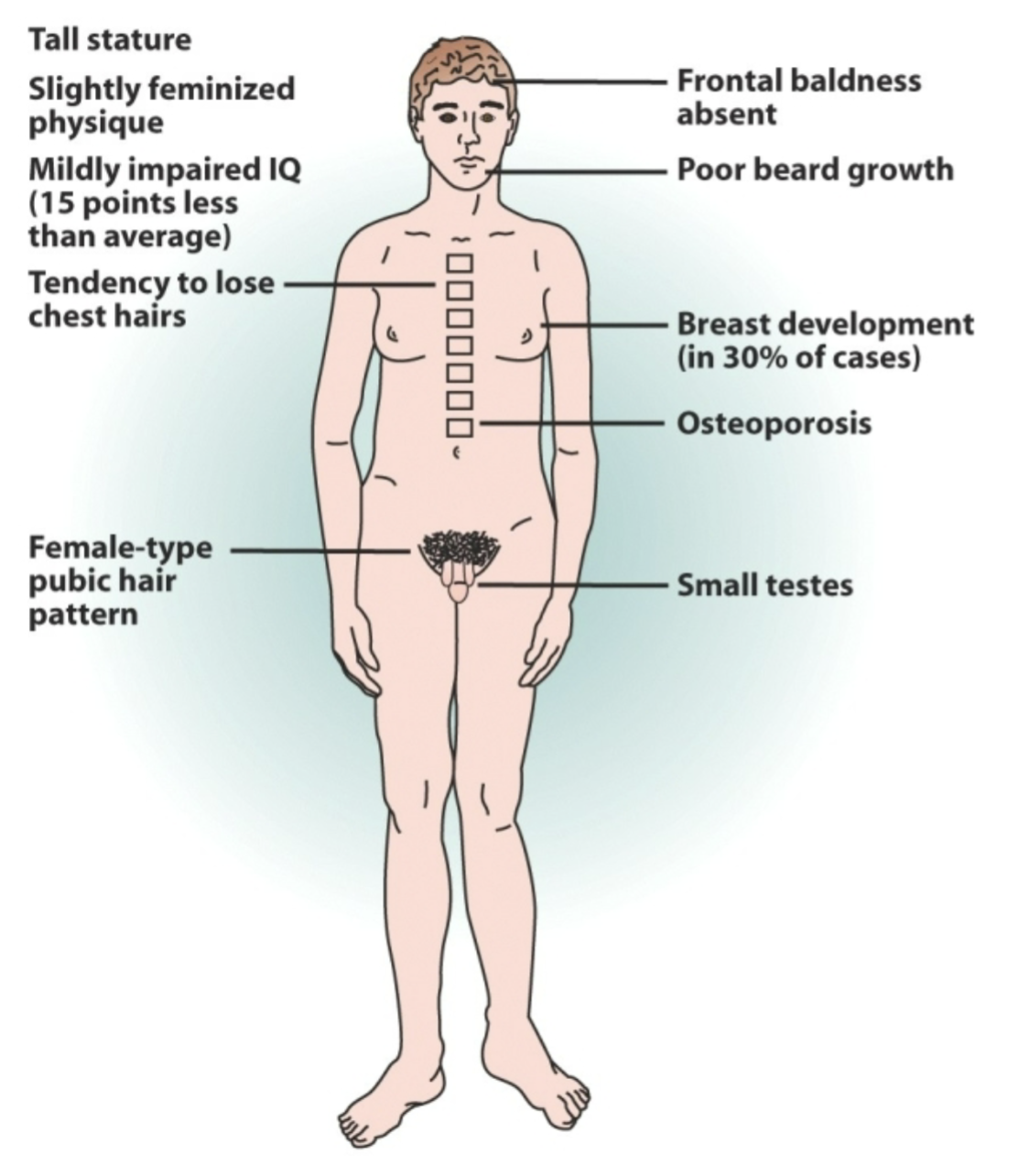
Klinefelter syndrome cause
XXY
Klinefelter syndrome symptoms
Male phenotype
Describe sex determination in fruit flies (Drosophila melanogaster)
The absence of a second X determines male sex.
Which organisms use ZW sex determination system?
Birds, reptiles
Which is male and female in the ZW sex determination system?
ZZ is male, ZW is female
Which organisms use haplodiploid sex determination system?
Insects - ants, bees
Which is male and female in the haplodiploid sex determination system?
2n is female, n is male
Stages of interphase
G1, S, G2
Outline the G1 stage of interphase.
Period of cell growth before the DNA is duplicated
Outline the S phase of interphase
Period when DNA (chromosomes) are duplicated
Outline the G2 stage of interphase
Period after DNA is duplicated; cell prepares for division
Stages of mitosis
Prophase, pro-metaphase, metaphase, anaphase, telophase
Describe prophase
DNA condenses into discrete chromosomes
Describe metaphase
Chromosomes align along metaphase plate, spindle fibres attach to kinetochores
Describe anaphase
Spindle fibres separate chromosomes into sister chromatids, daughter chromosomes pulled to opposite poles of the cell
Describe telophase
Chromosomes de-condense, new nuclear membranes form, the two daughter cells separate
What is the product of meiosis I?
2 haploid daughter cells
What is the product of meiosis II?
4 haploid daughter cells
Consequences of meosisi
Haploid gametes, increased genetic diversity
What events in meiosis increase genetic diversity
Random assortment, crossing over
Mendel’s Observations
Phenotype is determined by heritable factors (genes)
Alternate forms of genes (alleles) responsible for variation
An organism inherits 1 copy of the gene from each paretn
If two different alleles are present, one is dominant and one is recessive
The two alleles for each character segregate during gamete production
Albinism cause
Lack of melanin production, the enzyme responsible for melanin production (tyrosinase) breaks.
Albinism inheritance type
Recessive
Tyrosinase gene location
Chromosome 11
Phenylketonuria cause
Metabolic disorder, block in phenulketoneuria prevents production of tyrosine.
Phenylketonuria inheritance type
Recessive
Beta thalassemia cause
Blood disorder, beta-globin not formed properly, oxygen and carbon dioxide cannot be carried at same concentration/efficiency levels than needed
Incomplete dominance
3 distinct phenotypes are evidence
Co-dominance
In heterozygotes, both alleles are expressed
Hemizygote
An organism that has only one copy of a specific gene rather than the usual two
Describe prometaphase
Nuclear envelope breaks down, freeing the sister nucleotids from the nucleus; centrosomes move away from each other, development of kinetochore
Locus
Specific location of a gene along the length of a chromosome
Karyotype
Display of condensed chromosomes arranged in pairs by size + shape
Karyotype use
Screen for defective chromosomes or abnormal numbers of chromosomes
How are karyotypes prepared
Prepared from isolated somatic cells (treated with a drug to stimulate mitosis, then isolated + stained when chromosomes are most highly condensed). Digital software arranges pairs according to appearance.
Why do chromosomes in karyotype consist of two sister chromatids?
Chromosomes photographed during M phase.
Alternation of generations
A life cycle in which there is both a multicellular diploid form (sporophyte) and a multicellular haploid form (gametophyte)/ The sporophyte generation produces a gametophyte as its offspring and vice versa.
Third type of life cycle (fungi + some protists)
After gametes fuse and form a diploid zygote, the zygote undergoes meiosis to produces haploid cells that then divide by mitosis into unicellular descendants or a haploid multicellular adult organism.
Describe crossing over.
DNA molecule of two non-sister chromatids are broken at precisely corresponding points, then the chromatin condenses.
Homologues attach to each other, forming a synaptonemal complex.
During synapsis, the DNA breaks are closed up when each broken end is joined to the corresponding segment of the nonsister chromatid, producing crossovers.
After the synaptonemal complex disassembles, the homologues move slightly apartt from each other but remain attached. The points of attachment show up as chiasmata.
Synapsis
The pairing and physical connection of one duplicated chromosome to its homolog during prophase I of meiosis
Synaptonemal complex
A zipper-like structure composed of proteins which connects a chromosome to its homolog tightly along their lengths during prophase I of meiosis
Is crossing over compulsory?
At least one crossover per chromosome must occur in order for the homologous pair to stay together as it moves to the metaphase I plate
Chiasma
Result of crossing over and sister chromatid cohesion along the arms.
Which organism and trait did Mendel study?
White and purple pea flowers
Law of segregation
The two alleles for a heritable character segregate during gamete formation and end up in different gametes
Law of independent assortment
Each pair of alleles segregates independently of any other pair of alleles during gamete formation
Pleiotropy
The ability of a single gene to have multiple effects
Epistasis
When the phenotypic expression of one gene alters that of another independently inherited gene
Polygenic inheritance
An additive effect of two or more genes on a single phenotypic character
Multifactorial
A phenotypic character that is influenced by multiple genes and environmental factors
Amniocentesis
Amniotic fluid is tested for the presence of genetic disease
Chromosome theory of inheritance
Genes are located at specific loci on chromosomes and the behaviour of chromosomes during meiosis account for inheritance patterns
Describe X Inactivation in Females
The inactive X in each cell of a female condenses into a Barr body
Linked genes
Genes located close enough together on a chromosome that they tend to be inherited together
What did Griffith’s experiment prove?
Bacteria can transfer genetic information through a process of ‘transformation’
What did Griffith’s experiment demonstrate?
A cellular ‘transforming principle’ could pass from dead, virulent bacteria to live, harmless ones, permanently changing their traits
Results of Avery, MacLeod and McCarty experiment?
Enzymes that destroyed proteins or RNA did not stop transformation, however enzymes that destroyed DNA did.
What did Avery, MacLeod and McCarty’s experiment imply?
DNA is the transforming principle
Results of Hershey and Martha Chase’s experiment
Radioactively labelled sulfur was not passed down to offspring, however radioactively labelled phosphate was.
What did Hershey and Martha Chase’s experiment prove?
DNA, not protein, is the genetic material.
Is genotype determined by DNA or proteins?
DNA
Is phenotype determined by DNA or proteins?
Proteins
Name 3 ways in which proteins determine phenotype
The molecules visible in the phenotype
The enzymes that make molecules visible in the phenotype
The signals to make visible changes in phenotype
Semi-conservative replication
The parent DNA strands separate and individually serve as a template for a new strand
Conservative replication
Original parent DNA model stays entirely intact and serves as a template to create a completely new, separate DNA model made of two new strands
Dispersive replication
Resulting helices contain patchwork of old and new DNA segments
DNA polymerase III function
Extends the RNA primer by catalysing DNA polymerisation in the 5’ to 3’ direction after primase provides a semi-complete template.
Replication bubbles
Location of DNA replication
DNA helicase function
Unzip DNA from replication origins
Primase function
Produce RNA primer
Okazaki fragments
Start-stop regions of DNA replication on the lagging strand because DNA helicase and DNA pol III travel in opposite directions
DNA ligase
Seals DNA fragments and DNA backbone by forming covalent bonds.
DNA polymerase I function
Replace RNA primers with DNA and leaves a blunt end.
Telomere
End of a chromosome
RNA polymerase II function
Catalyses transcription from 5’ to 3’
Transcription steps
Initiation
Elongation
Termination
Describe the initiation step of transcription
RNA polymerase binds to a promotor (special DNA sequence)
Describe the elongation step of transcription
Addition of complementary rNTPs
Describe the termination step of transcription
Release of RNA polymerase and completed RNA from the DNA template at the terminator (unit of DNA with a particular sequence)
Redundant genetic code
More codes than amino acids
Name the tRNA binding sites
A (amino acyl) site, P (peptidyl) site, E (exit) site
What does the ribosome catalyse
Joining of amino acids by covalent bonds.
Describe the ribosome’s A (amino acyl) site
The next amino acid/tRNA waits for peptide bond formation
Describe the ribosome’s P (peptidyl) site
Holds the growing protein protein attached to a tRNA