Ch1 Intro - systems, anatomical directions, terms
 Call Kai
 Learn
Learn Practice Test
 Spaced Repetition
 Match
Match Flashcards
 Knowt Play
1/14

There's no tags or description
Looks like no tags are added yet.
Name | Mastery | Learn | Test | Matching | Spaced | Call with Kai | Chat |
|---|
No analytics yet
Send a link to your students to track their progress
15 Terms
All body systems
MR DICE RUNS
Muscular - movement, heat production
Respiratory - O2 intake + CO2 removal
Digestive - breaking down food + nutrient absorption
Integumentary - regulates body temp, protection, encloses other organs
Cardiovascular - oxygen, gas and nutrient transport
Endocrine - hormonal regulation
Reproductive
Urinary - water regulation, filters waste from blood
Nervous - rapid communication, control
Skeletal - structural support, RBC prod, mineral storage
Lymphatic/Immune
Front to back directional terms
Anterior/ventral - front
Posterior/dorsal - back
Up and down directional terms
Superior/cranial - up
Inferior/caudal - down
Lying on back / lying face down
Supine - lying on back
Prone - face down
Proximity to attachment point
Proximal - closer to attachment
Distal - farther from attachment
*These terms are used comparatively (eg. an elbow is not just “proximal” but “proximal to _”)
Body planes
& oblique: combination of 2+
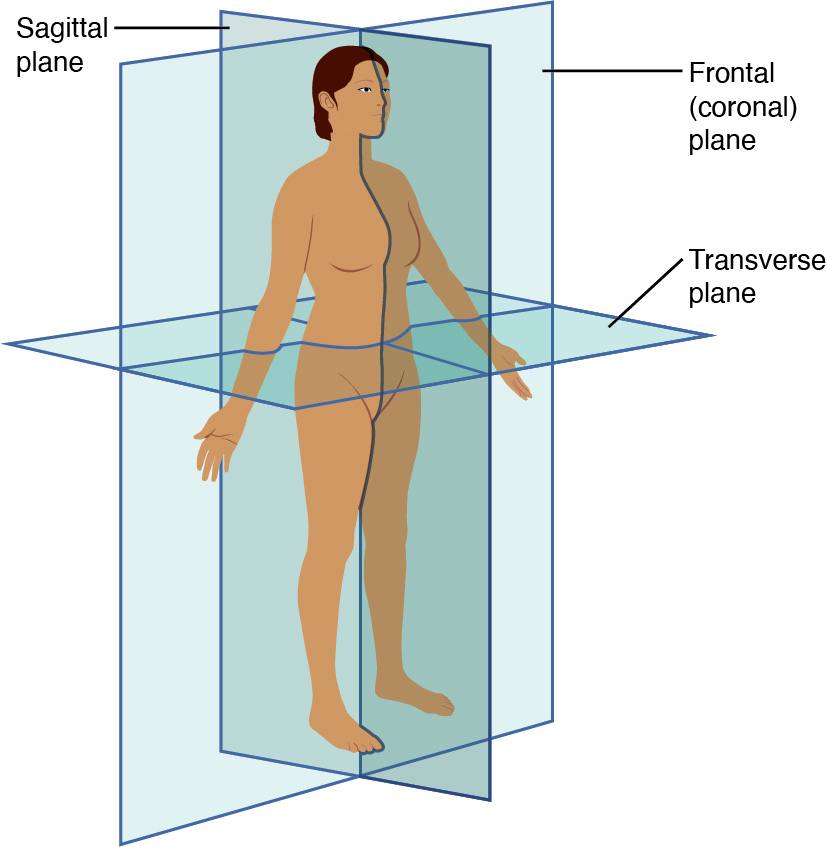
Midline of body
Medial - midline
Lateral - direction farther from middle line towards side
*eg. a vertical cut would be a mid-saggital section, moving left or right would be lateral compared to the midline
Surface / deep directional terms
Superficial - Surface
Deep
Ventral / anterior cavities
Thoracic (superior to diaphragm)
Abdominopelvic (inferior to diaphragm) - abdominal and pelvic cavities, no distinct border
Areas of thoracic cavity
L + R pleural cavities (cover lungs and line the chest)
Mediastinum
Contains major heart vessels, trachea, esophagus (superior cavity)
Has pericardial cavity with heart and surrounding membranes + fluid
Further divided into superior mediastinum and ventral, middle, posterior mediastinum (inferior)
Abdominopelvic quadrants
From up to down:
L + R hypochondriac, epigastric region (middle)
L + R lumbar, umbilical
L + R iliac, hypogastric
Posterior / dorsal cavities
Cranial and vertebral cavity
Types of serous membrane
Visceral - surrounds organ (innermost)
Parietal - lines body cavity (outermost)
Types of tissue
Muscular, nervous, epithelial, connective
Feedback loop
Stimulus (trigger) → sensor → control → effector
Sensory receptor, control center (brain), target organ