Physical diagnosis from study guide
 Call Kai
 Learn
Learn Practice Test
 Spaced Repetition
 Match
Match Flashcards
 Knowt Play
1/416

There's no tags or description
Looks like no tags are added yet.
Name | Mastery | Learn | Test | Matching | Spaced | Call with Kai | Chat |
|---|
No analytics yet
Send a link to your students to track their progress
417 Terms
What is the purpose of the physical examination in a patient's history and physical (H&P)?
To determine the general state of patient health.
What system is used in physical examination to gather data leading to a diagnosis and treatment plan?
Problem-oriented system.
What are the typical sections included in a physical examination template?
General appearance, Vital Signs, HEENT (head, eyes, ears, nose, and throat), Neck, Heart, Lung, Abdomen, Extremities, Neuro.
What is the primary goal of conducting a physical examination?
To create a data base.
After reviewing a patient's past medical history (PMH), what is the typical next step in the diagnostic process?
Physical exam, followed by imaging.
How does a data base from physical examination guide patient care?
It guides treatment recommendations.
In what situations should a medical consultation be sought for a patient?
If needed for unclear or complex cases.
What should not be requested during a medical consultation for a patient?
Permission for "clearance".
What should a physical examination always begin with?
Chief complaint (CC) and history of present illness (HPI).
What does ROS stand for in the context of patient assessment?
Review of Systems.
What systems are typically included in a Review of Systems (ROS)?
Constitutional, eyes, ENT, mouth, CV (cardiovascular), respiratory, GI (gastrointestinal), GU (genitourinary), integument, neuro, psycho, endocrine, hematology/lymphatic, allergic/immunologic.
What are the four primary methods used during a physical examination?
Inspection, palpation, percussion, auscultation.
What types of imaging studies are commonly used in medical assessments?
X-ray, CT, MRI (also known as NMR), PET (positron emission tomography).
What laboratory tests are often part of a physical examination summary?
CBC, coags/INR, basic metabolic panel, comprehensive metabolic panel, glucose levels, HbA1C, drug levels, viral loads.
What are the four vital signs (VS) typically measured?
Temperature, pulse, blood pressure (BP), respiration.
Why is temperature measurement particularly important in dentistry?
As an indication of infection.
What is the definition of hyperpyrexia or hyperthermia?
Body temperature over 41°C or over 106°F.
What is malignant hyperthermia?
A genetic hypermetabolic response of skeletal muscles primarily to halogenated ethers and succinylcholine.
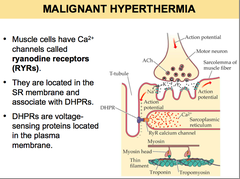
What is the treatment for malignant hyperthermia?
Dantrolene.
What is the definition of hypothermia?
Body temperature less than 35°C or 95°F.
How is core body temperature most accurately determined?
Rectally.
What does the term "febrile" mean in medical context?
Elevated body temperature.
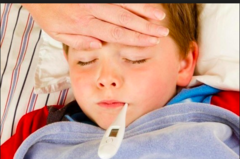
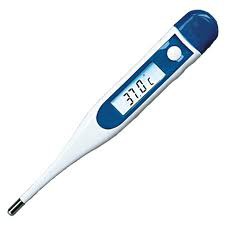
What does the term "afebrile" mean in medical context?
Normal body temperature.
What is the physiological mechanism that causes fever?
Macrophages and interleukins affecting the hypothalamus to change temperature.
Where is the radial artery located for palpating pulse?
Lateral wrist.
Where is the brachial artery located for palpating pulse?
Medial antecubital fossa.
Why should you avoid using your thumb when checking a patient's pulse?
Because the thumb has its own pulse.
What is the normal range for pulse rate in beats per minute (bpm)?
60-85 bpm.
What is the definition of tachycardia?
Pulse rate over 100 bpm.
What is the most common cause of tachycardia in a dental setting?
Intravascular injection.
What is the definition of bradycardia?
Pulse rate under 60 bpm.
What are common causes of bradycardia?
Beta blockers and other factors.
How can the regularity of a pulse be assessed?
By radial pulse or EKG.
What does blood pressure measure?
Pressure on arterial walls caused by arterial blood flow.
What does systolic blood pressure represent?
Peak pressure.
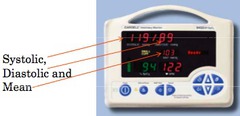
What does diastolic blood pressure represent?
Trough pressure.
What blood pressure reading indicates a hypertensive crisis?
180/120.
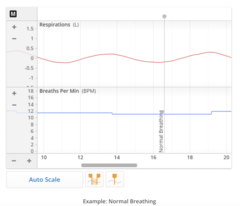
What is the normal respiration rate in breaths per minute (bpm)?
12 to 16 bpm.
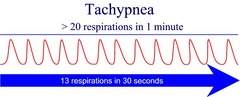
What is the definition of tachypnea?
Increased respiration rate with unchanged tidal volume (TV).
What is the definition of apnea?
No respiration and no tidal volume (TV).
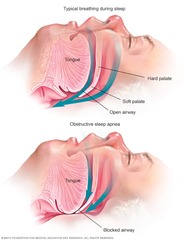
What is the definition of dyspnea?
Difficult breathing with subjective feeling of suffocation.

What is the typical value for tidal volume (TV) in respiratory physiology?
500 mL (often approximated as 0.5 L).
What is respiratory rate in the context of respiratory physiology?
The number of breaths per minute, typically 12-16.
What is respiratory minute volume?
Tidal volume multiplied by respiratory rate.
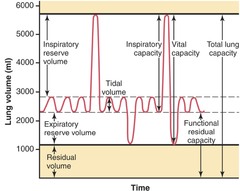
What is functional residual capacity (FRC) in respiratory physiology?
The volume of air remaining in the lungs after a normal exhalation.
What does CBC stand for in laboratory tests?
Complete Blood Count.
What components are typically included in a Complete Blood Count (CBC)?
WBC (white blood cells), Plt (platelets), HgB (hemoglobin), Hct (hematocrit).
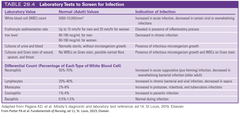
Why is white blood cell (WBC) count important in medical assessments?
For evaluating infections and monitoring chemotherapy.
What is the normal range for white blood cell (WBC) count?
4-11 x 10^3 cells/mm³.
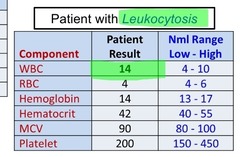
What is leukocytosis?
White blood cell count over 11,000, usually due to infection.
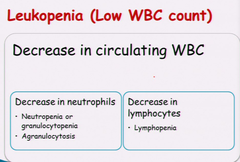
What is leukopenia?
White blood cell count under 4,000, due to viral infection, aplastic anemia, or medications like chemotherapy, antidepressants, psychotics.
What is the normal range for red blood cell (RBC) count?
4.5-6 x 10^6 cells/mm³.
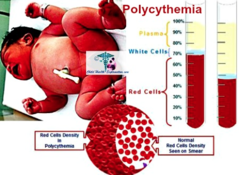
What is polycythemia?
Red blood cell count too high, due to bone marrow response to chronically low oxygen or malignancy.
What is anemia?
Impaired production, destruction, or fluid loss of red blood cells.
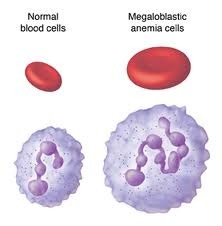
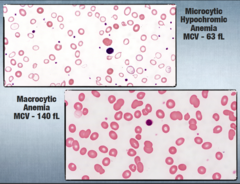
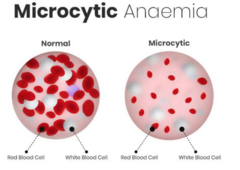
What are the two types of anemia based on cell size?
Microcytic anemia and macrocytic anemia.
What is hematocrit (Hct) related to in blood?
Oxygen carrying capacity of red blood cells, primarily dependent on the number of RBCs, not hemoglobin per cell.
What does hematocrit (Hct) represent?
Percentage of red blood cell mass in total blood volume.
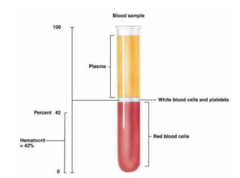
What causes a high hematocrit (Hct) level?
Polycythemia, dehydration, increased altitude, heart disease, etc.
What causes a low hematocrit (Hct) level?
Anemia, hemorrhage, alcohol, drugs, etc.
What is the normal hemoglobin (HgB) range for men?
14-18 g/dL.
What is the normal hematocrit (Hct) range for men?
40-50%.
What is the normal hemoglobin (HgB) range for women?
12-16 g/dL.
What is the normal hematocrit (Hct) range for women?
37-47%.
What is the normal range for platelet (Plt) count?
150-450 x 10^3 per mm³.
What is thrombocytosis?
Platelet count too high, due to bone marrow issues, leukemia, or spleen problems.
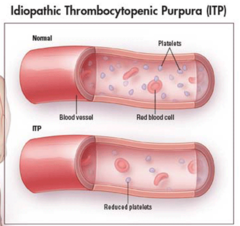
What is thrombocytopenia?
Platelet count too low (less than 50,000), due to B12/folic acid deficiencies, diseases like leukemia, liver failure, sepsis, syndromes, or medication-induced.
What does ITP stand for in hematology?
Idiopathic Thrombocytopenia Purpura.
What is the typical lifespan of a platelet?
7-10 days.
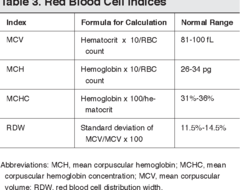
What do MCV, MCH, and MCHC help determine in blood tests?
The etiology of anemia.
What causes microcytic anemia?
Vitamin deficiency, liver disease, or medications.
What causes macrocytic anemia?
Iron (Fe) deficiency.
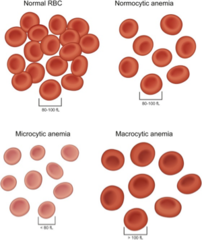
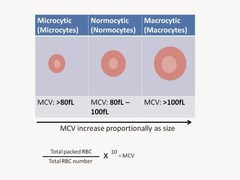
What is the normal range for Mean Corpuscular Volume (MCV)?
80-100 fL, representing average red blood cell volume.
What is the normal range for Mean Corpuscular Hemoglobin (MCH)?
27-31 pg, estimating weight of hemoglobin in average red blood cell.
What is the normal range for Mean Corpuscular Hemoglobin Concentration (MCHC)?
32-36 g/dL, estimating average concentration of hemoglobin in average red blood cell.
What does PT stand for in coagulation tests?
Prothrombin time.
What is the normal range for prothrombin time (PT)?
10-12 seconds.
What does INR stand for in coagulation tests?
International normalized ratio.
What is the normal INR range in the absence of coagulation therapy?
0.8-1.2.
What are the therapeutic INR ranges with coagulation therapy?
Either 2.0-3.0 or 2.5-3.5.
What INR level is required for safe surgery?
Less than 3.0.
What does PTT stand for in coagulation tests?
Partial thromboplastin time.
What is the normal range for partial thromboplastin time (PTT)?
40-100 seconds.
What is bleeding time used for in coagulation assessment?
Screening test for assessing platelet number and function; no benefit if platelets below 60,000.
What factors can increase bleeding time?
Platelets less than 100,000, medications like aspirin or abciximab, chronic liver disease, anemias.
What is the normal value for bleeding time?
2-7 minutes.
Which coagulation tests evaluate the extrinsic pathway?
PT and INR.
Which coagulation tests evaluate the intrinsic pathway?
PTT and aPTT.
What does aPTT measure in coagulation?
Clotting ability of all factors in the intrinsic pathway except factor XIII; partial thromboplastin substituted for platelet phospholipid; monitors effects of Heparin.
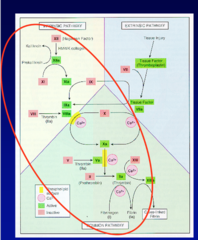
What is Lovenox in the context of anticoagulation?
Enoxaparin, a low molecular weight heparin.
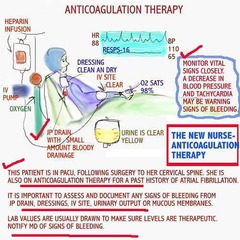
How does aspirin (ASA) affect platelets?
Irreversibly inhibits platelet cyclooxygenase, thus inhibiting platelet aggregation.
How long does it take for bleeding time to normalize after stopping aspirin (ASA)?
About 2-3 days, but recommended to wait a full 7 days without ASA prior to surgery.
How do NSAIDs affect platelet function?
Cause reversible inhibition of platelet aggregation.
In a metabolic panel, what potassium (K+) level raises concern for cardiac arrest?
Greater than 7 mEq/L.
In a metabolic panel, what potassium (K+) level raises concern for arrhythmias?
Below 3.5 mEq/L, causing weakness, confusion, tetany, ECG changes.
What is the normal range for potassium (K+) in a metabolic panel?
3.5-5.1 mEq/L.
What does BUN stand for in a metabolic panel?
Blood urea nitrogen.
What does BUN indicate in a metabolic panel?
Renal health, affected by changes in glomerular filtration rate (GFR) and fluid volume.
What is the normal range for BUN in a metabolic panel?
7-18 mg/dL.
What does Cr stand for in a metabolic panel?
Creatinine.
What does creatinine (Cr) indicate in a metabolic panel?
Renal health; it is a byproduct of muscle metabolism.