geology exam 2
 Studied by 0 people
 Call Kai
 Learn
Learn Practice Test
 Spaced Repetition
 Match
Match Flashcards
 Knowt Play
1/132

There's no tags or description
Looks like no tags are added yet.
Name | Mastery | Learn | Test | Matching | Spaced | Call with Kai |
|---|
No study sessions yet.
133 Terms
physical weathering
the breakdown of a rock produced by physical processes that do not alter its chemical composition, forms detritus
chemical weathering
the breakdown of a rock produced by chemical reactions, forms ions in solution
erosion
combination of processes that separate soil and rock from its substrate and move them away
with physical weathering, how do rocks break?
along natural zones of weakness (ex. bedding planes, fractures, foliation, joints, and cleavages) from expansion and contraction (hot/cold cycles - frost wedging), burrowing from creatures and roots wedging, and pounding forces from earth’s surface.
physical weathering opens the door for what…?
chemical weathering, as mechanical weathering breaks rocks into smaller pieces, more surface area is exposed to chemical weathering.
most important agent for chemical weathering?
water, responsible for transport of ions and molecules involved in the chemical processes.
processes of chemical weathering
dissolution, oxidation, and hydrolysis
how does water have its dissolving power?
it has an ability to dissolve minerals and transport them away. this process contributes to the formation of new rock formation and alteration of existing ones.
dissolving power of water equation
co2 (carbon dioxide) and h20 (water) = h2co3 (carbonic acid)
what type of minerals are prone to dissolution
carbonate minerals (calcite and dolomite) due to the presence of calcium and magnesium ions in them. when they are dissolute, they form caves and sinkholes.
granite being weathered
over time, quartz is weathered down into clay and quartz. everything (k-spar, plagioclase, biotite) besides quartz turns into sand and mud. quartz stays as quartz.
what makes up 75% of sedimentary rocks
siltstone, mudstone, and shale
what makes up 14% of sedimentary rocks
limestone and dolostone
what makes up 11% of sedimentary rocks
sandstone and conglomerate
hydrolysis
chemical weathering that involves the reaction of water with minerals, leading to their decomposition and alteration- significant for SILICATE MINERALS
chemical weathering of feldspar
hydrolysis… feldspar + water = clay and soluble ions (like potassium)
chemical weathering- iron oxidation
typically, in humid climates with water. iron pyroxene dissolves to release silica and ferrous ions to solution, that iron is oxidized by oxygen to form ferric iron. this iron combines with water to precipitate the solid iron oxide in the form of a solution.
oxidation
reaction of minerals and rocks with oxygen, leading to significant changes in theri composition and properties.
effects of chemical weathering
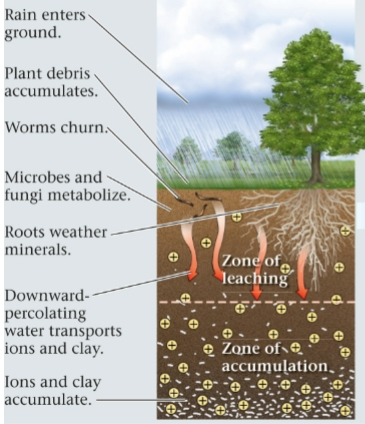
leaches out cations and silica, hydrates primary minerals to make new water bearing minerals, groundwater becomes less acidic.
rates of weathering influenced by
rock characteristics, mineral stability, climate, temperature, and precipitation
mineralogy with rates of weathering
silicate minerals weather in the same order as crystallization, carbonates and halides weather more quickly than silicates
climate/temperature/precipitation for rates of weathering
frequency of freeze-thaw, moisture available for dissolution, conditions favoring vegetation growth
marble vs granite mineral stability
marble is a calcite rich rock; it is very soluble to rain erosion and chemical weathering (dissolution) occurs way quicker than it does for the granite. granite experiences way less chemical weathering compared to the marble. it contains potassium feldspar, quartz, and plagioclase so when they go through hydrolysis it makes clay. oxidation also affects the headstone by causing discoloration and pitting. physical weathering affects granite with burrowing and frost wedging.
differential weathering
variations in local climate and the composition of the rock formation will produce uneven weathering of the rock
how do chemical and physical weathering work together
physical weathering will start to affect a rock and when it has more cracks it increases the surface area, making chemical weathering weakening the rocks and breaking it apart at a faster rate. once the rock is in grains and clay is made, the current washes the clay and quartz away
soil horizons
from top to bottom: organic material, leached sediment mixed with organics, leaching but no mixing with organic, ions and clay from mixed organics accumulate, and weathered rock with no leaching
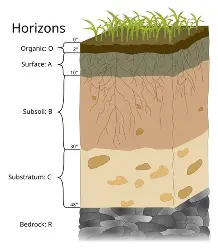
formation of soils
what is the main control on soil type
climate
other controls of soil type
the rock type below the soil. (ex- hardest rock=no soil, hard rock= thinner soil, weaker rock = thicker soil)
different types of sedimentary rocks
clastic, biochemical, chemical, organic
clastic rocks
weathered and eroded, transported by wind, water, or ice, deposited in layers, then cementation occurs. the clasts are cemented and compacted together, forming clastic rocks
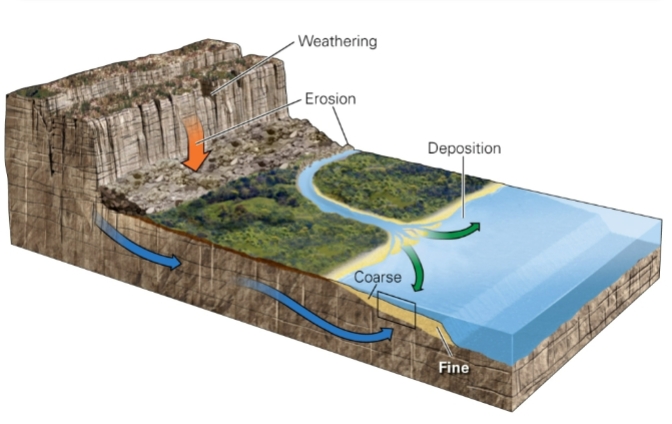
lithification
process in which sediments compact under increasing pressure and gradually become solid rock. converts unconsolidated sediments into sedimentary rocks
grain size and composition for clastic rocks
large grain size= closer to the source, smaller grain size= farther from the source
process of angularity to sphericity clastic rocks
angular (breccia), subangular, subrounded, to rounded (conglomerate)
clastic rocks and sorting
clastic rocks and the pebbles that are in them are sorted. when there is a combination of different pebble/clast sizes then it is poorly sorted. when the rocks are all the same uniform size than the rock is very well sorted.
clastic rocks and maturity
less mature rocks contain a plethora of different materials (clasts, silt, clay, feldspar, and quartz) in the rocks, while more mature rocks usually contain solely quartz sand grains.
why are sedimentary rocks so important?
their characteristics such as grain size, rounding, sorting, and composition can yield information about transport distance, transport medium, and depositional environment.
depositional environment
setting where sediments accumulate and form sedimentary rocks
bedding/stratification
distinct layers of sedimentary rocks deposited over time in various environments.
formation of bedding
overtime, layers of sedimentary rocks are formed from sediment deposition, compaction, and cementation.
ripple marks
when the current is going all in one direction
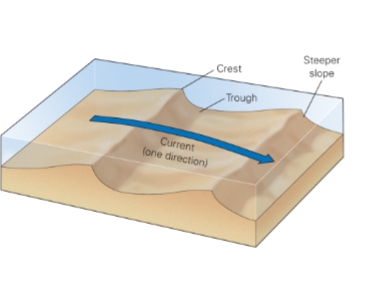
dune
the current is going in a back-and-forth motion
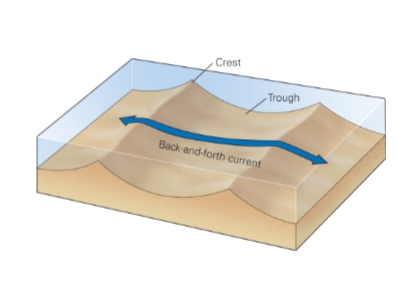
cross bedding
bedding planes that were influenced by water or wind. they are significant in interpreting ancient environments and are commonly found in structures like rivers, deltas, and coastal areas.
stratigraphic formations
where the different sedimentary layers of a rock are visible. (ex. the mt. simon formation of different sediment layers)
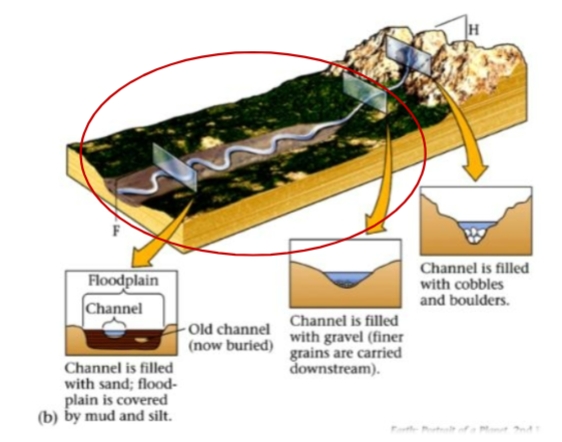
fluvial environments
channel is filled with sand and flood plain is covered by mud and silt- OLD CHANNEL IS BURIED, channel is filled with gravel and is filled with boulders
mountain stream (fluvial)
channel is filled with boulders

alluvial fan (fluvial)
mix of gravel, sand, silt, and mud. found in between mountain streams and river/ streams
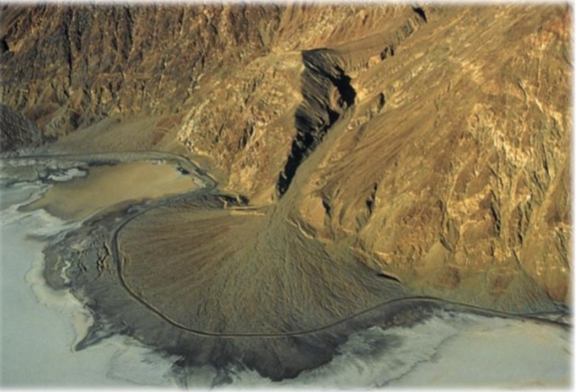
river and streams environment (fluvial)
channel is filled with sand and flood plain is covered by mud and silt- OLD CHANNEL IS BURIED
glacial diamictite
sedimentary rock that consists of unsorted and poorly sorted sediment. associated with glacial processes like debris flows and glacial till deposits.
river delta (marine environment)
interaction between the river flow and sediment supply as well as the distribution of river sediment by waves and tidal currents.
example of a biochemical sedimentary rock
limestone
biochemical sedimentary rock
formed from the accumulation of organic materials (like remains of animals and plants)
chemical sedimentary rock
formed by the precipitation of minerals from water or by the alteration of already existing material in place (chert)
organic sedimentary rock
formed from the accumulation and lithification of organic material (coal)
the hydrologic cycle
evaporation, transpiration, precipitation, infiltration, and runoff
what percentage of earth’s water is freshwater?
2.5% (freshwater)- 1% (saline lakes and groundwater)
forming streams and rivers
rain and precipitation flow down ground and take sediment with it, this forms a slight channel and over time it develops into a trunk stream and tributaries flow into the stream. headward erosion also lengths the channel
headward erosion
process where a stream or river erodes the land at its source, causing the channel to extend upstream and lengthen the stream
permanent/perennial streams
streams that are able to flow all year round when there is sufficient runoff to offset evaporation and water use.
ephemeral streams
streams that only flow for part of the year, common in arid and semi-arid regions where rainfall is infrequent
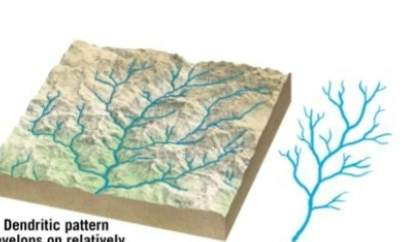
drainage patterns
arrangement of streams, rivers, and lakes in a specific area influenced by topography, geology, and hydrology of the area.
dendritic pattern
develops on relatively uniform surface materials
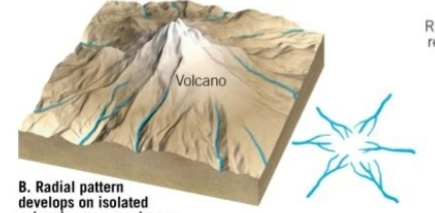
radial pattern
develops on isolated volcanic cones or domes
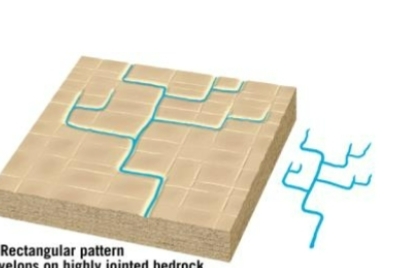
rectangular pattern
develops on highly jointed bedrock
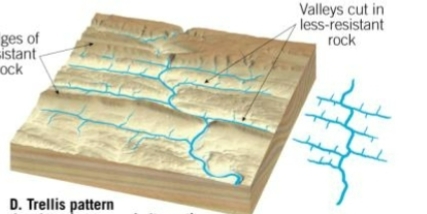
trellis pattern
develops in areas of alternation weak and resistant bedrock
drainage basins
land areas thar rain into a specific trunk stream, also known as catchments or watershed, divides are uplands that separate drainage basins
discharge
volume of water passing a point per unit of time
where is there more friction in channels?
in the shallower areas due to it catching onto sediments and other materials in the channel- SLOWER MOVING WATER
where is there less friction in a stream?
in the deep/middle of the river, does not catch onto sediment- FAST MOVING WATER
suspended load
portion of sediment that is carried within a solution and remains suspended due to the turbulence consisting of fine particles like clay and silt.
headwaters of a river
close to a steep gradient, water is moving fast, with the fast water is causes white waters, high energy, lots of sediment being moved, walls around riverbanks erode away quickly forming an alluvial fan
braided streams
have channel bars of piled sediment, all the sediment gathers
base level
gradients get low, meandering rivers, when rivers overflow, they give off slit and clay which is good for farming
meandering stream
channels form intricately looping meanders along the lower gradient portion of the longitudinal profile
cut banks
on the outside of a meander where velocity and turbulence are the greatest. formed when the river is flowing fast and causes the most erosion. point of erosion
point bars
when water slows on the inside of a meander, sediment is deposited and forms a point bar. point of deposition
oxbow lake
forms when the meanders of a meandering river connect at the neck and cut off the rest of the river, forming a lake.
floods
when the stream exceeds the capacity of its channel- the most common and destructive geologic hazard
types of floods
regional, ice-jam, dam failure, and flash flood
living with floods
flood risks are calculated as probabilities, discharges are plotted against recurrence intervals, the probability of a given discharge can be determined by graph inspection.
regional floods
seasonal floods that typically result from spring rains or rapid melting of snow (ex. 2011 in the mississippi river)
flash floods
occur with no warning, produce rapid rises in water levels and have devastating flow velocities, mountainous areas are extremely susceptible due to steep slopes (ex. 2011 flash floods in upstate new york from hurricane irene)
ice jam flood
ice forms in rivers creating dams that will break when temperatures rise, common problem with north flowing rivers in the northern hemisphere
dam failure floods
dams designed to contain small or moderate floods face a larger volume flood event, dams fail and release large amounts of water as a flash flood. (ex. derna dams collapsing in libya)
ways to control floods
artificial levees, channelization, and flood-control dams
artificial leeves
commonly used stream-containment structures, earth mounds built on riverbanks to increase the capacity of the channel, not built to withstand and often fail in floods
channelization
altering a stream channel to make a flow more efficient, can make the stream straighter or deeper, accelerates erosion
flood-control dams
built to store floodwater and release it slowly (in a controlled manner), typically provide water for irrigation and hydroelectric power
best approach to flood control
limit development within floodplains of high-risk flood areas
geologic history of the Mississippi river
the river has deposited sediment along its floodplain and at its terminus for over 150 million years and it has created much of Louisiana and mississippi.
development of the Mississippi
in the 1870’s the us government began large scale river control system on the river, the main reasons were 1) commerce, 2) flood control, 3) to prevent channel migration
other work done on the mississippi river
thousands of miles of levees installed, the river was straightened and shortened by 150 miles, dredging kept the river open for navigation, and wing dams were built to constrict the speed of the current- all of this was done for humans moving onto the river to prevent further issues and provide for them
moving the mississippi river documentary, what was the issue/solution
louisiana is sinking into the water fast, the solution is to cut controlled channels off of the mississippi so mud can spill out and form new land.
what was used for bank stabilization in the mississippi river
woven willow mats
the largest use of groundwater
irrigation, followed by public supply
how is groundwater stored in the earth?
the water table- moisture sticks grains surfaces; air pockets remain, all pore spaces are filled with water.
porosity
measure of void spaces in material where water can reside
permeability
the ability of water to flow through places- so water can be used
second porosity/permeability
happens when rocks have fractures, they are not as porosity/permeable as well as they used to- but they can still hold the water