Introduction to Medicine for the Practicing Dentist
 Call Kai
 Learn
Learn Practice Test
 Spaced Repetition
 Match
Match Flashcards
 Knowt Play
1/38

Earn XP
Description and Tags
Comprehensive vocabulary flashcards covering patient assessment, physical examination, and laboratory diagnostic standards for dental practice.
Name | Mastery | Learn | Test | Matching | Spaced | Call with Kai | Chat |
|---|
No analytics yet
Send a link to your students to track their progress
39 Terms
CAGE
A screening tool for alcohol and drug use consisting of four questions: Have you ever felt you should CUT DOWN? Have people ANNOYED you by criticizing? Have you ever felt GUILTY? Have you ever used first thing in the morning (EYE OPENER)?
Chief Complaint
The reason for the medical visit described in the patient’s own words, used to help establish priorities and clarify why treatment is desired.
History of Present Illness
The patient's description of their chief complaint, including when it first appeared, any changes, and constitutional symptoms.
STOP-BANG
A screening tool for Obstructive Sleep Apnea evaluating Snoring, Tiredness, Observed apnea, high blood Pressure, BMI, Age (>50), Neck circumference (>16in), and Gender (male).
Review of Systems (ROS)
A sequential, comprehensive method of eliciting patient symptoms organized by organ systems, which may reveal undiagnosed medical conditions.
HEENT
An acronym for the physical examination of the Head, Eyes, Ears, Nose, and Throat.
Korotkov Sounds
The turbulent flow sound produced when an artery is compressed during blood pressure measurement.
ASA I
A classification for a normal, healthy patient.
ASA II
A classification for a patient with mild systemic disease or a significant health risk factor.
ASA III
A classification for a patient with severe systemic disease that is not incapacitating.
ASA IV
A classification for a patient with severe systemic disease that is a constant threat to life.
ASA V
A classification for a moribund patient who is not expected to survive without the operation.
ASA VI
A classification for a declared brain-dead patient whose organs are being removed for donation.
Occiput
The back part of the head or skull.
Hypothyroidism (Hair Indicator)
Characterized by coarse hair texture during a physical examination.
Hyperthyroidism (Hair Indicator)
Characterized by fine hair texture during a physical examination.
Inflammatory Swelling
Swelling characterized by short duration, tenderness, erythema, and mobility.
Neoplastic Swelling
Swelling characterized by longer duration, fixed position, and variable growth rate and tenderness.
Direct Reaction
Pupillary constriction in the same eye being tested.
Consensual Reaction
Pupillary constriction in the opposite eye from the one being tested.
Miosis
The constriction of the pupils.
Mydriasis
The dilation of the pupils.
Anisocoria
The condition of having unequal pupils.
Hemoglobin (Normal Range)
13.5−17.5g/dL for males and 12−16g/dL for females; measures the oxygen-carrying capacity of blood.
Hematocrit (Normal Range)
39−49% for males and 25−45% for females; measures the relative volume of cells and plasma in blood.
White Blood Cells (WBC)
Cells that measure host defense against inflammatory agents; adult/late adolescent range is 4,000−10,500/μL.
Absolute Neutrophil Count (ANC)
A measure of infection risk; a value <1,000/μL indicates the patient is at increased risk for infection.
Prothrombin Time (PT)
Measures extrinsic and common pathways (factors I, II, V, VII, and X); normal value is 11−15sec.
Partial Thromboplastin Time (PTT)
Measures intrinsic and common pathways (factors I, II, VIII, IX, X, XI, and XII); normal value is 20−35sec.
Bleeding Time
Tests platelet and vascular phase and measures the quality of platelets; normal value is 2−7min.
International Normalized Ratio (INR)
A calculated ratio of patient PT to control PT; the normal value is 1 without anticoagulation therapy.
Sodium (Na)
Electrolyte with a normal range of 134−143mmol/L; increased in Cushing’s syndrome or excessive water loss.
Potassium (K)
Electrolyte with a normal range of 3.3−4.6mmol/L; increased in renal failure, Addison’s disease, or acidosis.
Bicarbonate (HCO3)
Reflects acid-base balance; normal range is 22−29mmol/L.
Blood Urea Nitrogen (BUN)
A marker for kidney function and hydration with a normal range of 7−20mg/dL.
Creatinine (Cr)
Used to evaluate kidney function; normal range is 0.7−1.3mg/dL.
Hemoglobin A1C (HbA1C)
Measure of average blood sugar; normal is <5.6%, prediabetes is 5.7−6.4%, and DM is >6.5%.
CD4 Count
A measure of immune health in HIV patients; a level <200cells/mm3 is an AIDS-defining condition.
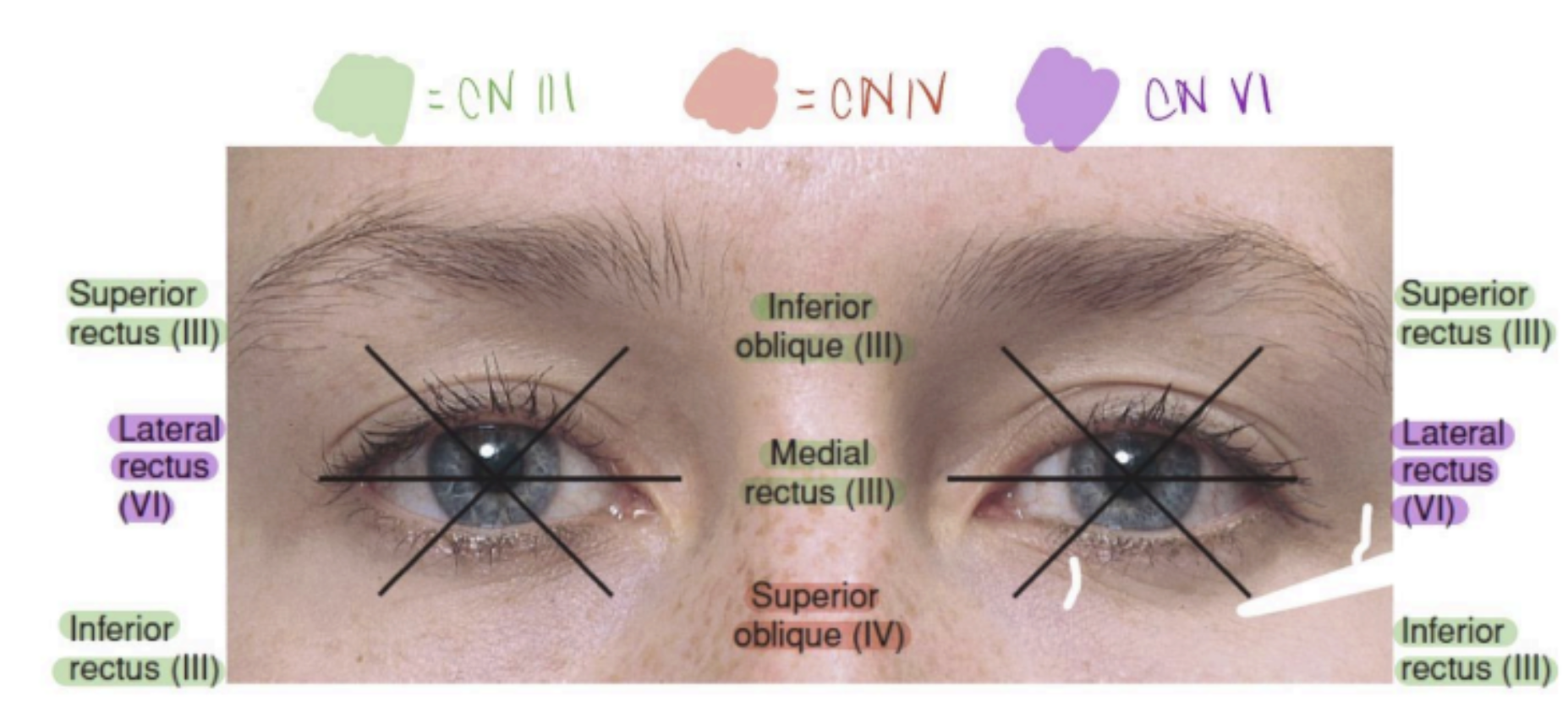
Extraorbital muscles and their cranial nerves
All CN III except for Lateral Rectus (CN VI) and Superior Oblique (CN IV)