Gen Chem Quiz 3
 Call Kai
 Learn
Learn Practice Test
 Spaced Repetition
 Match
Match Flashcards
 Knowt Play
1/49

There's no tags or description
Looks like no tags are added yet.
Name | Mastery | Learn | Test | Matching | Spaced | Call with Kai | Chat |
|---|
No analytics yet
Send a link to your students to track their progress
50 Terms
Factors affecting reaction rates
1. Physical states of the reactants
2. Concentration of reactants
3. Temperature
4. Surface area
5. Catalysts
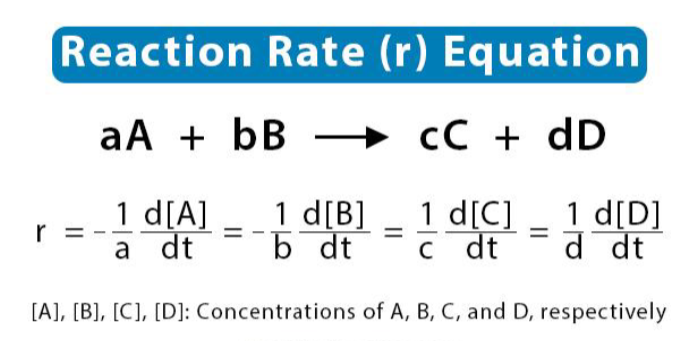
Reaction Rate Equation
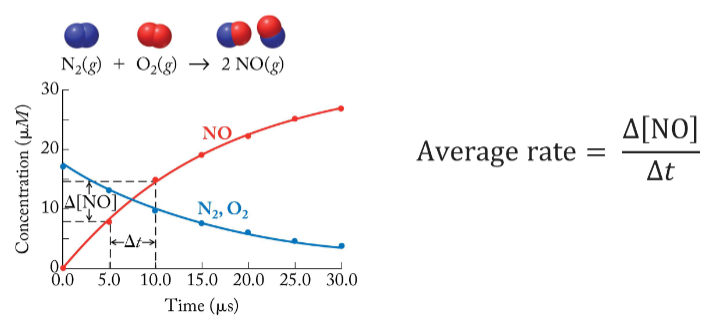
Average rate
Change in concentration of reactant or product over a
specific time interval
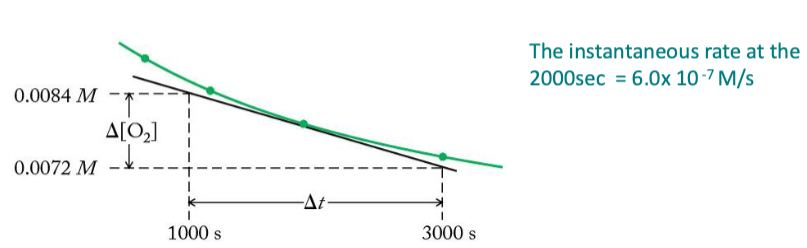
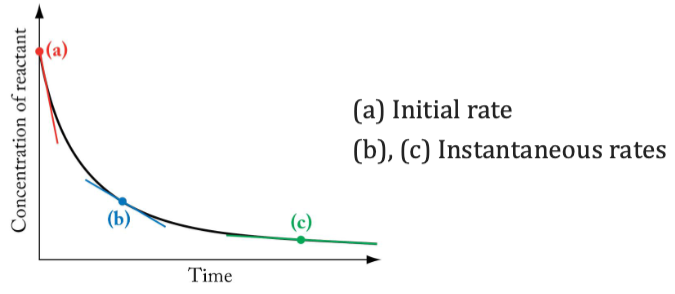
Instantaneous rate
• Reaction rate at a particular instant
• Determined graphically as tangential slope of concentration versus time
plot
• The slope of a line tangent to the curve at any point gives the
instantaneous rate at that time.
Initial rate
The rate of a reaction at t = 0, immediately after the reactants are
mixed
• We find the initial rate from the slope of the line tangent to the curve at t = 0 s.
• The initial rate is faster than the instantaneous rate at any later time during
the reaction.
Rate law
Equation that defines the experimentally determined relationship between reactant concentrations and the rate of the reaction

Reaction order
Experimentally determined number defining the dependence of the reaction rate on the concentration of a reactant
m and n are the reaction order with respect to reactants A and B
• Each reagent in the rate law has a reaction order. The larger the reaction order, the
greater the effect the concentration of the reactant has on the rate;
• The balancing coefficients in the reaction equation are not necessarily related in any way to reaction order m and n;
• The reaction orders must be found by experiment
Rate constant (k)
Proportionality constant that relates the rate of a reaction to the concentration of reactants
First Order
If the rate doubles when [A] doubles, the rate depends on [A] raised to
the first power, [A]1.
Rate = k [A]
Second Order
if the rate quadruples when [A] doubles, the rate depends on [A]
squared ([A]^2).
Rate = k [A]^2
Zero Order
If the rate does not change when [A] doubles, the rate does not
depends on [A], but we express this fact mathematically by saying that the rate
depends on [A] raised to the zero power, [A]^0.
![<p>If the rate does not change when [A] doubles, the rate does not</p><p>depends on [A], but we express this fact mathematically by saying that the rate</p><p>depends on [A] raised to the zero power, [A]^0.</p>](https://assets.knowt.com/user-attachments/92f09863-b5d3-4bb1-9b31-a52d205f697d.png)
How to determine rate law
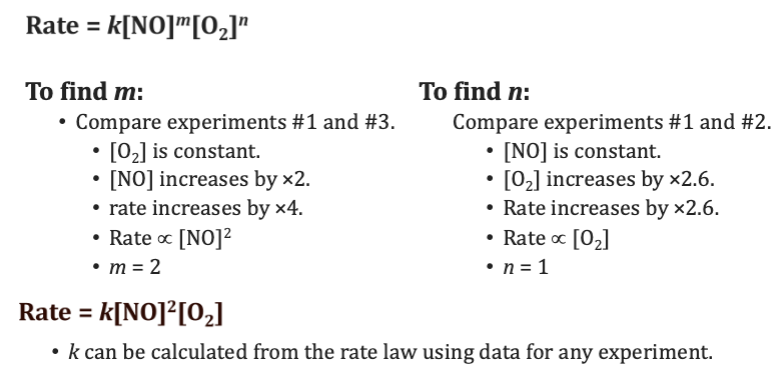
Effects of Concentration on Reaction Rates
Increasing concentration increases collisions between reactants, leading to formation of products.
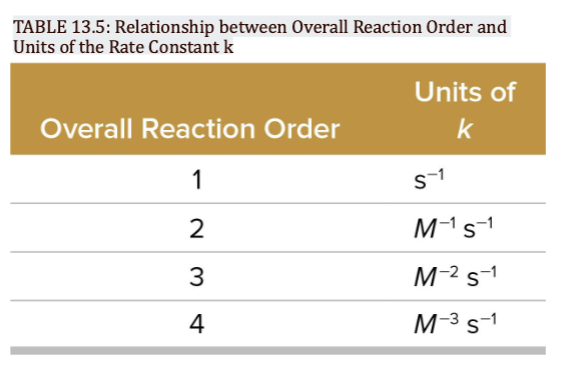
Units of Rate Constants for Different Reaction Orders
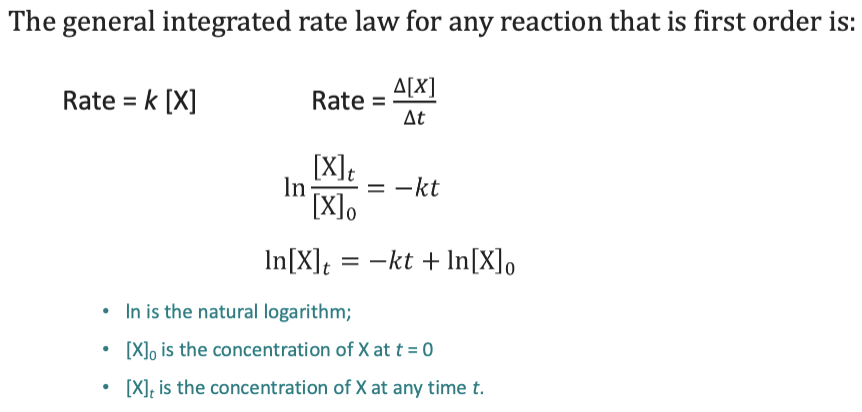
Integrated Rate Law: First-Order Reactions
Graphical Determination of First-Order Reactions
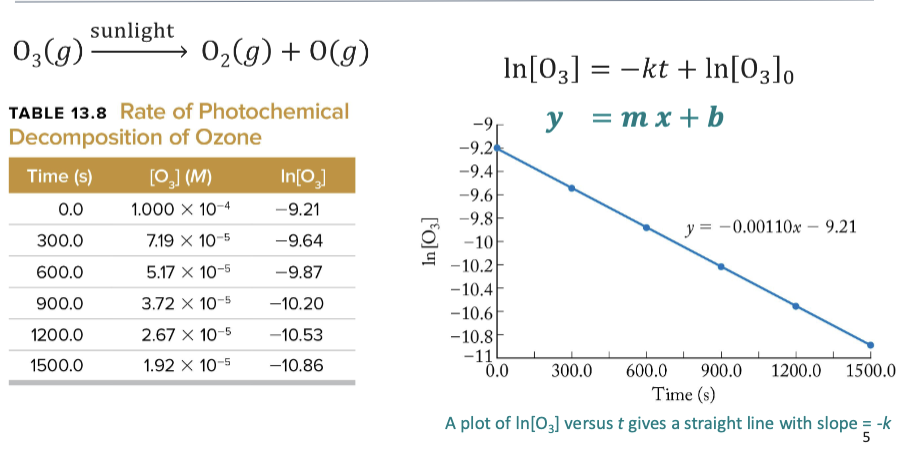
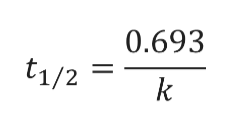
Half-Life: First-Order Reactions
• The time in the course of a chemical reaction during which the
concentration of a reactant decreases by half
• t ½ and k are inversely proportional. A faster reaction, a reaction with a relatively large rate constant, has a short half-life.
• For a first-order reaction, the time it takes to reach one-half the starting concentration is a constant, and thus, independent of reactant concentration.
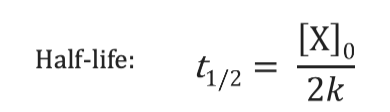
Half-life: Second-order Reactions
• As in first-order reaction, t ½ and k are inversely proportional for a second-
order reaction.
• The half-life of a second-order reaction is inversely proportional to the initial reactant concentration.
• A second-order reaction with a high initial reactant concentration has a shorter half-life, and one with a low initial reactant concentration has a longer half-life.
• For a particular reaction, each successive half-life is double the preceding one, since [X] is halved during each half-life.
![<p>• As in first-order reaction, t ½ and k are inversely proportional for a second-</p><p>order reaction.</p><p>• The half-life of a second-order reaction is inversely proportional to the initial reactant concentration.</p><p>• A second-order reaction with a high initial reactant concentration has a shorter half-life, and one with a low initial reactant concentration has a longer half-life.</p><p>• For a particular reaction, each successive half-life is double the preceding one, since [X] is halved during each half-life.</p>](https://assets.knowt.com/user-attachments/43e63277-05e1-4c97-89ca-f09f5f93fc55.png)
Integrated Rate Law: Second-Order Reactions
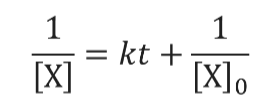
Zero-Order Reaction

Half-life: Zero-order Reactions
If a zero-order reaction begins with a high reactant concentration, it has a longer half-life than if it begins with a low reactant concentration.
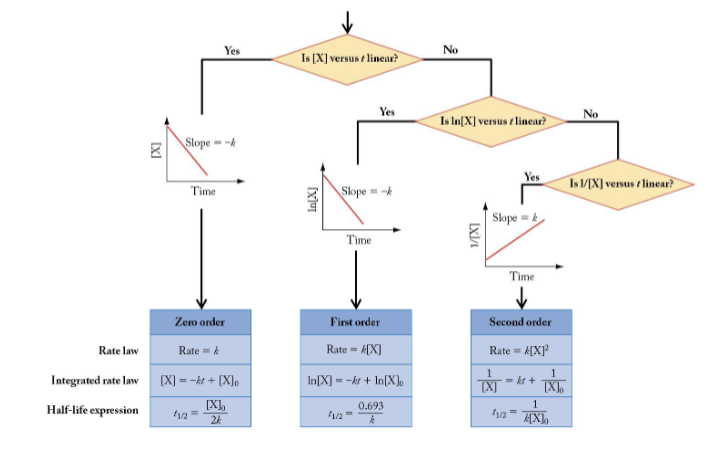
Summary of Reaction Orders
Factors Affecting Rate: Temperature
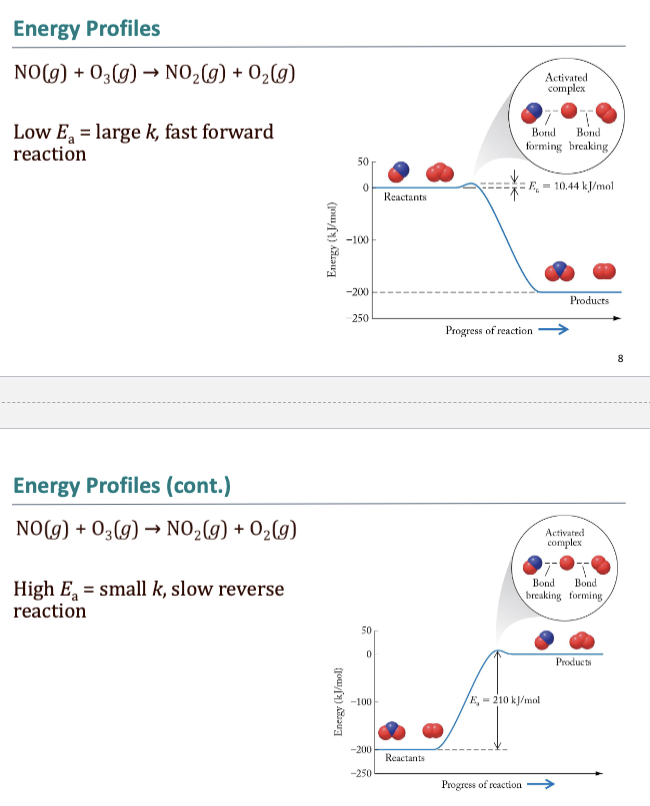
Increased temperature increases kinetic energy of molecules and molecular collisions.
Factors Affecting Rate: Activation energy (Ea)
The minimum energy of molecular collisions required to break bonds in reactants, leading to formation of products
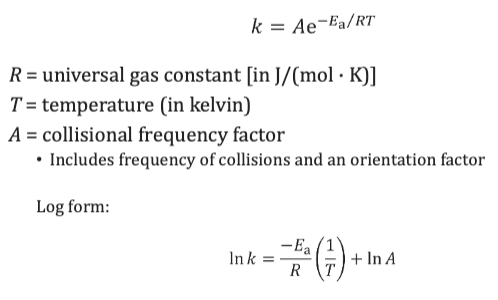
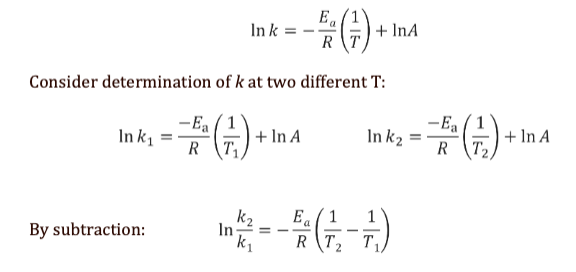
Arrhenius Equation
How does Ea affect reaction rate?
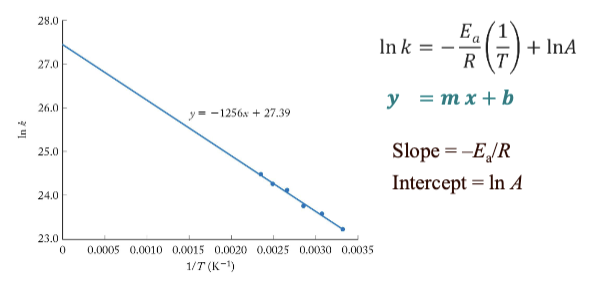
Graphical Determination of Ea
Mathematical Determination of Ea
Molecularity
• Unimolecular: an elementary step that involves a single molecule.
• Bimolecular: an elementary step that involves a collision between two molecules (atom or ions)
• Termolecular: an elementary step that involves a collision between three molecules.
• The molecularity of an elementary step is the same as its reaction order.
The Rate-Determining Step of a Reaction Mechanism
• Rate determining step (rate-limiting step) is slowest step in the reaction mechanism steps. It limits how fast the overall reaction proceeds.
• The rate law for the rate-determining step becomes the rate law for the overall reaction.
Homogeneous catalyst
A catalyst in the same phase from that of the reactants
Heterogenous catalyst
A catalyst in a different phase from that of the
reactants
What is a catalyst?
A. A catalyst provides an alternate mechanism for a
reaction.
B. A catalyst is regenerated in a reaction.
D. A catalyst speeds up the forward and reverse
reactions.
Spontaneous process
A process that occurs without continuous outside intervention:
• Spontaneity depends on dispersion of energy that occurs during a process
Nonspontaneous process
A process that only occurs as long as energy
is continually added to the system
True/False: The sign of ∆ H by itself does not predict the direction of a spontaneous change
True
Although many spontaneous processes are exothermic (i.e., combustion), that is not true for all spontaneous reactions:
How does entropy increase?
• Phase change: solid → liquid → gas
Particles have more freedom to move around each other. Thus the energy of motion is more dispersed.
• Dissolving of salt: crystalline solid + liquid → ions in solution
Solid salt turns into ions to interact with solvent molecules so their freedom
of motion and their energy of motion more dispersed
• Chemical change: crystalline solid → gases + ions in solution
Free morels of crystalline solid produce more moles of gases or solvated ions.
So their energy of motion is more dispersed
Entropy (S)
A measure of how dispersed the energy in a system is at a specific temperature
a measure of molecular randomness or disorder.
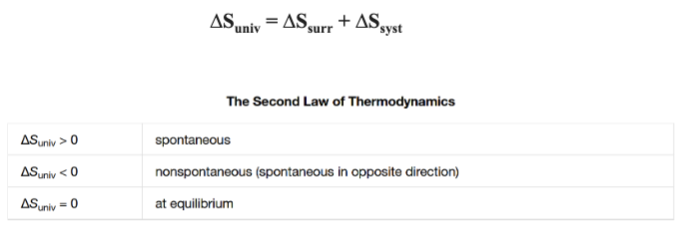
Second Law of Thermodynamics
The principle that the total entropy of the
universe increases in any spontaneous process
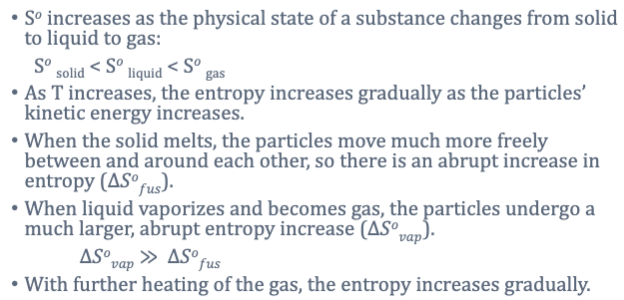
Entropy Increases When Temperature Increases
Entropy Increases When Volume Increases (Dilution)
Dilution of a concentrated
salt solution by adding
more solvent is a
spontaneous process.
Both solvent and solute
molecules are now
dispersed in a larger
volume.
Entropy of a Solid Alone vs Dissolved in a Liquid
For ionic compound, when the crystal dissolves in water, the ions have much more freedom of motion . Thus the entropy of ions is greater in the solution.
What happens to Entropy When Molar Mass Increases?
• Standard molar entropy increases with
increasing molar mass.
• The greater the number of bonds in a
molecule means that there are different
ways the molecule can move (bend, stretch,
etc.)
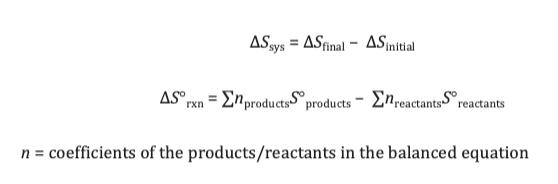
Entropy change for the system
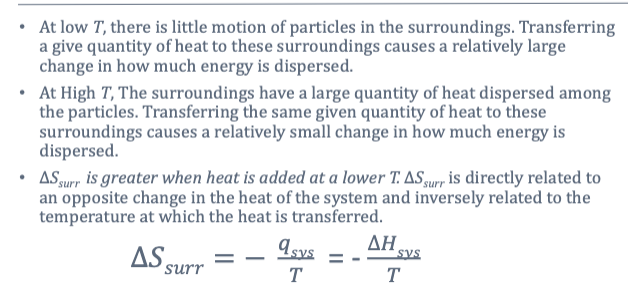
Entropy Change in the Surrounding
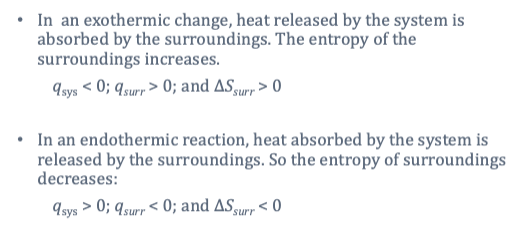
What happens to Ssurr when heat is added?
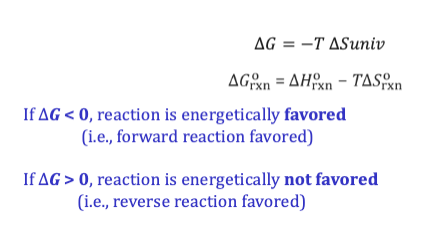
Gibbs Free energy
a measure of the maximum amount of work that a thermodynamic system can perform
Free energy change (∆G)
is a measure of the spontaneity of a process.
Relation between Sponteneity and Thermodynamic Properties
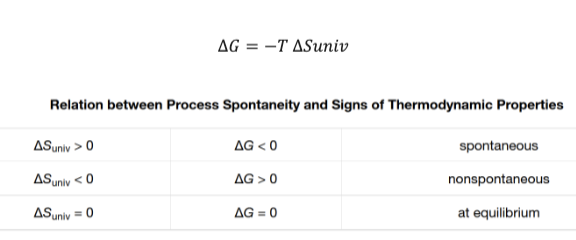
Spontaneity and Entropy-
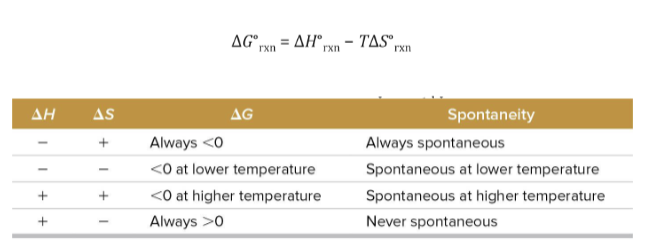
Effects of ΔH, ΔS, and T on G and Spontaneity