Regional Anatomy III (6) (last for test 1)
 Call Kai
 Learn
Learn Practice Test
 Spaced Repetition
 Match
Match Flashcards
 Knowt Play
1/76

There's no tags or description
Looks like no tags are added yet.
Name | Mastery | Learn | Test | Matching | Spaced | Call with Kai | Chat |
|---|
No analytics yet
Send a link to your students to track their progress
77 Terms
hypothalamus general function
principal modulator of autonomic system → receives sensory info about physiological status and regulates based on this to maintain homeostasis (often by regulating hormal effectors)
3 main regions of hypothalamus
lateral hypothalamic area
medial hypothalamic area
periventricular area
lateral hypothalamic area location, regions
along rostro-caudal axis, has no discrete nuclei
medial hypothalamic area location, regions
from rostral to caudal, 3 regions: chiasmatic, tuberal, mammillary
periventricular area location
faces third ventricle

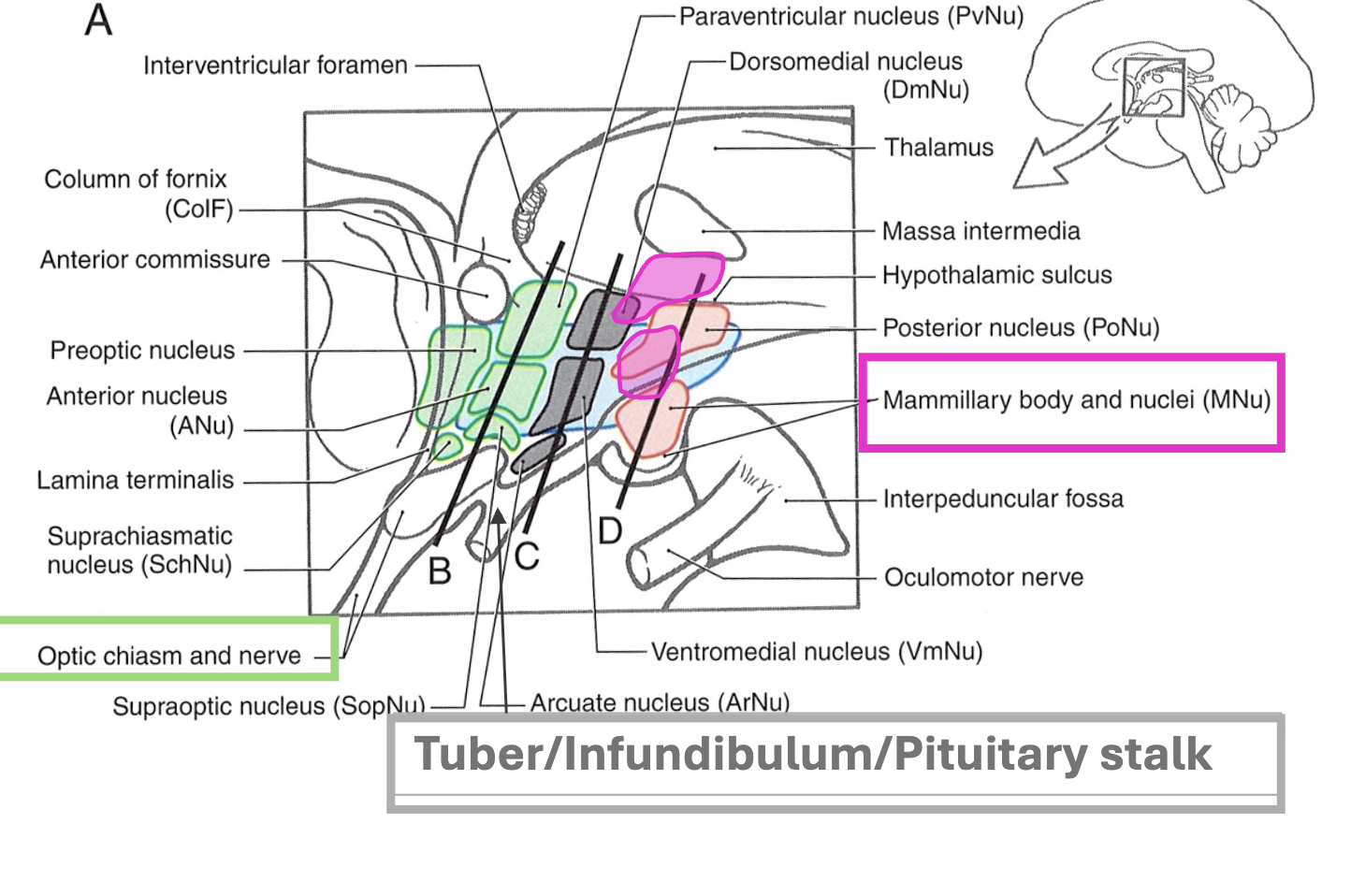
label hypothalamic regions

lateral hypothalamic area general function
involved in motivation-reward, feeding (hunger center), sleep-wake control (wakefulness)
chiasmatic/supraoptic region general function
regulates hormone release in pituitary gland
maintains water concentration in EC fluid, stress response, cardiovascular function, body temp, food intake, circadiuan rhythms
nuclei in the chiasmatic/supraoptic region release…
CRH (corticotropin-releasing hormone → stress response)
TRH (thyrotropin-releasing hormone → maternal behavior, lactation)
GnRH (gonadotropin-releasing hormone → ovulation or testosterone, depeding M or F)
oxytocin, vasopressin, somatostatinn
tubural area functions
food intake regulation (hunger, especially satiety master switch), senses chemicals for full/empty stomach indication, releases growth hormone-releasing hormone (GHRH)
mammillary area function
regulation of memory formation, spatial navigation, thermoregulation (shivering/vasoconstriction
periventricular area function
analgesia, production of GnRH, THR, somatostatin

label 3 regions
green: chiasmatic/supraoptic
gray: tuberal
pink: mammillary body and nuclei

label optic chiasm and nerve, infundibulum, pituitary stalk
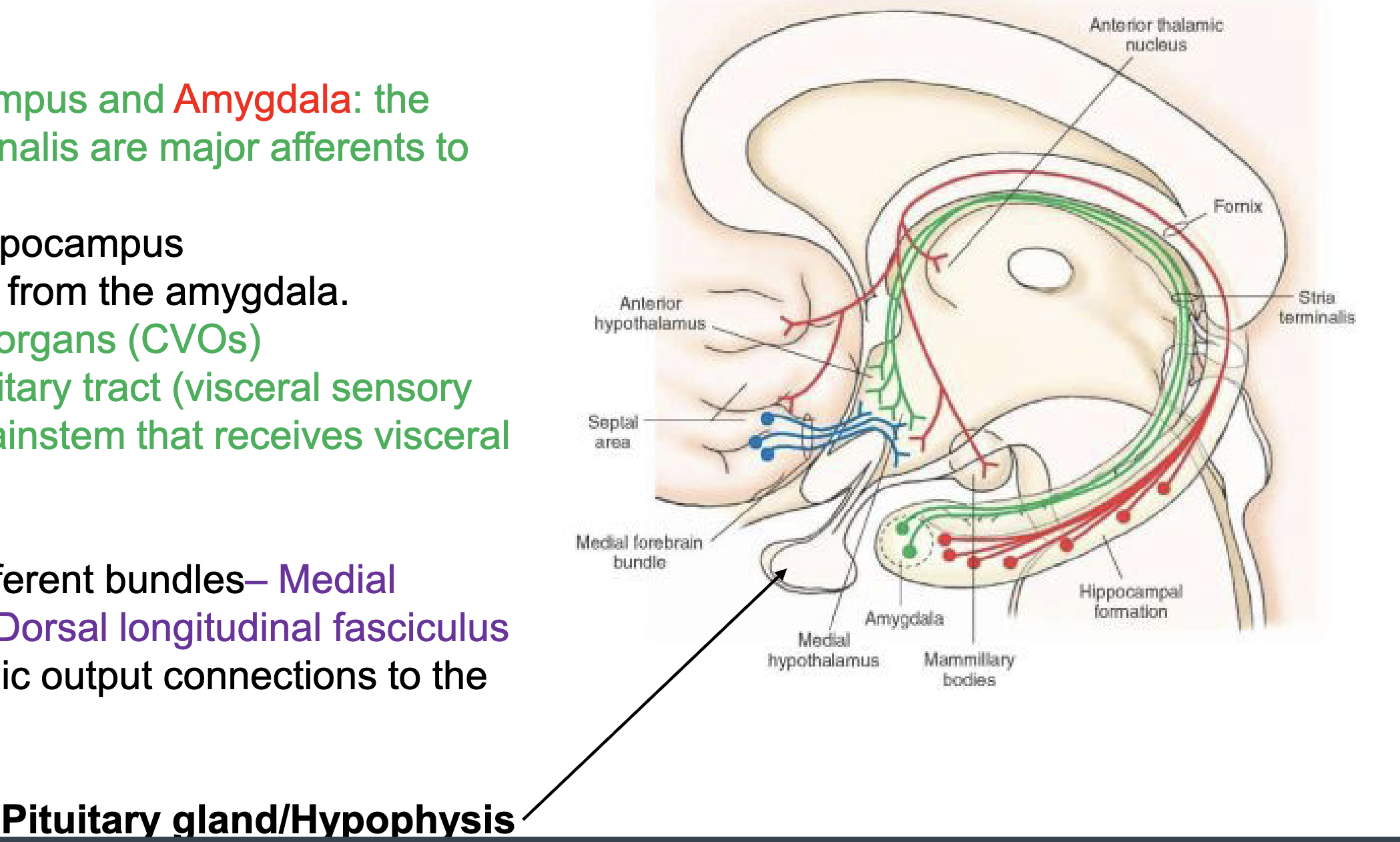
main inputs to hypothalamus
fornix (from HC)
stria terminalis (from amygdala)
CVOs
nucleus of solitary tract
main outputs of hypothalamus
major efferent bundles: medial forebrain bundle, dorsal longitudinal fasciculus
output control of pituitary gland/hypophosis

label major afferents/efferents, portions of brain, pituitary gland
main sources of blood supply to diencephalon
willis circle, PCA branches
branches from ACA and ACom supply…
optic chiasm, chiasmatic and tuberal hypothalamus
branches from PCA and PCom supply…
caudal hypothalamus
most of the thalamus’ blood is supplied from…
PCom artery branches (thalamoperforating and thalamogeniculate)

label thalamus, midbrain, pons


label parts of brainstem

midbrain from, includes
derived from mesencephalon, includes tectum and tegmentum
pons derived from, includes
derived from metencephalon, includes pons tegmentum, basilar pons, cerebellar peduncles
medulla derived form, includes
derived from myelencephalon, the spinal cord merges into medulla at pyramidal decussations
main sources of blood supply to brainstem
basilar artery, vertebral artery and branches
the basilar artery supplies blood to…
ventral and lateral cerebellum, pons, choroid plexus of 4th ventricle
the PCA supplies blood to…
midbrain
the vertebral artery and branches supply blood to…
medulla, part of cerebellum, posterior dura
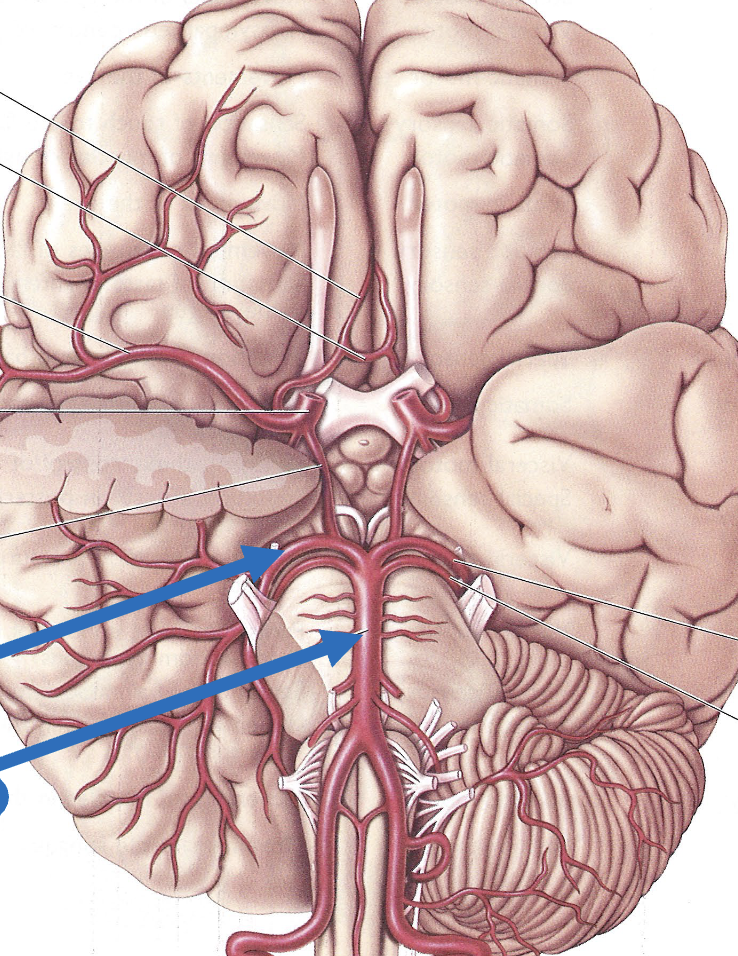
label brainstem blood sources

cellular structures located throughout all the brainstem
cranial nerve nuclei (sensory and motor)
fiber tracts
reticular formation
raphe nuclei
ascending v descending fiber tracts
ascending convey information toward forebrain, descending convey information toward spinal cord
structures located specifically in midbrain
superior and inferior colliculi, red nuclei, substantia nigra
structures located specifically in pons
pontine nuclei, superior olivary nucleus
structures located specifically in medulla
inferior olivary nuclei, dorsal column nuclei
ratio between cranial nerve nuclei and nerves
NOT 1:1 → nerves may be associated with multiple nuclei/travel through multiple locations (esp if carrying multiple kinds of info, ie sensory and motor, must stop in multiple nuclei)
general information about efferent cranial nerves
closer to midline, derive from Basal plate (motor), typically innervate muscles
General somatic efferent nerve nuclei …
adjacent to midline
innervate skeletal muscles (derive from somites)
what are skeletal muscles
derive from somites
main GSE nuclei
Oculomotor, trochlear, abducens, hypoglossal
oculomotor nucleus
movement of eye/eyelid, control of pupil
trochlear nucleus
movement of eye
abducens nucleus
movements of eye
hypoglossal nucleus
control of tongue
general visceral efferent nerve nuclei…
GVE, innervate smooth muscles, cardiac muscles, glands
adjacent/lateral to GSE
general, special, visceral
‘visceral’ → internal organs
general: not in the head
special: in the head
visceral: internal organs
main GVE nuclei
Edinger-Westphal, superior and inferior salivatory nuclei, dorsal vagal
Edinger-Westphal nucleus
related to oculomotor → eye/eyelid movement, pupil control
superior salivary nucleus
control of face → facial expression muscles, control of salivary glands, sensation of taste and olfaction
inferior salivatory nucleus
relates to glossopharyngeal → control of throat muscles, salivary glands, 1/3 tongue (sensation of taste), detection of blood pressure in aorta
dorsal vagal nucleus
control of heart, lungs, abdominal organs; sensation of pain from viscera; control of throat muscles
special visceral efferent nerve nuclei…
innervate muscles derived from pharyngeal arches, adjacent/lateral to GVE
pharyngeal arches are…
muscles of pharynx, larynx, facial expression (only in head)
main SVE nuclei
trigeminal motor, facial motor, ambiguus (in spine), accessory
trigeminal motor nucleus
sensation of touch to the face, control of mandibular muscles
facial motor nucleus
control facial expression muscles, sontrol of salivary glands, sensation of taste and olfaction
ambiguus nucleus
related to glossopharyngeal & vagus: throat muscles, salivary gland, 1/3 tongue (taste), blod pressure in aorta detection, hear/lung/abdominal organ control, pain from viscera
accessory nucleus
control of throat and neck muscles (spinal accessory)

label GVE, GSE, SVE


label GVA, SVA, GSA, SSA

general info about afferents
derive from Alar plate (sensory)
GVA info
general visceral afferent, sensory input from internal organs, glands, blood vessels
GVA nucleus
nucleus of the solitary tract
SVA info…
special visceral afferent, input from special chemical or visceral senses (gustative/taste)
SVA nucleus
nucleus of solitary tract
SSA info…
special somatic afferent, input from special ‘non-visceral’ senses (vision, hearing, balance)
SSA nuclei
vestibular, cochlear
GSA info…
general somatic afferent, input from skin, muscle, tendons
GSA nucleus
trigeminal - mesencephalic, principal, spinal parts
functional group of brainstems are…
nuclei that process information of the same functional modality; tend to be located in the same topological location across brainstem, grouped by columns on rostro-caudal axis
functional group away from sulcus limitans toward posterior
alar plate; somatic function, afferent
functional group close to sulcus limitans
visceral function
functional group away from sulcus limitans towards anterior
basal plate; somatic function, efferent

label nuclei (efferents)

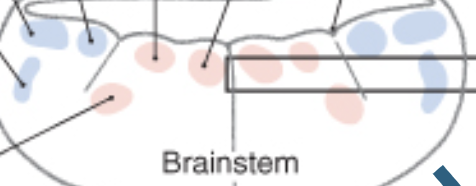
label nuclei groups


label
