Unit 2 - Lecture 12
 Call Kai
 Learn
Learn Practice Test
 Spaced Repetition
 Match
Match Flashcards
 Knowt Play
1/166

There's no tags or description
Looks like no tags are added yet.
Name | Mastery | Learn | Test | Matching | Spaced | Call with Kai | Chat |
|---|
No analytics yet
Send a link to your students to track their progress
167 Terms
Nucleic Acids
__ are the chemical substances that contains genetic information
Nucleic Acids
The genetic information that codes for proteins is contained in __
DNA
__ is the key information storer of the genes that encode proteins. It is what is replicated and passed down from one generation to the next
RNA
__ acts as an intermediate messenger that is transcribed from DNA and provides the templates (called m__s) for the synthesis of proteins in a process called translation
Structure
The __ of nucleic acids is key to their function as genetic information
Inside; Outside
The information contained in the polymer can be accessed from the __ (by separating the strands) as well as the __ (through large grooves in its structure)
Nucelotides
The building blocks of DNA
Polymers
How are nucelotides put together
Nucleic Acid Primary Structure
What is the product of adding nucleotides and polymers together called?
A Base, Sugar, and Phosphate
Nucleotides are composed of what three components?
2.4×10^23
Humans have approximately 40 trillion cells, and each cell has 6 billion base pairs. What number is used to represent this?
Cancer
Just a few few errors in base pairing can cause things such as __
DNA; RNA
Nucleic acids are polymers built for nucleotides for both __ and __
Sugar
The OH group on the __ in nucleotides determine whether it is used for DNA or RNA?
OH
For RNA, the sugar has an __ attached to its 2’ location
H
For DNA, the sugar has an __ attached to its 2’ location
2
How many OH groups are attached to the sugar in an RNA nucleotide?
1
How many OH groups are attached to the sugar in an DNA nucleotide?
Purines and Pyrimidines
The nitrogenous base (aka nucelobase or just base) in a nucleotide has two different different types. What are they?
Purine
A __ nitrogenous base has a bigger structure
Purine
A __ nitrogenous base has 9 carbons and is a double ring
Pyrimidine
A __ nitrogenous base has a smaller structure
Pyrimidine
A __ nitrogenous base has 5 carbons and is a single ring
Adenine - A
Cytosine - C
Guanine - G
Tyrosine - T
DNA uses what bases? What are their abbreviations?
Adenine - A
Cytosine - C
Guanine - G
Uracil - U
RNA uses what bases? What are their abbreviations?
DNA has tyrosine and RNA has uracil
What are the differences between DNA and RNA bases?
Adenine - A
Guanine - G
Which bases are purines?
Cytosine - C
Thymine - T
Uracil - U
Which bases are pyrimidines?
Nucleoside
A base connected to a pentose (5-carbon) sugar is called a __
Ribose
For RNA, the sugar in a nucleoside is __
Deoxyribose
For DNA, the sugar in a nucleoside is __
5; 3
The __’ and __’ positions of the sugar are key positions involved in the building the nucleic acid polymer
2’ OH
The defining chemical difference between RNA and DNA is not which base is attached to it, but rather whether there is the presence or absence of the __
1; Nitrogen
The connection between the base and the sugar in a nucleoside occurs between the __’ position on the sugar and a __ on the base
A Glycosidic Bond (aka an N-Glycosidic Linkage)
The bond between the 1’ of the sugar and nitrogen on the base is called what?
Rotation
The glycosidic bond (aka an N-glycosidic linkage) can have some free __
Nucleotides
__ are nucleosides with phosphoryl group(s) attached via ester linkage
The 5’ on the Sugar
Where does the ester linkage between a sugar (pentose) and phosphoryl group(s) occur in a nucleotide?
Nucleoside Monophosphates
These are what we see in the final nucleic acid polymer
Nucleoside Triphosphates
These serve as high energy building blocks used by the cells to synthesize the nucleic acid polymer
Phosphate
Sugar
Nitrogenous Base
A nucleotide contains what three groups?
Sugar
Nitrogenous Base
A nucleoside contains what two groups?
H
R’ in DNA is what?
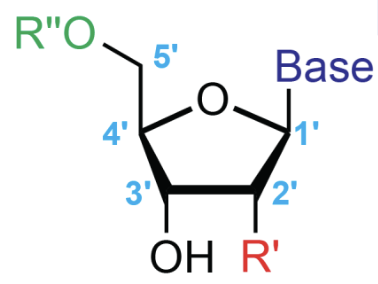
OH
R’ in RNA is what?
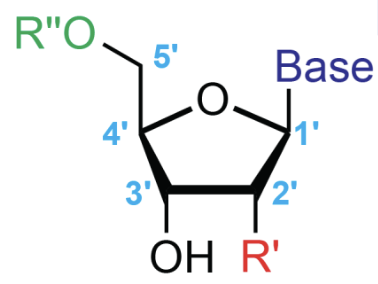
Ester Linkage
What type of bond is at the 5’?
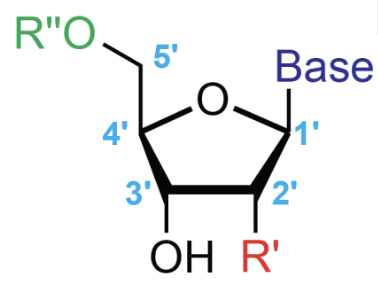
Nuceloside
If R’’ is an H, the molecule is a what?
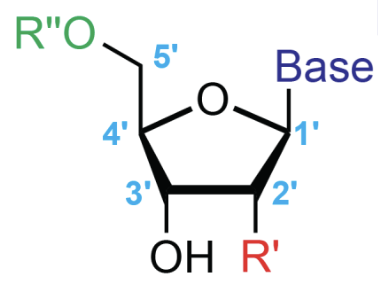
Nucelotide
If R’’ is a phosphate, the molecule is a what?
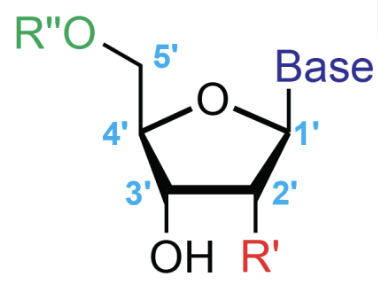
Glycosidic Bond
What type of bond is at the 1’?
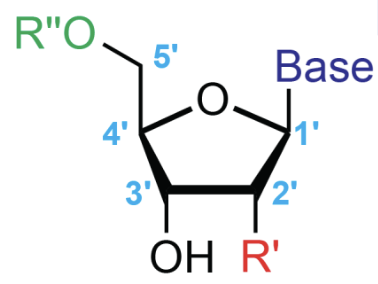
Phosphodiester
Nucleotides are joined together through __ bonds. They are the backbone of nucleic acid structure
3;5
One side of the phosphate in a phosphodiester bond is linked to the __’ of a sugar and the other side is linked to the __’ of another sugar
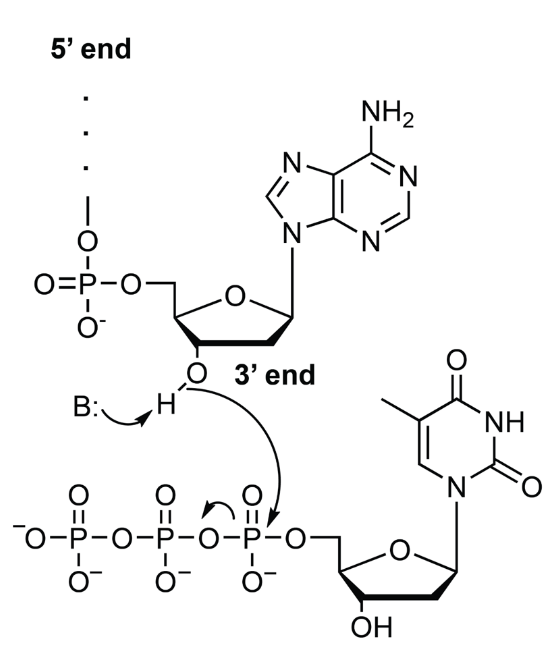
Phosphodiester
__ bonds form by 3’OH nucleophilic attack on activated 5’P
Base activation of 3’OH
Nucleophilic attack of 3’ OH on an “activated” 5’ phosphate
What are the two steps in a phosphodiester bond formation?
Leaving Group
activated in phosphodiester bond formation means there is a __ attached to the 5’ phosphate to drive the reaction forward
5’;3’
Nucleic acid strands are always synthesized and polymerized in the __ to __ direction
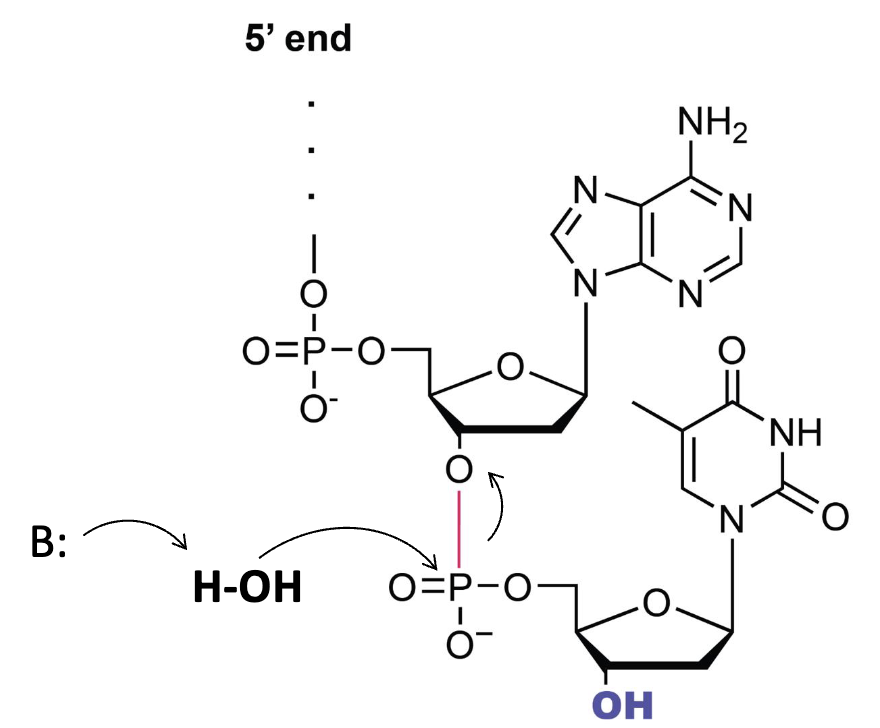
Cleavage
Nucleic acids can also be broken down by the __ of phosphodiester bonds
Base activation of a water molecule allows for a nucleophilic attack on the phosphodiester bond
How are phosphodiester bonds cleaves?
Phosphodiester Bond Formation
What is being shown?
Phosphodiester Bond Cleavage
What is being shown?
Triphosphate
The incoming nucleotide in phosphodiester bond formation always has to be a __ so that there is a leaving group present
Yes
Can phosphor bond formation be repeated?
Nuclease
What is the protein that breaks down nucleic acids in phosphodiester bond cleavage?
Watson-Crick-Franklin
Nucleotides interact through hydrogen bonding to form __ base pairs
3
Cytidine, Guanosine and Thymidine all have __ H-bond donor or acceptor regions
2
Adenosine has __ H-bond donor or acceptor regions
Donors
1
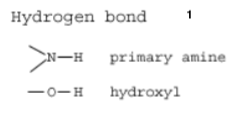
Acceptors
2
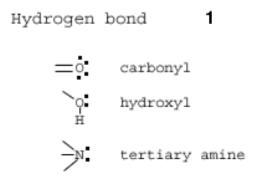
Donor’ Acceptor
__ and __ pairs have to line up between two bases or H-bonding will not be good
Antiparallel
__ strands are required for proper hydrogen bonding to form Watson-Crick-Franklin base pairs in nucleotides
Unfavorable
If the wrong bass pairing occurs it is energetically __
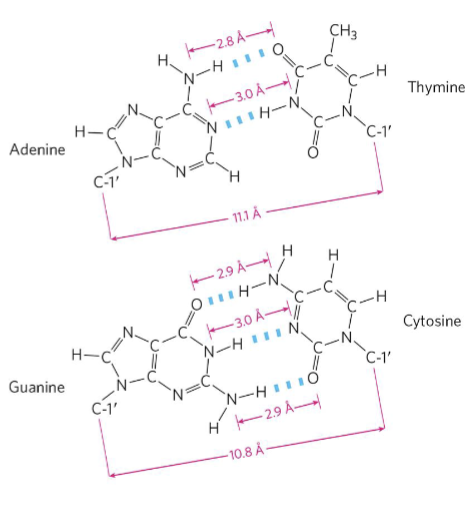
Watson-Crick-Franklin (WCF)
__ H-bonding occurs between bases on strands oriented anti-parallel to one another
2
Adenine and thymine forms __ H-bonds
3
Guanine and cytosine forms __ H-bonds
3
All base pairs have an Ao length around __
Watson-Crick-Franklin Base Pairing
What is being shown?
B
The _-form of a double stranded helix is more stable
10.4
There are __ base pairs per turn in a double stranded helix
Outside
In a B-form double stranded DNA double helix, the sugar phosphate backbone is on the __
Inside
In a B-form double stranded DNA double helix, the nucleobases are on the __
Inside
A/T and C/G base pairs are on the __ of the helix
Van der Waals Interactions
Pi-Stacking
What are the two base-stacking interactions?
Bulge
Base pairs that are paired correctly stack perfectly and are smooth and __ free
Planar
Nucleobases have a __ geometry
Hydrophobic
Van der Waals interactions occur between __ nucleobase faces
Steric
Van der Waals interactions in base stacking causes __ effects
Electronic
Pi-stakcing in base stacking causes __ effects
Stabilization
Base-stacking interactions have the effect of re-enforcing the individual A/T and C/G hydrogen-bonding interactions to drive massive __ in the larger context of the dsDNA helix. They work together to strengthen the double helix
Asymmetrical
B-form DNA double-helix structure is __
Major
Which groove is wide and deep?
Minor
Which groove is shallow and narrow?
Grooves
Even when the two strands of DNA are joined together, the B-form double helix presents two __ which provide access to the nucleobases from the outside
Groove
Each base will have a major and minor __
Acceptors; Donors
Each major and minor grooves have hydrogen __ and __
Major
Proteins can bind to double stranded DNA through the __ groove in a sequence specific manner
Major
Which type of groove bonding is more common?
B-form
The __ DNA double helix forms when two separate strands of DNA interact through Watson-Crick-Franklin (WCF) base pairing
T
A pairs with __
G
C pairs with __
Shorter
The A-form double helix is __ than the B-form
Riboswitch
Structured RNA that binds two small molecules and tailors gene expression to produce more or less of the small molecule or export it from the cell. Is dependent on the ligand
Transfer RNA
tRNA is short for what?