conflict and peace in asia
 Studied by 0 people
 Call Kai
 Learn
Learn Practice Test
 Spaced Repetition
 Match
Match Flashcards
 Knowt Play
1/13

There's no tags or description
Looks like no tags are added yet.
Name | Mastery | Learn | Test | Matching | Spaced | Call with Kai |
|---|
No analytics yet
Send a link to your students to track their progress
14 Terms
Wars in Asia since 1945
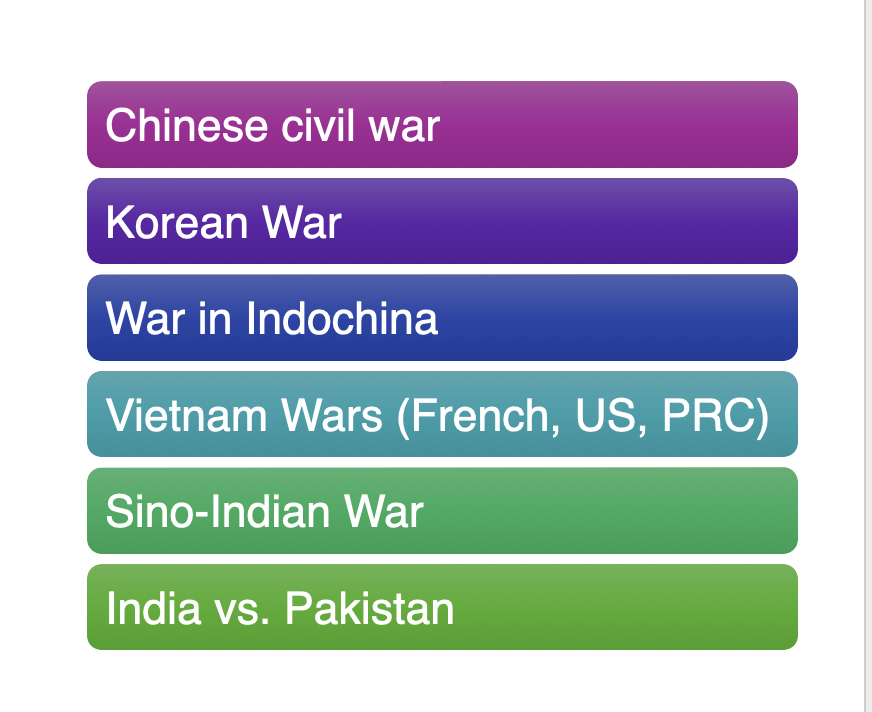
Chinese Civil War (Phase 1: 1927-1937), Phase 2 (1945-1949)
KMT fled to taiwan
The Second World War in Asia
Japan’s losses: 2.5 million military and civilians
Sino-Japanese War (1937-1945)
Cost of war for China remains a subject of fierce debate - estimates range between 9,400,000 to 20,000,000 Chinese military and civilian dead from all causes between July 1937 and August 1945
Most of the war began in china
the year was 1937 or even earlier 1931
60-95 million refugees
Second highest losses in WWII after USSR
Japan’s war against US, British, Dutch (1941-1945)
US lost 106k dead
Britain: 90k casualties
Commonwealth: 70k+ casualties
Japan’s military power decisively defeated in WWII
it was the loss of Japanese power that was never regained
Thereafter not viewed as a military threat
Despite vast physical destruction, Japan remains the great industrial power of Asia … but loses its biggest market … China
With US support, Japan rebuilds economy and expands outside of China
By 1980s, Japan rivals US economy
By 1990s, Japan’s economy falters – the new rising power becomes China
asia in the early cold war
1950s-60
defines the security map of asia
korean war
communist power launches a war of aggression of non communist
stalin forces n korea to attack s korea to take our mind way from rebuilding europe
Casualties (killed + wounded): 4 million
70% of deaths civilians
Impact felt around the world
China intervenes
Fear that Soviet Union would take advantage and invade W. Europe
Leads to:
US rearmament,
expansion of NATO,
defense of Taiwan,
fear that china will try to do the same in taiwan
support to French war in Indochina,
support to British fight in Malaya
Creation of permanent US military presence in S. Korea
defacto peace but no peace treaty
A technical state of war on Korean Peninsula still exists
UN command
founded after n korea invade of s korea
United Nations Command (UNC) was established on July 24, 1950
Signifies the world’s first attempt at collective security under the United Nations system.
United Nations Security Council Resolutions 83 and 84 provided the international legal authority for member states to restore peace on the Korean Peninsula
Designated the United States as the leader of the unified command we know as UN Command.
The end of the colonial empires
British fight insurgency in Malaya in 1950s (labelled an Emergency); later fight in Borneo
Dutch fight to regain control of Indonesia
Despite military successes, combination of financial burden, external pressure leads both to reduce commitments/withdraw
no problem militarily. was about the external political pressure and financial burden
War in Indochina: 1946-1954
France suffers important military defeat at Dien Bien Phu though technically/militarily remained superior to the Viet Minh forces
Despite this, the costs of maintaining presence in Indochina are too high … France withdraws after 1954
Vietnam split in two: Communist north and Non-Communist south pending national election
with the geneva settlement
US supports government of South Vietnam/rejects effort for national election
A superpower humbled —> us
A new nation —→ vietnam at the cots of 2 mil dead
2 million dead
India-Pakistan Wars
Three wars
1947-1948 (Kashmir)
1965 (Kashmir)
1971 (E. Pakistan/Bangladesh)
Combatant casualties amount to several thousand per side per war
Fourth war
1999
Combatant casualties amount to 1,000
Both sides nuclear powers
All wars characterized by low intensity and short duration
neither side wanted to escalate due to nuclear
Sino-Vietnamese War, February 1979
turning point for conflict in asia
china invades vietname
Labelled the “Self-Defensive Counterstrike against Vietnam” by China (对越自卫反击战)
Labelled “the War against Chinese Expansionism” by Vietnam (Chiến tranh chống bành trướng Trung Hoa)
Begins on 17 February 1979 with invasion by 220,000 Chinese troops
Military action limited to ground war only
limited in time lasted 1 month
War lasts one month following unilateral Chinese ceasefire
last time we see chinese military action in asia (1970s)
Each side suffered roughly 30,000 deaths and 35,000 wounded
Pre-war territorial status quo maintained
East Asian Peace Theory
why no war in asia?
As of 2025, there is war in the Middle East and war in Europe – why no war in Asia?
From 1946-1979, East Asia accounted for roughly 80 percent of the world’s battle deaths
Since 1979 Sino-Vietnamese war, countries in East Asia have enjoyed relative peace – no major interstate war, only minor conflicts, mostly internal (e.g. Myanmar)
interlinked econ and detterence
How to explain?
ASEAN+ model of consultation/consensus-building, focus on trade, limited political integration (at least compared to EU)
Democratic peace theory doesn’t work since many countries are autocratic/semi-democratic
Deterrence?
Spread of peace did not necessarily start in 1979 but it nevertheless serves as a useful marker with no major war since
Spread of peace came about as a cumulative effect of a series of national priority shifts – governing elites decided to shift from ideological priorities to state-driven economic growth
Most Asian states stabilize politically/economically after first decades of independence – internal opposition mostly evaporates
Peace has always been fragile with nations still arming against each other, threatening each other, and making operational plans for war
will it last
Will it last for several more decades or is it likely to come to an end?
Most Likely Future War Scenarios
PRC vs. Taiwan (US intervention? Japan?)
North vs. South Korea/US (Japan?)
India vs. Pakistan
India vs. PRC
PRC vs. Philippines (US intervention?)
PRC vs. Japan (US intervention?)
PRC intervention in Myanmar
DESIGN THIS WAR:
People’s Republic of China invasion of Taiwan
Your role: Use all the knowledge you’ve gained on this course to provide insights into what this war is expected to look like
Who are the war’s participants?
Will the conflict be geographically limited to the Taiwan Strait?
How long is the conflict expected to last?
What limits will China and other participants place on the use of force?
How will the conflict end?
After we’ve discussed what the war might look like, you will be asked the following three questions:
1. Why hasn’t an invasion already taken place?
2. What lessons from Ukraine can inform our views of what a war over Taiwan would like
3. Although an invasion is not inevitable, what policy recommendations (to the EU, US, UN, Taiwan, etc.) would you propose to reduce the prospect?
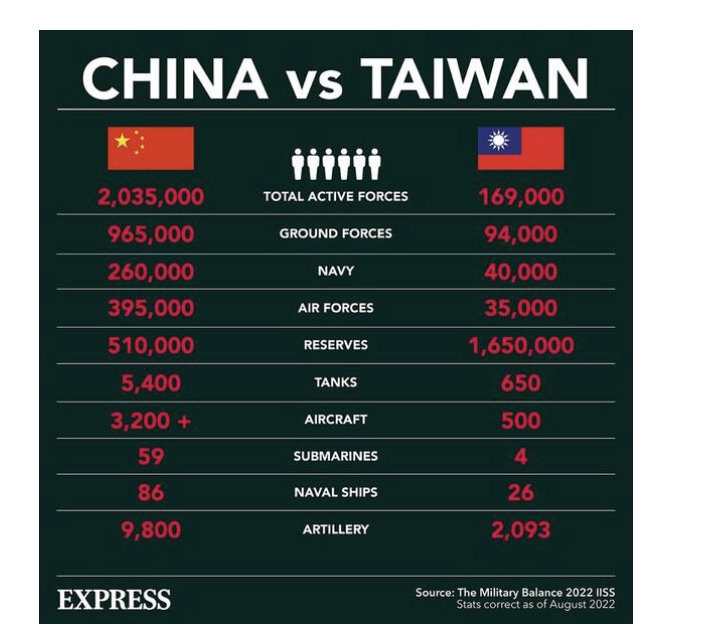
china has an army and taiwan has reserve forces
warning time: it takes time to sail the ship to taiwan
having interlinked economies cab reduce a war but doesnt mean it will eliminate it
 Note
Note  Flashcards (179)