(4) Drug Metabolism
 Call Kai
 Learn
Learn Practice Test
 Spaced Repetition
 Match
Match Flashcards
 Knowt Play
1/30

There's no tags or description
Looks like no tags are added yet.
Name | Mastery | Learn | Test | Matching | Spaced | Call with Kai | Chat |
|---|
No analytics yet
Send a link to your students to track their progress
31 Terms
Drug Metabolism
Purpose
Drug metabolism chemically changes a drug and usually prepares it for excretion.
Most commonly, metabolism decreases or eliminates drug activity.
Other possible results:
drug activity is maintained → may contribute to a longer duration
drug activity increases → less common
an inactive prodrug becomes active
Drug Metabolism
Overall goal:
Drug → add/expose a polar functional group → increase water solubility → eliminate the drug
The body commonly tries to create or expose an oxygen-containing group:
alcohol
phenol
carboxylic acid
Drug Metabolism
Where occurs?
Liver = main metabolic powerhouse.
Gut = another major site, especially for orally administered drugs.
Gut metabolism can prevent some drugs from surviving oral administration.
The professor said metabolism can occur in the CNS and essentially any organ, but emphasized the liver and gut.
Drug Metabolism
Phase I vs Phase II
Phase I | Phase II |
|---|---|
Many different reactions are possible | Conjugation reaction joins two molecules |
Multiple Phase I reactions may occur on one drug | Usually one Phase II reaction occurs before excretion |
Adds or exposes a polar functional group | Adds a polar conjugate |
Can activate, maintain, increase, decrease, or eliminate drug activity | Usually completes the metabolic pathway discussed |
What enzyme perform many Phase I oxidation reactions?
CYP = cytochrome P450.
For this lecture, think of CYP as an enzyme that commonly:
adds OH, or
removes a small group to expose OH or NH
Factors that can change metabolism
Age
Gender
Diet/nutritional status
Disease states
Environmental chemicals
Two factors emphasized most
Co-administered drugs
Pharmacogenomics
Factors that can change metabolism
Co-administered drugs
Two drugs may compete for the same metabolic enzyme.
One drug may not be metabolized normally → its concentration stays higher for longer.
With repeated doses, the concentration may continue rising → possible toxicity.
Factors that can change metabolism
Pharmacogenomics
Patients can have different amounts or activity of metabolic enzymes.
If a prodrug requires an enzyme that the patient has low activity of:
poor activation → reduced drug effect
Oxidation =
Reduction =
Oxidation = add oxygen, remove H
Reduction = remove oxygen, add H
Major Phase I reactions and enzymes
Reaction type | Main enzymes emphasized | What happens |
Oxidation | CYP; alcohol dehydrogenase; aldehyde dehydrogenase; MAO | Adds/exposes oxygen or removes an amine |
Reduction | Aldo-keto reductase | Common example: ketone → alcohol |
Hydrolysis | Mainly esterases in this discussion |
|
What’s body’s main metabolic approach?
Oxidation
What are all are the Phase 1 Oxidation called?
Aromatic hydroxylation
Benzylic hydroxylation
Aliphatic/alicyclic hydroxylation
O-dealkylation
N-dealkylation
Deamination
Alcohol/aldehyde oxidation
What are all are the Phase 1 Reduction called?
Ketone reduction
What are all are the Phase 1 Hydrolysis called?
Ester hydrolysis
Oxidation
Aromatic hydroxylation
Recognition rule: CYP adds OH directly to the aromatic ring.
Even if OH were placed at another position on the aromatic ring, it would still be aromatic hydroxylation.
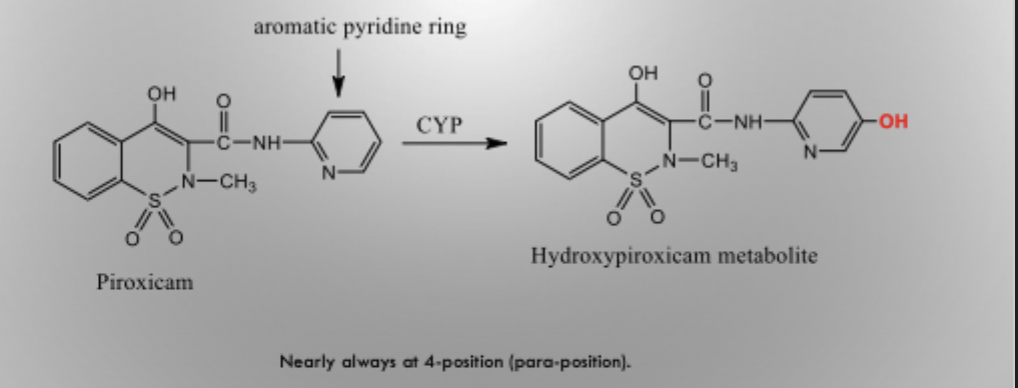
Aromatic hydroxylation
CYP adds OH directly to the aromatic pyridine ring.
Pyridine ring: 5 carbons + 1 nitrogen
Oxidation
Benzylic hydroxylation
Recognition rule: CYP adds OH to the first saturated carbon directly attached to an aromatic ring.
look for a methyl group directly attached to an aromatic ring.
Helpful side info 🙂
Saturated carbon: C–C ✅
Unsaturated carbon: C=C or C≡C

Benzylic hydroxylation
Oxidation
Aliphatic and alicyclic hydroxylation
Aliphatic: Carbon is in not part of a double bond/ non-ring chain
Alicyclic: Carbon is in a saturated, nonaromatic ring.
Recognition rule: CYP adds OH to a saturated carbon that:
is not part of an aromatic ring
is not part of a double bond
is not the benzylic carbon

Aliphatic hydroxylation
Oxidation
O-dealkylation
Recognition rule: Find an oxygen with a methyl group: O–CH₃.
CYP removes the methyl group.
The oxygen is left as OH.
The professor described this as removing a “mask” to expose the OH.
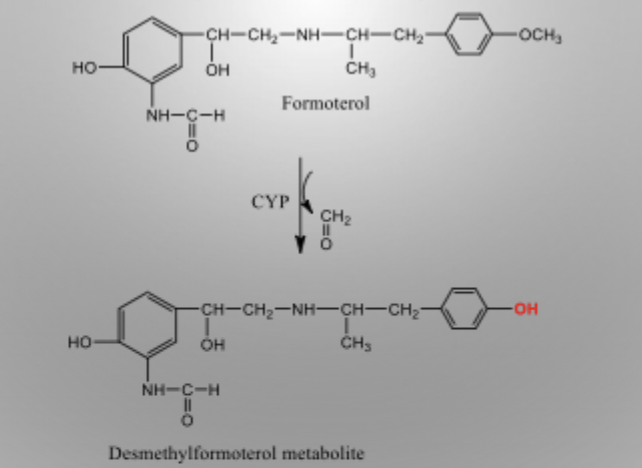
O-dealkylation
Oxidation
N-dealkylation
Recognition rule: Find a nitrogen with a methyl group: N–CH₃.
CYP removes the methyl group and replaces it with H.
Sequential removal
CYP removes only one methyl group per reaction.
If nitrogen has two methyl groups:
Tertiary amine → secondary amine → primary amine
This requires two separate N-dealkylation reactions.
A methyl group automatically has the α-hydrogen needed for removal.
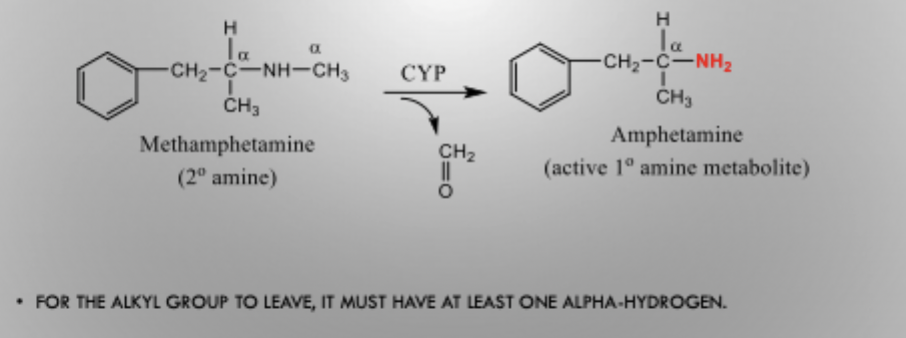
N-dealkylation
Reduction
Ketone reduction
Recognition rule:
Ketone → alcohol = reduction by aldo-keto reductase
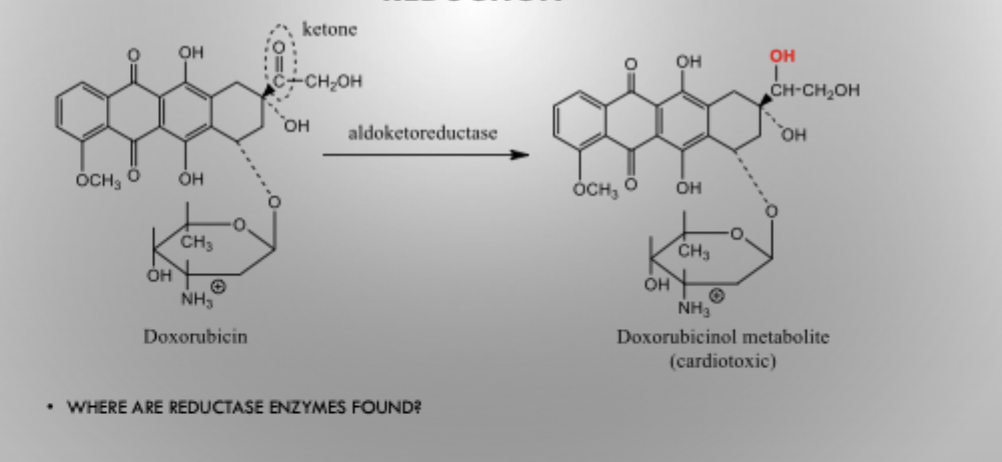
Ketone reduction
Oxidation
Alcohol and aldehyde oxidation
Starting group | What happens |
Primary alcohol |
Aldehyde
|
Secondary alcohol | Oxidizes to a ketone |
Tertiary alcohol | Cannot oxidize further; stable |
Oxidation
Explain these pathways:

⭐ Professor Example — Ibuprofen
Pathway 1
CYP performs aliphatic hydroxylation.
Produces a tertiary alcohol.
Tertiary alcohol is stable → no further oxidation.
Pathway 2
CYP performs aliphatic hydroxylation on a methyl group.
Produces a primary alcohol.
Primary alcohol → aldehyde → carboxylic acid.
Oxidation
Deamination
Recognition rule: Deamination removes a primary amine and produces an aldehyde.
The aldehyde can then be converted to a carboxylic acid by aldehyde dehydrogenase.
Oxidation
Deamination - ENZYME RULE
Easy method:
Find nitrogen
Find the carbon directly beside it = α-carbon
Count the hydrogens on that carbon
CH₂ = 2 α-hydrogens → MAO or CYP
CH = 1 α-hydrogen → CYP only
Oxidation
Deamination - What happening here?
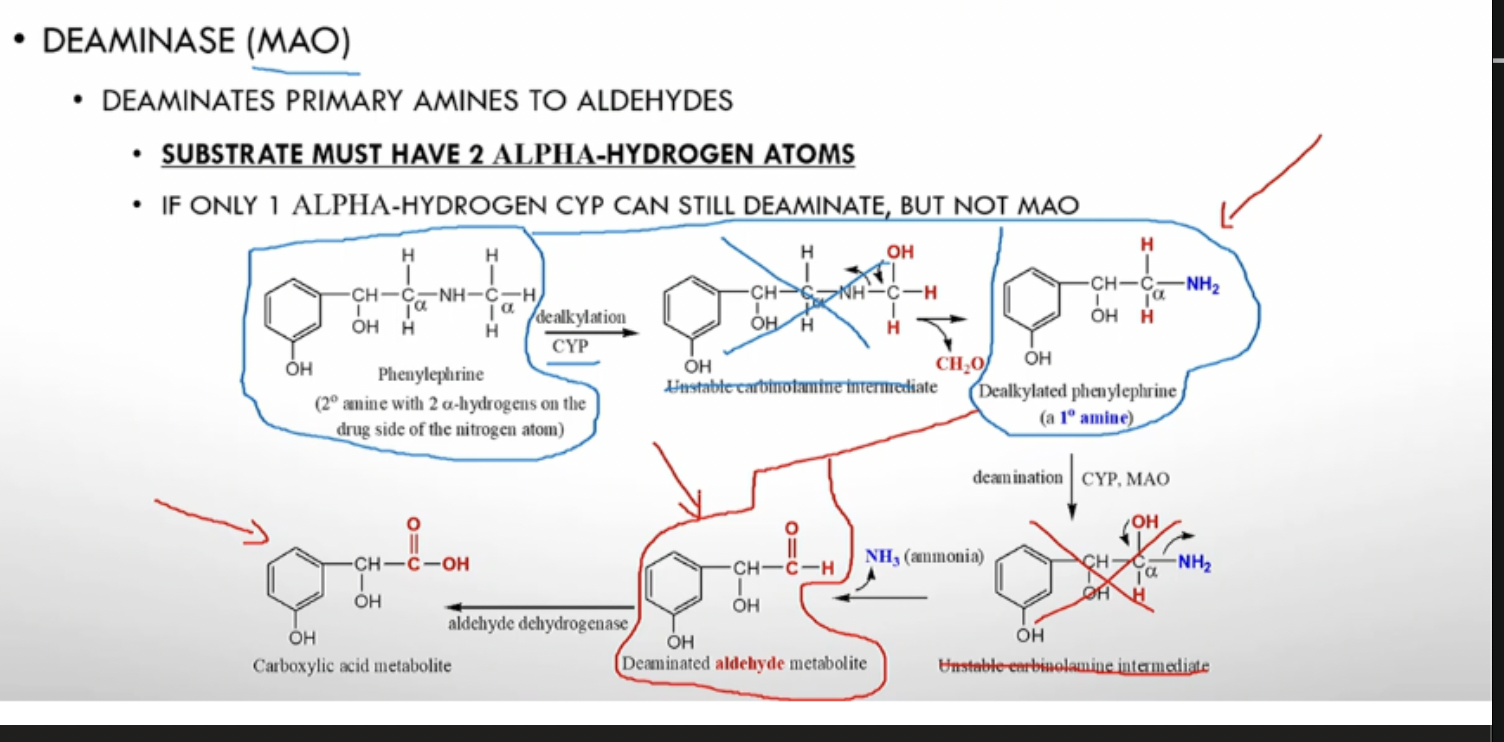
Phenylephrine begins with a secondary amine.
A secondary amine cannot be deaminated yet.
CYP performs N-dealkylation and removes the methyl group.
This produces a primary amine.
Its α-carbon has two α-hydrogens → MAO or CYP can deaminate it.
Deamination produces an aldehyde.
Aldehyde dehydrogenase converts the aldehyde → carboxylic acid.
If a drug already has a primary amine, it does not need the initial N-dealkylation step.