Cell Biology and gentics
 Studied by 0 people
 Call Kai
 Learn
Learn Practice Test
 Spaced Repetition
 Match
Match Flashcards
 Knowt Play
1/22

There's no tags or description
Looks like no tags are added yet.
Name | Mastery | Learn | Test | Matching | Spaced |
|---|
No study sessions yet.
23 Terms
Features all living organisms share, and why viruses are NOT living
All living things carry out the life processes in MESENGER:
Viruses are not considered living because:
They cannot carry out MESENGER on their own.
They cannot respire, cannot grow, and cannot excrete waste.
They have no cytoplasm and no organelles.
They can only reproduce by infecting a host cell, meaning they depend completely on another organism.
So viruses do not perform the essential life processes, which is why scientists don’t classify them as living organisms.
The seven life processes (MESENGER) explained
Movement
All living organisms show some kind of movement. This can be moving from place to place or movement inside the organism (like blood flowing or cytoplasm moving in cells).
Respiration (Energy release)
Living things release energy from glucose through respiration. This energy is needed for everything they do, like growth, repair, and movement.
Sensitivity
Organisms can notice and react to changes in their surroundings. For example, animals sense danger, and plants grow toward light.
Excretion
They remove waste products made inside the body, such as carbon dioxide or urea, so the waste doesn’t build up and cause harm.
Nutrition
They take in useful substances they need to survive. These can be minerals, water, or energy-rich foods like glucose.
Growth
Living things get bigger and make more cells. This is a sign that their metabolism and cell division are working properly.
Reproduction
They create new members of the same species. This can happen sexually or asexually, and it helps the species continue existing.
Why all living cells need cytoplasm
All living cells need cytoplasm because:
It is where metabolic reactions happen (the chemical reactions needed for life).
It contains enzymes that control these reactions.
Organelles like mitochondria and ribosomes float in it.
It allows movement of materials inside the cell.
Because MESENGER requires metabolism, and metabolism happens in the cytoplasm, cells cannot survive without it.
Order of biological structures from largest to smallest
Plant cells – Eukaryotic; the largest structure in this list.
Mitochondria – Organelles inside eukaryotic cells.
Bacteria – Prokaryotic cells, around 0.2–2 µm.
Viruses – Much smaller than bacteria; too small for light microscopes.
Ribosomes – Smallest; found in all cells and the site of protein synthesis.
This order reflects real biological scales.
Size descriptions
Viruses – Extremely small; cannot be seen with a light microscope (need an electron microscope).
Bacteria – 0.2–2 µm; visible with a light microscope but small.
Eukaryotic cells – Large cells that can be seen clearly with a light microscope.
Calculating magnification
Magnification = Image size ÷ Actual size.
Example: If a cell is 0.005 mm wide and looks 5 mm under a microscope:
Magnification = 5 ÷ 0.005 = 1000 → The cell is 1000× larger.
Calculating actual size
Actual size = Image size ÷ Magnification
This allows you to find the real size of the organism or structure.
Why light microscopes cannot see viruses
Light microscopes do not have enough resolution to show viruses.
Viruses are far smaller than 0.2 µm, which is the limit of what light microscopes can show.
: Prokaryotes vs Eukaryotes
Prokaryotes (bacteria) – Simple, small cells without a nucleus.
Circular DNA and plasmids – Their main DNA is circular, and plasmids are small extra DNA pieces that can carry useful genes.
Small ribosomes – Ribosomes are smaller than in eukaryotes and make proteins.
Have a cell wall – The cell wall gives the cell shape and protects it.
No mitochondria or other membrane-bound organelles – All reactions happen in the cytoplasm or at the cell membrane.
Divide by binary fission – They reproduce asexually by splitting into two identical cells.
Eukaryotes (plants + animals) – Complex cells with a nucleus and organelles.
DNA inside a nucleus (linear DNA) – DNA is stored safely in the nucleus in long strands.
Large ribosomes – Bigger ribosomes make proteins more efficiently.
Mitochondria for respiration – Organelles that release energy from food.
Other organelles: Golgi, ER, lysosomes – Golgi packages proteins, ER transports materials, and lysosomes digest waste.
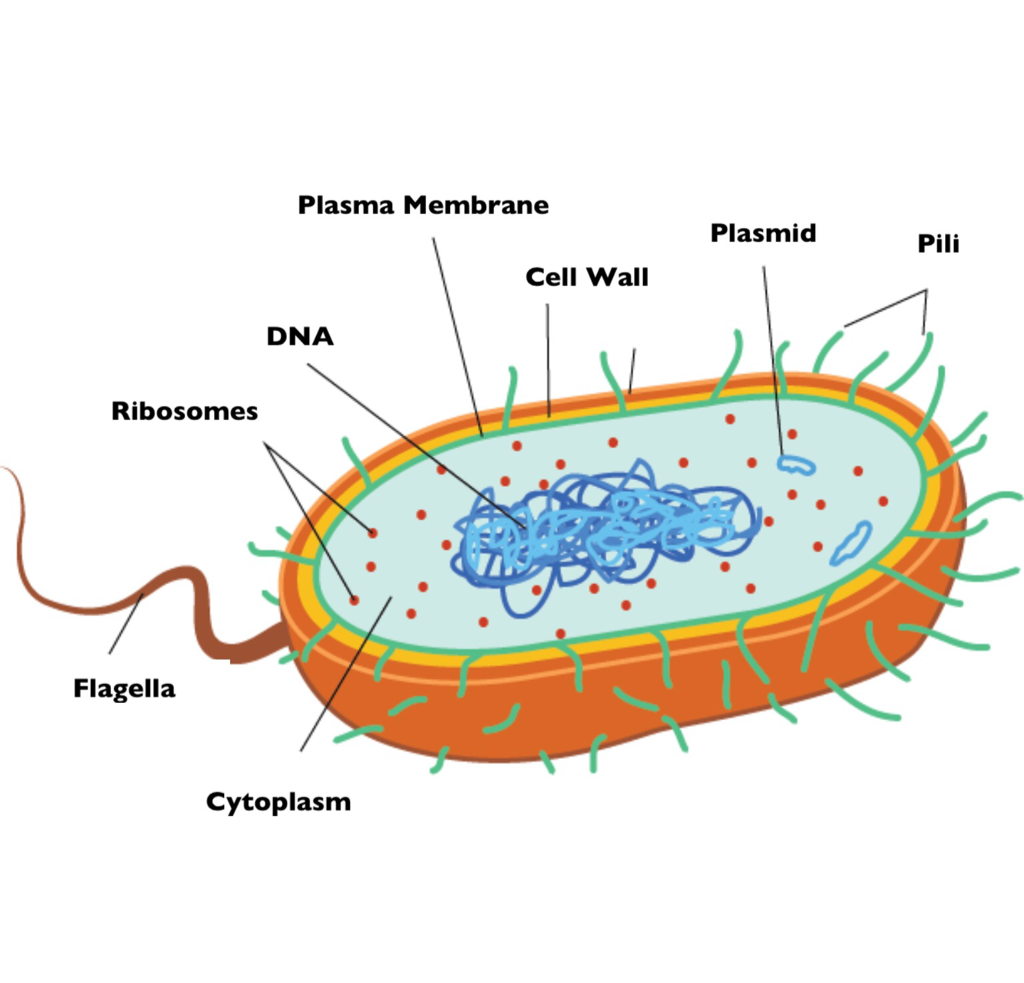
Basic structure of bacteria
Circular DNA in a nucleoid – Main genetic material of the cell.
Plasmids – Extra DNA loops that can carry useful genes.
Cell wall – Provides shape and protection.
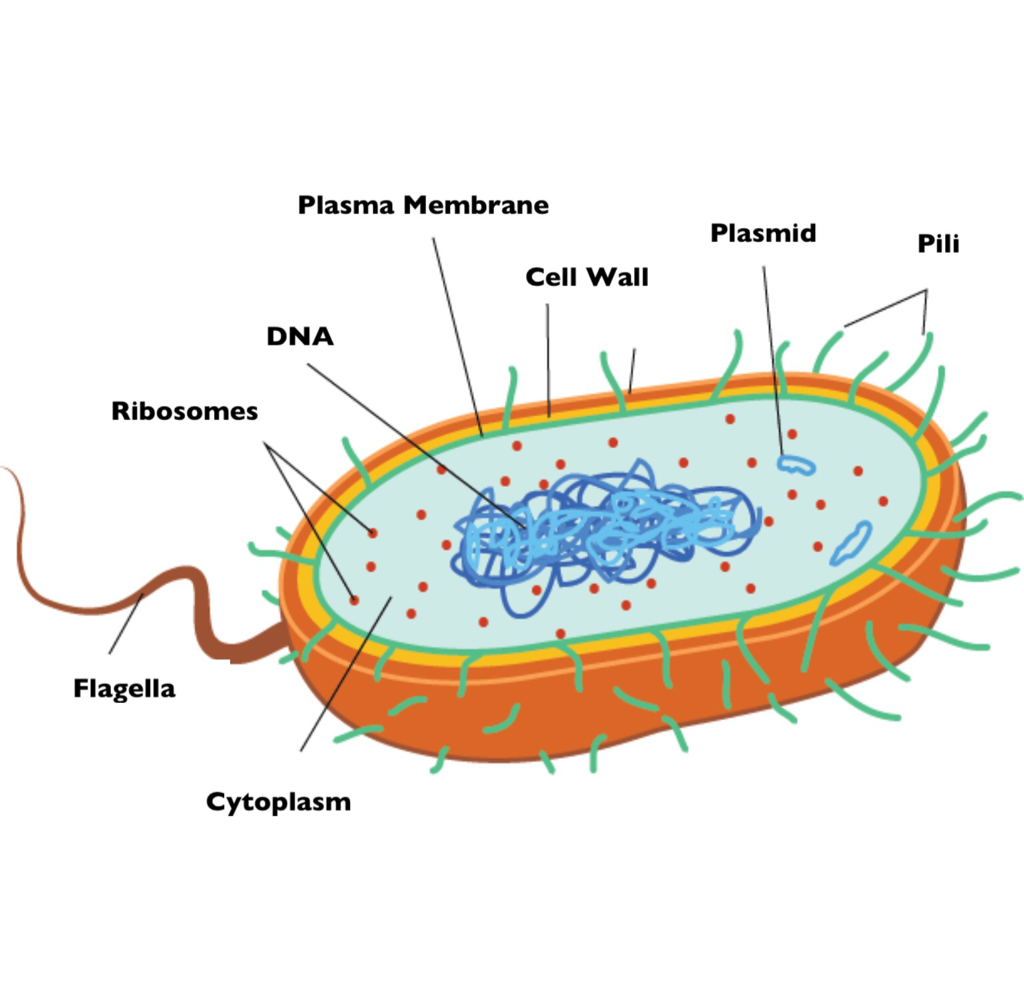
Small ribosomes – Make proteins for the cell.
Pili – Sometimes present; help attach to surfaces or exchange DNA with other bacteria.
No nucleus or mitochondria – All reactions happen in the cytoplasm.
Types and locations of DNA in bacteria:
Circular DNA – Main genetic material, located in the nucleoid.
Plasmids – Small loops of DNA carrying extra genes.
Location – Both circular DNA and plasmids float freely in the cytoplasm, because bacteria have no nucleus.
Why doctors worry about plasmids:
Plasmids – Small loops of DNA separate from the main DNA.
Antibiotic resistance genes – Plasmids often carry genes that make bacteria resistant to antibiotics.
Easy sharing – Bacteria can pass plasmids to each other through processes like conjugation.
Rapid spread – This can create dangerous strains quickly.
Result – Antibiotic resistance can spread fast.
Function of the nucleus
Stores DNA – Contains all the cell’s genetic material.
Controls cell activities – Directs what the cell does.
Gene expression – Decides which genes are turned on and when.
Essential for life – Without it, the cell cannot grow or function properly.
Why the nucleus has pores
mRNA to exit – So it can be used for protein synthesis.
Materials to enter – Such as nucleotides for DNA and RNA production.
Communication – Pores let the nucleus interact with the cytoplasm.
Appearance and function of ER, Golgi, and lysosomes
Endoplasmic Reticulum (ER) – A network of membranes in the cell that helps make and transport proteins and lipids.
Rough ER – Covered in ribosomes; folds proteins and starts packaging them.
Smooth ER – No ribosomes; makes lipids, hormones, and detoxifies the cell.
Golgi apparatus – A stack of flattened sacs; modifies proteins from the ER and sends them in vesicles.
Lysosomes – Small vesicles filled with enzymes; break down waste, damaged organelles, or invaders.
Three main types of cells
Animal cells – Cells that make up animals.
Plant cells – Cells that make up plants.
Bacterial (prokaryotic) cells – Simple cells without a nucleus.
Photosynthesis – Sunlight + Carbon dioxide + Water → Glucose + Oxygen
Glucose (C₆H₁₂O₆) – Used for energy and growth
Oxygen (O₂) – Released into the air
What mitochondria make
Mitochondria perform aerobic respiration.
They release ATP energy, which cells use for movement, growth, and other activities.