ch8 - bacterial genetics
 Call Kai
 Learn
Learn Practice Test
 Spaced Repetition
 Match
Match Flashcards
 Knowt Play
1/21

There's no tags or description
Looks like no tags are added yet.
Name | Mastery | Learn | Test | Matching | Spaced | Call with Kai | Chat |
|---|
No analytics yet
Send a link to your students to track their progress
22 Terms
genetic change in bacteria
genetic changes are inevitable in any organism
all living organisms have to evolve with time to survive
organisms adapt to changing environments
natural selection occurs thru mutations and it favors those with greater fitness
some mutations can make it better…
how bacteria adjust to new circumstances
regulation of gene expression: in diff environment and diff carbon/food sources, they can express diff genes for that source
lactose: bacteria will make the enzyme to break down lactose and allow b to live in the presence of lactose
genetic change (ch8)
change in organism’s DNA alters genotype
allows it to survive when there’s mutations in the genotype of the DNA
this will then change the phenotype
may change observable characteristics, or phenotype
also influenced by environmental conditions

mechanisms of genetic change in bacteria
mutation: change in base sequence of DNA
if you have a sequence of DNA and during the process an A is changed to a C (ATCGTA vs CTCGTA)
occurs during process of DNA replication
horizontal gene transfer: acquisition of DNA (plasmid)
where the bacteria can acquire extrachromosomal dna like plasmid
one with and one without it
extra dna extra genes on it
when it divides all of its progeny will have that…
antibotic reistance genes example
once it acquires it itll be resistant and all offsprings will be resistant
spontaneous mutations
occur randomly in absence of a mutagen (chemical or source) → mutants (resultant organism)
mutation rate: between 10^-4 and 10^-12 for a given gene
mutations passed to progeny
types of mutations that can be passed on to offspring if it occurs
?ex. lactose intolerant vs tolerant
if a mutation did occur, where would it have to occur to be passed down to next gen in humans
?only the ones in the (what are these) germ cells will be passed on
in bacteria they only have one which is the chromosome and it can be passed on to offspring
mutations can occur from
base substitutions
deletion or addition of nucleotides
transposable elements
spontaneous mutations - base substitution
most common
?because it occurs thru DNA replication
incorrect nucleotide incorporated during DNA synthesis in the strand
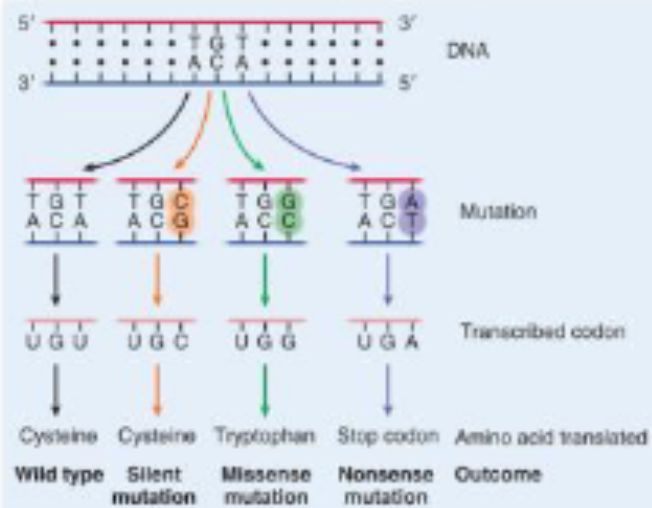
point mutation: a single base pair is substituted for another

spontaneous mutations - 3 possible outcomes of point mutations
silent mutation
same amino acid, no observable change in protein
no change in amino acid even tho the dna changed bcuz of the redundancy of genetic code
cysteine example
missense mutation
different amino acid
resulting protein may be only partially functional (leaky mutation)
if it’s a very imp amino acid the enzyme may not be functional at all
nonsense mutation
stop codon produced
yields shorter protein
may or may not be functional depending on how short they are
what happens when this is in your rna?
mRNA rbs aug……uga………….uga
when rbs gets to the nonsense mutation of uga, it stops even though the whole protein hasnt been translated
therefore, the protein may not be functional especially if its closer to the beginning
if its near the end it might not be as critical
spontaneous mutations - deletion or addition of nucleotides
a lot more lethal than point mutations bcuz they shift translational reading frame → frameshift mutations
affects all amino acids downstream and they wont be the correct amino acid bcuz of how the mRNA reads it after deletion or addition
the fat cat ate the rat → the fa cat ate the rate → theafat cat ate the rat
produces totally different protein or very rarely generates stop codons
truncated protein?
open reading frames
have to start from correct one to produce correct protein
read in 3s
will not produce correct protein

spontaneous mutations - transposons
jumping genes
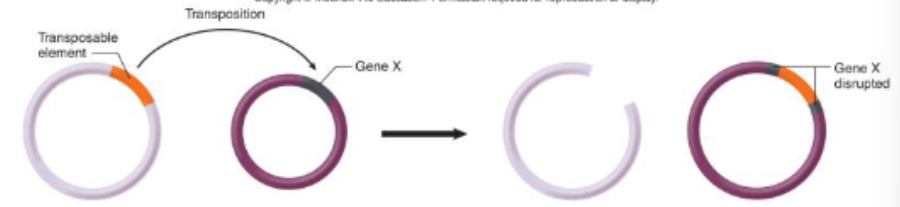
DNA pieces that can move spontaneously from one location to another (transposition)
small pieces that can cut themselves and put themselves anywhere
can go from one organism to the other
can inactivate gene → knockout mutations
gene product generally non-functional
?when it inserted itself, the gene is inactivated bcuz the protein is no longer functional, the characteristic it produces wont be there and it will never be able to produce anymore
?simplest is insertion sequence (IS)
encodes only transposase enzyme, inverted repeats
knows what dna is part of transposon bcuz of inverted repeats
composite transposons
include one or more genes
can confer antimicrobial resistance
what will?..it will be resistant to whatever resistant gene is encoded in the transposon

induced mutations
result from outside influence
mutagen (chemical that can induce mutation to occur): agent that induces DNA change
2 types: chemical, radiation

induced mutations - chemical mutagens
nitrous acid: changes cytosine to uracil by the removal of ?NHH amino group
base-pairs with adenine instead of guanine
C G (U) A A T?
intercalating agents: insert between adjacent bases
create space between bases → extra base added to fill space
addition mutation
ethidium, bromine, acridine, chloroquine
mutations can lead to tumors and to potential carcinogen

induced mutations - radiation
two type
ultraviolet irradiation: causes thymine dimers in DNA
covalent bonds between adjacent thymine bases
A T-T A C G T
causes stalling or replication and transcription
is this strand is used as a template, it wont know how to interpret the thymine dimer and will stall
cell will die if not repaired or it will continue which results? in a SOS response calling in a less specific dna polymerase which puts in any base pair and it will move on
deletion mutation two T to one base pair
x rays
cause breaks and alteration in DNA
can cause cells to die severing the two strands of the dna molecule
double-strand breaks
often lethal

repair of damaged dna
repair is critical
if not repaired → lead to cell death or cancer in animals
repair ensure integrity of dna
repair of base substitution
proofreading by dna polymerase
dna polymerase makes very few mistakes which is why its 10^#
mismatch repair
repair of damaged dna - mismatch repair
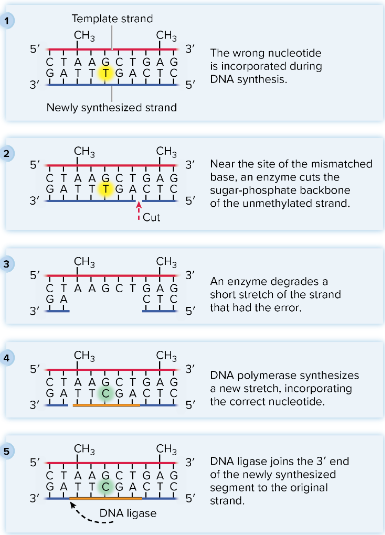
the wrong nucleotide is incorporated during DNA synthesis
near the site of the mismatched base, an enzyme cuts the sugar-phosphate backbone of the unmethylated strand
an enzyme degrades a short stretch of the strand that had the error
dna polymerase synthesizes a new stretch, incorporation the correct nucleotide
dna ligase joins the 3’ end and of the newly synthesized segments to the original strand
repair of thymine dimers - photoreactivation
several methods to repair damage from UV light
light repair
enzymes use energy from light to break covalent bond of thymine dimer
only found in some bacteria
thymine dimer distorts the DNA molecule
an enzyme uses visible light to break the covalent bond of the thymine dimer, restoring the DNA to its original state

repair of thymine dimers - excision repair
several methods to repair damage from UV light
dark repair
enzyme removes damage
dna polymerase, dna ligase repair
thymine dimer distorts the DNA molecule
an enzyme removes the damaged section by cutting the DNA backbone on either side of the thymine dimer
the combined actions of DNA polymerase and DNA ligase fill and seal the gap after the bond is broken

when repair mechanisms are defective or missing
xeroderma pigmentosum
genetic disorder → inability to repair damaged dna caused by UV light → skin carcinoma
exposure to sunlight is limited or forbidden
cuz if they are exposed it could lead to thymine dimer and potential skin carcinoma
mechanisms of horizontal gene transfer
genes naturally transferred by three mechanisms
transformation: naked DNA uptake by bacteria
transduction: bacterial DNA transfer by viruses
conjugation: dna transfer during cell-to-cell contact
transformation
acquisition of ?what is it: naked dna
discovered by Frederick Griffith while working with Streptococcus pneumoniae
S. pneumoniae existed in 2 forms
smooth in appearance
encapsulated, virulent form
bcuz of the capsule, it prevents the bacteria from going thru phagocytosis → more likely to cause disease
rough in appearance
nonencapsulated, avirulent form
white blood cells will engulf and destroy them cuz theres no capsule
??the living non encapsulated cells acquire the dene from the dead cell
when it dies everything goes to environment and it was picked up by the nonE gene to have a capsule
acquire dna from heat killed encapsulated () and incorporate it to their genome

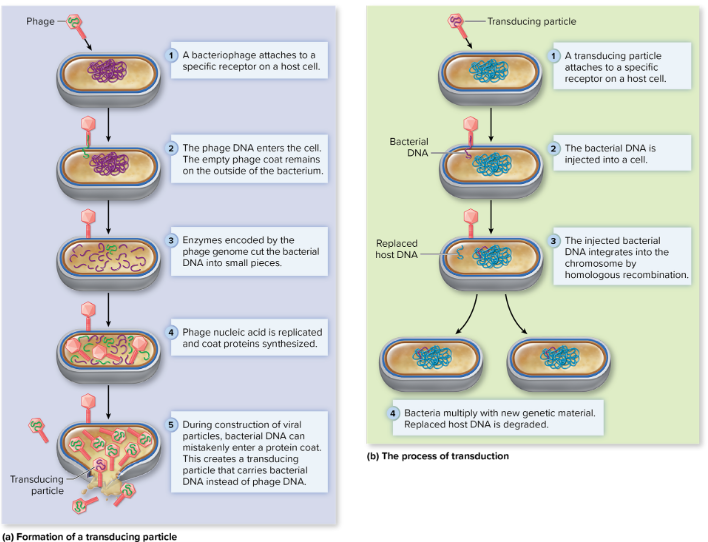
transduction - formation of transducing particle
bacterial DNA transferred from donor to recipient via a bacterial virus (bacteriophage)
result from mispackaging of bacterial DNA during viral replication
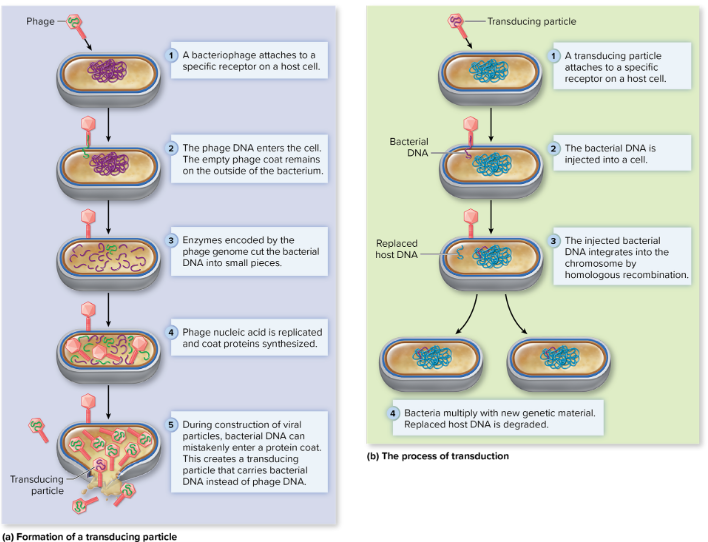
a bacteriophage attaches to a specific receptor on a host cell
the phage dna enters the cell. the empty phage coat remains on the outside of the bacterium
enzymes encoded by the phage genome cut the bacterial DNA into small pieces
phage nucleic acid is replicated and coat proteins synthesized
during construction of viral particles, bacterial dna can mistakenly enter a protein coat. this creates a transducing particle that carries bacterial dna instead of phage dna
stored in the head, can include virus/disease?
the viral dna is released
part of dna is inserting to phage head and when the head carries dna from donor to recipient and will combine with recipient and divide with it ?
donor to recipient by bacterial phase
process of transduction
a transducing particle attaches to a specific receptor on a host cell
the bacterial dna is injected into a cell
the injected bacterial dna integrates into the chromosome by homologous recombination
bacteria multiply with new genetic material. replaced host dna is degraded
cont. conjugation
dna transfer between bacterial cells
mediated by a conjugative plasmid (F factor)
requires direct contact between cells via a sex pilus
cells must be of opposite mating types
F+ donor cell
carries plasmid for fertility factor
F- recipient cell
does not carry a plasmid

the mobile gene pool
consists of extrachromosomal DNA
plasmids, transposons, genomic islands, phage DNA
very common
confer some advantage to bacterium


plasmids
self-replicating
R plasmids
confer resistance to antimicrobial medication and heavy metals (mercury and arsenic)
