genomes
 Call Kai
 Learn
Learn Practice Test
 Spaced Repetition
 Match
Match Flashcards
 Knowt Play
1/26

There's no tags or description
Looks like no tags are added yet.
Name | Mastery | Learn | Test | Matching | Spaced | Call with Kai | Chat |
|---|
No analytics yet
Send a link to your students to track their progress
27 Terms
parts of a chrommosome
Telomeres – ends of chromosomes. Contain telomeric repetitive DNA sequences and not completely replicated in somatic cells (ageing)
❑p-arm – short arm of a chromosome.
❑q-arm – long arm of a chromosome.
❑Centromere – chromosome locus where kinetochore fibers bind to chromatids, allowing for the correct chromatid segregation in daughter cells (contains α-satellite DNA).
species karotype
an individuals complete set of chromosomes
defines its specific number, size and shape
c value paradox
the c value is the amount of DNA in the haploid genome of an organism
varies over a wide range with an increase in the c value with complexity of the organism
paradox is that very similar organisms can show a large difference in c values,
the amount of genomic DNA in complex eukaryotes is much greater than the amount needed to encode proteins
chromosom content
genes
repetitive dna (tandem, interspersed)
regulatory DNA sequences
structure of genes
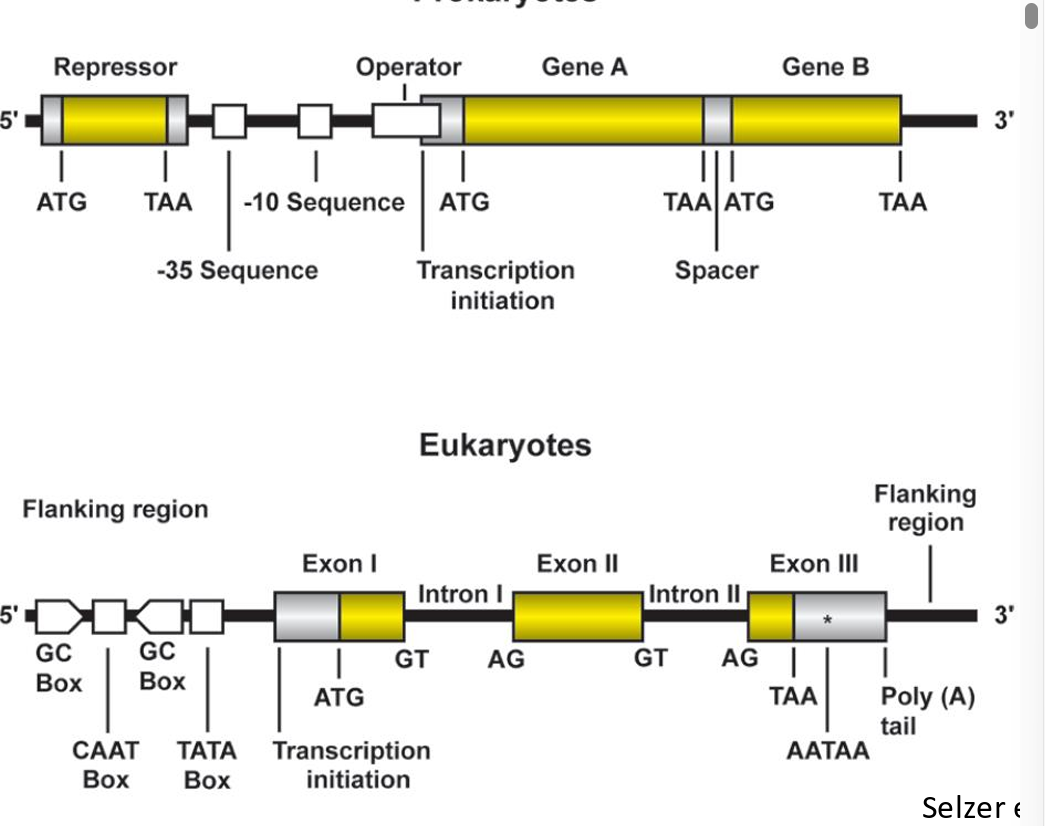
what do alternative splicing form
multiple isoforms
genes in mammals
around 90 percent of genes are present (have orthologs) in all mammals
human an dchimp share 99 percent genes
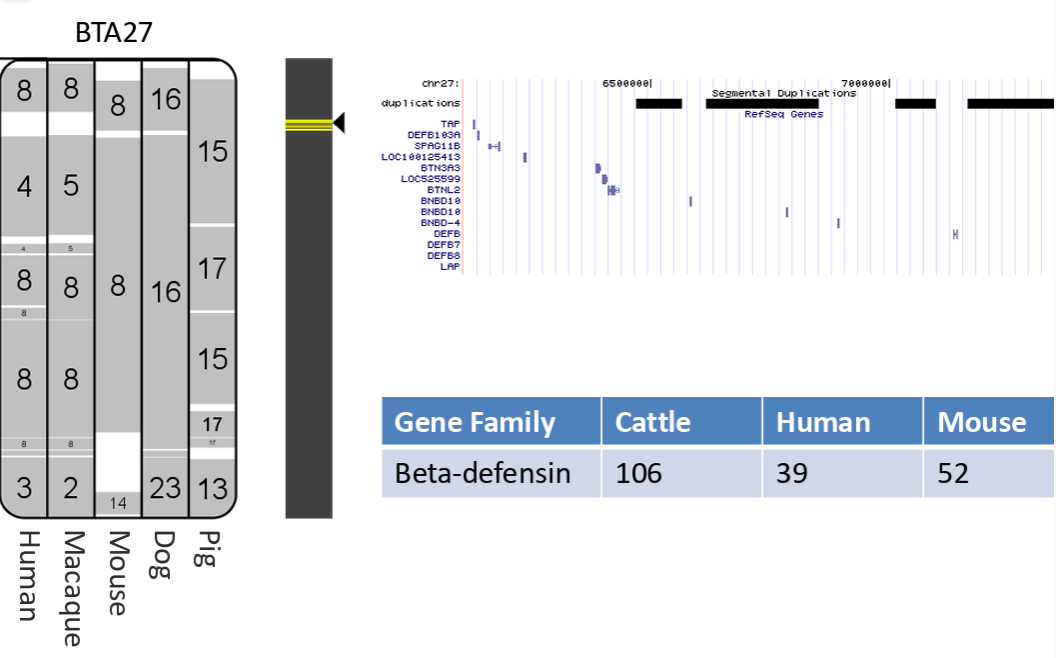
expansion of the beta defensin cluster in cattle
what are beta defensins
what are they characterised by
what is extensive across mammals
beta defensins are peptides with antimicrobial roles chatracterised by a conserved tertiary structure.
copy number variation is extensive across mammals
telomer DNA
protects end of chromosomes
reproduced by telomerase in germ cells
interspersed DNA repeats
what do they do and what do they not form
what percent of the human and maize genome do they comprise
what are they either
what can they do
no not form tandemly repeated blocks
intermingle with other sequences
together comprise around 45 percent of the human genome and more than 50 in maize
either transposable elements or sequences derived from transposable elements
can copy and move genes
regulatory DNA sequences
2 types
functions
cis is close and trans is on a diff chromosome
by fucntions- enhancers, silenccers, insulators
conserved or non
ultra conserved elements
how many
what species
481 elements that are conserved between human, fish, dog and mice
genetic marker
a DNA sequence with a known location (physical or relative) on a chromosome. the marker itself may be a part of a gene or may have no known function
genetic linkage map
what does it represent
what are the distances expressed as
requiremens
what do they not connect
is a representation of markers on a chromsome in linear order with distances between them expressed as a percent of recombination (map units, centimorgans)
require special large mapping populations of more than 1000 individuals
do not directly connect markers to chromosomes. linkage groups
physical map
representation of physical position of markers in a chromosome
syntetic
genetic markers on the same chromosme
synteny
physical co localisation of genes of the saem chromosome in the same species
principles of genetic mapping
what do we need to distinguish
what must markers in a mapping population be
what do we count
what indicates independent assortment
To detect if markers are linked (syntenic) we should distinguish between maternal and paternal alleles of a genetic marker
. Markers must be polymorphic in a mapping population.
❑Counting number of offspring of different type and comparing to the numbers assuming independent assortment (chi square)
. ❑Recombination frequency between two markers of 50% indicates independent assortment
features of genetic maps
what does distance between markers may not match
what is it often impossible to do
what is it useful for
what is it not useful for
distance between markers on a genetic map may not match physical distances on a chromosome
it is often impossible to resolve order of closely located markers-no recombination
useful for detection of association between markers and phenotypic traits within species
not useful for comparative analysis between species
linkage maps for agricultural species
what is used for
are used to connect phenotypuc traits to markers
plants- relaively easy to produce because construction of an appropriate mapping populations is not a problem
animals- construction of mapping populations is diffuclt and expensie. untul very recently maker selection was complicatioed. Therefore animal linkage maps often contain very few markers (~300 genome-wide).
types of physical maps
cytogenetic
genome sequencs
cytogenetic maps
what does it do
what technique was first used to map genes in drosophila
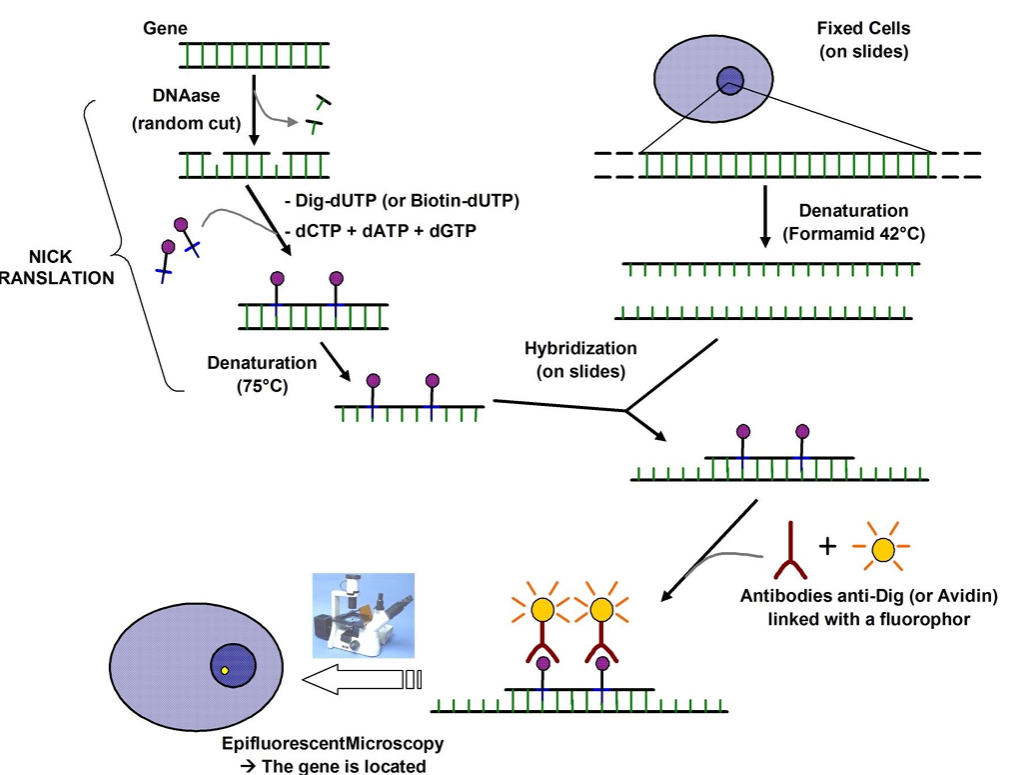
detection position of known DNA fragment on a chromosome by in situ hybridisation
common used variation fluorescence in situ hybridisation
FISH was first used to map genes in drosophila
genomic diversity
gene point mutation
ene duplication/deletion
chromosome rearrangement
transposable (mobile) element activity
gray causing mutation in horses
phenotypic effects
what type of mutation is it
gradual loss of hair pigmentation
dark skin pigmentation is maintained
is a copy number variation
❑Linkage (genetic) mapping to a 352 kb interval, chr 25.
❑Genes: NR4A3, TXNDC4, INVS, STX17
❑PCR analysis detected a 4.6 kb insertion in intron no. 6 of STX17. ❑Duplication detected in all Gray horses and in none of non-Gray. ❑Regulatory mutation that affects expression of NR4A3 and STX17
white coat colour in dog
❑Linkage mapping to a region containing MITF gene (transcription factor).
❑Two mutations were found.
❑Short Interspersed Repeat (SINE)
. ❑Variation in MITF promoter.
❑Different combinations of the alleles lead to different phenotypes.
sulfites in wine
SO2 keeps wine fresh, prevents oxidation ❑Longer shelf life ❑Wines without sulfites must be stored at perfect conditions
Enhanced expression of SSU1 gene enables wine yeast strains carrying the translocation to resist higher sulfite concentrations.
what is evolution of a species dependent on
Genes are passed from one generation to another according to Mendelian principles. All offspring produced through sexual reproduction posses both differences and similarities to their parents. ❑Genetic changes that occur in populations and within species over time are the basis of evolution. Unlike individuals, populations continue over time.
❑Evolution of a species is dependent on changes in gene frequencies within or between populations over time.