AP Art History Unit 2 Flashcards
 Call Kai
 Learn
Learn Practice Test
 Spaced Repetition
 Match
Match Flashcards
 Knowt Play
1/35

There's no tags or description
Looks like no tags are added yet.
Name | Mastery | Learn | Test | Matching | Spaced | Call with Kai | Chat |
|---|
No analytics yet
Send a link to your students to track their progress
36 Terms
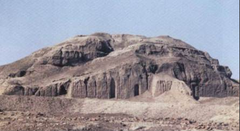
White Temple and Ziggurat: Uruk (modern Warka, Iraq) Sumerian. c. 3500-3000 B.C.E. Mud brick.
Form: Mud brick covered with bitumen (asphalt)
Context: dedicated to Sky God Anu
Content: corners oriented towards cardinal points of compass. modest proportion- only a select few were allowed to go and worship. Thought to be raised so worshippers could
Function: A place to meet with the god, used for religious purposes.
Statues of votive figures, from the Square Temple at Eshnunna. Sumerian. c. 2700 B.C.E. Gypsum inlaid with shell and black limestone
Form: no ankles, big eyes, stylized, simplified, stocky
Context: placed in chapel to watch for gods, shows the dedication of church goers
Content: the figured are very stylized, almost geometric. they are in a position as if holding a candle, a stance of worship. the eyes are unusually large
Function: used to be "stand-ins" for church goers as they were gone

Code of Hammurabi: Babylon (modern day Iran). Susian. c. 1792-1750 B.C.E. Basalt
Form: low relief, very hard material to sculpt, twisted perspective
Context: King Hammurabi was known for his very harsh and strict Law Code. This stele is covered in all the laws
Content: the king Hammurabi is seen receiving laws from God. The artist made Hammurabi almost as big as the god, insinuating that he is of almost equal power and authority.
Function: This stele was used to teach and present the law code. Not all citizens could read of course, but those who could would see this stele and be reminded of the cruel laws put in place by Hammurabi

Lamassu from the citadel of Sargon II: Dur Sharrukin (modern Khorsabad, Iraq). Neo-Assyrian. c. 720-705 B.C.E. Alabaster
Form: high relief, composite creature, very tall, twisted perspective. bull-human. somewhat naturalistic since you can see the veins, bones and muscles.
Context: the lammassu was a protective diety used to defend palaces
Content: as seen from the side the creature is seen in motion, with 4 legs. but from the front it is still with 2 legs. therefore giving the lammassu 5 legs.
Function: These high relief composite creature sculptures would have been places outside the kings palace to "guard" protective diety

Audience Hall (apadana) of Darius and Xerxes. Persepolis, Iran. Persian. c. 520-465 B.C.E. Limestone.
Form: aspects of old Egyptians conventions and new conventions very large
Context: The Persian empire was conquered by Alexander the Great
Content: low relief sculptures on walls and stairs with hundreds of figures , many of them being peoples from other regions showing the diversity in persia
Function: used for receptions by Kings

Seated Scribe: Saqqara, Egypt. Old Kingdom, Fourth Dynastic. c. 2620-2500 B.C.E. Painted limestone.
Form: very natural, very frontal, symmetry,
Context: found in large cemetery- necropolis. one of the few people who could read and write
Content: the seated scribe is sitting in a relaxed manner, very frontal, his eyes are made of crystal creating a sense of awareness, his is missing a pen in his right hand
Function: meant to be in tomb

King Menkaura and Queen: Old Kingdom, Fourth Dynasty. c. 2490-2472 B.C.E. Greywacke w/ traces of red and black paint.
Form: smooth, almsot life-size, very idealized. facial fetures are individualized. very high relief, almost in the round
Context: found in tomb with other statues
Content: the king is slightly turned to the right, covered in shedjet and nemes. his body is straight, strong, with no signs of age. he hold ritual cloths. the queen entirely frontal, equal height as king, suggesting shared power (could be his mother)
Function:ensure the rebirth for king in afterlife, in tomb

Great Pyramids (Menkaura, Khafre, Khufu) and Great Sphinx: Giza, Egypt. Old Kingdom, Fourth Dynasty. c. 2550-2490 B.C.E. Cut limestone.
Form: one of the largest structures in Egypt, sun would hit the buildings in a certain way
Context: one of the last remaining structures of the seven wonders of the ancient world. there are other smaller pyramids.
Content: the pyramids are massive structures of the light rock limestone. they were done over a long period of time showing they were done with much purpose. sun rays create figurative stairway to heaven
Function: used to house the kings bodies and belongings (things they wish to bring to the afterlife) a large tomb

Palette of King Narmer: Predynastic Egypt. 3000-2920 BCE. Greywacke
Form: use of registers, twisted perspective, low relief sculpture
Context: discovered with other artifacts
Content: story of establishment and unification of upper and lower Egypt
Function: used as makeup palette. kohl palette used for sunscreen

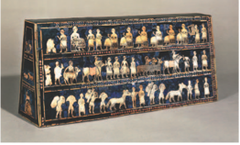
Standard of Ur from the Royal Tombs at Ur: (modern Tell el-Muqayyar, Iraq). Sumerian. c. 2600-2400 B.C.E. Wood inlaid with shell, lapis lazuli, and red limestone.
Form: hierarchical scale, twisted perspective, use of registers, stylized
Context: religious purposes, found in preset day Iraq
Content: symbolizes peace and prosperity, depictions of war , murder, and people being captured
Function: Art Historians are unsure of the absolute function of the artwork but many assume it could be for religious purposes, a soundbox, or possibly a safe.
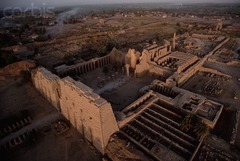
Temple of Amun-re and Hypostyle Hall
Karnark: near Luxor, Egypt. New Kingdom, 18th and 19th Dynasties. Temple: c. 1550 B.C.E.; hall: c. 1250 B.C.E. Cut sandstone and mud brick.
Form: axial plan temple, CLERESTORY, relief sculptures
Context: size communicated power. very large, sacred temple . LOTS OF COLUMNS
Content: represents unity between upper and lower egypt through the lotus and papyrus plants.
Function: religious purposes
Mortuary Temple of Hatshepsut: Near Luxor, Egypt. New Kingdom, 18th Dynasty. c. 1473-1458 B.C.E. Sandstone, partially carved into a rock cliff, and red granite.
Form: procession lines with statues (standing and seated), sphinx's, Osirus. sense or verticality from rock, carved from same stone of surounding rock. long courtyards
Context: a mile away from she was buried. the first female pharoah
Content: this temple was used to meet with the Pharoah Hatshepsut while she was in the afterlife. The building is mostly a long staircase to get to the sacred temple at the end. The use of columns is used multiple times to match the lines in the rocks.
Function: used to meet with and pay respects to the Pharoah or God

Akhenaten, Nefertiti, and Three Daughters:
New Kingdom (Amarna), 18th Dynasty. c. 1353-1335 B.C.E. Limestone.
Form: Elongated forms, protruding stomachs, androgenous, curvilinear, stylized. sunken relief carving
Context: MAJOR change in Egyptian art. New king, Akhenaten coverts Egypt from polytheistic society to monotheistic, now worshipping the sun God, Aten.
Content: Akhenaten and his wife, Neferiti, playing with their three daughters. God Aten giving the two the "breath of life"
Function: would've been in private home used for worship.

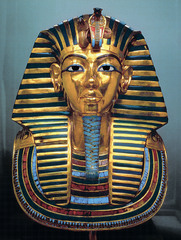
Tutankhamun's Tomb, intermost coffin: New Kingdom, 18th Dynasty. c. 1,323 B.C.E. Gold with inlay of enamel and semiprecious stones.
Form: stylized, curvilinear
Context: one of the greatest archaeological discoveries of all time. King Tutankhamun restored Egypt bak to polytheism after King Akhenaten.
Content: The coffin was modeled after what the King wouldve presumably looked like as a God. With gold skin, bones of silver, and hair of lapis lazuli. The goddesses Nekbet and Wadjet are also seen streatching their wings around his torso. holds crook and flail
Function: Used to hold the body of King Tut
Last judgement of Hu-Nefer: from his tomb
New Kingdom, 19th Dynasty. c. 1,275 B.C.E. Painted papyrus scroll
Form: twisted perspective, composite creature, stylized, hieroglyphics, linear, registers, gods,
Context: hundreds of these papyrus scrolls have been found depicting various challenges people may face in the afterlife
Content: this is a scene from a book of dead showing the weighing of the heart ritual. this ritual involves the god Anubis taking the heart and weighing it against the feather of truth or the Maat. we see that his heart is in fact pure and weighs less, so therefore he can pass on into the afterlife
Function: book of the dead, used for said person to look at when in the afterlife to help guide them

Anavysos Kouros. ca 530 BCE. Marble.
Form: fully in the round, power stance, attempts of naturalism. larger than lifelike.
Context: Kouros translates to "youth". this male figure was seen many many times, representing the ideal male at the time. characteristics include: always naked, his counterpart, the kore, was always clothed, static/rigid posture.
Content: The figure of a man is in a strong, power stance. with his arms at his hips, and his left foot forward, the stance is an indication of status. This sculpture also revolutionizes an attempt at naturalism. although the face may be lacking detail, and the hair being very stylized, the human body is more natural than seen previously. there is a soften line between the torso and the start of the legs, and more fluidity all over the body. the body is less geometric and a lot more curvilinear. the face however is laking individuality and detail. the archaic smile is a staple in the archaic art period.
Function: used to commemorate and remember whoever's tomb this marked. being remembered was the highlight of ones afterlife, making tomb stones very important.

Peplos Kore from the Acropolis, Athens, Greece. ca 530 BCE. Marble
Form: another power stance, fully in the round, drapery.
Context: different from popular belief- the greek statues were not white, they were once beautifully painted. When European Imperialists found these sculptures, they washed the statues to rid them of their beautiful paint. the counterpart of the kouros, the kore translated to "young woman". this kore was found in acropolis.
Content: her outfit, the peplos, gives the audience a sense of what clothing was like in ancient Greece. the bent left arm was broken, but art historians speculate she could've been holding a bow in that hand, and an arrow in the other, making her the Goddess Artemis. although minuscule, her legs give a sense of motion, maybe mirroring the stance of the kouros. this sculpture is also one of the few left with remnants of paint.
Function: in contrast to the kouros sculpture, the kore is used to religious symbolism. Art Historians speculate she could be an offering to the Goddess Athena, or in fact the woman herself could be the goddess Athena or Aretmis.

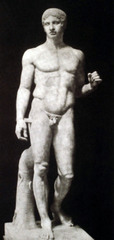
Doryphoros (Spear Bearer). Polykleitos. Original 450-440 B.C.E. Roman copy (marble) of Greek original (bronze).
Form: naturalism, contrapposto, canon of proportion
Context: completely changed the way sculptures and even architecture is made for the rest of history. The stance before (balancing one leg in front and arms to the side) this stance (all weight on one leg) breathes life into the sculpture.
Content: the man is called spear bearer because art historians speculate he once carried a speak in his left hand. this stance is one of significance, introducing contrapposto. his body is much more natural with lots of attention to muscle detail, and even more individualization in the facial features
Function: served as an important example of how the ideal man in greece should look
Niobides Krater Classical Greece painter known as the Niobid Painter. c. 460-450 B.C.E. Clay, red-figure technique
Form: no ground line, static, red-figure painting, severe style. gods are profile while children are frontal
Context: some art historians speculate could copy a greek cave painting
Content: we see the story of Niobides' 14 children getting murdered by Apollo and Artemis. on the otherside however we see herakkles , so people think there are soldiers going to praise and ask for protection from herakles
Function: mix water and wine

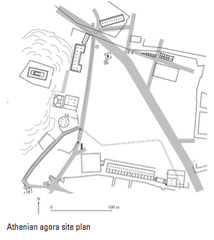
Athenian Agora. Archiac through Hellenistic Greek. 600 B.C.E.-150 C.E. plan
Form: leads to acropolis, very large, spaced out
Context: experimenting in democracy. With an election, anyone who's a great speaker, or someone who's particularly wealthy could become politically powerful
Content: floor plan includes multiple stoas, panathenaic way takes your directly through the whole center
Function: city center, meetings, governmental decisions
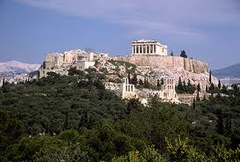
Acropolis. Athens, Greece. Iktinos and Kallikrates. c. 447-410 B.C.E. Marble
Form: extremely large, classical period
Context: has been ransacked and burnt, blown up, etc multiple times.
Content: there are multiple buildings most notably the parthenon, then theres the temple of nike, old temple of athena, altar of athena polias, rome and agustus altar, athna promachos, erechtheion, and propylai. All with unique detail and purpose.
Function: most important religious center in all of Greece
Grave stele of Hegeso. Attributed to Kallimachos. c. 410 B.C.E. Marble and paint.
Form: made of marble, was once painted, drapery
Context: hellenistic period focussed on the everyday individual rather than Gods/Goddsses
Content: women opening necklace given to her by her servant. wearing thin veil. architectural setting represents home
Function: gravestone

Winged Victory of Samothrace. Hellenistic Greek. c. 190 B.C.E. Marble
Form: drapery, marble once painted. nine feet tall very large.
Context: the statue was placed upon a windy hill, matching the wind moving through her dress.
Content: nike stands victorious , grounded by her feet but starting to move, lots of texture. celebration of body
Function: ritual worship

Great Altar of Zeus and Athena at Pergamon. Asia Minor (present-day Turkey). Hellenistic Greek. c. 175 B.C.E. Marble (architecture and sculpture).
Form: hellenistic. scene of war. contrast between highlights and shadows of figured. very high relief, some figures even popping out of the frieze. was once painted
Context: when alexander the great died his territory was divided among 4 generals, one of them saw a hill off the coast of turkey and built the garrison of Pergamon which later became the kingdom of Pergamon.
Content: battle of supremacy between the Gods/Goddesses of Olympus and giants (Titans). full of diagonals.
Function: religious reasons, alar of zeus.

Alexander Mosaic from the House of Faun, Pompeii
Republican Roman. c. 100 B.C.E. Mosaic
Form: naturalism, modeling. made of a million and a half pieces of glass and stone. very empty at top. turning point in battle
Context: art historians speculate this was a replica of a greek wall painting. intended to be seen vertically
Content: war between the greeks and the Persians. in the mosaic, it is right when Darius ordered his men to retreat, making Alexander the winner.
Function: show the victory of alexander the great

Seated boxer. Hellenistic Greek. c. 100 B.C.E. Bronze.
Form: bronze, very expensive, incredible detail. lost wax casting. naturalism. hollow inside
Context: this sculpture i one of the few greek original bronze statues. boxing in Greece was to the death, with a focus on blows to the face
Content: the greek boxer is seen sitting, tilting his head. Some people think he is in the beginning, middle, or end of his battle. he has cuts on his face and a swollen ear, wearing his leather boxing gloves
Function: no definitive function, made purely for art

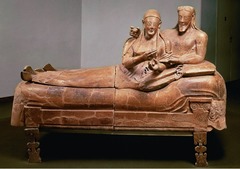
Sarcophagus of the Spouses
Etruscan. c. 520 B.C.E. Terra cotta.
Form: terra cotta/clay very hard. archaic smile. fully in the round. stylized. hollow inside, big eyes
Context: would've been inside a huge tomb. conventions of Egyptian art- the archaic smile, detailed tombs. fired in 4 parts. the Etruscan have no written history but left a lot of beautiful artwork behind
Content: a husband and wife laying in bed. sense of eternity and longing with the arms out to the viewers.
Function: house the bodies of the spouses
Temple of Minerva (Veii, near Rome, Italy) and sculpture of Apollo. Master sculptor Vulca. c.510-500 BCE. Original temple of wood, mud brick, or tufa (volcanic rock); terra cotta sculpture.
Form: entasis, large, one single staircase, deep porch, drapery, once painted. no base of building. very stylized
Context: greek convention of pediment, but the sculpture are above instead on the pediment, and entasis.
Content: apulu very dynamic, clothed. scene from ancient greek mythology (the third labor of hercules) engaging eyes, striding forward. different body proportions
Function: religious temple

Tomb of the Triclinium. Tarquina, Italy. Etruscan. c. 480-470 BCE. Tufa and Fresco.
Form: colorful lots of pattern, very large,
Context: the etruscans believed the afterlife was quite similar to everyday life, so tombs strongly resembled regular homes.
Content: red door painted, meant to be the "door to the afterlife" the etruscans celebrated the afterlife, there are murals of etruscans dancing and playing instruments.
Function: tomb- house for the dead

House of the Vettii. Pompeii, Italy. Imperial Roman. Cut stone and fresco.
Form: very open, lots of columns, large courtyard
Context: pompeii was destroyed by the eruption of volcano mount vesuvius. Republican government
Content: house's decorative schema is representative of a key transitional phase, between the Third and Fourth styles of Pompeian wall painting.
Function: a private home, also a stage on which the rituals of daily life and social hierarchy would be performed

Head of a Roman patrician. Republican Roma. c. 75-50 B.C.E. Marble.
Form: verism or hyperrealism, physical embodiment of gravitas and virtus, frontal
Context: influenced by "imagines" (aristocratic death masks) patricians worked in the senate
Content: the mans expression is very stoic. art historians don't know who this man was, but it is extremely personalized. lots of wrinkles, toothless, very sunken skin and jowels
Function: Symbolizes the virtues of wisdom, determination, experience, valor and strength that all Roman Republicans hoped to obtain

Agustus of Primaporta. Imperian Roman. Early first century C.E. Marble.
Form: in the round, similar to the doryphorus, following canon of proportion
Context: copy of a bronze original. this sculpture was major propaganda, they were placed in every roman city to promote Agustus
Content: his breastplate shows a mythological scene, of roman victory. his pose shows he is a public speaker- something very valued in ancient rome. the cupid at his foot is meant to portray him as a god.
Function: VISUAL PROPAGANDA
Colosseum (Flavian Amphitheater), Rome, Italy. Imperial Roman. 70-80 C.E. Stone and concrete.
Form: different types of arch's, HUGE, doric, ionic, and corinthian pilasters,
Context: subjects were seated by class, the lowest class being closer to the top, and in the sun. the stadium was also specifically designed to get people in and out quickly, with 80 access arch's.
Content: optical illusion meant to make the building look smaller, the arch's get shorter each level. tunnels underneath, many flattened out, purely decorative columns.
Function: made to appease the people to get them to accept imperialism, also to hold entertainment such as gladiator fights, naval battles, animal fights

Forum of Trajan. Rome, Italy. Apollodorus of Damascus. Forum and markets: 106-112 C.E.; column completed 113 C.E. Brick and concrete (architecture); marble (column).
Form: concrete, very large, lots of rooms
Context: the romans were known for their concrete craftsmanship
Content: column of Trajan shows Trajan's military victories, multiple sculptures of Trajan and the people he's conquered
Function: civic center, place to conduct business, hold meetings, there were also 2 libraries, also place to glorify Trajan

Pantheon. Imperial Roman. 118-125 C.E. Concrete with stone facing.
Form:perfect proportion,
Context: all the columns in the front were made from one piece of concrete! materials imported from Egypt to show the power and control of Hadrian
Content: fills whole range of vision, symbolizes the meeting of heaven and earth, representation of Hadrian's power
Function: originally used for temple of the gods, later converted to catholic church

Ludovisi Battle Sarcophagus. Late Imperial Roman. c. 250 C.E. Marble.
Form: marble, deep relief, very large, weird perspective, looks like its moving, drapery
Context: romans originally preferred cremation, but burial gained popularity once more. the owner of this sarcophagus hasn't been identified but art historians believe it would've belonged to someone of high class and power. the sarcophagus shows the shift in focus from the high classical carvings like in the parthenon to interaction between figures.
Content: a battle scene between the romans and the enemy which art historians believe to be the goths. at the top, there is a hero erupting through the crowd with his right arm held high in the air, while riding a horse. The romans are seen winning this battle, with many of them taking the goths as captive.
Function: sarcophagus- tomb for deceased
