Module 4: Polysaccharides
 Call Kai
 Learn
Learn Practice Test
 Spaced Repetition
 Match
Match Flashcards
 Knowt Play
1/40

There's no tags or description
Looks like no tags are added yet.
Name | Mastery | Learn | Test | Matching | Spaced | Call with Kai | Chat |
|---|
No analytics yet
Send a link to your students to track their progress
41 Terms
Aldose
monosaccharides with aldehyde groups
Ketose
monosaccharides with ketone groups
D Sugars
Natural carbohydrates are almost exclusively ___ sugars
Epimers
________ are monosaccharides that differ in the orientation at only one position
Anomeric Carbon
The ______________ is the reduced, or reacted, carbon ring structure
Pyranose
A six-membered ring containing 5 carbon atoms and 1 oxygen atom
Furanose
A five-membered ring containing 4 carbon atoms and 1 oxygen atom
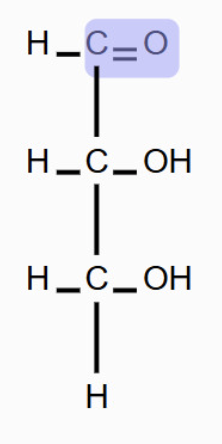
Aldose or ketose?
Aldose
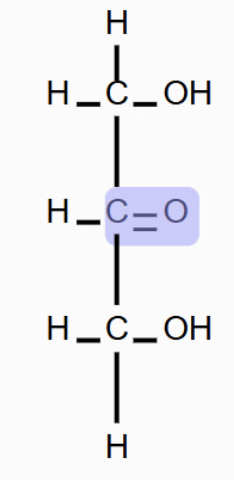
Aldose or ketose?
Ketose
On carbon number 3, which is the penultimate carbon.
Which carbon in erythrose would tell you if the monosaccharide is D or L? Give the carbon's number in your answer
Galactose
Glucose and mannose are epimers. Name another epimer of glucose besides mannose.
The alpha 1→6 bond is found in polysaccharides when branching occurs.
When is the alpha 1→6 connection typically found in carbohydrates?
Similarities: Both of are homopolysaccharides of glucose. They each have alpha 1 → 4 connections between glucose. They each are part of starch.
Differences: Amylopectin has branching with alpha 1→6 linkages. Amylose does not. Amylopectin is typically larger than amylose.
What are the similarities and differences between amylose and amylopectin? Explain in at least three complete sentences.
Chitin has glucose with derivatives attached. -NH-CO-CH3 is connected to each glucose.
How is chitin different from cellulose?
They are found where glycogen and amylopectin branch.
Where are alpha 1 → 6 bonds found in carbohydrates?
They both can form alpha helices.
In what ways are amylose and a protein alike?
Dihydroxyacetone
Which of the following monosaccharides is a ketose?
Dihydroxyacetone
Galactose
Glucose
Glyceraldehyde
Idose
Water is eliminated
In dehydration reactions…
beta-D-glucose
Chitin and cellulose are both polymers of
Both serve primarily as structural elements in cell walls
Which statement about starch and glycogen is false?
Glyceraldehyde
Which monosaccharide is not a six-carbon monosaccharide?
D (carbon group at top of chain)
Which arrow correctly identifies the atom that will become the anomeric carbon?
Cellulose is a homopolysaccharide
Which statement about cellulose is true?
Cellulose
The polysaccharide chitin is most chemically similar to:
Glucose
The organic molecule that is produced abundantly by photosynthesis is
Dextrorotatory
The "D" in the D-carbohydrates stands for:
Table Sugar
Sucrose is also known as:
N
What element besides C, H, and O is found in the chitin?
24 to 30
Amylopectin has alpha 1 → 6 branching about every________ residues.
Alpha-helix
Amylose folds into which of the following structures?
mutarotation
The equilibrium between alpha and beta structures is called __________.
A) 1 pyranose; 1 furanose
B) beta 1 → 4
C) yes, it has free anomeric carbon
A) In the above structure, how many monosaccharide units are furanoses and how many are pyranoses?
B) What is the linkage between the monosaccharides?
C) Is this a reducing sugar?
The human enzyme cannot break down the bond between the glucose residues in chitin. The bond is a beta 1 →4, but human enzymes only act upon alpha 1 →4. So, no he should not eat the beetles as food.
A hiker is lost in the wilderness and without food. He runs across several beetles with hard chitin exoskeletons. Would he get nutrition in the form of glucose from eating these beetles? Explain.
An oligosaccharide is a polymer of 2 to 20 monosaccharides joined together. A polysaccharide is more than 20 monosaccharides joined together. They are typically linked together by the same1 → 4 linkages practically, and there are usually thousands of monosaccharides in a polysaccharide. In addition, polysaccharides can have branches in the structure, which permits them to form large complexes. In contrast, most oligosaccharides do not have branching.
How are oligosaccharides and polysaccharides similar in their structure? How are they different?
Carbon E. It is the penultimate carbon and tells the viewer if the sugar is D or L. This monosaccharide is D.
A) Which carbon in the following molecule determines if the molecule is D or L? Indicate the letter corresponding the correct carbon ("A", "B", etc.) and explain. B) Is this molecule D or L?
The -OH groups on the oligosaccharide form many hydrogen bonds with water molecules. For this reason, the carbohydrate forms an aqueous solution with many molecules dissolving. These interactions permit water to solubilize the carbohydrate.
The following oligosaccharide interacts favorably with water. What is the source of the ability of the interaction between H2O and this carbohydrate?
Monosaccharide
Simple Sugar
Oligosaccharide
Short chain sugar
Polysaccharide
Long chain sugar (20+)
3-8 carbons
Monosaccharides typically have how many carbons?
Mutarotation
Anomers can convert from one ring structure to the other through the open chain molecule