Psych 111 Terms (Test 2)
 Call Kai
 Learn
Learn Practice Test
 Spaced Repetition
 Match
Match Flashcards
 Knowt Play
1/210

There's no tags or description
Looks like no tags are added yet.
Name | Mastery | Learn | Test | Matching | Spaced | Call with Kai | Chat |
|---|
No analytics yet
Send a link to your students to track their progress
211 Terms
Glial Cells
Provide structural, foundational, functional support for other cells in the nervous systems
Blood Brain Barrier
barrier around brain that is meant to protect it
protection to keep out substances that might negatively affect it
Neuroplasticity
The brains ability to change/make adjustments based on our experiences
change in neural status/interaction
Neurogenesis
Production of new brain cells
starts deep in the brain then slowly branches outwards
Neurons
Nerves made of this, communicate and process information
A: Dendrites
B: Soma/Cellbody
C: axon
D: Mylein sheith
F: Terminal Buttons/Axon terminal
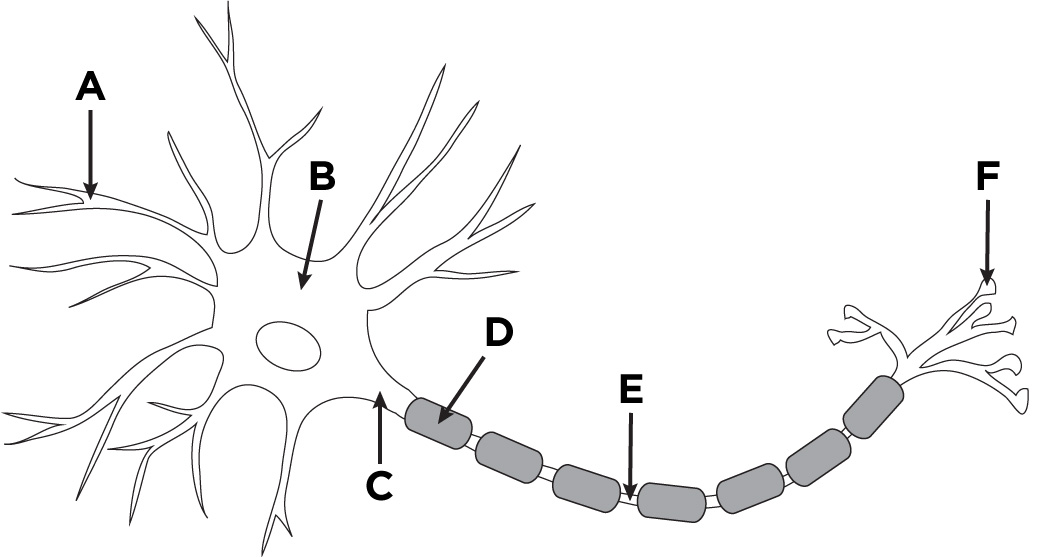
Ignore (E)
Dendrites
Part of the Neuron:
Reaches out for information that it brings back to its neuron
Cell body/soma
Part of the Neuron:
Dendrites deliver information here in order to process information
Axon
Part of the Neuron:
Make up the largest part of the neuron which transfers the information across the neuron, or to other neurons
Myelin Sheath
Part of the Neuron:
Speeds up the information being transmitted
Terminal Buttons/Axon terminal
Part of the Neuron:
where information is released in order to be passed on to another neuron to be picked up
Synapse
Space between the terminal buttons of one neuron and the dendrites of another neuron
Synaptic Pruning
Removes connections between neurons that are generally weak in order to make networks faster
Sensory Neurons
Afferent Neurons
Takes information from sensory organs and takes it to the brain
_____: general term for taking information to the brain
Motor Neurons
Efferent Neurons:
Taking information from the brain in order to make the body move
_____: general term for taking information away from brain to somewhere else
Mirror Neurons
Neuron that mirrors those of which we are interacting with
Ex: mirroring someone's hurt expression even if you aren't hurt (Empathy?)
Inter-neurons
neurons there to transmit information throughout the body
Most neurons
Electrical V. Chemical
Action Potential
Transfer of information within a neuron
Transfer of information between neurons
Within neuron, sending information across axon
Change in electrical charge from -70mV to +40mV
Sodium and Potassium
Ions associated with Electrical information transmission
flows into or out of axon
Refractory Period:
Absolute v. relative
general term for the two: ______
brief time after action potential, cell membrane is recoverying resisting sending new electrical impulse
_____: neuron will not send information again no matter what
_____: get more information or more stimulus to send information again
Gives neuron time to come back and prevent unnecessary loops
Law of forward condition
Information sent from dendrite flow to terminal buttons
NEVER OPPOSITE WAY
All or none principle
If a neuron fires, it will go through completely and not die half way through
Excitatory v. Inhibitory signals:
_____: encourage cell body to send information on
_____: encourage cell body to stop the information
Hebb’s rule:
Connection between neurons will strengthen if information is constantly sent between the neurons
Neuro-transmitters
chemical part of chemical transmissions between neurons
Agonist v. Antagonist:
_____: make a neurotransmitter more affective
_____: make neurotransmitter less affective
Dopamine
what brain releases when your brain believes you should receive a reward or a pleasureful experience
Serotonin
controlling negative emotionele
Important for sleep, and arousal or attention
Disruption leads to OCD, depression(SSRI used to treat)
Epinephrine: Adrenaline
causes energized mental states
Just mental component
Norepinephrine
Causes Mental and physical arousal or alert
Ptsd, some forms of depression
Endorphins
natural pain killers in the body when body is damaged
Ex: runners high
Body is damaged for short term but gives emotional high
GABA
inhibitory, signal to not send information through, slows nerve activity
If not functioning properly can cause Epilepsy
Glutamate
activates/facilitates nerve cells
Too much = seizures and migraines
Acetylcholine
helps control muscle movement, memory, and basic organ functions in the nervous system
Helps treat Alzheimer's or dementia
Clean up:
Enzymatic degradation:
Reuptake:
Clean Up:
_____: enzymes come along and eat up flowing neurotransmitters which cleans out synapsis for space
_____: take back some of the neurotransmitters that were released that can be used again
Recycling for terminal buttons
The brain
Center of the Nervous System, cannot function without it
More wrinkles/more surface area makes an individual more intelligent but not the size
What is the intelligence correlation for the brain?
what makes a brain smarter than anothers?
Brain development: timeline
Bottom, Top
upper part
oldest parts of the brain are on the ____, and newest is on the ____
____ parts don't develop fully until after an individual is born
Contralateral control
Left side of the brain is concerned with right side of the body
Right side of the brain is concerned with left side of the body
Association Area
Region of Cerebral Cortex that connects sensory and motor inputs to perform at areas of the body associated with specific complex cognitive ability or skill
Hindbrain(brainstem), Midbrain, Forebrain
3 parts of the brain
_____: oldest from evolutionary perspective and developmentally
_____: Smallest part of the brain
_____: Newest area evolutionary and developmentally, highest level (on top of the brain)
Hindbrain(Brain Stem)
part of the brain:
conducts information to and from spinal cord
associated with vital body functions that keep the body alive/functioning
Medulla
Recticular Formation
Part of the Hindbrain:
lower part of the hindbrain
spinal bodily function: heart rate, reflexes, circulation, respiration
if damaged = dead
_____: important for sleep, mood, attention and is the source of Serotonin and Epinephrine
Pons
Parts of the Hindbrain:
on top of the medula
important for sleep, facial expression, arousal
works as a relay to third part of the hindbrain
Cerebellum (Little brain)
Parts of the Hindbrain:
Has most condensed neurons
Critical for fine motor movement and balance
muscle movement/balance
biggest area that helps differentiate humans from other animals in intelligence
Midbrain
Orientation of space
part of the brain:
_____: place ourselves in an environment and move within it
critical source of dopamine
Tectum
Part of the Midbrain:
Take in sent information and moves the body in response to that information
For humans, a lot of visual information
For other species, could be hearing, smell, etc.
directs the other part of the midbrain
Tegmentum
Part of the Midbrain:
A network of nerves that keeps you awake, alert, and conscious
Guide our attention in the environment in order to continue to process environment
can help recognize danger
Forebrain
cerebral cortex
Part of the brain:
Most complicated thinking is occurring here
_____: wrinkly skin/outer layer, 2 hemispheres
(1): males
(2): females
Sex differences between brain:
(1): More connections/concentration of neurons in the front of the brain
(2): A lot of cross talk between left and right hemisphere not mainly front concentration
Corpus callosum
connection that allows for the left hemisphere to talk with the right hemisphere of the brain
Subcortical Structure
structure sitting beneath cerebral Cortex
bridge between body and higher thinking
Frontal Lobe, Parietal Lobe, Occipital Lobe, Temporal Lobe
8 Lobes across Cerebral cortex:
(4 names, left and right mirror each other)
Frontal Lobe
Higher order processing
8 Lobes across cerebral cortex:
manages movement thinking and behavior, CEO of the brain
_____: judgement, creative thinking
Prefrontal Cortex, Motor Cortex
2 Parts of the Frontal Lobe
Prefrontal Cortex
Parts of the Frontal Lobe:
larger in humans than in other animals
Regulating a lot of cognitive components or brain patterns
manages high-level thinking, emotional regulation, and goal-directed behavior
Central executive system
Generally last area to develop in humans
Motor Cortex
Homonculus
Parts of the Frontal Lobe:
Deal with motor movement
Hand movement, mouth movement
_____: image of a human if parts of the body is proportional to the function of the motor cortex
Phineas Gage
Had a pipe went through his skull, affected frontal lobe most
Mild manner developed into impulsive, anger issues
Front lobe controls impulse control
Occipital Lobe
8 Lobes across cerebral cortex:
Responsible for vision
Builds: as information processes, build into complex image
Parietal Lobe
Somatosensory cortex
visual integration
Orientation
8 Lobes across cerebral cortex:
responsible for orientation
_____: right behind motor cortex Focuses on touch information across the body, More proportionate to body, but not really: hands and mouth more focus
_____: making sense of a signal that the structure receives
_____: details within a process
Temporal Lobe
8 Lobes across cerebral cortex:
Hearing and language = recognition
Puts a name to what you see
Lateralization:
the specialization of certain mental functions, cognitive processes, or physical behaviors to one side of the body or brain hemisphere over the other
left and right hemispheres
Broca’s Area:
Broca’s Aphasia
Left temporal lobe:
_____: Responsible for speech movement
_____: Communication disorder that affects a person's ability to speak and write, caused by damage to the frontal lobe of the brain
Wernicke’s Area:
Wernicke’s Aphasia
Left temporal lobe:
_____: Responsible for Speech comprehension and assortment
_____: words are being spoken but no meaning behind it at all
Thalamus
Subcortical Structures:
All Sense information goes thru here: exception is smell, which goes straight to forebrain
Goal is to send sense information to the appropriate part of the brain
Pituitary Gland
Subcortical Structures:
Controls release of hormones throughout the body
ex: digestion, stress, reproduction
Limbic System
The emotional part of the brain
Relating to emotion and membrane
Hypothalamus
Limbic System:
Deals with fleeing, fighting, feeding, reproduction (4Fs)
Hunger signals, when or when not to eat
Amygdala
Limbic System:
Emotional Memory
Controls a lot of negative emotions, especially fear(danger)
ex: PTSD
Hippocampus
Limbic System:
Important for creating long term stable memory
As an individual gets older, decrease function
Acetylcholine
Cingulate Gyrus
Limbic System:
Band of issue in the brain that helps with focus on information
allows to focus on emotion pain and decision making information
Schizophrenia typically indicates that it is not working properly
Basal Ganglia
Limbic System:
Has its own system, important source of dopamine, positive emotion and voluntary muscle movements
Taking on dual role
Hypothalamus, Amygala, Hippocampus, Cingulate Gyrus, Basal Ganglia
All the parts of the Limbic System
Brain Imaging Techniques: Structure
CT Scan
MRI
DTI
NIRS
_____: series of x ray of the brain from different angles that combine to make a picture of the brain
_____: magnets to take pictures of the brain to put it together to see what is happening
Focus on brain matter
_____: type of (the one above) that uses magnets focuses on the myelination of the neurons
Focus on white matter: Myelin sheath
_____: Light pulses to see images of the brain based on reflection of the pulses
Brain Imaging Techniques: Activity
EEG
ERP
fMRI
PET
TMS
_____: electrodes that are placed along the scalp to determine when electrical changes are happening
_____: the specific data coming from a singular electrode placed on the scalp
_____: uses magnets to track the metal in our blood to see where blood is going to determine where activity is happening
_____: tracking glucose since brain uses glucose for energy
_____: using magnets to disrupt the brain to see what happens when it is disrupts it
Spinal conduction, Brain, Cerebrospinal fluid
parts of the Central nervous system
Spinal conduction
Helps the conduction of information between brain and body
Cerebrospinal fluid
cushioning to help the central nervous system
Also provided nourishment for central nervous system
Autonomic nervous system:
Sympathetic
Parasympathetic
Enteric
:controls involuntary bodily functions without needing conscious thoughts:
_____: fight or flight response
Increase heart rate or respiration
_____: Rest or digest system
Helps body recovery from a charge period by the sympathetic
Day to day component
_____: nerve cells embedded in the gastral intestinal system
Second brain, as many nerve cells here as in the spinal cord
Serotonin wrapped in this system, includes fullness signal
Sensation
Objective interaction between sense organ and external stimulant
Perception
brain subjective interpretation of that interaction
Happens after external/objective and internally
Transduction
external sensation turns into internal perception
Just Noticeable Difference
Smallest change in the stimulant needed for you to perceive a change in the stimulant
subjective
Not fixed amount of change: vary depending on initial stimulus
ex: small candle + one vs. lots of candles + one
Weber’s Law:
Just noticeable difference is constant in proportion to/based on the size of the initial stimulus
Absolute Threshold
Minimum amount of stimulus to say that a stimulus exists
Response Criteria: 4 options
Hits:
False Alarm:
Correct Rejection:
Miss:
____: Stimulus Present, answer: yes
____: Stimulus not present, answer: yes
____: stimulus not present, answer: no
____: Stimulus present, answer: no
Response Criteria
Liberal
Conservative
how much experience someone has to say something exists
_____: saying yes more than no to a stimulus existing
more False Alarms
_____: says no more than yes, less chance of being wrong when yes
more misses
Stimulus intensity
Amount of a stimulus applied to a sense
Noise
Any unrelated stimulus typically from External environment
ex: movie is stimulant, phone light is external
Processing theory: Bottom Up
Starting with stimulant right in front of us then Builds perception based on the information from initial
Typically more accurate when processing info
Processing theory: Top down
Perceptual Set
Expectations, previous knowledge or belief influence perception
_____: Ambiguous sensory info is being interpreted as it fit into a past experience
Constancy
ability to recognize singular stimulant is the same even if sensation is changing, perception might still be the same
(1)Light vs. (2)Color
(1): objective visual stimuli causing sensation
(2): brain’s interpretation of a visual stimuli (perception)
Light’s waves:
Wavelength:
Amplitude:
_____:
Longer = warmer colors
Shorter = cooler colors
_____:
(small height)Low: washed out, pale color
(tall height) High: saturated to the point it looks dark
Eye:
Cornea, Pupil, Iris, Lens
Parts of the eye for processing light
Cornea
outer protective layer of the eye
Pupil
black of our eye, hole where light will go thru
Iris
colored part of the eye which is a muscle to change the shape of pupil
Lens:
Accommodation
behind the pupil, focusing the light
_____: shape changes depending on focus point
Retina
cells at the very back of your eyes where real sensation is occurring