PMS III Week 9 (Hearing Loss)
 Call Kai
 Learn
Learn Practice Test
 Spaced Repetition
 Match
Match Flashcards
 Knowt Play
1/109

There's no tags or description
Looks like no tags are added yet.
Name | Mastery | Learn | Test | Matching | Spaced | Call with Kai | Chat |
|---|
No analytics yet
Send a link to your students to track their progress
110 Terms
How do we hear?
Complex pathway that changes sound waves traveling through the air into electrical signals to the auditory nerve which carries these signals to the brain.
Hearing Pathway
1.Sound waves enter outer ear & travel through EAC leading to the TM
2. TM vibrates from sound waves and sends vibrations to ossicles (malleus, incus, stapes) w/in middle ear space
3. Vibrations from ossicles pass thru the oval window into inner ear. The inner ear, the cochlea, houses fluid which ripples secondary to the vibrations causing a traveling sound wave along the basilar membrane consisting of hair cells that generate the signal for the auditory nerve
4. The sound wave ends at the round window where the energy is released

common cc of hearing loss
"I can't hear." "My hearing is muffled." My family and friends say I can't hear." "I have ringing in my ear." "My ear is clogged."
H&P: Important Questions
• One ear? Both ears? One ear worse than the other?
• Duration? Sudden vs Gradual
• What makes it better/worse?
• Provocative vs Palliative factors
• Injury/Trauma/Recent travel?
• Recent infection/illness?
• History of surgery, trauma, recurrent ear infections, pregnancy
• Family history of hearing loss? What age?
• New medications?
• Noise exposure? Occupational, military, hobbies
H&P associated symptoms
pain, pressure, popping, drainage, ringing, headache, vertigo
Physical Exam: External Ear and EAC
External ear: lesions, injury/trauma, proptosis, redness, drainage
External Auditory Canal: cerumen, FB (bugs, Q-tips, cotton, ear buds, ear plugs, beads, earrings), drainage, blood, lesions, mass
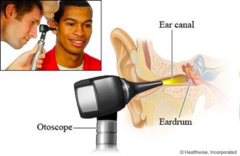
Physical Exam: TM and Middle ear
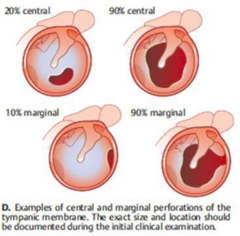
TM: intact? Perforation - how big? Thick? Scarring (tympanosclerosis), retraction, cholesteatoma
Middle ear: effusion - serous vs mucoid?, masses (glomus tumor)
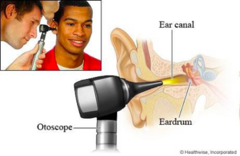
Tuning Fork - Rinne Test
Conduction
1. Normal hearing will show an air conduction that is longer and louder than bone conduction
2. If you have conductive hearing loss, the bone conduction is heard louder than the air conduction sound.
3. If you have sensorineural hearing loss, air conduction is heard louder than bone conduction, similar to normal hearing

Tuning Fork - Weber Test
Localization
1. Normal hearing will produce equal sound in both ears.
2. Conductive loss will cause the sound to be heard best in the abnormal ear.
3. Sensorineural loss will cause the sound to be heard best in the normal ear.

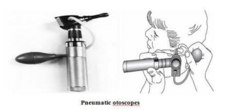
Pneumatic Otoscopy
• Helpful to detect middle ear effusion and key in dx of otitis media w/ effusion (OME)
• Allows determination of the mobility of TM in response to pressure changes
• Normal TM moves in response to pressure
• Immobility due to fluid in the middle ear, perforation, tympanosclerosis
Toynebee Maneuver
Used in office to equalize pressure within the middle ear. Combination of the valsalva maneuver and swallowing
Instruct pt to plug both nostrils and position their tongue on the roof of their mouth and swallow --> causes tongue to move upward, which facilitates the muscle movement of the palate required to equalize the pressure
If the TM is retracted, you will see the tympanic membrane "pop" laterally toward you.
Normal vs Abnormal TM
•First, know what is normal.
•Look at every ear that walks through the door! You may need to look at 100 ears to realize what is normal and abnormal.
•Don't get discouraged!
•No ear looks the same
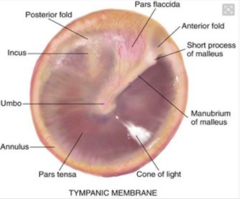
identify A, B, C, D
A - Normal
B - Otitis Media (abt to rupture)
C - Eustachian tube dysfunction
D - Ear tube

perforation
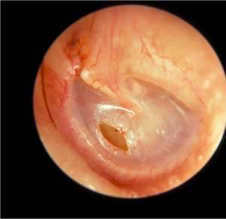
tympanosclerosis (scarring from recurrent ear infections)

Clytostoma → BAD
may lead to mastoidectomy
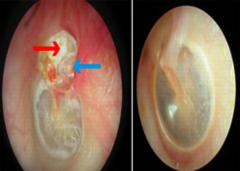
retracted TM

Ear lesions
•Lesions on external ear/pinna, lesions in the canal
•Think about BCC, exposure to sun. We see a lot of lesions on the pinna that turn out to be cancer - refer to dermatology for MOHS.

Pure Tone Audiometry
•Determines the type, degree, and configuration of hearing loss
•PTA (pure tone average) = 500, 1000, 2000 Hz average
Speech Reception Threshold (SRT)
•Confirms the pure tone results (should be same as PTA)
•Records the faintest speech that can be heard half the time
Speech/Word Discrimination
Ability to correctly repeat back words at a comfortable decibel level
Air Conduction
Assesses sensitivity when the signal is transmitted through the outer, middle, and inner ear and then to the brain (entire hearing pathway)
Bone Conduction
Assesses sensitivity when signal is transmitted through the bones of the skull to the cochlea and then to the brain (stimulates nerve directly)
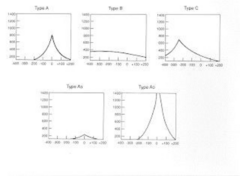
Tympanometry
An examination used to test the condition of the middle ear and mobility of the TM and the ossicles by creating variations of air pressure in the ear canal.
Tympanometry is an objective test of middle ear function.
identify each
A - Normal
B - No eardrum movement. Perforation or fluid.
C - Eustachian tube dysfunction (negative pressure)
As - Shallow or stiff movement. Tympanosclerosis.
AD - Hypermobile (flaccid/floppy eardrums).
degree of hearing loss (dB and Hz)
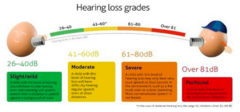
degree of hearing loss (dB and Hz)
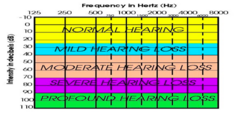
Types of Hearing Loss
1. Sensorineural Hearing Loss (SNHL) --> age related, degeneration to auditory nerve
2. Conductive Hearing Loss (CHL) --> mechanical, something that can be fixed
3. Mixed Hearing Loss --> very common
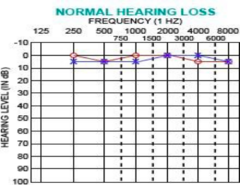
anything about ____ dB is normal
anything about 20 dB is normal
this is an example of a normal hearing test
Sensorineural Hearing Loss (SNHL) is referred to as?
Presbycusis
- "hearing loss of old age"
- most common type of hearing loss!
Sensorineural Hearing Loss (SNHL) occurs when?
occurs when there is damage to the inner ear (hair cells) or to the nerve pathways (CN VIII) from the inner ear to the brain
SNHL reduces ability to hear ?
SNHL reduces ability to hear faint sounds
Even when speech is loud enough to hear, it still may be unclear or muffled.
•Symmetric vs. Asymmetric
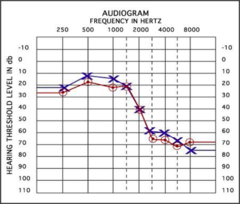
speech recognition (word score), once declined is ?
speech recognition (word score), once declined is not reversible
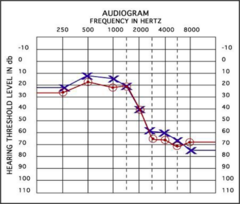
word score vs dB
dB: frequency (like on hand raise test)
word recognition - list of words, they repeat to the pt at different dB levels. what is the faintest speech level they can hear the word at. testing for CLARITY of the word.
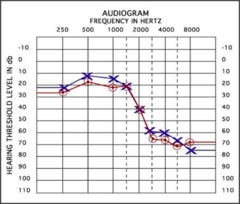
lose high or low frequency first?
high frequency first (laterally located)
low frequency (medially located)
as graph progresses to the right, hearing loss worsens

Asymmetric SNHL
≥10 dB difference at 2-3 contiguous frequencies --> do further work up
concerned about acoustic neuroma

acoustic neuromas
benign tumors
slow growing. balance, ringing, one sided hearing loss.
Causes of SNHL: aging
presbycusis
Causes of SNHL: Exposure
Exposure to loud noise (NIHL)
Acoustic trauma
Causes of SNHL: Head Trauma
- damage to cochlea
- temporal bone fx with otic capsule fx
Causes of SNHL: Disease/Illness
• Sudden Sensorineural Hearing Loss (SSNHL) → likely viral, tx with steroids within 72 hours!! get them in to r/o.
• Congenital - prenatal exposure to Rubella, CMV, HSV, maternal DM
Causes of SNHL: Autoimmune inner ear disease
Think about when you see asymmetric SNHL
i.e.: Multiple Sclerosis, RA, Lupus
Causes of SNHL: Meniere's Disease
Usually one ear → Asymmetric SNHL, low frequency
QUADRAD:
- unilateral aural pressure
- unilateral hearing loss
- tinnitus
- vertigo
Causes of SNHL: Tumors
Acoustic neuroma → asymmetric SNHL
Causes of SNHL: Medications/Ototoxicity
aminoglycosides
chemotherapeutic agents
Presbycusis & the Geriatric Patient
Effects on Quality of Life?
At present time, 50-60% of today's population over 70 years of age experiences hearing impairment
•Negative impact on social interactions leading to social isolation
•Decreased employment opportunities leading to lost income
•Patient safety relating to automobile, occupational, environmental and other hazards is a concern for the hearing impaired since they cannot appropriately receive the auditory stimuli that alert them to presence of danger
Noise Induced Hearing Loss
Can be caused by a one-time exposure to an intense "impulse" sound (ie: explosion) or by continuous exposure to loud sounds over time (i.e.: woodworking, machinery, recreational activities such as target shooting, hunting, playing in a band)
Caused by damage and eventual death of hair cells
Sounds less than ____ dB are unlikely to cause hearing loss.
Sounds at or above ____ dB can cause hearing loss.
- Sounds less than 75 dB are unlikely to cause hearing loss.
- Sounds at or above 85 dB can cause hearing loss.
The louder the sound (dB), the shorter the amount of time it takes for NIHL to occur!
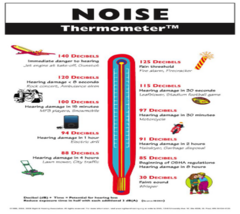
OSHA standards for noise exposure

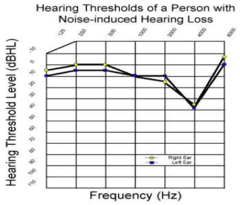
"Noise notch" at 4,000 Hz
common
Treatment Options (SNHL)
• Conventional Hearing Aids
• BiCross Hearing Aids (Unilateral SNHL, SSNHL)
• Cochlear Implants (surgically implanted - Profound SNHL)
• EarLens - new technology, non-invasive procedure done in office. A tiny lens is placed directly on the ear drum. The ear tip transmits high fidelity audio signals directly to the lens which vibrates the ear drum directly across the full frequency range. Not compatible with MRI - needs to be removed by ENT and then replaced.

Meniere's Disease
Disorder of the inner ear that causes episodes of vertigo, tinnitus, fullness/pressure, and fluctuating hearing loss
Usually affects one ear and is preceded by fullness in that ear
Average attack lasts 2-4 hours
Meniere's Disease - occurence and
• Usually in those over 40 with equal distribution btwn M and F
• Episodes may occur in clusters (several attacks in a short period of time) or there may be many years that pass btwn (in which most people are symptom free)
• Low frequency SNHL pattern is commonly found initially, but as time goes on, usually changes into flat loss or a "peaked" pattern
Meniere's Disease Audiogram
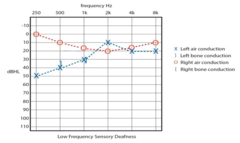
What causes Meniere's Disease?
Underlying cause is really unknown
Most often attributed to viral infections of the inner ear, head injury, hereditary predisposition and allergy
Acute attack → "hydrops"
Meniere's Disease: Acute attack → "hydrops"
Fluctuating pressure of the fluid within the inner ear (endolymph).
The membranes become dilated like a balloon when pressure rises (endolymphatic duct/sac becomes blocked or if too much fluid is secreted (stria vascularis)

Diagnosing Meniere's Disease
• Refer to ENT
• Workup includes Audiogram (should see low frequency SNHL but overtime will typically flatten out)
• ENG - Electronystagmogram (Vestibular weakness, not always)
• ECOG - Electrocochleography
• MRI - r/o acoustic neuroma, hydrops
Treatment of Meniere's: Medications
Usually self-limiting, may take years
Medication
•Meclizine (antivert)
•Betahistine TID as prophylaxis
•Valium
•Diuretics (Dyazide)
•Zofran
Treatment of Meniere's: Diet
•Low sodium
•Avoid caffeine, alcohol, tobacco
Treatment of Meniere's: Vestibular Therapy
Exercises aimed at strengthening the vestibular system and central compensation
Treatment of Meniere's: Surgery
• Middle ear injections of steroid
• Ablative therapy - middle ear injection of gentamycin- vestibulotoxic/ototoxic and can ablate vestibular system to "turn off" in order to compensate for loss
• Endolymphatic sac decompression
Ototoxicity and SNHL - Common Medications affecting hearing and/or balance
•Gentamycin - primarily vestibulotoxic, but can be both
•Streptomycin - primarily vestibulotoxic, rarely used
•Neomycin - primarily cochleotoxic (topical drops) — not for use with TM perforation or open tubes***
•Polymixin B - primarily cochleotoxic (topical drops)***
•Tobramycin - primarily vestibulotoxic (topical drops)
•Erythromycin/azithromycin -cochleotoxic in high IV doses
•Cisplatin - primarily cochleotoxic, synergistic with gentamicin, high doses can cause profound deafness
•Furosemide - cochleotoxic, rarely seen
•Bumetanide - same as furosemide but less often seen
Conductive Hearing Loss
Occurs when sound is not conducted efficiently though the outer ear to the TM and ossicles of the middle ear
Usually involves a reduction in sound level or the ability to hear faint/quiet sounds
Often can be corrected medically or surgically
"Mechanical hearing loss"

Causes of Conductive Hearing Loss
• Otitis media with effusion
• Allergies (SOM)
• ETD
• Perforation TM (Large volumes)
• Benign tumors (glomus tympanicum, osteoma)
• Impacted wax, foreign body
• Otitis externa ("swimmer's ear")
• Absence or malformation of outer ear, canal or middle ear
• Cholesteatoma
• Otosclerosis
Cerumen Impaction
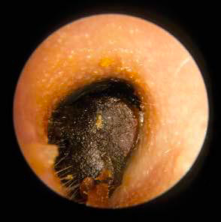
Acute Otitis media with Effusion

Serous Otitis Media
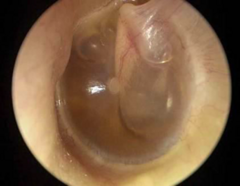
Acute Otitis Media: Causes
ET becomes blocked due to allergies, cold, flu, sinus infection, enlarged adenoids
bacteria: strep pneumo, H flu, M Catarrhalis
Acute Otitis Media: Risk Factors
6-36 months old, pacifier, daycare, bottle fed, exposure to cigarette smoke, drinking while laying down, changes in altitude/climate
Acute Otitis Media: Symptoms and PE
SYMPTOMS
-Fussiness/Intense crying (in infants), irritability, sleeplessness
-Clutching the ear while wincing in pain (toddlers)
-Complaining of pain in ear (older children/adults)
-Fever, hearing loss, off balance, fullness in ear, drainage if perforation
PE: redness, bulging TM, pus, air bubbles, perforation
Acute Otitis Media: Audio
Conducive Loss/B tymp (low volume)
Acute Otitis Media: Treatment
Majority resolve on own
Home pain medications, warm washcloth, amoxicillin, medrol pack, adenoidectomy, myringotomy tubes
Chronic Otitis Media
Occurs when fluid remains in the ear for a long time or returns over and over again, even without acute infection
Most common cause of pediatric CHL
Also due to ETD, adenoid hypertrophy, URI, allergic rhinitis
Chronic Otitis Media: Treatment
myringotomy tubes

TM Perforation - tx options
paper patch (small only)
tympanoplasty
Otitis Externa
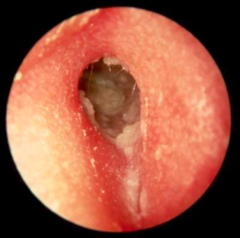
Otitis Externa "Swimmer's Ear"
Inflammation or infection of the EAC, auricle or both
classifications of otitis externa
•Acute diffuse OE
•Acute localized OE (furunculosis)
•Chronic OE
•Eczematous (eczematoid) OE
•Necrotizing (malignant) OE
•Otomycosis
Acute diffuse OE
Most common form of OE, typically seen in swimmers
Acute localized OE (furunculosis) - associated with?
Associated with infection of a hair follicle
Chronic OE
Same as acute diffuse OE but is of longer duration (>6 weeks)
Eczematous (eczematoid) OE
Encompasses various dermatologic conditions (eg, atopic dermatitis, psoriasis, systemic lupus erythematosus, and eczema) that may infect the EAC and cause OE
Necrotizing (malignant) OE
Infection that extends into the deeper tissues adjacent to the EAC
occurs primarily in immunocompromised adults (eg, diabetics, patients with AIDS)
Otomycosis
Infection of the ear canal from a fungal species (eg, Candida Aspergillus)
Otitis Externa causes
water sports/activities, preceding ear trauma (ear cleaning, cotton swabs, water in ear canal)
Bacteria - most commonly pseudomonas, also staph aureus
Fungal - candida, aspergillus
Otitis Externa Symptoms
pain with palpation of tragus or traction to the pinna, otalgia, hearing loss, ear fullness, redness, edema, narrowing of EAC, tinnitus, fever, itching (fungal/chronic), deep pain (immunocompromised/necrotizing), discharge, cellulitis/LAD ipsalateral neck
Otitis Externa Diagnosis
Clinical.
*If patient is immunocompromised with severe pain, the ear should be examined by ENT to r/o necrotizing OE
Otitis Externa Treatment
pain management, removal of debris from EAC, topical medications (Otic Ciprofloxacin, Otic ofloxacin, dexamethasone)
Fungal- Vosol (hydrocortisone/acetic acid otic), otic clomitrazole, nystatin powder)
**AVOID TRIGGERS**
may need surgical debridement (usually for NOE or complicated OE)
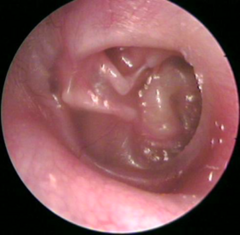
Tympanic Membrane Retraction
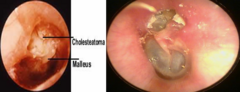
Cholesteatoma
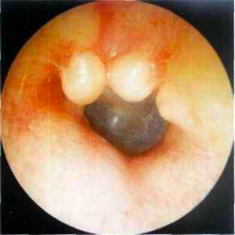
Glomus Tympanicum

Osteoma
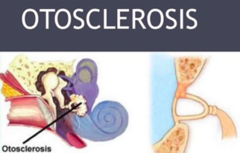
Otosclerosis
Caused by abnormal bone remodeling in the middle ear which is a usually a lifelong process which bone tissue renews itself by replacing old tissue with new.
Abnormal remodeling disrupts the ability of sound to travel from the middle ear to the inner ear.
Many thought to be inherited
RF for Otosclerosis
White, middle-aged women are most at risk.
women who carried male babies
Otosclerosis - hearing loss
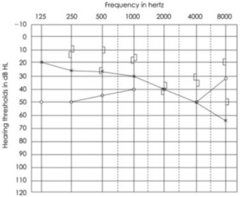
•Hearing loss is described as gradual with associated tinnitus, sometimes balance issues
•Audiogram - will show a mixed hearing loss with a "carhart notch" at 2000 khz
Otosclerosis - Diagnosis
CT scan - abnormal growth, soft tissue, etc
Otosclerosis - Treatment
Mild otosclerosis can be treated with a hearing aid but surgery is often required
Surgery --> Middle Ear Exploration with ossicular chain reconstruction or Stapedectomy
Otosclerosis - Other Options for Treatment (Surgical)
• OCR - Ossicular Chain Reconstruction (any repair to the ossicles)
• Stapedectomy - Similar to OCR, but replacing stapes with a prosthesis
• Typanomastoidectomy - COM, cholesteatoma, tumors
Otosclerosis - Other Options for Treatment (Hearing Aids)
•Traditional hearing aids
•Bone anchored hearing aid (BAHA) - implantable hearing aids into temporal bone that provides vibration to bone directly
Mixed Hearing Loss
•Occurs when there is a combination of a conductive hearing loss with a sensorineural hearing loss
•In other words, there is damage to the outer ear and middle ears' ability to conduct sound into inner ear (usually corrected medically / surgically) and damage to the inner ear (cochlea) or auditory nerve (corrected with hearing aids)
•Treatment therefore may be a combination approach