Solids, Liquids & Gases - IGCSE Chemistry Flashcards
 Call Kai
 Learn
Learn Practice Test
 Spaced Repetition
 Match
Match Flashcards
 Knowt Play
1/17

Earn XP
Description and Tags
Vocabulary practice flashcards covering kinetic theory, states of matter, state changes, pressure/temperature relationships, and diffusion based on IGCSE Chemistry notes.
Name | Mastery | Learn | Test | Matching | Spaced | Call with Kai | Chat |
|---|
No analytics yet
Send a link to your students to track their progress
18 Terms
Kinetic Theory of Matter
A model describing matter as consisting of tiny particles in constant motion, used to explain the physical properties of solids, liquids, and gases.
Solid
A state of matter in which particles are packed very closely together in a fixed, regular pattern, vibrating about fixed positions, resulting in a fixed volume, fixed shape, and high density.

Liquid
A state of matter with a fixed volume that adopts the shape of its container, where particles are close together in a random arrangement and move past each other.

Gas
A state of matter with very low density and no fixed volume, where particles are far apart and move randomly and quickly (around 500m/s) in all directions.

Melting
The state change in which a solid changes into a liquid at a specific temperature known as the melting point, requiring heat energy that is converted into kinetic energy.
Freezing
The state change in which a liquid changes into a solid at a specific temperature, requiring a significant decrease in temperature or loss of thermal energy.
Boiling
The state change in which a liquid changes into a gas at a specific temperature known as the boiling point, requiring heat that causes bubbles of gas to form below the surface of the liquid.
Evaporation
The state change in which a liquid changes into a gas occurring only at the surface of liquids over a range of temperatures below the boiling point.
Condensation
The state change in which a gas changes into a liquid on cooling over a range of temperatures as particles lose energy and group together.
State Changes Interconversion
The processes through which matter transforms between solid, liquid, and gas states, accompanied by changes in particle energy, arrangement, and movement.

Heating Curve
A graph showing the states, state changes, and temperature changes of a substance as time progresses during heating, featuring horizontal sections during state changes where temperature remains constant.

Cooling Curve
A graph showing state changes and temperature changes over time as a substance cools, where thermal energy loss breaks or forms interparticle attractions without changing average kinetic energy during state changes.

Gas Pressure
The force created inside a closed container by moving gaseous particles colliding with the internal walls of the container.

Diffusion
The process where particles move from a region of high concentration to a region of low concentration due to their random motion, requiring no energy input.
Diffusion in Liquids Experiment
The process demonstrated by placing potassium manganate(VII) (KMnO4) crystals in water, where particles diffuse through the solution until equilibrium and an even concentration are reached.

Diffusion in Gases Experiment
The demonstration of gas diffusion where orange-brown bromine gas diffuses upward from an area of high concentration into an inverted jar of air until evenly spread throughout both containers.

Relative Molecular Mass (Mr) Effect on Diffusion
The principle that at the same temperature, gases with a lower relative molecular mass (Mr) are lighter, travel faster, and travel further in a given time than gases with a higher Mr.
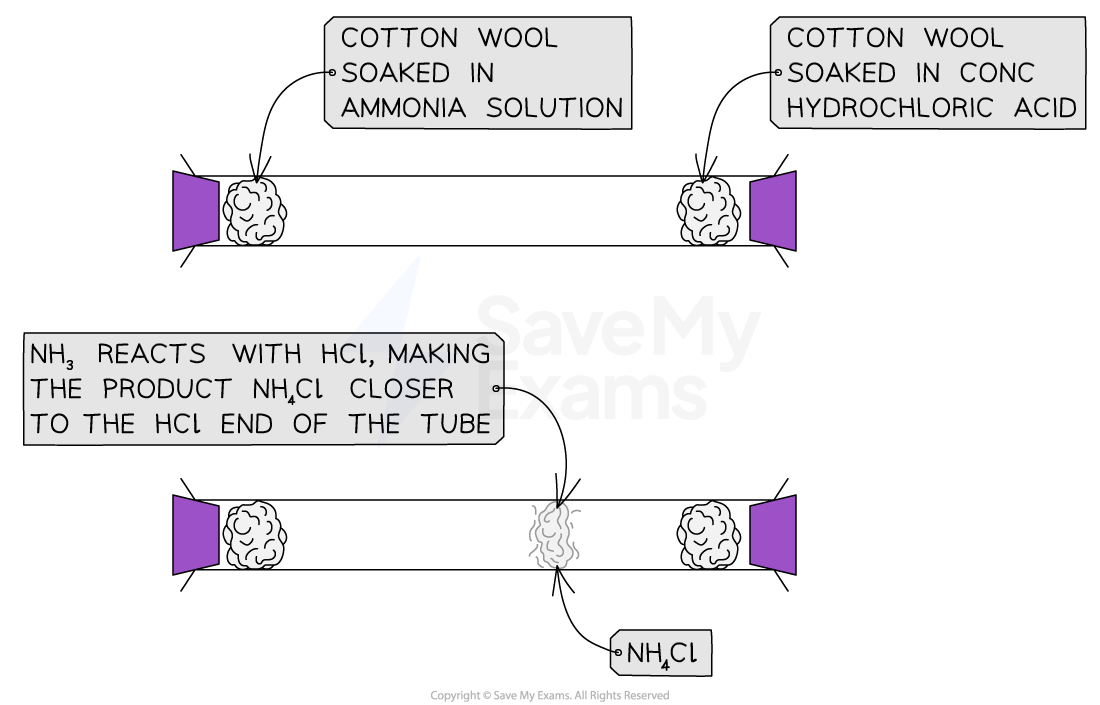
Reaction of Ammonia and Hydrogen Chloride
The chemical reaction NH3(g)+HCl(g)→NH4Cl(s) in a tube, which forms a white ring of ammonium chloride closer to the HCl end because lighter NH3 (Mr=17) diffuses faster than heavier HCl (Mr=36.5).