ASVAB Mechanical Comprehension part 2
 Call Kai
 Learn
Learn Practice Test
 Spaced Repetition
 Match
Match Flashcards
 Knowt Play
1/97

There's no tags or description
Looks like no tags are added yet.
Name | Mastery | Learn | Test | Matching | Spaced | Call with Kai | Chat |
|---|
No analytics yet
Send a link to your students to track their progress
98 Terms
What is drag force?
a force that opposes the motion of an object moving through a fluid.
A fluid can be:
Gas (air)
Liquid (water)
What causes drag force?
Occurs when an object moves through a fluid and the fluid pushes against the object.
Examples of drag force.
Air pushing against a moving airplane
Water resisting a swimming fish
Air resistance slowing a falling object
The fluid creates resistance that makes movement harder.
Which direction does drag force act?
Always acts Opposite the direction of motion.
How does the thickness of a fluid affect drag force?
A thicker fluid creates more drag force.
Thicker fluid → Greater drag
Memory Trick:
"Thicker liquid, bigger resistance."
What creates more drag is it water or air?
Water; water is denser.
How does fluid movement affect drag force?
Drag force increases when the fluid moves against the object's motion.
Example of how fluid movement affects drag force?
A strong headwind pushes against an airplane:
➡ Plane moves forward
⬅ Wind pushes backward
Result:
More drag force.
How does drag force affect the force needed to keep an object moving?
The greater the drag force, the more forward force is needed to maintain motion.
More drag → More forward force needed
Memory Trick:
"More drag means more push to stay in motion."
When is an object in equilibrium?
when the sum of all forces acting on the object equals zero.
Mathematically:
∑F=0
What happens to an object when it is in equilibrium?
The object does not accelerate.
This means the object will either:
Remain at rest
ORContinue moving at a constant velocity
because there is no unbalanced force changing its motion.
Memory Trick:
"Balanced force, no change in course."
What does it mean when forces are balanced?
Forces that are equal in size but opposite in direction.
Example of a balanced force.
A book sitting on a table:
⬇ Gravity pulls downward
⬆ Normal force pushes upward
The forces cancel:
Net Force=0
The book remains still.
Can equilibrium occur in only one direction?
Yes.
An object can be in equilibrium when:
Vertical (y-direction) forces balance:
∑Fy=0
Can equilibrium occur in only one direction?
Can equilibrium occur in only one direction?
( for horizontal )
Yes.
Horizontal (x-direction) forces balance ∑Fx=0
Example:
A box being pushed equally from both sides.
What are the conditions for equilibrium?
An object is in equilibrium when:
∑Fx=0
and/or
∑Fy=0
Meaning:
Horizontal forces cancel out
Vertical forces cancel out
Or both directions are balanced
Memory Trick:
"Zero net force means zero acceleration."
What is mechanical advantage?
The amount by which a simple machine increases or decreases the force applied to it.
Mechanical advantage tells us how much a machine multiplies force.
Memory Trick:
"Mechanical advantage = machine's force advantage."
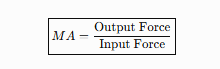
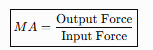
What is the formula for mechanical advantage?
MA = Mechanical Advantage
Output Force = force produced by the machine
Input Force = force applied to the machine
What does a mechanical advantage greater than 1 mean?
The machine increases force.
This means:
✅ Output force is greater than input force
Output Force>Input Force
What is an example of a mechanical advantage is greater than 1?
A lever allows you to lift a heavy object using a smaller force.
When the mechanical advantage is greater than 1, what is the distance relationship?
Input distance>Output distance
Meaning:
You move your hand farther than the load moves.
Memory Trick:
"More force gained, more distance paid."
What does a mechanical advantage less than 1 mean?
The machine decreases force but increases movement speed or distance.
This means:
Input force is greater than output force
What is the distance relationship for a mechanical advantage less than 1?
Output distance>Input distance
The output moves farther than the input.
Memory Trick:
"Less force gained, more distance gained."
What is an example of the distance relationship for a mechanical advantage of less than 1?
A fishing rod has a mechanical advantage less than 1 because it sacrifices force to create greater movement distance.
What does a mechanical advantage equal to 1 mean?
The machine does not increase or decrease force.
The machine only changes the direction or movement.
What is the example of a mechanical advantage equal to 1?
A simple pulley can have a mechanical advantage of 1 when it only changes the direction of force.
What is torque?
A twisting force that causes an object to rotate around a fixed point; Torque measures how much a force can make something turn.
Examples of torque?
Turning a wrench
Opening a door
Using a screwdriver
Memory Trick:
"Torque turns things."
Is torque a scalar or vector quantity?
Vector quantity
A vector has:
✅ Magnitude (amount of force)
✅ Direction (direction of rotation)
Because torque can cause rotation in different directions:
Clockwise
Counterclockwise
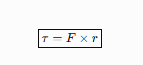
How is torque calculated?
τ = torque
F = applied force
r = perpendicular distance from the center of rotation (lever arm)
The distance must be measured perpendicular to the force.
What is the lever arm in torque?
The perpendicular distance between:
The point where force is applied
The center of rotation (pivot point)
A longer lever arm creates more torque.
What is an example of the lever arm in torque?
Opening a door:
Pushing near the hinges → less torque
Pushing at the handle → more torque
Memory Trick:
"Farther from the pivot, easier to twist it."
How does increasing the lever arm affect torque?
Torque is directly proportional to the lever arm.
This means:
Greater distance from pivot=Greater torque
A long lever arm will create more or less torque?
More torque.
A short lever arm will create more or less torque?
Less torque.
How does increasing force affect torque?
Torque increases when the applied force increases.
Relationship: Greater force=Greater torque
What two things increase torque?
1. Force
2. Lever arm distance
What does more force create for torque?
Creates more twisting
↑F→↑τ
What does lever arm distance create for torque and which arm length creates more torque?
Longer distance from the pivot will create more twisting.
How do gears affect speed when a small gear drives a big gear?
The big gear rotates slower; The small gear must turn many times to move the larger gear around because the larger gear has more teeth and a larger circumference.
Which has the faster rotation, is it small gears or large gears?
Small gears = Fast rotation
Large gears = Slow rotation
How do gears affect speed when a big gear drives a small gear?
The small gear rotates faster; The large gear has more teeth, so as it turns, it causes the smaller gear to complete more rotations.
What is the output for large gears and for small gears?
Large gears = Slow input
Small gears = Faster output
What is the relationship between gear size and speed for a smaller gear to a bigger gear?
Speed decreases
Torque increases
Small to big = strength takes might
What is the relationship between gear size and speed for a bigger gear to a smaller gear?
Speed increases
Torque decreases
Big to small = speed takes flight
Formula for Mechanical Advantage using Torque.
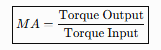
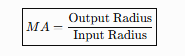
Formula for Mechanical Advantage using Radius.
Formula for Mechanical Advantage using Number of Teeth.
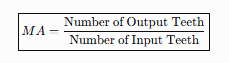
How does the number of teeth affect gear mechanical advantage?
A gear with more output teeth creates greater mechanical advantage.
Memory Trick:
"More teeth receiving = more force achieving."
How does a gear system trade speed for torque for a small gear driving a big gear?
✅ More torque
❌ Less speed
Known as a mechanical trade-off.
How does a gear system trade speed for torque for a big gear driving a small gear?
More speed
Less torque
Can gears increase both speed and torque at the same time?
NO, they cannot.
Is speed path-dependent?
YES, it is path-dependent.
What is a gear ratio?
The comparison between the output speed and the input speed of a gear system; Gear ratio shows how many times one gear turns compared to another.
Memory Trick:
"Gear ratio tells the rotation ratio."
What are the driving gear?
The gear that receives the original force and starts the motion.
It is connected to the power source.
It causes the other gear to move.
What are the driven gear?
The gear that receives motion from the driving gear.
It is the gear being turned.
It produces the output speed.
What is an example of a driving gear?
Example:
Engine gear turning another gear.
How is gear ratio calculated?
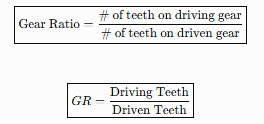
Why can gear ratio be calculated using the number of teeth?
The number of teeth on a gear is directly related to its speed when gears are meshed together.
How does more teeth affect the gear ratio?
➡ Larger gear
➡ Slower rotation
How does fewer teeth affect the gear ratio?
➡ Smaller gear
➡ Faster rotation
What does a gear ratio of 3:1 mean?
The driving gear rotates 3 times.
The driven gear rotates 1 time.
The input gear is moving faster than the output gear.
What happens when the driving gear is larger than the driven gear?
The output gear rotates faster.
Effects:
✅ Speed increases
❌ Torque decreases
Memory Trick:
"Big driver, faster rider."
What happens when the driving gear is smaller than the driven gear?
The output gear rotates slower.
Effects:
✅ Torque increases
❌ Speed decreases
Memory Trick:
"Small driver, stronger rider."
What is the main difference between a hydraulic jack and a first-class lever?
First-class lever: Uses the length of the lever arms.
Hydraulic jack: Uses the area of the pistons.
Memory Trick:
"Lever uses length. Hydraulic uses area."
How are hydraulic jack and a first-class lever similar?
They are made to lift heavy objects easier by providing mechanical advantage.
How does a first-class lever create mechanical advantage?
increases force by changing the length of the lever arms.
Memory Trick:
"Longer lever = easier lift."
Examples of a first-class lever.
Crowbar
Seesaw
Hammer pulling a nail
How does a hydraulic jack create mechanical advantage?
Creates mechanical advantage by using different-sized pistons.
What does a hydraulic jack depend on?
Depends on the area of the pistons.
Memory Trick:
"Hydraulics don't use length—they use piston strength."
Explain the piston model for a hydraulic jack?
A small input piston pushes fluid to a larger output piston, creating a much larger lifting force.
Examples of hydraulic jack.
Car jack
Auto repair lift
Hydraulic press
What determines the mechanical advantage of a hydraulic jack?
The Area; the mechanical advantage depends on the relative areas of the pistons.
larger output piston = greater lifting force.
Why can't you compare piston radii directly?
A piston is a circle, its lifting ability depends on its area, not just its radius.
What is the area of a circle?
Notice that the radius is squared.
This means even a small increase in radius creates a much larger increase in area.

Why does a larger piston produce more lifting force?
A larger piston has more surface area, so that pressure acts over a larger area, producing more force; This is why a small force on the input piston can lift a very heavy object on the output piston.
Do the same pressures act on both pistons in a hydraulic system?
YES; The pressures do act the same.
Memory Trick:
"Same pressure, bigger area, bigger force."
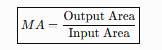
Formula of Mechanical Advantage using Area.
Formula of Mechanical Advantage using Force.
How is a pulley and belt system different from a gear system?
The biggest difference is the direction of rotation.
Pulley and Belt System
Both pulleys rotate in the same direction.
Belts are buddies (same direction)
In a gear system what rotates in opposite directions?
Meshing gears
gears are enemies (opposite directions)
Why do pulleys rotate in the same direction?
A belt connects both pulleys.
As the driving pulley turns, the belt carries the motion to the second pulley, causing it to rotate the same way.
Why do gears rotate in opposite directions?
When two gears mesh, their teeth push against each other.
This causes the second gear to rotate in the opposite direction.
Memory Trick:
"Gear teeth push back, so direction flips."
How does pulley size affect speed?
A smaller pulley always spins faster than a larger pulley; The smaller pulley has less distance to travel in one complete rotation.
What is the relationship of a small pulley and speed?
Higher speed
What is the relationship of a large pulley and speed?
Lower speed
How does pulley size affect torque?
A larger pulley produces more torque; the larger radius provides a greater turning effect (similar to a longer lever arm).
What is the relationship of a large pulley and torque?
More torque; larger pull
What is the relationship of a small pulley and torque?
Less torque; lesser pull
What is the relationship between pulley size, speed, and torque?
Pulley systems trade speed for torque.
What are the characteristics of a small pulley?
✅ Faster rotation
❌ Less torque
Memory Trick:
"Fast is small, strong is tall."
What are the characteristics of a large pulley?
✅ More torque
❌ Slower rotation
Memory Trick:
"Fast is small, strong is tall."
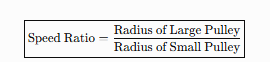
How is the speed ratio of pulleys calculated?
Comparing the radii (or diameters) of the pulleys.
What is an inclined plane?
A slanted flat surface used to move an object to a higher or lower position with less force; move it along the slope.
Examples of inclined plane?
Ramp
Wheelchair ramp
Loading ramp
Playground slide
How does an inclined plane make work easier?
Reduces the amount of force needed by increasing the distance over which the force is applied.
What does a longer ramp provdie?
✅ Less force needed
❌ Greater distance traveled
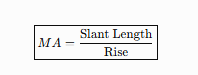
How is the mechanical advantage of an inclined plane calculated?
Slant Length = length of the ramp
Rise = vertical height
A larger mechanical advantage means less force is needed.