BIO 1: Intro, Carbohydrates
 Call Kai
 Learn
Learn Practice Test
 Spaced Repetition
 Match
Match Flashcards
 Knowt Play
1/49

Earn XP
Description and Tags
Name | Mastery | Learn | Test | Matching | Spaced | Call with Kai | Chat |
|---|
No analytics yet
Send a link to your students to track their progress
50 Terms
Scientific study of life at the molecular level.
Biochemistry
What are the biomolecules involved with metabolism (energy, metabolic pathway)?
Carbohydrates, lipids, and proteins
What biomolecule is involved in the central dogma (RNA DNA genetic product)?
Nucleic acids
What are the basic building blocks of living organisms, responsible for carrying out all functions essential for life?
Cells
Differentiate Prokaryotic vs Eukaryotic cells: in terms of presence of organelles, structure, and function.
Prokaryotic: no nucleus, smaller and simpler with less organelles (cell wall, plasma membrane, DNA in cytosol, ribosomes), present in bacteria and archaea.
Eukaryotic: with nucleus, larger and more complex organelles present, present in animals, plants, fungi, and protists.

4 Levels of Cell Organization
Monomeric Units (biomolecules)
Macromolecules (made of 1 type of biomolecule)
Supramolecules complexes (made of 2+ type of biomolecule)
Cell and organelles

____ are specialized structures within a cell that perform specific functions essential for the cell’s survival and activity.
Organelles
5 Major Organelles: Function, Presence in Prokaryote/Eukaryote
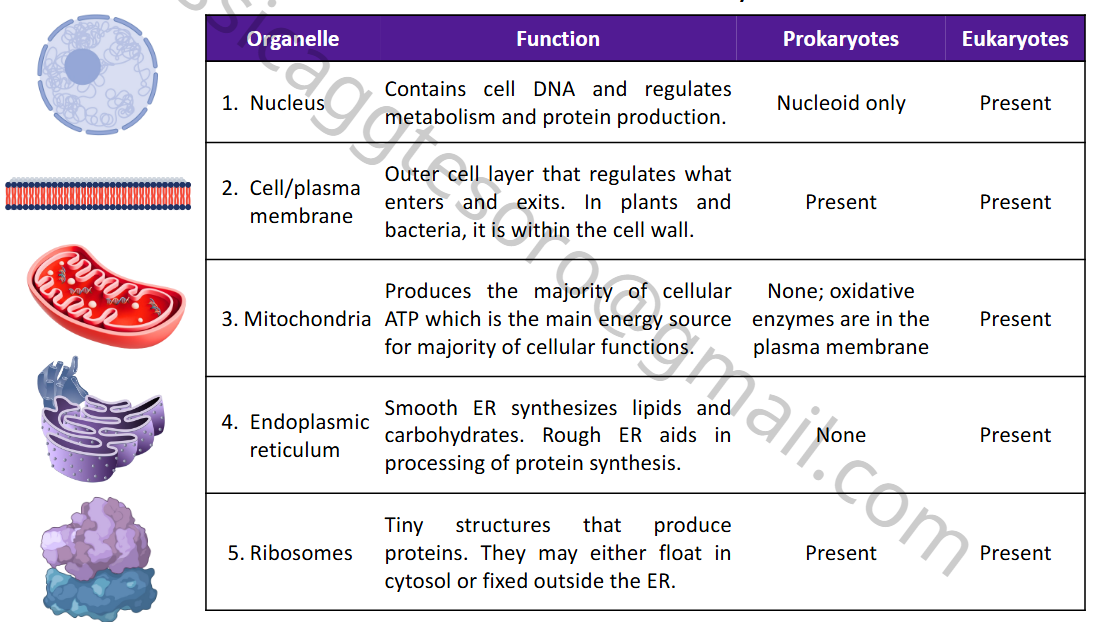
5 Less Major Organelles: Function, Presence in Prokaryote/Eukaryote
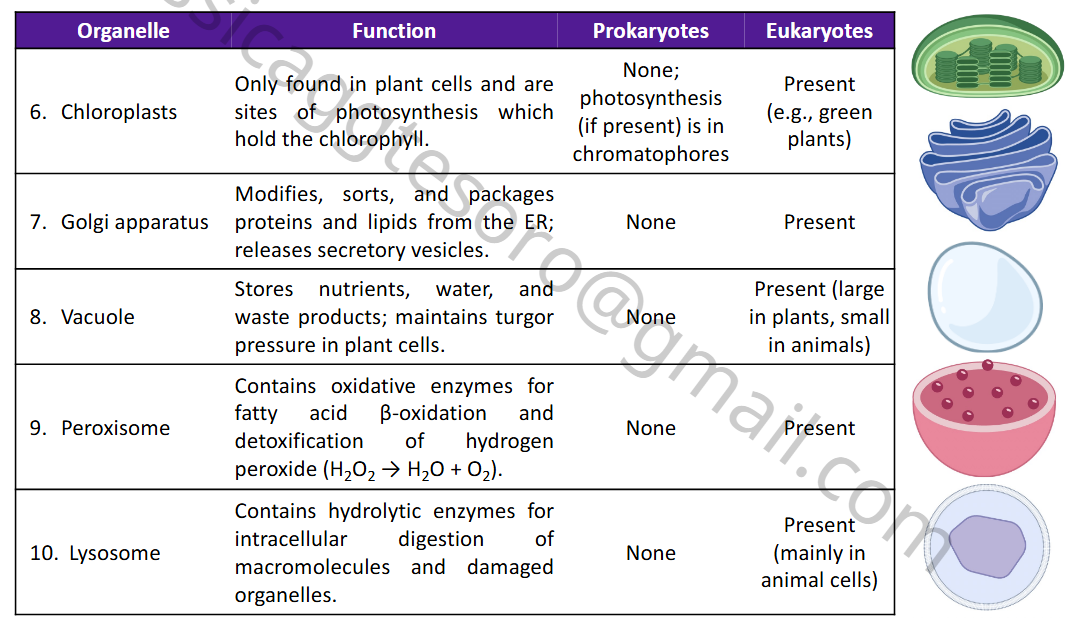
What organelle produces secretory vesicles?
Golgi apparatus
Why is vacuole larger in plants?
Plants use the vacuole as a rigid wall cell structure (when full with water will swell and push against cell wall “turgor pressure”). Plants are stationary, need more water reserves.
Differentiate smooth and rough ER.
Smooth ER synthesizes lipids and carbohydrates
Rough ER has ribosomes attached, aids in processing of protein synthesis
Both are used in “post modification” of biomolecules
What is cytosol?
Cytosol is the aqueous component of the cytoplasm, where cellular processes occur, and it contains various organelles, proteins, and other substances essential for cell function.
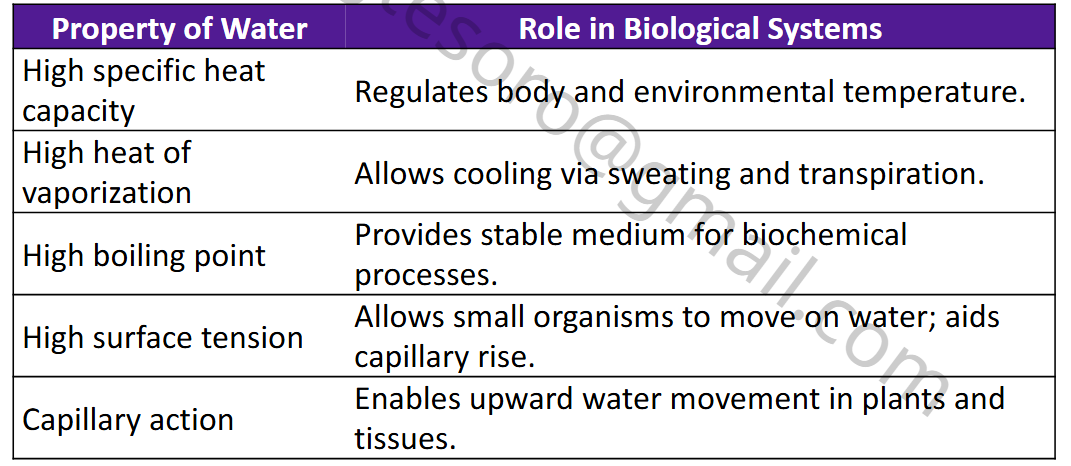
What 4 chemical characteristics make water essential for biological systems?

Water is the most abundant molecule in the human body, at ____%.
70%
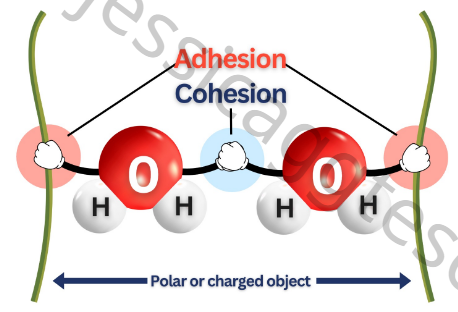
Water: Adhesion vs Cohesion
Cohesion - attraction between H2O-H2O
Adhesion - attraction between H2O-surfaces
Water: Key Physical Properties
Which organelle is single, semi-double, or double membraned?
Lysosome - single membrane (need easy in out of digestive enzymes)
Rough ER - semi-double
Nucleus - double
Chloroplast - double

______ are polyhydroxy aldehydes and ketones, or compounds that can be hydrolyzed into them.
Carbohydrates
What configuration of carbohydrates are naturally occurring? D or L?
D
α vs β: which has a dynamic/functional role, and which has a structural role?
α = dynamic/functional role
β = structural role
General formula of carbs
Cn H2n On
What type of bond does carbohydrate have?
Glycosidic bond
Classifications of Carbohydrates
Simple or complex
Monosaccharide
Disaccharide
Monosaccharides: Classification based on Length of C, and Functional Group location
Length of C: Triose, Tetrose, Pentose, Hexose
Functional Group: Aldose C1 aldehyde, Ketose C2 ketone

Chirality vs Optical Rotation: D-L vs d-l
D and L - “absolute configuration,” D-right + L-left, most chiral furthest C from top
d and l - optical rotation d (+) and l (-), needs polarimeter
Name 15 most common monosaccharides.
GET Ribs Are Xtra Lean
All Altruists Gladly Make Gum In Gallon Tanks
Glyceraldehyde Erythrose Threose Ribose Arabinose Xylose Lyxose
Allose Altrose Glucose Mannose Gulose Idose Galactose Talose

_______ are diastereomers that differ in the configuration around one stereogenic center only. Give examples.
Epimers / Epimeric pairs
Galactose-Glucose C4
Glucose-Mannose C2
What new stereogenic center is formed after the cyclization of monosaccharides?
Anomeric carbon.
α baba (pababa) trans
β up (beh taas) cis
(β -D-glucose at equi is 67% more preferred to form)
When pure α + β glucose anomers are dissolved in water, their optical rotation gradually changes, a phenomenon known as _____, which occurs due to ring-chain tautomerism, α + β interconverts until equilibrium
Mutarotation

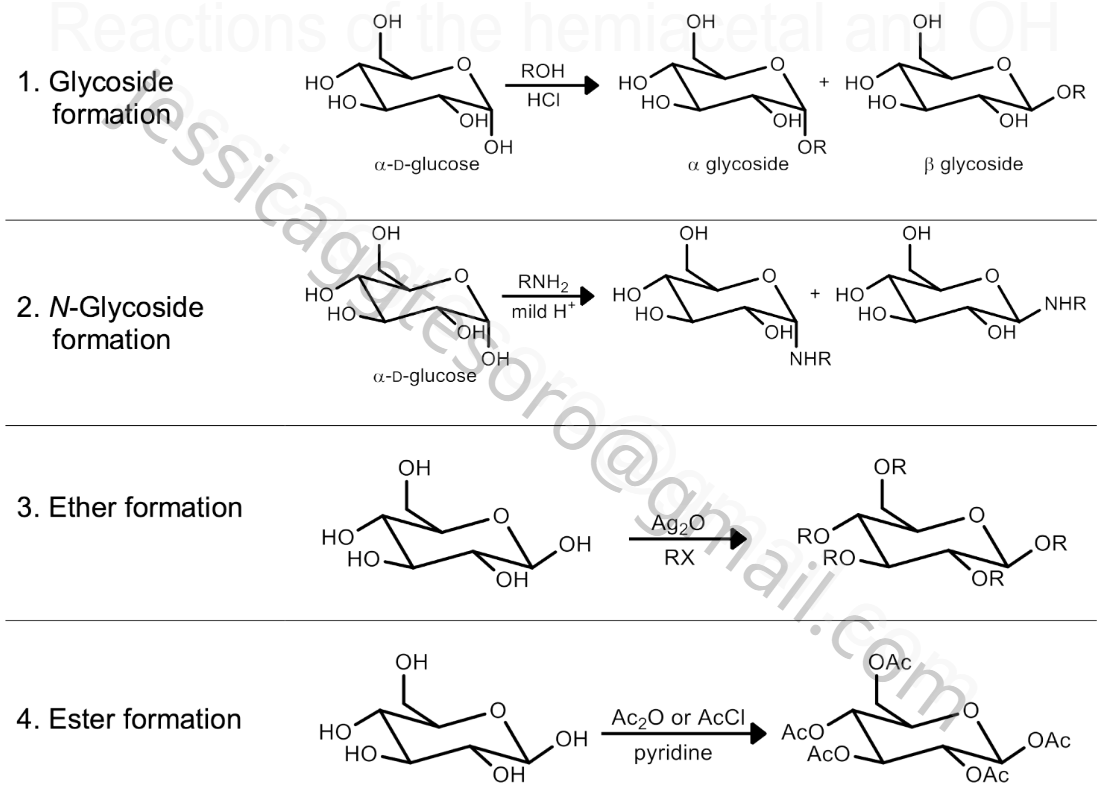
Monosaccharides Reactions: Hemiacetal and OH group
Glycoside formation | Anomeric C OH → OR α + β (HCl)
N-Glycoside formation | Anomeric C OH → NHR α + β (mild H)
Ether formation | all OH → OR (Ag2O RX)
Ester formation | all OH → OAc (Ac2O or AcCl, pyr)
1,2 mild formation
3,4 strong formation
Monosaccharides Reactions: Carboxyl group
Reduction of Aldose | CHO @C1 → CH2OH “alditol” (NaBH4 CH3OH)
Oxidation of Aldose | both ends → COOH 1 end OR 2 COOH both → aldonic-mild Ox OR aldaric -strong ox agent ([O]) (
Wohl degradation | -HCOH @C2 (NH2OH Ac2O,NaOAc NaOCH3)
Kiliani-Fischer synthesis | +HCOH @C2 → left OH + right OH (NaCN,HCl H2,Pd-BaSO4 H3O)
![<ol><li><p><strong>Reduction of Aldose</strong> | CHO @C1 → CH2OH “<mark data-color="#af4949" style="background-color: rgb(175, 73, 73); color: inherit;">alditol</mark>” <span style="color: rgb(125, 5, 5);">(NaBH4 CH3OH)</span></p></li><li><p><strong>Oxidation of Aldose</strong> | both ends → COOH 1 end OR 2 COOH both → aldonic-mild Ox OR aldaric -strong ox agent <span style="color: rgb(119, 8, 8);">([O]) (</span></p></li><li><p><strong>Wohl degradation</strong> | -HCOH @C2 <span style="color: rgb(119, 5, 5);">(NH2OH Ac2O,NaOAc NaOCH3)</span></p></li><li><p><strong>Kiliani-Fischer synthesis</strong> | +HCOH @C2 → left OH + right OH <span style="color: rgb(126, 1, 1);">(NaCN,HCl H2,Pd-BaSO4 H3O)</span></p></li></ol><p></p>](https://assets.knowt.com/user-attachments/aca272c1-16ed-401a-a1ba-0e7af1ca7d94.png)
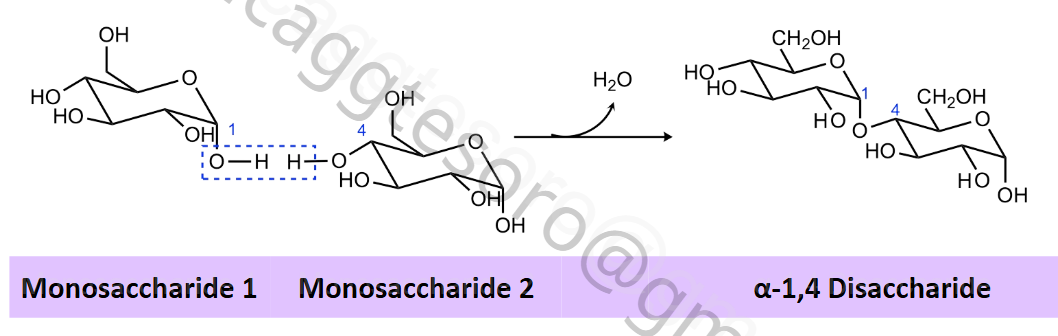
_____ is the covalent linkage between 2 monosaccharides, formed through dehydration reaction that eliminates water molecule.
Glycosidic bond (OH-OH at C1,4 or C1,6)
Reducing vs Nonreducing Sugar
Reducing sugar = still has 1 free anomeric carbon (not linked)
Non-reducing sugar = 2 anomeric carbons are linked (e.g. sugar)
Simple vs Complex Carbohydrates
Simple Carbohydrates (mono) = can’t be hydrolyzed into smaller molecules
Complex Carbohydrates (oligo- poly-) = made of 2 or more simple sugars
Differentiate oligosaccharides, disaccharides, trisaccharides, and hetero/homo polysaccharides.
Oligo = 2-10 monosaccharides
Disaccharides = 2 monosaccharides
Trisaccharides = 3 monosaccharides
Polysaccharides = 2+ monosaccharides
Homopolysaccharides = one type of monosaccharides
Heteropolysaccharides = 2+ type of monosaccharides
Give 6 most common oligosaccharides + common name + composition
Sucrose = table sugar = gluc + fruc (α1, β2)
Maltose = malt sugar = gluc + gluc (α1,4)
Lactose = milk sugar = gluc + galact (β1,4)
Melibiose = broken down raffinose = gluc + galact
Raffinose = starch, beet, seed = gluc + galact + fruc
Stachyose = soybeans, jasmine,lentils = 2 galact + fruc
Glucose + Glucose disaccharide examples (5)
Nigerose = gluc gluc (reducing, α1,3)
Trehalose = zombie sugar = gluc gluc (nonreducing, α1, α1)
Cellobiose = gluc gluc = hydrolysis of cellulose
Gentobiose = gluc gluc = plant glycosides, amygdalin
Isomaltose = gluc gluc = hydrolysis of glycogen, amylopectin
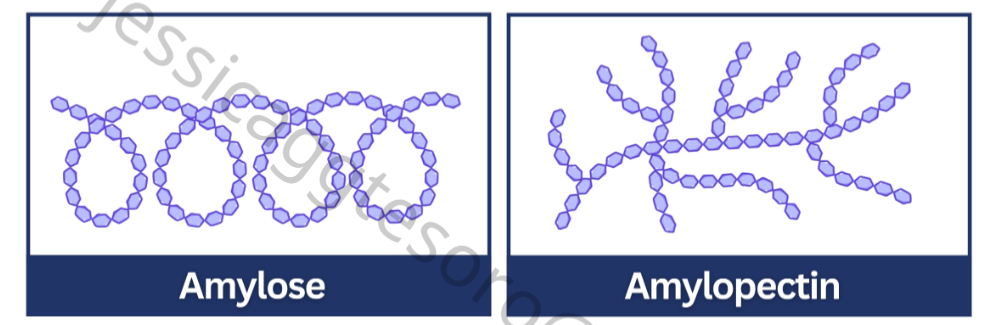
Polysaccharides: energy reserve in plants.
Starch
Glucose (α-1,4 and α-1,6)
Made 80% amylose (spiral) and 20% amylopectin (branched)
Polysaccharides: energy reserve in animals.
Glycogen
Glucose (α-1,4 and α-1,6)
More branched than amylopectin

Polysaccharides: provides rigidity in plant cell walls.
Celluose
Glucose (β-1,4 linkages)
water insoluble

Differentiate polysaccharides: chitin, alginic acid, carrageenan, pectin

Percentage of starch
80% amylopectin, 20% amylose
Polysaccharide used as a stabilizer and gelling agent.
Carrageenan
Humans can’t degrade cellulose, because we don’t have the enzyme: ____ found in ruminant animals like cows and goats.
Cellulase
Which of the following correctly describes the classification and structure of glucose? Aldopentose, aldohexose, ketopentose, or ketohexose?
Aldohexose
Percent during equilibrium of mutarotation of D-glucose α + β?
67% β
33% α
trace% open form of D-glucose
Which of the following are kinds of epimeric pairs?
a. galactose-mannose
b. galactose-altrose
c. glucose-mannose
d. glucose-altrose
c. glucose-mannose
During oxidation of aldoses, what are the two products that can form?
Aldonic acids (if mild oxidizing agents are used, 1 COOH)
Aldaric acids (if strong oxidizing agents are used, 2 COOH)
What is the formula for number of chiral centers?
2^n