CE Exam #1 - Management
 Call Kai
 Learn
Learn Practice Test
 Spaced Repetition
 Match
Match Flashcards
 Knowt Play
1/110

There's no tags or description
Looks like no tags are added yet.
Name | Mastery | Learn | Test | Matching | Spaced | Call with Kai | Chat |
|---|
No analytics yet
Send a link to your students to track their progress
111 Terms
What are the four pillars of management?
Planning
Control
Organizing
Leading
planning
-setting goals
-developing strategies
control
-measuring results against objectives
-monitoring
-rewarding
-taking corrective actions
organizing
-allocating resources
-assigning tasks
-establishing procedures
leading
-guiding
-motivating
-persuading
-providing vision
What increases as the number of people decrease?
-awareness
-interactions
-shared goal/purpose
What is Tuckman’s model of team development?
Forming
Storming
Norming
Performing
forming
-team members meet, form initial impressions, and establish team goals and roles
-questions: what are we to do? who will lead?
-expected behaviors: silence from many, self-conscious, waiting to be told what to do
-what to focus on: identify purpose, build relationships, establish expectations
storming
-team members disagree over what to do and how to do it
-questions: how can we make decisions amidst disagreements? how can we communicate negative information constructively?
-expected behaviors: cliques being formed, disagreement and/or competition among team members, challenging viewpoints
-what to focus on: manage conflict, concentrate on issues, not personalities, fostering consensus building
norming
-team members settle into their roles
-results in growth of team cohesion and development of positive team norms
-questions: are people in the roles they should be in? are norms being followed?
-expected behaviors: conformity and cooperation; ignoring disagreements…leads to groupthink (no good)
-what to focus on: facilitate participation and diversity of views; build trust, provide clear feedback on performance
performing
-performance improves as team matures into an effective functioning team
-synergy present
-questions: what can I do? how can i help?
-expected behaviors: high mutual trust, support of team members, full commitment to team efforts
-what to focus on: continued process and output improvement; encourage diverse views; foster strong communication; delegate
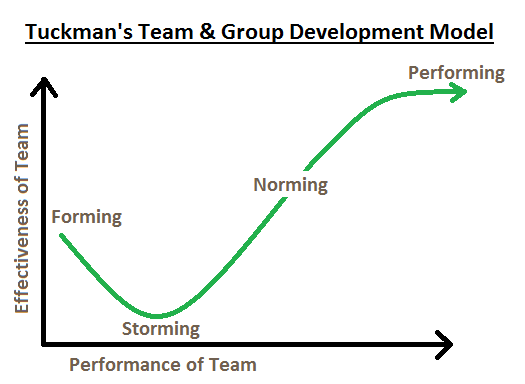
What can be said about the progression of Tuckman’s model
Once team’s are formed, the storming phase negatively impacts the team, but once this phase has passed, team performance improves as it reaches the norming phase, up to when it peaks in the performing phase.
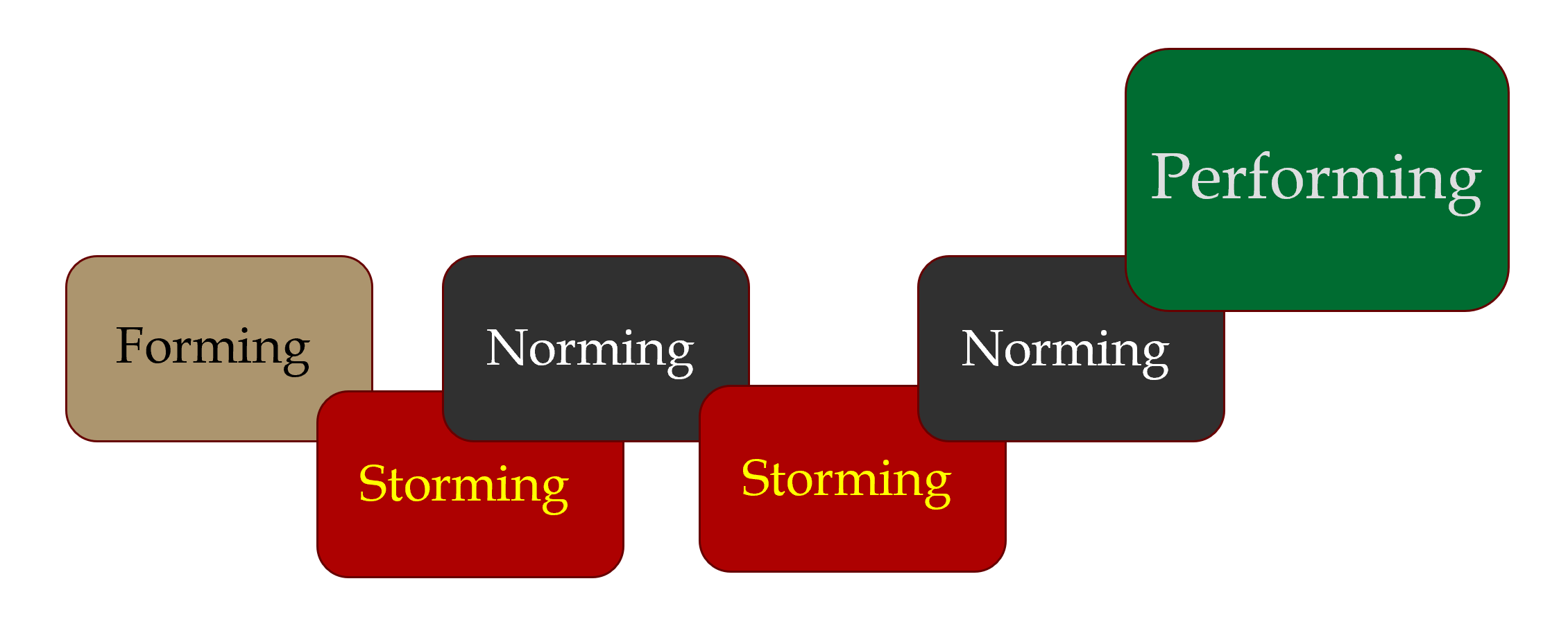
What can be said about the linearity of Tuckman’s model?
A team could bounce back and forth between stages, such as between storming and norming until performing has be achieved.
What can be said about the potential cyclic nature presented by Tuckman?
After teams form, teams can be in a perpetual cycle of storming, norming, and performing
False
T/F: Effort = Performance

Punctuated Equilibrium Model (PEM) - Gersick Model
proposes that teams develop through long periods of stability followed by sudden bursts of change, rather than gradually improving over time
PEM Model Phases
First Meeting and Inertia
Midpoint Transition
Action and Completion
First Meeting and Inertia
-organization
-norms build upon assumptions which may or may not be true
-inertia: locked into initial habits
Midpoint Transition
-at halfway point, alarm clock goes off, panic ensues
-old habits dropped, conflict over new direction, changes made in approach
-new plan made: fresh strategy focused on achieving goal
Action and Completion
-fast execution and high energy
-old ineffective habits are abandoned
-inertia resumes at new level of performance
-final burst of intense activity to deliver the goal
How do teams progress between Tuckman and Gersick’s models?
Tuckman: Linearly, sequentially
Gersick: sudden bursts of progress
Whose model is people-oriented? Whose is task-oriented?
Tuckman: People
Gersick: Task
What is the focus on between Tuckman and Gersick’s model?
Tuckman: Interpersonal
Gersick: Deadline
When does storming happen in Tuckman’s model? In Gersick’s?
Tuckman: Early
Gersick: Midpoint
No
Do teams strictly follow one model?
False
T/F: Only one model (Tuckman vs Gersick) can be presently seen in a team at any given time
True
T/F: Gersick’s phases might influence Tuckman’s stages and vice versa
groupthink
-reaching an agreement without proper vetting of alternatives to prevent conflict
-causing members to ignore alternative ideas, concerns, or potential problems

5 Dysfunctions of a Team
Absence of Trust
Fears of Conflict
Lack of Commitment
Avoidance of Accountability
Inattention to Result
Absence of Trust
-can you depend on one another to get things done?
-are you comfortable stating your opinion on a team even if it may mean disagreeing?
-ex: employee makes a mistake but hides it because they are afraid of judgement
Fear of Conflict
-team members avoid honest disagreements and difficult conversations
-driver of groupthink
-teams that successfully engage in conflict:
put critical topics on the table
wait the silence out
don’t accept “I don’t care” as an option
have lively discussions
Lack of Commitment
-team members don’t fully support or commit to team’s decisions
-a team that commits:
uses an inclusive/inquiry-based decision-making process
creates clarity around direction and priorities
fosters an inclusive environment
Avoidance of Accountability
-team members don’t hold each other accountable for meeting expectations
-a team that holds each other accountable:
makes it routine
has defined roles and plans
ensures poor performers feel pressure to improve
establish respect among team members who are all held at the same high standards
Inattention to Results
-team members focus on individual interests rather than team’s overall goals
-a team that focus on collective results:
puts team goals before individual goals
avoids distractions
celebrates successes and suffers failures together
Diversity of thought
Actively fighting dysfunction
Affection
What makes a team successful?
Time suck
Why do people hate meetings?
5 P’s of Effective Meetings
Purpose
Participants
Plans
Participation
Perspective/Postmortem
Participants
-does the meeting include decision-makers
-two pizzas should be enough to feed the number of participants in the rom
Plans
-come to the meeting with an agenda already made
-it should be sent out 24 hours before the meeting
gives participants time to prepare
-time management is crucial
Participation
-encourage everyone to contribute ideas, ask questions, and stay engaged
-silence =/ agreement
Perspective/Postmortem
-consider different view points
-summarize decisions that were made
-establish next steps: who, what, where…
-feedback
-confirm minutes
It’s where decisions are made
Why is it important to get meetings right?
5 Factor Model
Extroversion
Agreeableness
Consciensciousness
Stability
Openness
extroversion
captures one’s comfort levels with relationships
agreeableness
refers to a person’s propensity to defer to others
conscientiousness
refers to the number of goals of which a person focusesem
stability
refers to a person’s ability to withstand stress
openness
refers to one’s range of interests
decision environment
set of external and internal conditions, information available, and variables present when making a decision
certain environment
-alternative courses of action and their outcomes are known to decision maker
-low risk
-programmed decision
risk environment
-decision maker’s views alternatives and their outcomes in terms of probabilities
-medium risk
uncertain environment
-decision maker doesn’t know all alternatives and outcomes, even as probabilities
-high risk
-nonprogrammedW
What are the two types of problems and decisions?
Structured Problems/Programmed Decision
Unstructured Problem/Nonprogrammed Decision
Structured Problems/Programmed Decision
-routine and repetitive
-clear, complete information
-less risky
-certain environment
Unstructured Problem/Nonprogrammed Decision
-one-time, not routine, unique
-less straightforward than programmed decisions
-incomplete information - unknown unknowns
-more risky
-uncertain environment
Rational Decision-Making Process
Identification of Problem/Opportunity
Search for Alternative Solutions
Evaluation of Alternatives
Determine Solutions
Implementation
Pros Group Decision-Making
-diversity of thought
-more alternatives
-”buy-in”
Cons of Group Decision-Making
-time consuming
-relationships can cloud judgement
-groupthink
Decision-Making Flaws/Reality
-bounded rationality (satisficing) - making a decision that is good enough but not perfect
-heuristics - simple rules of thumb to make decisions
-biases - leaning, preference, or prejudice for or against something usually in a way that prevents fair or objective judgement
confirmation bias
favoring information that supports what you already believe
recency bias
giving too much importance to the more recent information
availability bias
relying to heavily on information that is easy to remember or comes to mind quickly
bandwagon (groupthink)
adopting an idea or decision because many other people support it
How to avoid Groupthink
-value all viewpoints
-keep a second solution alive
-appoint a devil’s advocate
-beware of time pressure
escalation of committment
human behavior where people invest time, money or effort (sunk costs) into a failing choice despite clear signs that it won’t work
analysis paralysis
perfect decisions are the enemies of timely onesx
True
T/F: When it comes to making a decision, weighing criteria can be a good idea
Establish Decision Rules
-majority
-super majority
-highest number of votes
-how will you vote?
lateral thinking
-looking at problems from unconventional approach and generate creative alternatives
-ie: thinking outside the box
nominal group technique (NGT)
-structured method for group brainstorming that encourages contributions from everyone
-Process: Define Problem —> Individually Think/Brainstorm —> Share Ideas —> Discuss —> Anonymous Vote/Rank
Benefits of Nominal Group Technique
-reduces groupthink
-generate more ideas
-encourages participation
-prevents dominating personalities
Downside of Nominal Group Technique
TAKES UP A LOT OF TIME
Strategic Management Process
Vision, Values, and Mission
Goals and Objectives
Situation Assessment
Formulate Strategy
Execution
Which types of goals perform the best?
Difficult specific goalsW
Which types of goals perform the worst?
Easy goals
False
T/F: Easy goals are better than no goals
SMART Goals
Specific
Measurable
Achievable
Relevant
Time-bound
Everest/Big Hairy Audacious Goals (BHAG) Goals
-inspirational, innovative
-clarity/focus
-involves all parts of an org
-unifying
-big stretch
-innovativeg
goal
-broad, general outcome you want to achieve
-ex: improve company’s profits
objective
-specific, measurable action or result to help achieve a goal
-ex: increase profits by 10% by the end of the year
strategic (leading) objectives
-focus on future performance and the action that will drive future results
-things the organization can influence now
-includes an action verb
-causes future results
-ex: achieve customer retention rate of X%
financial (lagging) objectives
-focus on financial results that have already occurred
-show whether past decisions and actions were successful
-measures past results
-ex: X% increase in annual revenue
strategic plan
-describes the strategy and operations of that business
-top level
-encompass all parts of the operation
-sets out organizational goals (“ends”)
work scheduling
-strategic plan cascades down through goals/objectives
-scheduling in small increments
-explains how resources are to be used (“means”)
Gannt Chart
-ideal for planning projects
-tracks multiple tasks at once
-needs to be kept “live”
-demonstrates parallel vs sequential tasks
control
monitoring and regulation of an organization that performs in relation to its goals and objectives
What is control applied to?
-quality of output
-employee behavior
-financial processes
-resource allocation and usage
Types of Control
Input
Process
Output
Input Controls
-feedforward
-check information and resources before work begins to anticipate problems
Process Controls
-concurrent
-monitor activities while work is being performed to correct problems as they happen
Output Controls
-feedback
-evaluate final results after work is complete and correct problems after they occur
Control Process
Establish standards
Monitor ongoing organizational behaviors and results
Compare actual behaviors and results against standards
Evaluate and take action
Establish standards
Set —> Measure —> Compare —> Correct
clan control
-uses shared beliefs, norms, and cultures to guide employee behavior
-internal
-company has strong culture of teamwork, so cooperation is expected
bureaucratic control
-uses rules, procedures, and policies to control behavior
-interal
-ex: employees must follow established procedures for purchase approvals
market control
-uses external market forces and performance measures to evaluate performance
-external
-ex: company comparing price and profits to competitors to determine whether they are performing well
Dysfunctional Side of Control
-inflexible/unreasonable standards
-unfocused
-incomplete
Balanced Scorecard
Financial
key ratios
cost reductions
Learning/Growth
skill development
employee satisfaction
turnover
Customer
customer satisfaction
customer retention
market share
Internal Processes
Efficiency
Quality control
New product development
Qualities of Effective Control
-accuracy
-timeliness
-flexibility
-understandability
True
T/F: Too much control is a bad thing
What are current communication trends?
-reliance on technology
-dominance of email
-text/chat growing
-less face-to-face
-AI influence