4.1 Introduction to Time Series
 Call Kai
 Learn
Learn Practice Test
 Spaced Repetition
 Match
Match Flashcards
 Knowt Play
1/9

Earn XP
Description and Tags
Section 4.1 of Exam MAS-II
Name | Mastery | Learn | Test | Matching | Spaced | Call with Kai | Chat |
|---|
No analytics yet
Send a link to your students to track their progress
10 Terms
Define:
{Xₜ}
mₜ
sₜ
xₜ
g
k
cₖ
rₖ
cₖ(x, y)
rₖ(x, y)
Time series
Trend
Seasonal variation
Random patterns
Seasonal base
Lag
Lag k sample autocovariance
Lag k sample autocorrelation
Lag k sample cross-covariance
Lag k sample cross-correlation
The three main decomposition models are:

A multiplicative model can be converted into an ________ model by taking the _______ of both sides.
A multiplicative model can be converted into an additive model by taking the logarithm of both sides.
Stationarity: A stochastic process is second-order stationary if the following two conditions are met:

Decomposition of Series: Using a centered moving average, the monthly trend is:

Additive Seasonality: To estimate average additive seasonality components,

Multiplicative Seasonality: To estimate average multiplicative seasonality components,

Autocorrelation:
c_k =
r_k =
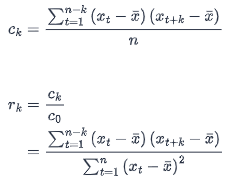
A correlogram plots ___ against and can be used to determine if any statistically significant ___________ exist in a time series.
A correlogram plots r_k against k and can be used to determine if any statistically significant autocorrelations exist in a time series.
Cross-Correlation
c_k(x,y) =
r_k(x,y) =
